
Earth has seasons because its axis is tilted about 23.5 degrees compared with a line perpendicular to its orbit around the Sun. As Earth travels around the Sun, this tilt changes how directly sunlight reaches each hemisphere and how many hours of daylight it receives.
★What to remember
- Earth's seasons are caused mainly by its axis being tilted about 23.5 degrees.
- The tilt changes the angle of sunlight and the number of daylight hours in each hemisphere.
- More direct sunlight and longer days help make summer warmer.
- Lower-angle sunlight and shorter days help make winter colder.
- The hemispheres have opposite seasons because one tilts towards the Sun while the other tilts away.
- Solstices mark the longest and shortest daylight periods of the year in each hemisphere.
- At an equinox, day and night are close to equal in length in most places.
- Autumn days get shorter as that hemisphere tilts farther away from the Sun.
🎧Listen3:02 · transcript
AnnaLet’s start with the basic question. What causes the seasons?
MarcoEarth’s axis is tilted about twenty-three point five degrees from a line at right angles to its orbit around the Sun. As Earth travels around the Sun, that tilt changes how directly sunlight reaches each hemisphere, and how many hours of daylight it gets.
AnnaSo does the axis change its tilt as Earth goes around the Sun?
MarcoNo. It keeps pointing in nearly the same direction in space. Because of that, each hemisphere takes a turn tilting toward the Sun, then away from it.
AnnaAnd when a hemisphere tilts toward the Sun, what changes for people there?
MarcoSunlight strikes more directly. The Sun appears higher in the sky, and its energy is concentrated on a smaller area of ground. That helps warm the hemisphere. The days are also longer, so the ground receives sunlight for more hours.
AnnaThen winter is the reverse?
MarcoRight. When a hemisphere tilts away, sunlight arrives at a lower angle and spreads over a larger area. The Sun stays above the horizon for fewer hours, too. Those effects together make the season colder.
AnnaThat also explains why the two hemispheres have opposite seasons, doesn’t it?
MarcoExactly. When the Northern Hemisphere tilts toward the Sun, it has summer, while the Southern Hemisphere has winter. About six months later, that arrangement is reversed.
AnnaPeople sometimes say summer happens because Earth is closer to the Sun. Does that fit?
MarcoNo. Earth is actually closest to the Sun in early January. At that time, it is winter in the Northern Hemisphere and summer in the Southern Hemisphere. Distance doesn’t explain opposite seasons at the same time.
AnnaWhere do solstices fit into this pattern?
MarcoA solstice happens when a hemisphere is tilted most toward the Sun, or most away from it. Its summer solstice is the day with the most daylight hours of the year. The Sun also reaches its highest midday position. At the winter solstice, daylight is at its shortest, and the Sun reaches its lowest midday position. After each solstice, daylight starts moving toward the next equinox.
AnnaAnd an equinox is when neither hemisphere is tilted strongly toward or away from the Sun?
MarcoYes. At midday, the Sun is directly overhead at the equator. Day and night are close to equal in length in most places. There are two equinoxes each year, around March and September, marking spring and autumn in different hemispheres.
AnnaBut not exactly twelve hours of day and twelve hours of night everywhere?
MarcoThat’s right. The Sun appears as a disk, and sunlight bends in Earth’s atmosphere, so day and night aren’t exactly equal everywhere on an equinox.
AnnaFinally, why do autumn days keep getting shorter?
MarcoThe hemisphere having autumn tilts farther away from the Sun as Earth moves along its orbit. The Sun’s path gets lower, and it stays above the horizon for fewer hours each day. In the Northern Hemisphere, this continues after the June summer solstice until the December winter solstice, with day and night close to equal around September. The Southern Hemisphere follows the same pattern at the opposite time of year.
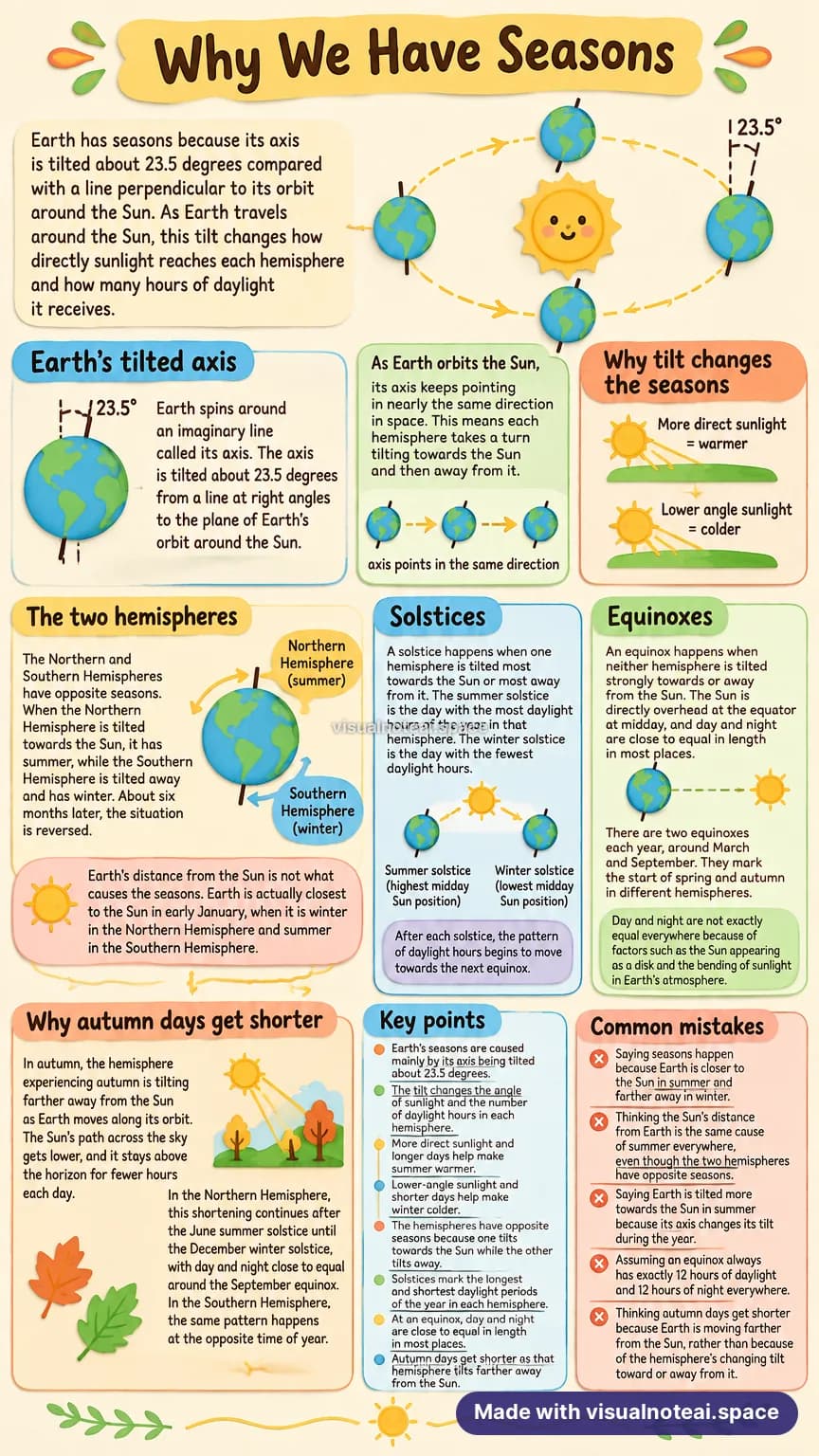
The whole topic on one page. Made with VisualNote.
!Common mistakes
- Saying seasons happen because Earth is closer to the Sun in summer and farther away in winter.
- Thinking the Sun's distance from Earth is the same cause of summer everywhere, even though the two hemispheres have opposite seasons.
- Saying Earth is tilted more towards the Sun in summer because its axis changes its tilt during the year.
- Assuming an equinox always has exactly 12 hours of daylight and 12 hours of night everywhere.
- Thinking autumn days get shorter because Earth is moving farther from the Sun, rather than because of the hemisphere's changing tilt toward or away from it.
🧠Explore the map34 ideas
The mind map VisualNote made for this topic. Drag to pan, scroll to zoom.
- Why Earth Has Seasons
- Earth's Axial Tilt
- Axis tilted about 23.5°
- Axis points nearly the same direction in space
- Hemispheres alternately tilt toward or away from the Sun
- Sunlight and Temperature
- Tilt toward Sun: more direct sunlight
- Sun higher in sky; energy concentrated
- Longer daylight; warmer season
- Tilt away from Sun: lower-angle sunlight
- Energy spread over larger area
- Shorter daylight; colder season
- Tilt toward Sun: more direct sunlight
- Opposite Hemispheric Seasons
- Northern and Southern Hemispheres have opposite seasons
- About six months later, the seasonal pattern reverses
- Sun-Earth distance does not cause seasons
- Earth is closest to the Sun in early January
- Solstices
- Hemisphere tilted most toward or away from the Sun
- Summer solstice: longest daylight; highest midday Sun
- Winter solstice: shortest daylight; lowest midday Sun
- Daylight pattern moves toward the next equinox
- Equinoxes
- Neither hemisphere strongly tilted toward or away
- Sun directly overhead at the equator at midday
- Day and night are close to equal in most places
- Occur around March and September
- Mark spring and autumn in different hemispheres
- Not exactly 12 hours everywhere
- Autumn's Shortening Days
- Autumn hemisphere tilts farther away from the Sun
- Sun's path gets lower
- Fewer daylight hours each day
- Northern and Southern patterns occur at opposite times
- Earth's Axial Tilt
🃏Flashcards12 cards
- What primarily causes Earth's seasons?
- Earth's axis is tilted about 23.5 degrees relative to a line perpendicular to its orbit. As Earth orbits the Sun, this tilt changes the sunlight angle and daylight duration in each hemisphere.
- How does Earth's axis behave as Earth orbits the Sun?
- The axis keeps pointing in nearly the same direction in space. As a result, each hemisphere takes a turn tilting toward the Sun and then away from it.
- Why does a hemisphere tilted toward the Sun become warmer?
- Sunlight strikes more directly and concentrates its energy over a smaller area. The Sun is also above the horizon for more hours each day.
- Why does a hemisphere tilted away from the Sun become colder?
- Sunlight arrives at a lower angle and spreads over a larger area, while shorter days provide fewer hours of sunlight.
- Why do the Northern and Southern Hemispheres have opposite seasons?
- When one hemisphere tilts toward the Sun, the other tilts away. About six months later, their positions and seasons reverse.
- Does Earth's distance from the Sun cause the seasons?
- No. Seasons are caused mainly by Earth's axial tilt; Earth is closest to the Sun in early January, when it is winter in the Northern Hemisphere.
- What is a solstice?
- A solstice occurs when a hemisphere is tilted most toward or most away from the Sun. It marks that hemisphere's longest or shortest daylight period of the year.
- What happens at the summer solstice?
- It is the day with the most daylight hours of the year in that hemisphere. The Sun also reaches its highest midday position of the year.
- What happens at the winter solstice?
- It is the day with the fewest daylight hours of the year in that hemisphere. The Sun reaches its lowest midday position of the year.
- What is an equinox?
- An equinox occurs when neither hemisphere is tilted strongly toward or away from the Sun. Day and night are close to equal in length in most places.
- When do equinoxes occur, and what do they mark?
- They occur around March and September and mark the start of spring and autumn in different hemispheres.
- Why do autumn days get shorter?
- The hemisphere experiencing autumn tilts farther away from the Sun, making the Sun's path lower and reducing the hours it stays above the horizon.
✅Test yourself5 questions
What is the main reason Earth has seasons?
Earth's approximately 23.5-degree axial tilt changes the sunlight angle and daylight duration in each hemisphere over the year.
When the Northern Hemisphere is tilted towards the Sun, what season is it in the Southern Hemisphere?
The hemispheres have opposite seasons because when one tilts towards the Sun, the other tilts away.
Which fact best shows that Earth's distance from the Sun does not cause the seasons?
Earth is closest to the Sun in early January, when the Northern Hemisphere has winter and the Southern Hemisphere has summer.
What is true of a hemisphere's summer solstice?
A hemisphere's summer solstice is its longest-daylight day, when that hemisphere is tilted most towards the Sun.
Which statement about an equinox is most accurate?
At an equinox, day and night are close to equal in most places, though they are not exactly equal everywhere.
📝The notes
Earth's tilted axis
Earth spins around an imaginary line called its axis. The axis is tilted about 23.5 degrees from a line at right angles to the plane of Earth's orbit around the Sun.
As Earth orbits the Sun, its axis keeps pointing in nearly the same direction in space. This means each hemisphere takes a turn tilting towards the Sun and then away from it.
Why tilt changes the seasons
When a hemisphere is tilted towards the Sun, sunlight strikes it more directly. The Sun appears higher in the sky, so its energy is concentrated on a smaller area of ground. This helps warm that hemisphere.
When a hemisphere is tilted away from the Sun, sunlight arrives at a lower angle and spreads over a larger area. The Sun is also above the horizon for fewer hours each day, so there is less time for the ground to receive sunlight. These effects together make the season colder.
The two hemispheres
The Northern and Southern Hemispheres have opposite seasons. When the Northern Hemisphere is tilted towards the Sun, it has summer, while the Southern Hemisphere is tilted away and has winter. About six months later, the situation is reversed.
Earth's distance from the Sun is not what causes the seasons. Earth is actually closest to the Sun in early January, when it is winter in the Northern Hemisphere and summer in the Southern Hemisphere.
Solstices
A solstice happens when one hemisphere is tilted most towards the Sun or most away from it. The summer solstice is the day with the most daylight hours of the year in that hemisphere. The winter solstice is the day with the fewest daylight hours.
At the summer solstice, the Sun reaches its highest midday position in the sky for that year. At the winter solstice, it reaches its lowest midday position. After each solstice, the pattern of daylight hours begins to move towards the next equinox.
Equinoxes
An equinox happens when neither hemisphere is tilted strongly towards or away from the Sun. The Sun is directly overhead at the equator at midday, and day and night are close to equal in length in most places.
There are two equinoxes each year, around March and September. They mark the start of spring and autumn in different hemispheres. Day and night are not exactly equal everywhere on an equinox because of effects such as the Sun appearing as a disk and the bending of sunlight in Earth's atmosphere.
Why autumn days get shorter
In autumn, the hemisphere experiencing autumn is tilting farther away from the Sun as Earth moves along its orbit. The Sun's path across the sky gets lower, and it stays above the horizon for fewer hours each day.
In the Northern Hemisphere, this shortening continues after the June summer solstice until the December winter solstice, with day and night close to equal around the September equinox. In the Southern Hemisphere, the same pattern happens at the opposite time of year.
Make this for your own notes
Paste a chapter or a PDF and get the sheet, map, cards, quiz and episode back in about a minute. No credit card.