
Electron Configuration
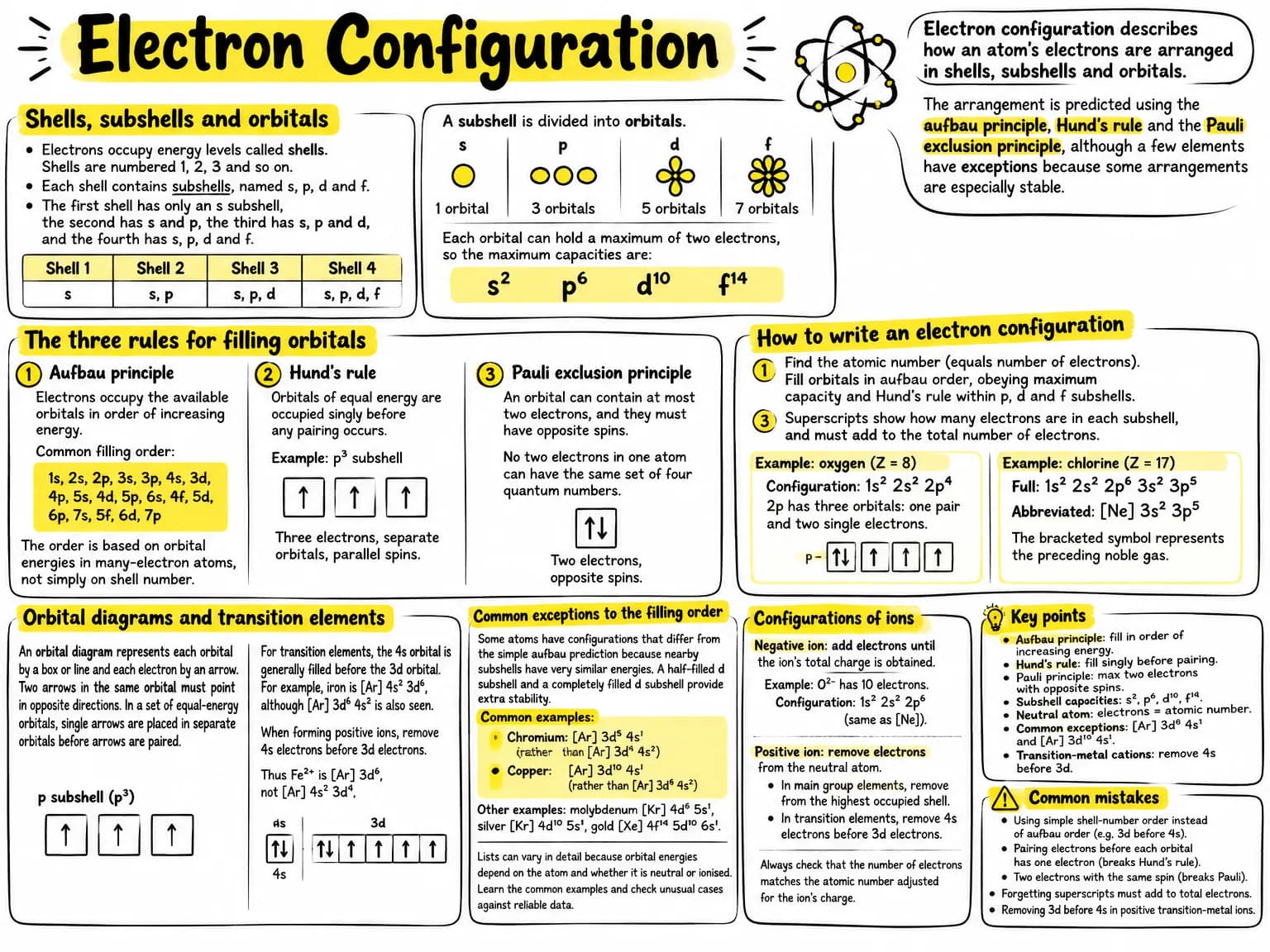
Electron configuration describes how an atom’s electrons are arranged in shells, subshells and orbitals. The arrangement is predicted using the aufbau principle, Hund’s rule and the Pauli exclusion principle, although a few elements have exceptions because some arrangements are especially stable.
Electron Configuration at a glance
Listen: Electron Configuration
Two hosts talking it through, 3:28. The full transcript is below, so you can read along or skip the audio.
Transcript
AnnaWhat does electron configuration actually describe?
MarcoIt describes how an atom’s electrons are arranged in shells, subshells, and orbitals. Shells are energy levels, numbered one, two, three, and so on. Each shell contains subshells called s, p, d, and f.
AnnaDo all shells contain all four subshells?
MarcoNo. The first shell has only s. The second has s and p. The third has s, p, and d. The fourth has s, p, d, and f. Each subshell is divided into orbitals. An s subshell has one orbital, p has three, d has five, and f has seven.
AnnaAnd each orbital can hold two electrons, right?
MarcoExactly, and the electrons must have opposite spins. So the capacities are s squared, p to the sixth power, d to the tenth power, and f to the fourteenth power. That restriction comes from the Pauli exclusion principle.
AnnaWhat are the other rules for filling orbitals?
MarcoThe aufbau principle says electrons occupy available orbitals in order of increasing energy. The commonly used order starts one s, two s, two p, three s, three p, four s, three d, and four p. It continues through the higher subshells. The order is based on orbital energies, not simply shell numbers.
AnnaWhere does Hund’s rule fit in?
MarcoOrbitals with equal energy are filled singly before any pairing happens. In a p cubed subshell, for example, three electrons occupy the three p orbitals separately, with parallel spins. They do not pair in one orbital first.
AnnaHow would we write a configuration from scratch?
MarcoFirst find the atomic number. For a neutral atom, that is also the number of electrons. Then fill the orbitals in aufbau order, follow the capacity limits, and apply Hund’s rule. The superscripts show the number of electrons in each subshell, and they must add to the total.
AnnaCan we test that with oxygen?
MarcoOxygen has atomic number eight, so it has eight electrons. Its configuration is one s squared, two s squared, two p to the fourth power. In that two p subshell, the four electrons form one pair and two single electrons across the three orbitals.
AnnaWhat about larger atoms?
MarcoA preceding noble gas can be used as shorthand. Chlorine is one s squared, two s squared, two p to the sixth, three s squared, three p to the fifth. Or it is written as neon in brackets, three s squared, three p to the fifth.
AnnaAre transition elements different?
MarcoThe four s orbital is generally filled before three d in a neutral atom. Iron can be written as argon in brackets, four s squared, three d to the sixth. But when iron forms iron two plus, electrons are removed from four s first, giving argon in brackets, three d to the sixth.
AnnaAre there exceptions to the filling order?
MarcoYes. Nearby subshell energies can be very similar. Chromium is argon in brackets, three d to the fifth, four s to the first, rather than the simple prediction. Copper is argon in brackets, three d to the tenth, four s to the first. Half-filled or completely filled d subshells can be especially stable.
AnnaAnd for ions, we should check the electron count carefully?
MarcoAlways. Add electrons for a negative ion and remove them for a positive ion. Oxygen two minus has ten electrons, so its configuration is one s squared, two s squared, two p to the sixth, the same as neon. For transition-metal positive ions, remove four s electrons before three d electrons.
The notes
Shells, subshells and orbitals
Electrons occupy energy levels called shells. Shells are numbered 1, 2, 3 and so on. Each shell contains subshells, named s, p, d and f. The first shell has only an s subshell, the second has s and p, the third has s, p and d, and the fourth has s, p, d and f.
A subshell is divided into orbitals. An s subshell contains one orbital, a p subshell contains three orbitals, a d subshell contains five orbitals and an f subshell contains seven orbitals. Each orbital can hold a maximum of two electrons, so the maximum capacities are s2, p6, d10 and f14.
The three rules for filling orbitals
The aufbau principle states that electrons occupy the available orbitals in order of increasing energy. A commonly used filling order is 1s, 2s, 2p, 3s, 3p, 4s, 3d, 4p, 5s, 4d, 5p, 6s, 4f, 5d, 6p, 7s, 5f, 6d and 7p. The order is based on orbital energies in many-electron atoms, not simply on shell number.
Hund’s rule states that orbitals of equal energy are occupied singly before any pairing occurs. For example, the three electrons in a p3 subshell occupy the three p orbitals separately, with parallel spins, rather than pairing in one orbital. The Pauli exclusion principle states that an orbital can contain at most two electrons, and the two electrons must have opposite spins. No two electrons in one atom can have the same set of four quantum numbers.
How to write an electron configuration
To write a configuration for an element, first find its atomic number. This equals the number of electrons in a neutral atom. Fill orbitals in the aufbau order, obeying the maximum capacity of each subshell and applying Hund’s rule within p, d and f subshells. The superscripts show how many electrons are in each subshell, and the superscripts must add to the total number of electrons.
For example, oxygen has atomic number 8, so it has eight electrons. Its configuration is 1s2 2s2 2p4. The 2p subshell contains three orbitals. Four electrons occupy these as one pair and two single electrons, rather than pairing in two orbitals while leaving the third empty.
For larger atoms, a noble gas can be used as a shorthand. Chlorine has the full configuration 1s2 2s2 2p6 3s2 3p5, or the abbreviated configuration [Ne] 3s2 3p5. The symbol in brackets represents the electron configuration of the preceding noble gas.
Orbital diagrams and transition elements
An orbital diagram represents each orbital by a box or line and each electron by an arrow. Two arrows in the same orbital must point in opposite directions because of the Pauli exclusion principle. In a set of equal-energy orbitals, such as the three p orbitals, single arrows are placed in separate orbitals before arrows are paired.
For transition elements, the 4s orbital is generally filled before the 3d orbital when building the neutral atom. For example, iron is written as [Ar] 4s2 3d6, although [Ar] 3d6 4s2 is also commonly seen. When transition elements form positive ions, electrons are usually removed from the outer s orbital before the d orbital. Thus Fe2+ is [Ar] 3d6, not [Ar] 4s2 3d4.
Common exceptions to the filling order
Some atoms have configurations that differ from the simple aufbau prediction because the energies of nearby subshells are very similar. A half-filled d subshell and a completely filled d subshell can provide extra stability. The most commonly taught exceptions are chromium, which is [Ar] 3d5 4s1 rather than [Ar] 3d4 4s2, and copper, which is [Ar] 3d10 4s1 rather than [Ar] 3d9 4s2.
Other transition elements also have exceptions, especially among the heavier elements. Examples include molybdenum, [Kr] 4d5 5s1, silver, [Kr] 4d10 5s1, and gold, [Xe] 4f14 5d10 6s1. Lists of exceptions can vary in detail because orbital energies depend on the atom and on whether it is neutral or ionised. The safest method is to learn the common examples required by the course and check unusual cases against reliable data.
Configurations of ions
For a negative ion, add electrons to the neutral atom until the ion’s total charge is obtained. For example, oxygen has eight electrons, so O2− has ten electrons and the configuration 1s2 2s2 2p6, which is the same as [Ne].
For a positive ion, remove electrons from the neutral atom. In main group elements, this often means removing electrons from the highest occupied shell. In transition elements, remove 4s electrons before 3d electrons, even though 4s was filled first in the neutral atom. Always check that the number of electrons in the written configuration matches the atomic number adjusted for the ion’s charge.
What to remember
- The aufbau principle says that electrons fill orbitals in order of increasing energy.
- Hund’s rule says that equal-energy orbitals fill singly before electrons pair.
- The Pauli exclusion principle limits each orbital to two electrons with opposite spins.
- The subshell capacities are s2, p6, d10 and f14.
- A neutral atom has the same number of electrons as its atomic number.
- The common configurations of chromium and copper are [Ar] 3d5 4s1 and [Ar] 3d10 4s1.
- When transition-metal cations form, 4s electrons are removed before 3d electrons.
Electron Configuration as a mind map
- Electron Configuration
- Atomic Structure
- Shells
- Subshells: s, p, d, f
- Orbitals per subshell: 1, 3, 5, 7
- Subshell capacities: s2, p6, d10, f14
- Filling Rules
- Aufbau Principle
- Increasing orbital energy
- Filling order: 1s, 2s, 2p, 3s, 3p, 4s, 3d, 4p
- Hund’s Rule
- Equal-energy orbitals fill singly first
- Parallel spins before pairing
- Pauli Exclusion Principle
- Maximum of two electrons per orbital
- Opposite spins in one orbital
- Aufbau Principle
- Writing Configurations
- Find atomic number
- Neutral electrons equal atomic number
- Fill orbitals using the rules
- Superscripts show electron counts
- Superscripts total the electron count
- Examples: oxygen, chlorine, iron
- Noble gas shorthand
- Ions and Transition Elements
- Negative ions gain electrons
- Positive ions lose electrons
- Transition-metal neutral atoms fill 4s before 3d
- Transition-metal cations lose 4s before 3d
- Orbital diagrams use boxes and arrows
- Exceptions and Common Errors
- Chromium: [Ar] 3d5 4s1
- Copper: [Ar] 3d10 4s1
- Exceptions favor half-filled or filled d subshells
- Avoid shell-number filling order
- Avoid premature pairing
- Check electron totals and ion charges
- Atomic Structure
Flashcards
- What does electron configuration describe?
- It describes how an atom’s electrons are arranged in shells, subshells, and orbitals.
- What are shells and subshells?
- Shells are numbered energy levels, while subshells within them are named s, p, d, and f. Shells contain increasing numbers of subshell types as the shell number increases.
- How many orbitals are in s, p, d, and f subshells?
- An s subshell has 1 orbital, p has 3, d has 5, and f has 7 orbitals.
- What are the maximum electron capacities of the subshells?
- The capacities are s², p⁶, d¹⁰, and f¹⁴. Each orbital can hold a maximum of two electrons.
- What is the aufbau principle?
- Electrons occupy available orbitals in order of increasing energy. The commonly used order begins 1s, 2s, 2p, 3s, 3p, 4s, 3d, and 4p.
- What is Hund’s rule?
- Orbitals of equal energy are occupied singly before any pairing occurs. The unpaired electrons occupy separate orbitals with parallel spins.
- What does the Pauli exclusion principle state?
- An orbital can contain at most two electrons, and they must have opposite spins. No two electrons in one atom can have the same four quantum numbers.
- How is an electron configuration determined for a neutral atom?
- Use the atomic number to find the number of electrons, then fill orbitals in aufbau order while applying subshell capacities, Hund’s rule, and the Pauli principle. The superscripts must total the number of electrons.
- How is noble-gas shorthand used?
- The configuration of the preceding noble gas is written in brackets, followed by the remaining subshells. For example, chlorine is [Ne] 3s² 3p⁵.
- How are transition-metal electron configurations and ions handled?
- For neutral atoms, 4s is generally filled before 3d. When forming positive ions, 4s electrons are removed before 3d electrons; therefore Fe²⁺ is [Ar] 3d⁶.
- What are common electron-configuration exceptions?
- Chromium is [Ar] 3d⁵ 4s¹ rather than [Ar] 3d⁴ 4s², and copper is [Ar] 3d¹⁰ 4s¹ rather than [Ar] 3d⁹ 4s². These arrangements gain stability from especially stable d subshells.
- How are electron configurations written for ions?
- Add electrons for negative ions and remove electrons for positive ions, adjusting the neutral atom’s electron count by the charge. For transition-metal cations, remove 4s electrons before 3d electrons.
Test yourself
Which sequence correctly gives the next orbitals filled after 3p according to the aufbau principle?
The aufbau order places 4s before 3d and 4p because electrons fill available orbitals in increasing energy order.
What is the correct orbital arrangement for four electrons in a p subshell?
Hund’s rule requires the three equal-energy p orbitals to fill singly before a fourth electron pairs in one orbital.
What is the electron configuration of Fe2+?
Iron is [Ar] 4s2 3d6 when neutral, and its two 4s electrons are removed first to form Fe2+.
Which is the accepted ground-state electron configuration of copper?
Copper has the especially stable configuration [Ar] 3d10 4s1 rather than the simple aufbau prediction [Ar] 3d9 4s2.
Which configuration represents O2−?
Oxygen has eight electrons, and gaining two electrons gives O2− ten electrons with the configuration 1s2 2s2 2p6.
Common mistakes
- Writing electrons into orbitals in simple shell-number order instead of using the aufbau filling order, especially placing 3d before 4s when writing a neutral atom.
- Pairing electrons in an equal-energy set before each orbital has one electron, which breaks Hund’s rule.
- Putting two electrons with the same spin in one orbital, which breaks the Pauli exclusion principle.
- Forgetting that the superscripts must add to the total number of electrons in the atom or ion.
- Removing 3d electrons before 4s electrons when forming a positive transition-metal ion.
Make this for your own notes
Everything on this page came from one source, generated in about a minute. Paste a chapter, upload a PDF or photograph your notes and get the same set back.
Try it freeNo credit card. Free every month.