
Le Chatelier's Principle
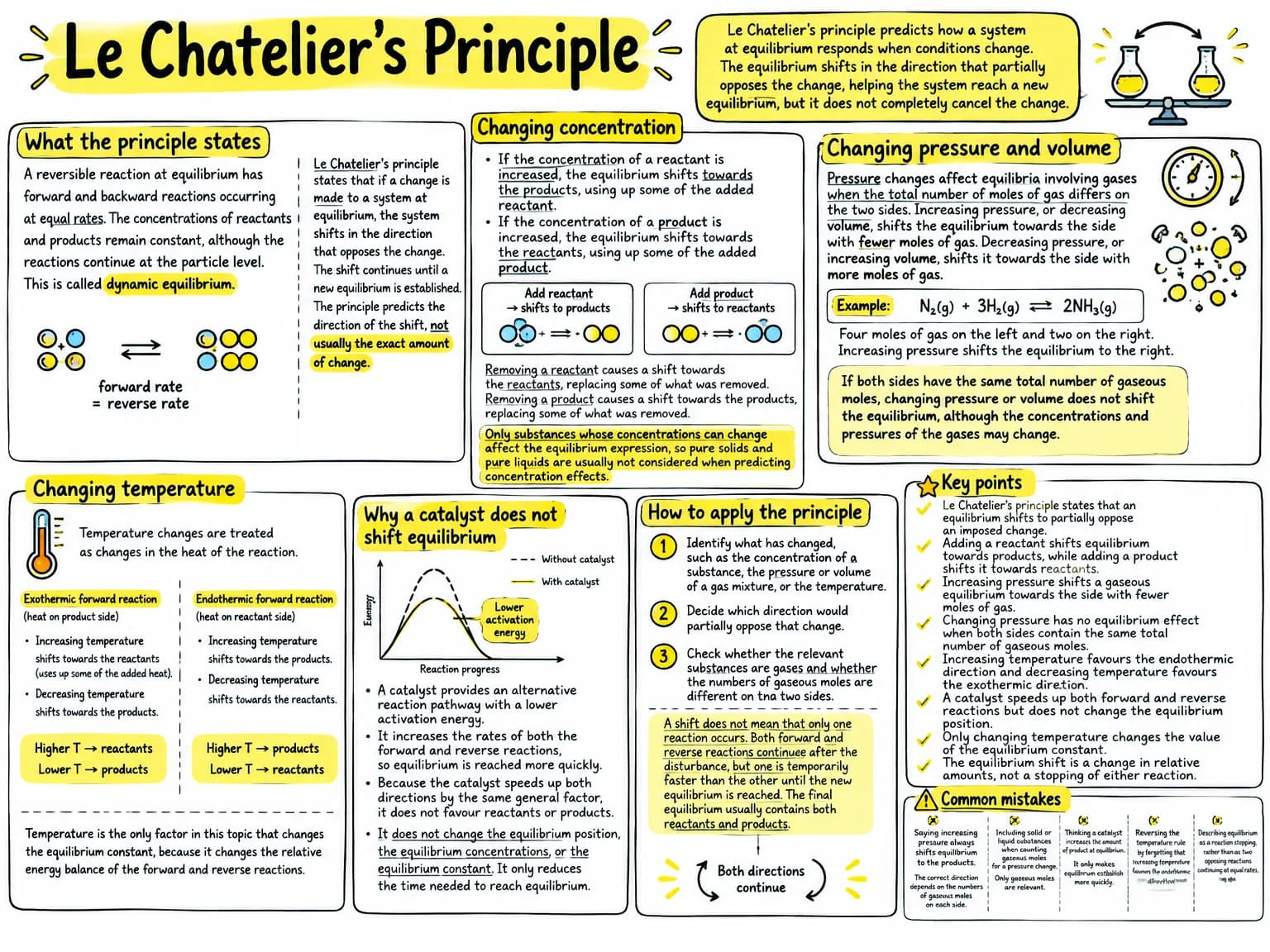
Le Chatelier's principle predicts how a system at equilibrium responds when conditions change. The equilibrium shifts in the direction that partially opposes the change, helping the system reach a new equilibrium, but it does not completely cancel the change.
Le Chatelier's Principle at a glance
Listen: Le Chatelier's Principle
Two hosts talking it through, 3:10. The full transcript is below, so you can read along or skip the audio.
Transcript
AnnaWhat does Le Chatelier’s principle actually predict?
MarcoIt predicts how a system at equilibrium responds when conditions change. The equilibrium shifts in the direction that partly opposes the change, until a new equilibrium is reached. It does not completely cancel the change, and it usually predicts the direction, not the exact amount.
AnnaBefore we discuss the changes, what does equilibrium mean here? Does the reaction stop?
MarcoNo. In a reversible reaction, the forward and backward reactions continue at equal rates. The concentrations stay constant, but particles are still reacting. That is called dynamic equilibrium. After a disturbance, both directions still continue, but one is temporarily faster until the new balance forms.
AnnaLet’s start with concentration. What happens if we add a reactant?
MarcoThe equilibrium shifts towards the products, using up some of the added reactant. If we add a product, it shifts towards the reactants and uses up some of that added product. Removing a reactant causes a shift towards the reactants, while removing a product causes a shift towards the products.
AnnaDo all substances count in those concentration changes?
MarcoOnly substances whose concentrations can change affect the equilibrium expression. So pure solids and pure liquids are usually not included when predicting concentration effects.
AnnaHow is pressure different?
MarcoPressure changes affect equilibria involving gases when the two sides have different total numbers of gaseous moles. Increasing pressure, or decreasing volume, shifts equilibrium towards the side with fewer gas moles. Decreasing pressure, or increasing volume, shifts it towards the side with more.
AnnaCan we test that with the ammonia reaction?
MarcoYes. In nitrogen gas plus three hydrogen gas molecules forming two ammonia gas molecules, there are four moles of gas on the left and two on the right. Increasing pressure shifts the equilibrium to the right. But if both sides have the same number of gaseous moles, pressure or volume changes do not shift equilibrium, even though gas concentrations and pressures may change.
AnnaWhat about temperature?
MarcoTreat temperature as adding or removing heat. For an exothermic forward reaction, heat is on the product side. Increasing temperature shifts towards the reactants, using some added heat. Decreasing temperature shifts towards the products. For an endothermic forward reaction, heat is on the reactant side, so increasing temperature shifts towards products, and decreasing it shifts towards reactants.
AnnaWhy is temperature especially important?
MarcoIt is the only factor here that changes the equilibrium constant, because it changes the relative energy balance of the two directions.
AnnaAnd what does a catalyst do?
MarcoIt offers a pathway with lower activation energy, speeding up both forward and reverse reactions. Equilibrium is reached faster, but the position, concentrations, and equilibrium constant do not change.
AnnaSo the safest method is to identify the change, ask which direction partly opposes it, and then check whether gases and gas-mole totals matter?
MarcoExactly. And remember: a shift changes relative amounts. It does not stop either reaction, and the final equilibrium usually contains both reactants and products.
The notes
What the principle states
A reversible reaction at equilibrium has forward and backward reactions occurring at equal rates. The concentrations of reactants and products remain constant, although the reactions continue at the particle level. This is called dynamic equilibrium.
Le Chatelier's principle states that if a change is made to a system at equilibrium, the system shifts in the direction that opposes the change. The shift continues until a new equilibrium is established. The principle predicts the direction of the shift, not usually the exact amount of change.
Changing concentration
If the concentration of a reactant is increased, the equilibrium shifts towards the products, using up some of the added reactant. If the concentration of a product is increased, the equilibrium shifts towards the reactants, using up some of the added product.
Removing a reactant causes a shift towards the reactants, replacing some of what was removed. Removing a product causes a shift towards the products, replacing some of what was removed. Only substances whose concentrations can change affect the equilibrium expression, so pure solids and pure liquids are usually not considered when predicting concentration effects.
Changing pressure and volume
Pressure changes affect equilibria involving gases when the total number of moles of gas differs on the two sides. Increasing pressure, or decreasing volume, shifts the equilibrium towards the side with fewer moles of gas. Decreasing pressure, or increasing volume, shifts it towards the side with more moles of gas.
For example, in N2(g) + 3H2(g) ⇌ 2NH3(g), there are four moles of gas on the left and two on the right. Increasing pressure shifts the equilibrium to the right. If both sides have the same total number of gaseous moles, changing pressure or volume does not shift the equilibrium, although the concentrations and pressures of the gases may change.
Changing temperature
Temperature changes are treated as changes in the heat of the reaction. For an exothermic forward reaction, heat can be written on the product side. Increasing temperature therefore shifts the equilibrium towards the reactants, because this uses up some of the added heat. Decreasing temperature shifts it towards the products.
For an endothermic forward reaction, heat can be written on the reactant side. Increasing temperature shifts the equilibrium towards the products, while decreasing temperature shifts it towards the reactants. Temperature is the only factor in this topic that changes the equilibrium constant, because it changes the relative energy balance of the forward and reverse reactions.
Why a catalyst does not shift equilibrium
A catalyst provides an alternative reaction pathway with a lower activation energy. It increases the rates of both the forward and reverse reactions, so equilibrium is reached more quickly.
Because the catalyst speeds up both directions by the same general factor, it does not favour reactants or products. It does not change the equilibrium position, the equilibrium concentrations, or the equilibrium constant. It only reduces the time needed to reach equilibrium.
How to apply the principle
First identify what has changed, such as the concentration of a substance, the pressure or volume of a gas mixture, or the temperature. Then decide which direction would partially oppose that change. Finally, check whether the relevant substances are gases and whether the numbers of gaseous moles are different on the two sides.
A shift does not mean that only one reaction occurs. Both forward and reverse reactions continue after the disturbance, but one is temporarily faster than the other until the new equilibrium is reached. The final equilibrium usually contains both reactants and products.
What to remember
- Le Chatelier's principle states that an equilibrium shifts to partially oppose an imposed change.
- Adding a reactant shifts equilibrium towards products, while adding a product shifts it towards reactants.
- Increasing pressure shifts a gaseous equilibrium towards the side with fewer moles of gas.
- Changing pressure has no equilibrium effect when both sides contain the same total number of gaseous moles.
- Increasing temperature favours the endothermic direction and decreasing temperature favours the exothermic direction.
- A catalyst speeds up both forward and reverse reactions but does not change the equilibrium position.
- Only changing temperature changes the value of the equilibrium constant.
- The equilibrium shift is a change in relative amounts, not a stopping of either reaction.
Le Chatelier's Principle as a mind map
- Le Chatelier's Principle
- Dynamic Equilibrium
- Forward and reverse reactions have equal rates
- Reactant and product concentrations remain constant
- Both reactions continue at particle level
- Equilibrium Response
- System partially opposes an imposed change
- Shift continues until a new equilibrium forms
- Shift predicts direction, not usually exact amount
- Concentration Changes
- Add reactant: shift toward products
- Add product: shift toward reactants
- Remove reactant: shift toward reactants
- Remove product: shift toward products
- Pure solids and liquids usually excluded
- Pressure and Volume Changes
- Increase pressure or decrease volume: fewer gas moles
- Decrease pressure or increase volume: more gas moles
- Equal gas moles: no equilibrium shift
- Only gaseous moles count
- Example: nitrogen and hydrogen form ammonia
- Temperature Changes
- Increasing temperature favors the endothermic direction
- Decreasing temperature favors the exothermic direction
- Exothermic forward reaction: heating shifts toward reactants
- Endothermic forward reaction: heating shifts toward products
- Only temperature changes the equilibrium constant
- Catalysts
- Provide an alternative pathway with lower activation energy
- Speed up forward and reverse reactions
- Do not change equilibrium position or concentrations
- Do not change the equilibrium constant
- Reduce time needed to reach equilibrium
- Applying the Principle
- Identify the concentration, pressure, volume, or temperature change
- Determine the direction that opposes the change
- Check gas involvement and gaseous mole numbers
- A shift changes relative amounts, not reaction continuation
- Both reactants and products usually remain
- Dynamic Equilibrium
Flashcards
- What does Le Chatelier’s principle state?
- When a system at equilibrium is disturbed, it shifts in the direction that partially opposes the change until a new equilibrium is established.
- What is dynamic equilibrium?
- Dynamic equilibrium occurs when the forward and reverse reactions continue at equal rates, so the concentrations of reactants and products remain constant.
- What happens when the concentration of a reactant is increased?
- The equilibrium shifts toward the products, using up some of the added reactant.
- What happens when a product is added to an equilibrium system?
- The equilibrium shifts toward the reactants, using up some of the added product.
- What happens when a reactant or product is removed?
- Removing a reactant shifts equilibrium toward the reactants, while removing a product shifts it toward the products.
- Which substances are usually excluded from concentration-based equilibrium predictions?
- Pure solids and pure liquids are usually excluded because their concentrations do not change significantly.
- How does increasing pressure affect a gaseous equilibrium?
- Increasing pressure, or decreasing volume, shifts equilibrium toward the side with fewer moles of gas.
- When does changing pressure have no effect on equilibrium position?
- If both sides of the equation contain the same total number of gaseous moles, changing pressure or volume does not shift the equilibrium.
- In N₂(g) + 3H₂(g) ⇌ 2NH₃(g), which way does increasing pressure shift equilibrium?
- It shifts equilibrium to the right, because the right side has fewer gaseous moles: two compared with four on the left.
- How does increasing temperature affect an equilibrium reaction?
- Increasing temperature favors the endothermic direction, while decreasing temperature favors the exothermic direction.
- What effect does temperature have on the equilibrium constant?
- Temperature is the only factor in this topic that changes the value of the equilibrium constant.
- Why does a catalyst not shift equilibrium?
- A catalyst lowers the activation energy and speeds up both forward and reverse reactions. It helps equilibrium establish faster but does not change the equilibrium position, concentrations, or equilibrium constant.
Test yourself
Which statement correctly describes a system at dynamic equilibrium?
At dynamic equilibrium, both reactions continue, but their rates are equal so concentrations remain constant.
For N₂(g) + 3H₂(g) ⇌ 2NH₃(g), what happens when the pressure is increased?
Increasing pressure favors the side with fewer gaseous moles, which is the right side with two moles instead of four.
For an exothermic forward reaction, what is the effect of increasing temperature?
In an exothermic reaction, heat is a product, so increasing temperature shifts equilibrium toward the reactants to absorb some added heat.
What effect does adding a catalyst have on an equilibrium system?
A catalyst speeds up both forward and reverse reactions, reducing the time needed to reach equilibrium without changing its position or constant.
What happens when a product is removed from a reaction mixture at equilibrium?
Removing a product causes the system to shift toward the products to replace some of the removed substance.
Common mistakes
- Students often say that increasing pressure always shifts equilibrium to the products, but the correct direction depends on the numbers of gaseous moles on each side.
- Students sometimes include solid or liquid substances when counting gaseous moles for a pressure change, even though only gaseous moles are relevant.
- Students may think a catalyst increases the amount of product at equilibrium, but it only makes equilibrium establish more quickly.
- Students often reverse the temperature rule by forgetting that increasing temperature favours the endothermic direction.
- Students may describe equilibrium as a reaction stopping, rather than as two opposing reactions continuing at equal rates.
Make this for your own notes
Everything on this page came from one source, generated in about a minute. Paste a chapter, upload a PDF or photograph your notes and get the same set back.
Try it freeNo credit card. Free every month.