
Kinematics Equations
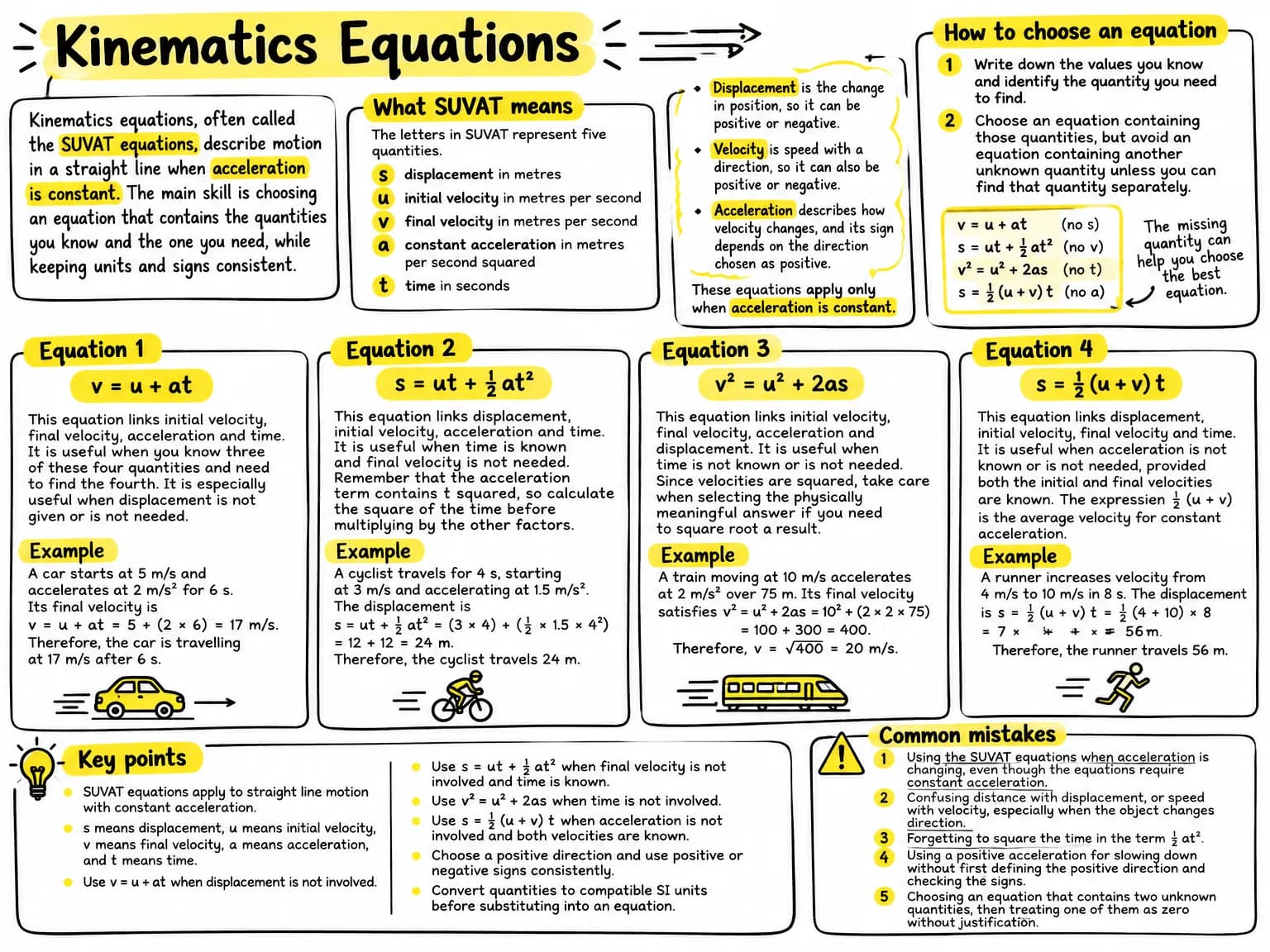
Kinematics equations, often called the SUVAT equations, describe motion in a straight line when acceleration is constant. The main skill is choosing an equation that contains the quantities you know and the one you need, while keeping units and signs consistent.
Kinematics Equations at a glance
Listen: Kinematics Equations
Two hosts talking it through, 3:08. The full transcript is below, so you can read along or skip the audio.
Transcript
AnnaToday we’re talking about kinematics equations, often called the SUVAT equations. Marco, what does SUVAT stand for?
MarcoThe letters represent five quantities. S is displacement, U is initial velocity, V is final velocity, A is constant acceleration, and T is time. Displacement is measured in metres, velocity in metres per second, acceleration in metres per second squared, and time in seconds.
AnnaWhy is the word constant so important here?
MarcoBecause these equations apply only to straight-line motion with constant acceleration. If acceleration changes, we cannot use them as they are. Also, displacement and velocity can be positive or negative, depending on the direction we choose as positive.
AnnaSo choosing an equation is more than just remembering four formulas. What should we do first?
MarcoFirst, write down what you know. Then identify what you need. Choose an equation containing those quantities, but avoid one containing another unknown. The missing quantity in each equation can help. For example, velocity equals initial velocity plus acceleration multiplied by time does not contain displacement.
AnnaLet’s test that one. A car starts at five metres per second, accelerates at two metres per second squared, and travels for six seconds. What happens?
MarcoWe use final velocity equals initial velocity plus acceleration multiplied by time. That is five plus two multiplied by six, which gives seventeen metres per second. Displacement was not needed.
AnnaWhat if we need displacement, and we know time but not final velocity?
MarcoThen we can use displacement equals initial velocity multiplied by time, plus one half multiplied by acceleration multiplied by time squared. The squared time matters. For a cyclist starting at three metres per second, accelerating at one point five metres per second squared for four seconds, the displacement is twelve plus twelve, or twenty-four metres.
AnnaAnd which equation avoids time altogether?
MarcoFinal velocity squared equals initial velocity squared plus two multiplied by acceleration multiplied by displacement. It is useful when time is unknown or unnecessary. A train starting at ten metres per second, accelerating at two metres per second squared over seventy-five metres, reaches twenty metres per second. We take the physically meaningful square-root result.
AnnaThere is also an equation without acceleration, correct?
MarcoYes. Displacement equals one half multiplied by the sum of initial and final velocity, multiplied by time. The one-half expression is the average velocity for constant acceleration. A runner changing from four to ten metres per second in eight seconds travels fifty-six metres.
AnnaWhat mistakes should listeners watch for?
MarcoDo not confuse distance with displacement, or speed with velocity. Define a positive direction and keep signs consistent, especially when slowing down. Convert to compatible SI units, and never treat an unknown as zero without justification. Most importantly, check that acceleration is constant before using SUVAT.
The notes
What SUVAT means
The letters in SUVAT represent five quantities. s is displacement in metres, u is initial velocity in metres per second, v is final velocity in metres per second, a is constant acceleration in metres per second squared, and t is time in seconds.
Displacement is the change in position, so it can be positive or negative. Velocity is speed with a direction, so it can also be positive or negative. Acceleration describes how velocity changes, and its sign depends on the direction chosen as positive. These equations apply only when acceleration is constant.
How to choose an equation
First, write down the values you know and identify the quantity you need to find. Then choose an equation containing those quantities, but avoid an equation containing another unknown quantity unless you can find that quantity separately.
The equation v = u + at does not contain s. The equation s = ut + 1/2at² does not contain v. The equation v² = u² + 2as does not contain t. The equation s = 1/2(u + v)t does not contain a. This missing quantity can help you choose the best equation.
Equation 1, v = u + at
This equation links initial velocity, final velocity, acceleration and time. It is useful when you know three of these four quantities and need to find the fourth. It is especially useful when displacement is not given or is not needed.
Example: A car starts at 5 m/s and accelerates at 2 m/s² for 6 s. Its final velocity is v = u + at = 5 + (2 × 6) = 17 m/s. Therefore, the car is travelling at 17 m/s after 6 s.
Equation 2, s = ut + 1/2at²
This equation links displacement, initial velocity, acceleration and time. It is useful when time is known and final velocity is not needed. Remember that the acceleration term contains t squared, so calculate the square of the time before multiplying by the other factors.
Example: A cyclist travels for 4 s, starting at 3 m/s and accelerating at 1.5 m/s². The displacement is s = ut + 1/2at² = (3 × 4) + (1/2 × 1.5 × 4²) = 12 + 12 = 24 m. Therefore, the cyclist travels 24 m.
Equation 3, v² = u² + 2as
This equation links initial velocity, final velocity, acceleration and displacement. It is useful when time is not known or is not needed. Since velocities are squared, take care when selecting the physically meaningful answer if you need to square root a result.
Example: A train moving at 10 m/s accelerates at 2 m/s² over 75 m. Its final velocity satisfies v² = u² + 2as = 10² + (2 × 2 × 75) = 100 + 300 = 400. Therefore, v = √400 = 20 m/s.
Equation 4, s = 1/2(u + v)t
This equation links displacement, initial velocity, final velocity and time. It is useful when acceleration is not known or is not needed, provided both the initial and final velocities are known. The expression 1/2(u + v) is the average velocity for constant acceleration.
Example: A runner increases velocity from 4 m/s to 10 m/s in 8 s. The displacement is s = 1/2(u + v)t = 1/2(4 + 10) × 8 = 7 × 8 = 56 m. Therefore, the runner travels 56 m.
What to remember
- SUVAT equations apply to straight line motion with constant acceleration.
- s means displacement, u means initial velocity, v means final velocity, a means acceleration, and t means time.
- Use v = u + at when displacement is not involved.
- Use s = ut + 1/2at² when final velocity is not involved and time is known.
- Use v² = u² + 2as when time is not involved.
- Use s = 1/2(u + v)t when acceleration is not involved and both velocities are known.
- Choose a positive direction and use positive or negative signs consistently.
- Convert quantities to compatible SI units before substituting into an equation.
Kinematics Equations as a mind map
- Kinematics Equations (SUVAT)
- Scope and Conditions
- Straight-line motion
- Constant acceleration
- Compatible SI units
- SUVAT Quantities
- s: displacement in metres
- u: initial velocity in metres per second
- v: final velocity in metres per second
- a: acceleration in metres per second squared
- t: time in seconds
- Sign Conventions
- Displacement includes direction
- Velocity includes speed and direction
- Acceleration sign depends on positive direction
- Equation Selection
- List known quantities
- Identify the required quantity
- Choose an equation with no extra unknowns
- Missing quantities guide equation choice
- v = u + at
- Use when displacement is not involved
- Links u, v, a, and t
- s = ut + 1/2at²
- Use when time is known and v is not needed
- Square time before multiplying acceleration term
- v² = u² + 2as
- Use when time is not involved
- Select the physically meaningful square-root result
- s = 1/2(u + v)t
- Use when acceleration is not involved
- Requires both initial and final velocities
- Average velocity: 1/2(u + v)
- Common Mistakes
- Using equations with changing acceleration
- Confusing distance with displacement
- Confusing speed with velocity
- Forgetting t² in 1/2at²
- Ignoring sign conventions when slowing down
- Treating an unknown quantity as zero without justification
- Scope and Conditions
Flashcards
- What are the SUVAT equations used to describe?
- They describe straight-line motion when acceleration is constant.
- What do the letters SUVAT represent?
- s = displacement, u = initial velocity, v = final velocity, a = constant acceleration, and t = time.
- What are the SI units for SUVAT quantities?
- Displacement is measured in metres (m), velocity in metres per second (m/s), acceleration in metres per second squared (m/s²), and time in seconds (s).
- How should signs be handled in kinematics problems?
- Choose a positive direction first, then use positive and negative signs consistently for displacement, velocity, and acceleration.
- How do you choose the correct SUVAT equation?
- List the known quantities and the quantity required, then choose an equation containing them without introducing another unknown quantity.
- What is the equation v = u + at used for?
- It links initial velocity, final velocity, acceleration, and time, especially when displacement is not involved.
- What is the equation s = ut + ½at² used for?
- It finds displacement when initial velocity, acceleration, and time are known, without requiring final velocity.
- What is the equation v² = u² + 2as used for?
- It links velocities, acceleration, and displacement when time is unknown or unnecessary.
- What is the equation s = ½(u + v)t used for?
- It finds displacement when both initial and final velocities and the time are known, without needing acceleration.
- What does ½(u + v) represent?
- For constant acceleration, ½(u + v) is the average velocity.
- What conditions must be met before using SUVAT equations?
- The motion must be along a straight line with constant acceleration, and all quantities must be converted to compatible SI units.
- What are common mistakes when using SUVAT equations?
- Common errors include using them with changing acceleration, confusing distance with displacement or speed with velocity, forgetting that time is squared in ½at², and treating an unknown as zero without justification.
Test yourself
Which condition must be satisfied for the SUVAT equations to apply?
SUVAT equations describe straight-line motion only when acceleration remains constant.
A vehicle’s initial velocity, acceleration, and time are known, but its displacement is not needed; which equation is most suitable for finding final velocity?
The equation v = u + at contains initial velocity, acceleration, time, and final velocity without involving displacement.
A cyclist starts at 2 m/s and accelerates at 3 m/s² for 4 s; what displacement does the cyclist undergo?
Using s = ut + 1/2at² gives s = 2(4) + 1/2(3)(4²) = 8 + 24 = 32 m.
An object moving in the positive direction slows down while its acceleration is constant; what sign should its acceleration have?
With positive velocity defined as forward, slowing down requires acceleration in the negative direction.
A runner’s velocity increases uniformly from 6 m/s to 14 m/s over 5 s; what displacement does the runner cover?
For constant acceleration, average velocity is 1/2(6 + 14) = 10 m/s, so displacement is 10 × 5 = 50 m.
Common mistakes
- Using the SUVAT equations when acceleration is changing, even though the equations require constant acceleration.
- Confusing distance with displacement, or speed with velocity, especially when the object changes direction.
- Forgetting to square the time in the term 1/2at².
- Using a positive acceleration for slowing down without first defining the positive direction and checking the signs.
- Choosing an equation that contains two unknown quantities, then treating one of them as zero without justification.
Make this for your own notes
Everything on this page came from one source, generated in about a minute. Paste a chapter, upload a PDF or photograph your notes and get the same set back.
Try it freeNo credit card. Free every month.