
Series vs Parallel Circuits
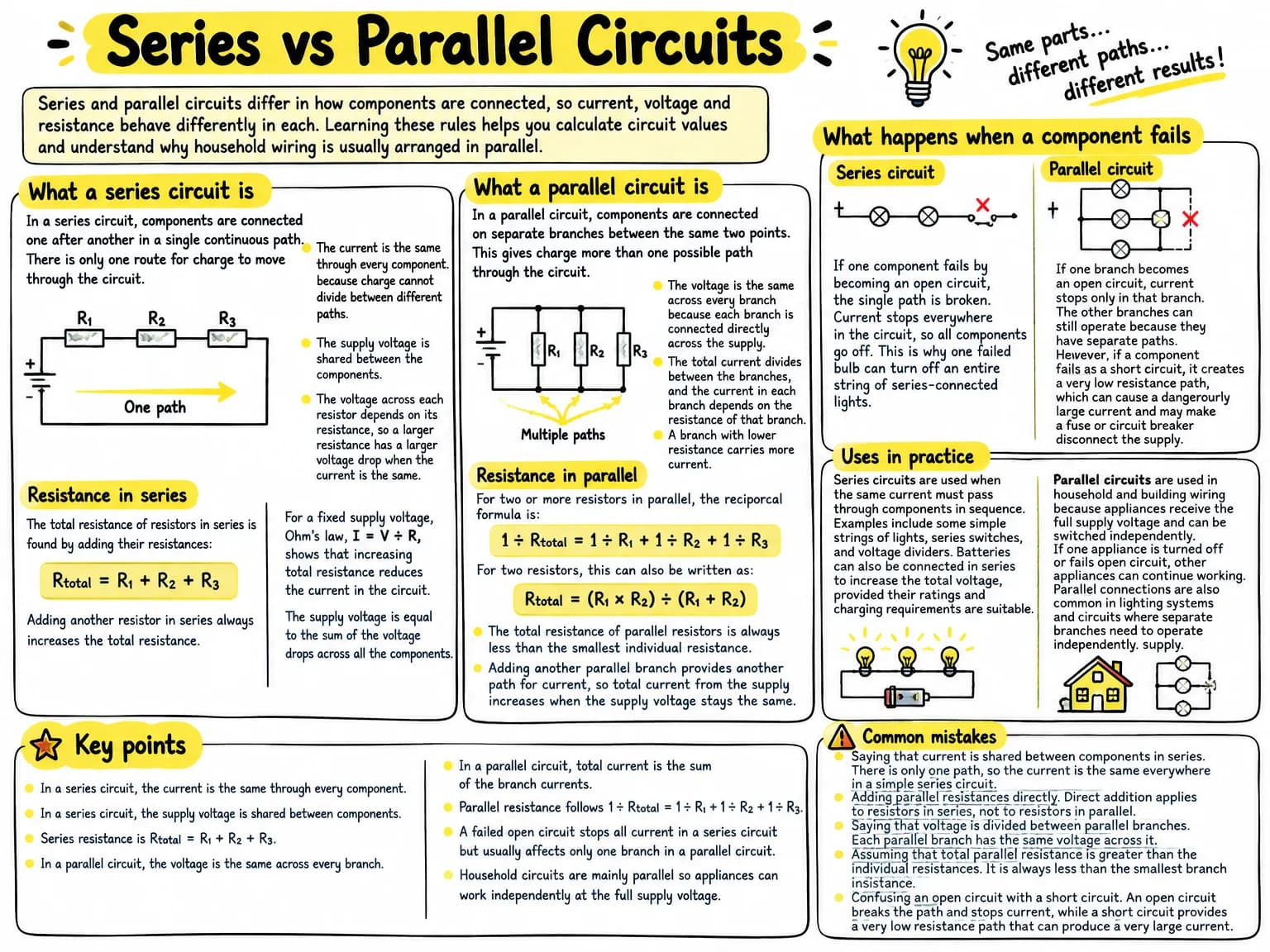
Series and parallel circuits differ in how components are connected, so current, voltage and resistance behave differently in each. Learning these rules helps you calculate circuit values and understand why household wiring is usually arranged in parallel.
Series vs Parallel Circuits at a glance
Listen: Series vs Parallel Circuits
Two hosts talking it through, 3:14. The full transcript is below, so you can read along or skip the audio.
Transcript
AnnaToday we’re comparing series and parallel circuits. Marco, what is the basic difference?
MarcoIt is how the components are connected. In a series circuit, components are connected one after another in one continuous path. In a parallel circuit, they are on separate branches between the same two points. So, in series, charge has one route. In parallel, it has several.
AnnaHow does that change the current and voltage in a series circuit?
MarcoThe current is the same through every component, because charge cannot divide between paths. But the supply voltage is shared. The voltage drop across each resistor depends on its resistance. If two resistors carry the same current, the larger resistance has the larger voltage drop.
AnnaAnd what happens to total resistance when we add resistors in series?
MarcoWe add them directly. The total resistance equals R one plus R two plus R three. Adding another resistor always increases total resistance. With a fixed supply voltage, Ohm’s law, current equals voltage divided by resistance, means the circuit current decreases. Also, the supply voltage equals the sum of all the voltage drops.
AnnaSo what is the matching rule for a parallel circuit?
MarcoThe voltage is the same across every branch, because every branch connects directly across the supply. The total current divides between the branches. A branch with lower resistance carries more current. The total current is the sum of the branch currents.
AnnaPeople often add parallel resistances directly. Why is that wrong?
MarcoDirect addition is for series resistors. For parallel resistors, we add reciprocals. One divided by total resistance equals one divided by R one, plus one divided by R two, plus one divided by R three. For two resistors, total resistance equals R one times R two, divided by R one plus R two. The result is always less than the smallest individual resistance.
AnnaWhat does adding another parallel branch do?
MarcoIt provides another path for current. If the supply voltage stays the same, total current from the supply increases.
AnnaLet’s talk about failures. What happens if a component becomes an open circuit in series?
MarcoThe single path is broken, so current stops everywhere. Every component goes off. That is why one failed bulb can turn off a whole string of series-connected lights.
AnnaAnd in parallel?
MarcoOnly that branch loses current. Other branches can still operate through their separate paths. But a short circuit is different. It creates a very low resistance path, which can cause dangerously large current and make a fuse or circuit breaker disconnect the supply.
AnnaWhy is household wiring mainly parallel?
MarcoAppliances receive the full supply voltage and can be switched independently. If one appliance is turned off or fails open circuit, the others can continue working. Parallel connections are also common in lighting systems and circuits whose branches need to operate independently.
AnnaSo the key warning is not to confuse current sharing in series with current division in parallel, or voltage sharing in series with equal voltage in parallel.
MarcoExactly. One path means the same current. Separate branches mean the same voltage across each branch.
The notes
What a series circuit is
In a series circuit, components are connected one after another in a single continuous path. There is only one route for charge to move through the circuit.
The current is the same through every component because charge cannot divide between different paths. The supply voltage is shared between the components. The voltage across each resistor depends on its resistance, so a larger resistance has a larger voltage drop when the current is the same.
Resistance in series
The total resistance of resistors in series is found by adding their resistances: Rtotal = R1 + R2 + R3. Adding another resistor in series always increases the total resistance.
For a fixed supply voltage, Ohm’s law, I = V ÷ R, shows that increasing total resistance reduces the current in the circuit. The supply voltage is equal to the sum of the voltage drops across all the components.
What a parallel circuit is
In a parallel circuit, components are connected on separate branches between the same two points. This gives charge more than one possible path through the circuit.
The voltage is the same across every branch because each branch is connected directly across the supply. The total current divides between the branches, and the current in each branch depends on the resistance of that branch. A branch with lower resistance carries more current.
Resistance in parallel
For two or more resistors in parallel, the reciprocal formula is 1 ÷ Rtotal = 1 ÷ R1 + 1 ÷ R2 + 1 ÷ R3. For two resistors, this can also be written as Rtotal = (R1 × R2) ÷ (R1 + R2).
The total resistance of parallel resistors is always less than the smallest individual resistance. Adding another parallel branch provides another path for current, so total current from the supply increases when the supply voltage stays the same.
What happens when a component fails
If one component in a simple series circuit fails by becoming an open circuit, the single path is broken. Current stops everywhere in the circuit, so all components go off. This is why one failed bulb can turn off an entire string of series-connected lights.
If one branch in a parallel circuit becomes an open circuit, current stops only in that branch. The other branches can still operate because they have separate paths. However, if a component fails as a short circuit, it creates a very low resistance path, which can cause a dangerously large current and may make a fuse or circuit breaker disconnect the supply.
Uses in practice
Series circuits are used when the same current must pass through components in sequence. Examples include some simple strings of lights, series switches, and voltage dividers. Batteries can also be connected in series to increase the total voltage, provided their ratings and charging requirements are suitable.
Parallel circuits are used in household and building wiring because appliances receive the full supply voltage and can be switched independently. If one appliance is turned off or fails open circuit, other appliances can continue working. Parallel connections are also common in lighting systems and circuits where separate branches need to operate independently.
What to remember
- In a series circuit, the current is the same through every component.
- In a series circuit, the supply voltage is shared between components.
- Series resistance is Rtotal = R1 + R2 + R3.
- In a parallel circuit, the voltage is the same across every branch.
- In a parallel circuit, total current is the sum of the branch currents.
- Parallel resistance follows 1 ÷ Rtotal = 1 ÷ R1 + 1 ÷ R2 + 1 ÷ R3.
- A failed open circuit stops all current in a series circuit but usually affects only one branch in a parallel circuit.
- Household circuits are mainly parallel so appliances can work independently at the full supply voltage.
Series vs Parallel Circuits as a mind map
- Series vs Parallel Circuits
- Series Circuits
- Single continuous path
- Same current through every component
- Supply voltage shared between components
- Larger resistance causes larger voltage drop
- Series resistance: Rtotal = R1 + R2 + R3
- Adding resistance reduces current at fixed voltage
- Parallel Circuits
- Separate branches between the same two points
- Same voltage across every branch
- Total current divides between branches
- Lower-resistance branch carries more current
- Total current equals the sum of branch currents
- Parallel resistance: 1/Rtotal = 1/R1 + 1/R2 + 1/R3
- Two-resistor formula: Rtotal = (R1 × R2) ÷ (R1 + R2)
- Total resistance is less than the smallest branch resistance
- Component Failures
- Open circuit breaks the path
- Series open circuit stops current everywhere
- Parallel open circuit affects only one branch
- Other parallel branches can continue operating
- Short circuit creates a very low-resistance path
- Short circuit may cause excessive current and trip protection
- Practical Uses
- Series lights, switches, and voltage dividers
- Series batteries increase total voltage
- Household wiring uses parallel connections
- Appliances receive full supply voltage
- Appliances can be switched independently
- Common Mistakes
- Current is not shared in a simple series circuit
- Do not add parallel resistances directly
- Parallel branches do not divide voltage
- Parallel resistance is not greater than individual resistances
- Open and short circuits have opposite effects
- Series Circuits
Flashcards
- What is a series circuit?
- A series circuit connects components one after another in a single continuous path, giving charge only one route to move.
- How does current behave in a series circuit?
- The current is the same through every component because there is only one path and charge cannot divide.
- How is voltage distributed in a series circuit?
- The supply voltage is shared among the components, and the voltage drops add up to the supply voltage.
- What is the total resistance formula for resistors in series?
- Rtotal = R1 + R2 + R3. Adding another resistor in series always increases total resistance.
- What happens to current when series resistance increases?
- For a fixed supply voltage, increasing total resistance decreases the current according to I = V ÷ R.
- What is a parallel circuit?
- A parallel circuit connects components on separate branches between the same two points, providing multiple paths for charge.
- How do voltage and current behave in a parallel circuit?
- The voltage is the same across every branch, while the total current divides among the branches. Total current equals the sum of the branch currents.
- Which parallel branch carries more current?
- A branch with lower resistance carries more current than a branch with higher resistance when the branch voltage is the same.
- What is the resistance formula for resistors in parallel?
- For multiple resistors, 1 ÷ Rtotal = 1 ÷ R1 + 1 ÷ R2 + 1 ÷ R3. For two resistors, Rtotal = (R1 × R2) ÷ (R1 + R2).
- How does parallel resistance compare with individual resistances?
- The total resistance of parallel resistors is always less than the smallest individual resistance; parallel resistances must not be added directly.
- What happens if a component fails open circuit in series and parallel circuits?
- In series, an open circuit breaks the only path, stopping current everywhere. In parallel, it usually stops current only in the affected branch.
- Why is household wiring usually arranged in parallel?
- Parallel wiring gives each appliance the full supply voltage and allows appliances to operate and be switched independently. If one appliance fails open circuit, others can continue working.
Test yourself
Why is the current the same through every component in a simple series circuit?
A series circuit has only one path, so charge cannot split into different routes.
Two resistors are connected in series with the same current flowing through both. Which resistor has the larger voltage drop?
Using V = IR, the same current produces a larger voltage drop across the larger resistance.
Which statement about the total resistance of resistors connected in parallel is correct?
Parallel branches provide additional paths for current, making the equivalent resistance less than the smallest branch resistance.
What is true about the voltage across components connected in parallel?
Every parallel branch is connected between the same two points, so each branch has the supply voltage across it.
A bulb becomes an open circuit in a simple circuit. What happens if the bulb is connected in series, rather than in parallel?
An open component breaks the only current path in a series circuit, stopping current everywhere.
Common mistakes
- Saying that current is shared between components in series. There is only one path, so the current is the same everywhere in a simple series circuit.
- Adding parallel resistances directly. Direct addition applies to resistors in series, not to resistors in parallel.
- Saying that voltage is divided between parallel branches. Each parallel branch has the same voltage across it.
- Assuming that total parallel resistance is greater than the individual resistances. It is always less than the smallest branch resistance.
- Confusing an open circuit with a short circuit. An open circuit breaks the path and stops current, while a short circuit provides a very low resistance path that can produce a very large current.
Make this for your own notes
Everything on this page came from one source, generated in about a minute. Paste a chapter, upload a PDF or photograph your notes and get the same set back.
Try it freeNo credit card. Free every month.