
Projectile motion is the motion of an object launched into the air and then acted on only by gravity, if air resistance is ignored. The key idea is to calculate horizontal and vertical motion separately, while using the same time for both.
★What to remember
- Resolve the launch velocity into ux = u cos θ and uy = u sin θ, with θ measured above the horizontal.
- In the ideal model, horizontal acceleration is zero and horizontal velocity is constant.
- Vertical acceleration is −g when upward is positive.
- Use the same time value for the horizontal and vertical calculations.
- For equal launch and landing heights, time of flight is T = 2u sin θ/g.
- Maximum height above the launch point is H = u² sin² θ/(2g).
- For equal launch and landing heights, range is R = u² sin(2θ)/g.
🎧Listen3:23 · transcript
AnnaWhen we describe projectile motion, what are we assuming?
MarcoWe’re describing an object launched into the air and then acted on only by gravity. We ignore air resistance, and we treat gravity as constant and downward. We also choose upward as positive. That sign choice matters, because the vertical acceleration is minus g.
AnnaAnd the key is that we split the motion into two directions, but don’t give them separate clocks, right?
MarcoExactly. The horizontal and vertical motions happen together, so they use the same time. If the launch speed is u and the angle above the horizontal is theta, the horizontal starting velocity is u cosine theta. The vertical starting velocity is u sine theta.
AnnaSo what changes after launch?
MarcoIn the ideal model, nothing changes the horizontal velocity. Horizontal acceleration is zero, so horizontal displacement after time t is u cosine theta times t. Vertically, gravity changes the velocity. The vertical velocity is u sine theta minus g times t. And vertical displacement from the launch point is u sine theta times t, minus one half g times t squared.
AnnaNear Earth’s surface, we use about nine point eight meters per second squared for g. How do we get the flight time?
MarcoThat depends on where the projectile lands. If it lands at the same height it started from, its vertical displacement is zero. Solving the vertical displacement equation gives a nonzero flight time: two u sine theta divided by g.
AnnaAnd if it lands at a different height, we can’t just use that shortcut?
MarcoRight. We use the vertical displacement equation with the actual height change, then solve for the relevant positive time. Once we have that time, we can use it in the horizontal equation.
AnnaWhat about the top of the path?
MarcoAt maximum height, vertical velocity is zero. That happens after u sine theta divided by g. Substituting that time into the vertical displacement equation gives the maximum height above the launch point: u squared sine squared theta divided by two g.
AnnaAnd the range is the horizontal distance by the time it lands?
MarcoYes. For equal launch and landing heights, range is horizontal velocity times flight time. That gives u squared sine of two theta divided by g. But that formula, too, assumes equal heights.
AnnaCan we check the equations with the ball in the example?
MarcoA ball launched at twenty meters per second, thirty degrees above horizontal, returns to its launch height. Its horizontal velocity is about seventeen point three meters per second, and its vertical velocity is ten meters per second. With g at nine point eight, the flight time is about two point zero four seconds. The maximum height is five point one zero meters, and the range is about thirty-five point three meters. Those are approximate because the numbers are rounded.
AnnaWhat should we watch out for when using these equations?
MarcoDon’t swap sine and cosine: sine gives the vertical component, cosine the horizontal one. Don’t treat vertical velocity as constant, and don’t use the equal-height formulas for a different landing height. Keep the same time for both directions, include units, and keep your sign convention consistent. Also, maximum height means height above the launch point, not total vertical distance traveled. Real air resistance can change horizontal velocity and make the path differ from the ideal parabola.
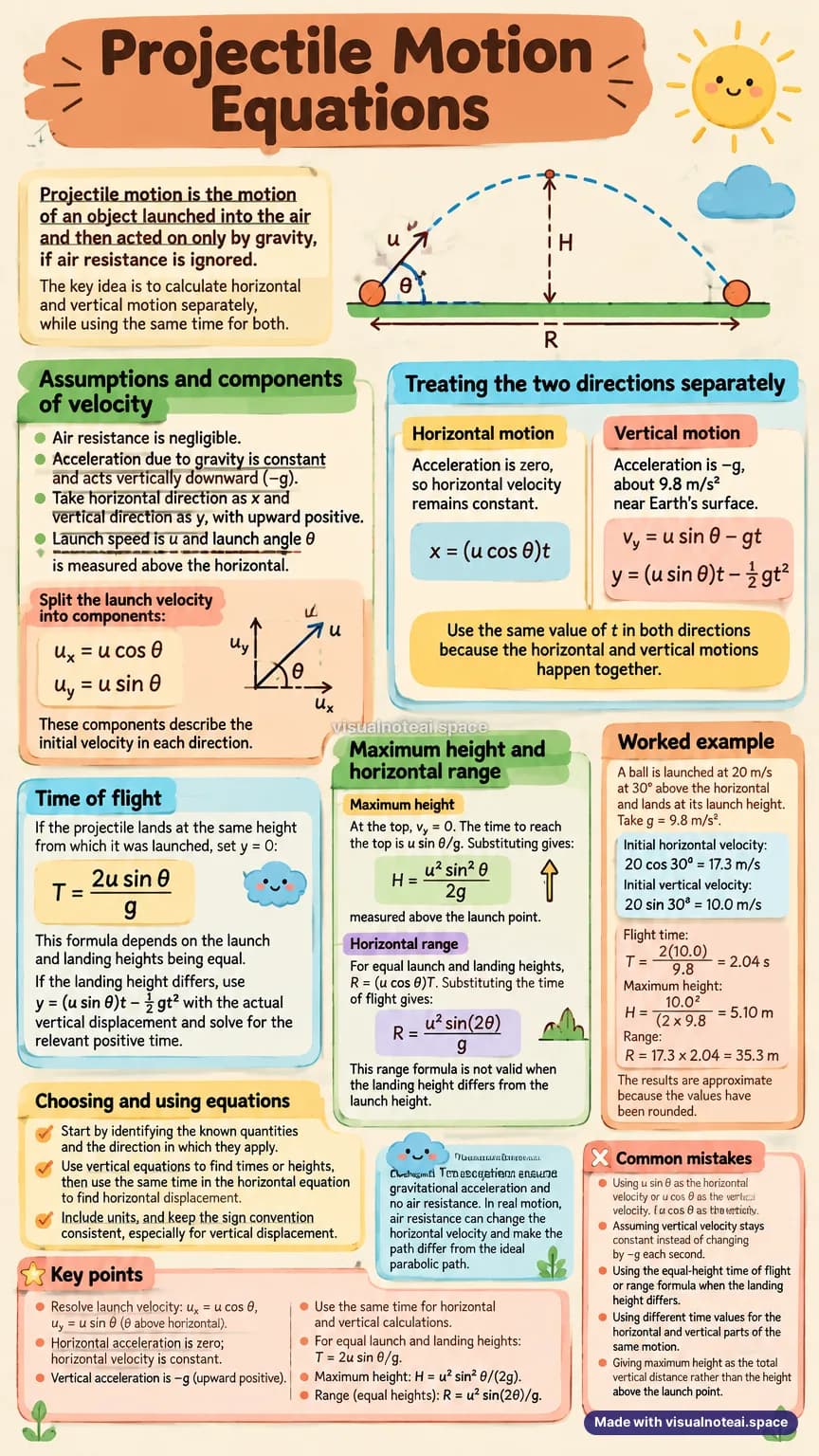
The whole topic on one page. Made with VisualNote.
!Common mistakes
- Using u sin θ as the horizontal velocity or u cos θ as the vertical velocity.
- Assuming vertical velocity stays constant instead of changing by −g each second.
- Using the equal-height time of flight or range formula when the projectile lands at a different height.
- Using different time values for the horizontal and vertical parts of the same motion.
- Giving maximum height as the total vertical distance travelled rather than the height above the launch point.
🧠Explore the map39 ideas
The mind map VisualNote made for this topic. Drag to pan, scroll to zoom.
- Projectile Motion Equations
- Ideal Model and Velocity Components
- Assumptions
- Negligible air resistance
- Constant gravity downward: −g
- Upward-positive vertical axis
- Launch speed u and angle θ above horizontal
- Horizontal velocity: ux = u cos θ
- Vertical velocity: uy = u sin θ
- Assumptions
- Horizontal Motion
- Zero horizontal acceleration
- Constant horizontal velocity
- Horizontal displacement: x = (u cos θ)t
- Vertical Motion
- Vertical acceleration: −g
- Vertical velocity: vy = u sin θ − gt
- Vertical displacement: y = (u sin θ)t − ½gt²
- Maximum height
- At the top, vy = 0
- Time to maximum height: u sin θ/g
- Height above launch point: H = u² sin² θ/(2g)
- Flight Time and Range
- Same launch and landing height
- Flight time: T = 2u sin θ/g
- Range: R = u² sin(2θ)/g
- Different landing height
- Use actual vertical displacement in y equation
- Solve for the relevant positive time
- Same launch and landing height
- Using the Equations
- Use the same time for both directions
- Use vertical equations for time or height
- Then use horizontal equation for displacement
- Keep signs consistent and include units
- Common errors
- Swapping sine and cosine components
- Treating vertical velocity as constant
- Applying equal-height formulas at different heights
- Confusing height above launch point with total vertical travel
- Real air resistance changes the ideal path
- Ideal Model and Velocity Components
🃏Flashcards12 cards
- What is projectile motion in the ideal model?
- It is the motion of an object launched into the air and acted on only by gravity, with air resistance ignored.
- What assumptions are used in the standard projectile equations?
- Air resistance is negligible, and gravity is constant and acts vertically downward. Upward is taken as the positive vertical direction.
- How are the launch velocity components calculated?
- For launch speed u at angle θ above the horizontal, the horizontal component is ux = u cos θ and the vertical component is uy = u sin θ.
- How does horizontal motion behave in the ideal model?
- Horizontal acceleration is zero, so horizontal velocity stays constant at u cos θ. Horizontal displacement after time t is x = (u cos θ)t.
- What are the vertical velocity and displacement equations?
- With upward positive, vy = u sin θ − gt and y = (u sin θ)t − ½gt², where g is the magnitude of gravitational acceleration.
- Why must the same time be used for horizontal and vertical calculations?
- Both components describe the same motion happening simultaneously, so they share the same elapsed time t.
- What is the approximate value of g near Earth's surface?
- The magnitude of gravitational acceleration is about 9.8 m/s², directed downward.
- What is the time of flight when launch and landing heights are equal?
- T = 2u sin θ/g. This formula assumes the projectile lands at its launch height.
- How should flight time be found when landing height differs from launch height?
- Use y = (u sin θ)t − ½gt² with the actual vertical displacement, then solve for the relevant positive time.
- How is the maximum height above the launch point calculated?
- At the top, vertical velocity is zero; the maximum height is H = u² sin² θ/(2g).
- What is the horizontal range for equal launch and landing heights?
- R = u² sin(2θ)/g, or equivalently R = (u cos θ)T. This formula does not apply as written when the landing height differs.
- What common errors should be avoided in projectile-motion calculations?
- Do not swap u cos θ and u sin θ, treat vertical velocity as constant, use equal-height formulas for unequal heights, or use different times for the two directions. Maximum height is measured above the launch point.
✅Test yourself5 questions
A projectile is launched at speed u at an angle θ above the horizontal. Which expressions give its initial horizontal and vertical velocity components, respectively?
Because θ is measured above the horizontal, the horizontal component is u cos θ and the upward vertical component is u sin θ.
In the ideal projectile model, what happens to the horizontal velocity after launch?
With air resistance ignored, gravity acts vertically, so horizontal acceleration is zero and horizontal velocity remains constant.
A projectile lands at the same height from which it was launched. Which expression gives its nonzero time of flight?
For equal launch and landing heights, the projectile’s vertical displacement returns to zero after a nonzero time of 2u sin θ/g.
A projectile lands at a height different from its launch height. Which approach should be used to find the landing time?
When the launch and landing heights differ, the equal-height flight-time formula does not apply, so the vertical displacement equation must use the actual height change.
What does H = u² sin² θ/(2g) represent?
At maximum height the vertical velocity is zero, and this formula gives the projectile’s height above its launch point.
📝The notes
Assumptions and components of velocity
For the standard projectile equations, assume air resistance is negligible and the acceleration due to gravity is constant and acts vertically downward. Take the horizontal direction as x and the vertical direction as y, with upward positive. The launch speed is u and the launch angle θ is measured above the horizontal.
Split the launch velocity into components: the horizontal component is ux = u cos θ, and the vertical component is uy = u sin θ. These components describe the initial velocity in each direction.
Treating the two directions separately
Horizontally, acceleration is zero in the ideal model, so horizontal velocity remains constant. The horizontal displacement after time t is x = (u cos θ)t.
Vertically, acceleration is −g, where g is the magnitude of gravitational acceleration, about 9.8 m/s² near Earth’s surface. The vertical velocity is vy = u sin θ − gt, and the vertical displacement from the launch point is y = (u sin θ)t − ½gt². Use the same value of t in both directions because the horizontal and vertical motions happen together.
Time of flight
If the projectile lands at the same height from which it was launched, its vertical displacement at landing is zero. Setting y = 0 in the vertical displacement equation gives a nonzero flight time of T = 2u sin θ/g.
This formula depends on the launch and landing heights being equal. If the projectile lands at a different height, use y = (u sin θ)t − ½gt² with the actual vertical displacement and solve for the relevant positive time.
Maximum height and horizontal range
At maximum height, the vertical velocity is zero. Using vy = u sin θ − gt gives the time to reach the top as u sin θ/g. Substituting this into the vertical displacement equation gives H = u² sin² θ/(2g), measured above the launch point.
For launch and landing at the same height, the horizontal range is R = (u cos θ)T. Substituting the time of flight gives R = u² sin(2θ)/g. This range formula is not valid as written when the landing height differs from the launch height.
Worked example
A ball is launched at 20 m/s at 30° above the horizontal and lands at its launch height. Take g = 9.8 m/s². Its initial horizontal velocity is 20 cos 30° = 17.3 m/s, and its initial vertical velocity is 20 sin 30° = 10.0 m/s.
The flight time is T = 2(10.0)/9.8 = 2.04 s. The maximum height is H = 10.0²/(2 × 9.8) = 5.10 m. The range is R = 17.3 × 2.04 = 35.3 m. The results are approximate because the values have been rounded.
Choosing and using equations
Start by identifying the known quantities and the direction in which they apply. Use vertical equations to find times or heights, then use the same time in the horizontal equation to find horizontal displacement. Include units, and keep the sign convention consistent, especially when using vertical displacement.
The equations assume a fixed gravitational acceleration and no air resistance. In real motion, air resistance can change the horizontal velocity and make the path differ from the ideal parabolic path.
Make this for your own notes
Paste a chapter or a PDF and get the sheet, map, cards, quiz and episode back in about a minute. No credit card.