
Moment of inertia describes how difficult it is to change an object's rotation about a chosen axis. It depends not only on the object's mass, but also on how that mass is spread out from the axis.
★What to remember
- Moment of inertia measures resistance to changes in rotation about a specified axis.
- For point masses, I = Σmr², where r is the perpendicular distance to the axis.
- Moment of inertia depends on both the amount of mass and how far that mass lies from the axis.
- Moving mass farther from the axis increases its contribution according to the square of the distance.
- A thin hoop about its central perpendicular axis has I = MR², while a solid disk about that axis has I = MR²/2.
- The parallel axis theorem is I = Icm + Md² for parallel axes.
- The SI unit of moment of inertia is kg m².
🎧Listen3:16 · transcript
AnnaWhen people hear “moment of inertia,” they may think it just means how much an object weighs. Is that close?
MarcoNot quite. It describes how difficult it is to change an object’s rotation about a chosen axis. Mass matters, but so does where that mass is. The same object can have different moments of inertia about different axes.
AnnaSo it’s like mass for rotation, but not simply the object’s mass. What does the relationship with torque tell us?
MarcoFor rotation about a fixed axis, net torque equals moment of inertia times angular acceleration. So, for a given torque, a larger moment of inertia means a smaller angular acceleration. Its unit is kilogram metres squared.
AnnaAnd the distance from the axis matters especially strongly, right?
MarcoYes. For point masses, add each mass times its perpendicular distance from the axis squared. For a continuous object, the matching expression is the integral of distance squared over small amounts of mass. Because distance is squared, moving the same mass twice as far from the axis makes its contribution four times as large.
AnnaThat makes the axis sound essential. Can you show how it changes the answer for a rod?
MarcoFor a thin, uniform rod, using an axis through its centre and perpendicular to its length, the moment of inertia is mass times length squared divided by twelve. Use an axis through one end, still perpendicular to the rod, and it is mass times length squared divided by three. The mass sits at different distances from those axes.
AnnaHow about a hoop and a disk? They can have the same mass and radius, but do they rotate the same way?
MarcoNot according to their moments of inertia. About an axis through the centre and perpendicular to the plane, a thin hoop has mass times radius squared. A uniform solid disk has mass times radius squared divided by two. Some of the disk’s mass is closer to the axis than the hoop’s mass is.
AnnaDoes that same distinction show up in cylinders?
MarcoIt does. A uniform solid cylinder about its central axis along its length has mass times radius squared divided by two. A thin-walled hollow cylinder about that axis has mass times radius squared. Those formulas assume uniform distribution in the stated shapes. For spheres, a uniform solid sphere about an axis through its centre has two-fifths of mass times radius squared. A thin spherical shell about a diameter has two-thirds of mass times radius squared.
AnnaSuppose I know the value through the centre of mass, but need a parallel axis somewhere else. What then?
MarcoUse the parallel axis theorem: the new moment of inertia is the centre-of-mass value plus total mass times the distance between the axes squared. The axes must be parallel. It doesn’t apply to axes pointing in different directions.
AnnaAnd beyond acceleration, where does moment of inertia enter?
MarcoRotational kinetic energy equals one-half times moment of inertia times angular speed squared. At the same angular speed, a larger moment of inertia means more rotational kinetic energy. It also takes more torque to produce the same angular acceleration. So first identify the axis, then match the mass distribution to the right formula, and keep the units in kilogram metres squared.
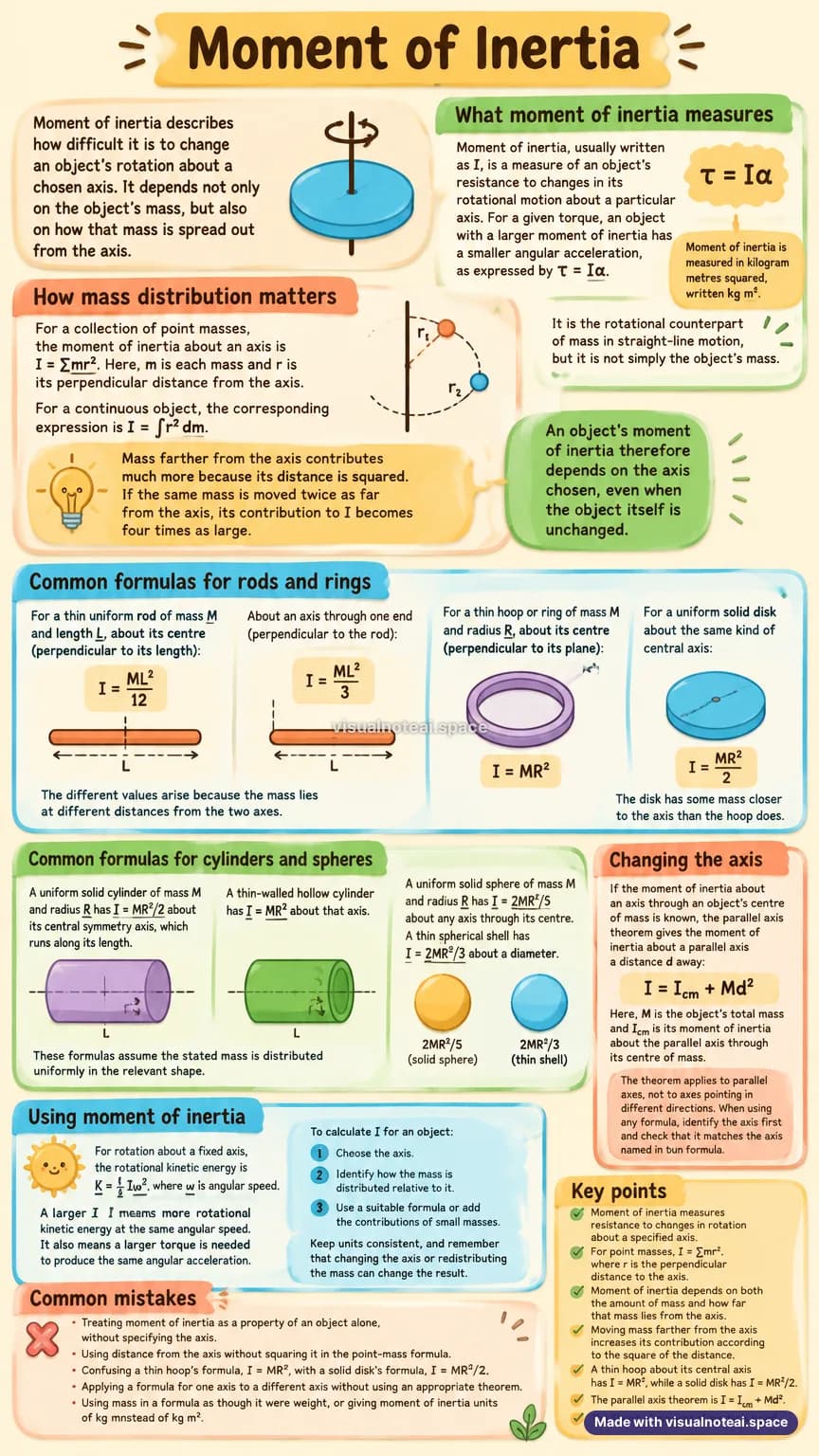
The whole topic on one page. Made with VisualNote.
!Common mistakes
- Treating moment of inertia as a property of an object alone, without specifying the axis.
- Using distance from the axis without squaring it in the point-mass formula.
- Confusing a thin hoop's formula, I = MR², with a solid disk's formula, I = MR²/2.
- Applying a formula for one axis to a different axis without using an appropriate theorem.
- Using mass in a formula as though it were weight, or giving moment of inertia units of kg m instead of kg m².
🧠Explore the map28 ideas
The mind map VisualNote made for this topic. Drag to pan, scroll to zoom.
- Moment of Inertia
- Meaning and Units
- Rotational resistance about a chosen axis
- Rotational counterpart of mass
- SI unit: kg m²
- Torque relation: τ = Iα
- Mass Distribution
- Point masses: I = Σmr²
- Continuous bodies: I = ∫r² dm
- r is perpendicular distance from the axis
- Doubling distance quadruples contribution
- Depends on chosen axis and mass distribution
- Common Shape Formulas
- Thin rod, center axis: ML²/12
- Thin rod, end axis: ML²/3
- Hoop: MR²; solid disk: MR²/2
- Solid cylinder: MR²/2; thin-walled cylinder: MR²
- Solid sphere: 2MR²/5; thin shell: 2MR²/3
- Axis Changes
- Parallel axis theorem: I = Icm + Md²
- Applies only to parallel axes
- Identify the axis before choosing a formula
- Applications and Calculation
- Rotational kinetic energy: K = ½Iω²
- Larger I requires more torque for the same angular acceleration
- Choose axis, assess mass distribution, then apply a formula
- Keep units consistent; use mass, not weight
- Common errors: omit r² or use mismatched axis formulas
- Meaning and Units
🃏Flashcards12 cards
- What does moment of inertia measure?
- It measures an object's resistance to changes in rotational motion about a specified axis.
- What determines an object's moment of inertia?
- Both its mass and how that mass is distributed relative to the chosen axis. The value can change when the axis changes.
- What is the point-mass formula for moment of inertia?
- I = Σmr², where m is each mass and r is its perpendicular distance from the axis.
- What is the moment-of-inertia formula for a continuous object?
- I = ∫r² dm, where r is the perpendicular distance of each mass element dm from the axis.
- How does doubling a mass element’s distance from the axis affect its contribution to I?
- Its contribution becomes four times as large, because distance is squared.
- What is the SI unit of moment of inertia?
- Kilogram metre squared (kg m²).
- How are net torque, moment of inertia, and angular acceleration related about a fixed axis?
- τ = Iα. For the same net torque, a larger moment of inertia gives a smaller angular acceleration.
- What is the moment of inertia of a thin uniform rod about its centre, perpendicular to its length?
- I = ML²/12.
- What is the moment of inertia of a thin uniform rod about one end, perpendicular to its length?
- I = ML²/3.
- Compare a thin hoop and a uniform solid disk about their central axis perpendicular to the plane.
- The hoop has I = MR²; the disk has I = MR²/2 because some of its mass lies closer to the axis.
- What is the parallel axis theorem?
- For axes that are parallel and separated by distance d, I = Icm + Md², where Icm is about the parallel axis through the centre of mass.
- What is rotational kinetic energy about a fixed axis?
- K = ½Iω², where ω is angular speed. At the same angular speed, a larger I means greater rotational kinetic energy.
✅Test yourself5 questions
For the same net torque about a fixed axis, what happens to angular acceleration if an object's moment of inertia increases?
From τ = Iα, a larger moment of inertia gives a smaller angular acceleration for the same torque.
A point mass is moved to twice its original perpendicular distance from the rotation axis. How does its contribution to moment of inertia change?
Since the contribution is mr², doubling r multiplies it by four.
Which expression gives the moment of inertia of a thin uniform rod about an axis through one end and perpendicular to its length?
For a thin uniform rod about a perpendicular axis through one end, I = ML²/3.
A thin hoop and a uniform solid disk have the same mass and radius. About a central axis perpendicular to their planes, how do their moments of inertia compare?
The hoop has I = MR², while the disk has I = MR²/2.
The moment of inertia about an object's centre-of-mass axis is Icm. What is the moment of inertia about a parallel axis a distance d away?
The parallel axis theorem states that I = Icm + Md² for parallel axes.
📝The notes
What moment of inertia measures
Moment of inertia, usually written as I, is a measure of an object's resistance to changes in its rotational motion about a particular axis. For a given torque, an object with a larger moment of inertia has a smaller angular acceleration, as expressed by τ = Iα when the net torque acts about a fixed axis.
Moment of inertia is measured in kilogram metres squared, written kg m². It is the rotational counterpart of mass in straight-line motion, but it is not simply the object's mass.
How mass distribution matters
For a collection of point masses, the moment of inertia about an axis is I = Σmr². Here, m is each mass and r is its perpendicular distance from the axis. For a continuous object, the corresponding expression is I = ∫r² dm.
Mass farther from the axis contributes much more because its distance is squared. If the same mass is moved twice as far from the axis, its contribution to I becomes four times as large. An object's moment of inertia therefore depends on the axis chosen, even when the object itself is unchanged.
Common formulas for rods and rings
For a thin uniform rod of mass M and length L, about an axis through its centre and perpendicular to its length, I = ML²/12. About an axis through one end and perpendicular to the rod, I = ML²/3. The different values arise because the mass lies at different distances from the two axes.
For a thin hoop or ring of mass M and radius R, about an axis through its centre perpendicular to its plane, I = MR². For a uniform solid disk about the same kind of central axis, I = MR²/2. The disk has some mass closer to the axis than the hoop does.
Common formulas for cylinders and spheres
A uniform solid cylinder of mass M and radius R has I = MR²/2 about its central symmetry axis, which runs along its length. A thin-walled hollow cylinder has I = MR² about that axis. These formulas assume the stated mass is distributed uniformly in the relevant shape.
A uniform solid sphere of mass M and radius R has I = 2MR²/5 about any axis through its centre. A thin spherical shell has I = 2MR²/3 about a diameter. These formulas apply to the specified ideal shapes and axes.
Changing the axis
If the moment of inertia about an axis through an object's centre of mass is known, the parallel axis theorem gives the moment of inertia about a parallel axis a distance d away: I = Icm + Md². Here, M is the object's total mass and Icm is its moment of inertia about the parallel axis through its centre of mass.
The theorem applies to parallel axes, not to axes pointing in different directions. When using any formula, identify the axis first and check that it matches the axis named in the formula.
Using moment of inertia
For rotation about a fixed axis, the rotational kinetic energy is K = 1/2 Iω², where ω is angular speed. A larger I means more rotational kinetic energy at the same angular speed. It also means a larger torque is needed to produce the same angular acceleration.
To calculate I for an object, choose the axis, identify how the mass is distributed relative to it, and use a suitable formula or add the contributions of small masses. Keep units consistent, and remember that changing the axis or redistributing the mass can change the result.
Make this for your own notes
Paste a chapter or a PDF and get the sheet, map, cards, quiz and episode back in about a minute. No credit card.