
DNA vs RNA: Comparison Diagram, Notes and Flashcards
Two textbook sections on nucleic acids, redrawn as one side by side comparison you can hold in your head. The flashcards came from the same sections, so they test the differences the diagram makes visible.
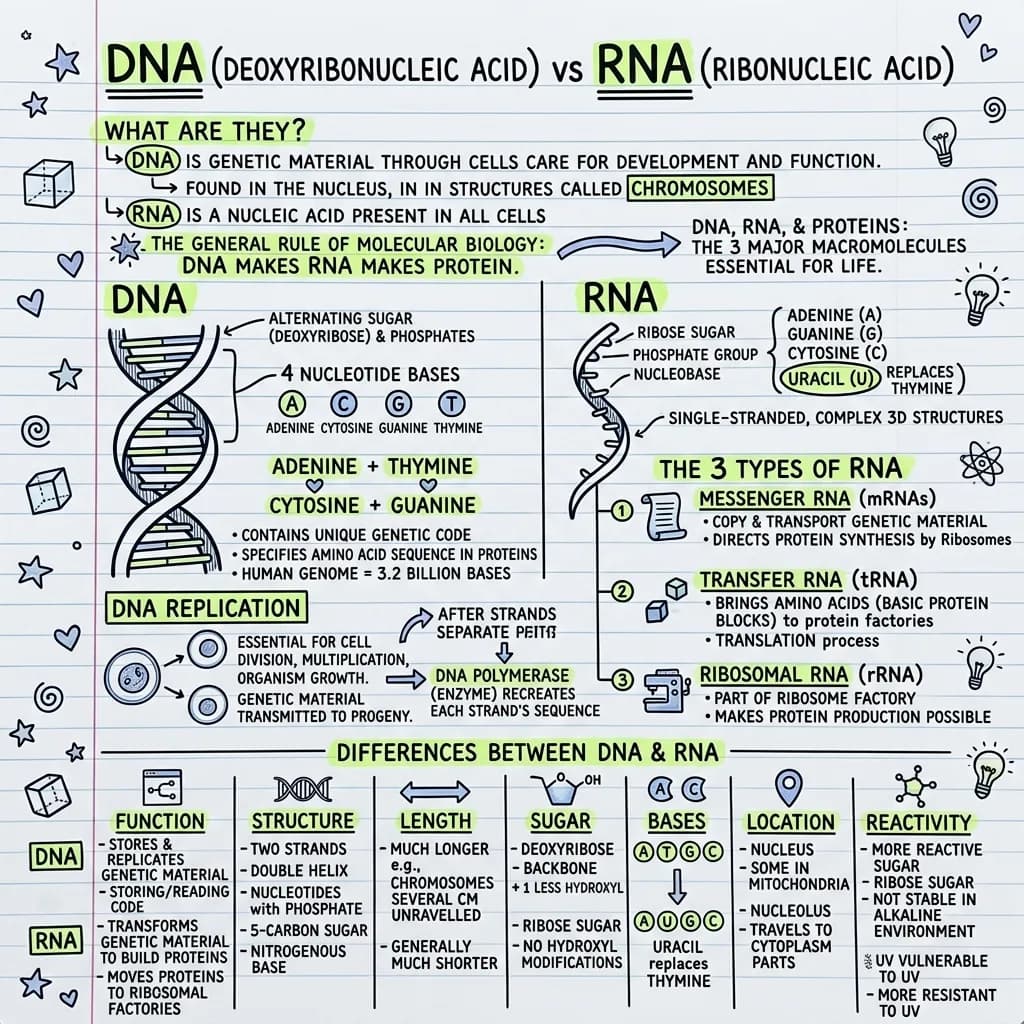
Section 5.3: nucleic acids. Deoxyribonucleic acid is a double stranded molecule wound into a double helix, in which the two antiparallel strands are held together by hydrogen bonds between complementary bases; adenine pairs with thymine through two hydrogen bonds and cytosine pairs with guanine through three. Ribonucleic acid is normally single stranded and contains uracil in place of thymine, so that adenine pairs with uracil. The sugar in the backbone differs: DNA contains deoxyribose, which lacks a hydroxyl group at the two prime position, whereas RNA contains ribose, which retains it and makes RNA more chemically reactive and less stable. DNA molecules are extremely long, comprising millions of base pairs organised into chromosomes, while RNA molecules are comparatively short. DNA is located principally in the nucleus, with small amounts in mitochondria and chloroplasts, and functions as the long term store of genetic information; RNA is transcribed in the nucleus and functions largely in the cytoplasm. The central dogma of molecular biology states that DNA is transcribed to RNA and RNA is translated to protein. Before cell division DNA is replicated semi conservatively: the helix is unwound by helicase, each strand acts as a template, and DNA polymerase adds complementary nucleotides to build a new strand, so that each daughter molecule contains one original and one newly synthesised strand. Three principal classes of RNA are recognised. Messenger RNA carries the transcribed genetic code from the nucleus to the ribosome. Transfer RNA carries specific amino acids to the ribosome and possesses an anticodon that pairs with the complementary codon on the messenger RNA. Ribosomal RNA forms a structural and catalytic component of the ribosome itself.
The flashcards from the same notes
Exports as Anki CSV, printable PDF, or plain text.
Which base replaces thymine in RNA?
Uracil. In RNA, adenine pairs with uracil instead of thymine.
Which sugar is found in DNA, and which in RNA?
Deoxyribose in DNA, ribose in RNA.
State the base pairing rules in DNA.
Adenine pairs with thymine, and cytosine pairs with guanine.
Which enzyme adds complementary nucleotides during DNA replication?
DNA polymerase.
What is the job of tRNA?
It carries a specific amino acid to the ribosome and matches its anticodon to the complementary codon on the mRNA.
Why is DNA more chemically stable than RNA?
DNA is double stranded and its deoxyribose sugar lacks the hydroxyl group at the two prime position, making it less reactive and suited to long term storage.
Make a deck from your own notes with the AI flashcard generator.
What's in this visual
DNA and RNA are the classic pair of topics that feel identical the first time you meet them and then split apart the moment you are asked a specific question. Sugar, bases, strand count, length, location and job all differ, and each difference exists for a reason. The comparison above puts the two molecules side by side so the differences are visible rather than listed. Here is what each one means.
Two strands versus one, and what that buys
DNA is double stranded, twisted into the familiar double helix, with the two strands running antiparallel and held together by hydrogen bonds between paired bases. RNA is normally single stranded, which lets it fold into working shapes and slip out of the nucleus. The strand count is not cosmetic. Two strands mean each one is a backup copy of the other, which is what makes accurate replication and repair possible; a single strand is disposable by design, made for a job and then broken down. Store versus messenger is the whole distinction in three words.
The four bases, the pairing rules, and uracil
DNA uses four bases: adenine, thymine, cytosine and guanine. The pairing rules are fixed. A pairs with T through two hydrogen bonds, and C pairs with G through three, which is why sections rich in C and G are harder to pull apart. RNA keeps A, C and G but swaps thymine for uracil, so in RNA adenine pairs with uracil instead. That one substitution is the most reliably examined fact in the whole topic, and the easiest to lose in a list of ten similar facts; on the diagram above it is a single visible swap.
DNA makes RNA makes protein
The organising rule of molecular biology is a one line flow: DNA makes RNA makes protein. DNA is transcribed into RNA in the nucleus; that RNA is translated into a chain of amino acids at the ribosome. This is why DNA can afford to stay locked in the nucleus and never leave: it sends a copy instead of going itself, which protects the master record from damage. Almost every downstream idea in genetics, from mutation to gene expression, is a variation on this single arrow, so it is worth being able to state it in one breath.
Replication, and the enzyme that does the building
Before a cell divides, DNA is copied semi-conservatively. The helix is unwound, each old strand acts as a template, and DNA polymerase adds complementary nucleotides along it. The result is two molecules, each with one original strand and one new one, which is where the word semi-conservative comes from. Because pairing is fixed, one strand carries all the information needed to rebuild the other, and that redundancy is the reason a double stranded molecule was the right choice for long term storage in the first place.
Three types of RNA, and the comparison worth memorising
RNA is not one thing. mRNA carries the transcribed code from nucleus to ribosome. tRNA ferries specific amino acids to the ribosome and matches its anticodon to the codon on the mRNA. rRNA is a structural and catalytic part of the ribosome itself. Line the two molecules up across seven rows and the topic is done: function (long term store versus working copy), structure (double helix versus single strand), length (millions of bases versus short), sugar (deoxyribose versus ribose), bases (thymine versus uracil), location (mainly nucleus versus mainly cytoplasm) and reactivity (stable versus reactive and short-lived). The six cards below were generated from the same two textbook sections as the diagram, so the questions land on those seven rows rather than on trivia. Build the same pairing from your own notes.
For teachers
The problem
- Students confuse thymine and uracil right up to the exam, however many times it is corrected.
- A comparison table on a slide reads as ten disconnected facts with no reason behind any of them.
- The link from structure to function, such as why DNA is the stable one, rarely survives into student answers.
How to use it in class
- Project the side by side comparison and cover one column at a time.
- Print it as a fill in the blanks table for a retrieval starter.
- Use the replication panel to introduce enzymes before the practical.
- Set the deck before the genetics unit test and reteach whichever row the class keeps missing.
For students & visual learners
The problem
- You know DNA and RNA differ but cannot produce the seven differences on demand.
- Deoxyribose and ribose sound close enough to swap under pressure.
- mRNA, tRNA and rRNA blur into one another the night before the paper.
How to use it to study
- Revise the comparison as a table you can redraw from memory in ninety seconds.
- Anchor uracil to a single visible swap on the diagram instead of a written note.
- Use the three RNA panels to separate the jobs before a translation question.
- Run the six cards, then repair any miss against the matching part of the visual.
Make your own visual like this
Paste your notes or upload a PDF
Drop in your own class notes, a textbook chapter or a PDF. Any subject, any language.
Pick a visual style
Choose a sketchnote, infographic or diagram style that fits the topic.
Generate and download
In about 15–40 seconds you get a one-page visual you can print, share or revise from.
Frequently asked questions
What are the main differences between DNA and RNA?
DNA is double stranded, uses deoxyribose, contains thymine, is very long and stays mainly in the nucleus as the long term store of information. RNA is single stranded, uses ribose, contains uracil instead of thymine, is short, works mainly in the cytoplasm and is more chemically reactive.
What are the three types of RNA and what does each do?
mRNA carries the genetic code from the nucleus to the ribosome. tRNA brings the correct amino acid to the ribosome using its anticodon. rRNA forms a structural and catalytic part of the ribosome itself.
Can I turn my own genetics notes into a comparison like this?
Yes. Paste the section or upload the textbook PDF and you get a side by side visual plus a matching deck built from the same text. See flashcards for students and teachers.
More visual examples
Turn your notes into a visual
Paste any notes or upload a PDF and get a sketchnote-style visual in under a minute.