
Spanish Present Tense Verbs: Visual Notes and Flashcards
Pages of conjugation tables that all look the same, rebuilt as one colour coded chart where the patterns are visible instead of memorised, with a deck that tests the endings you actually get wrong.
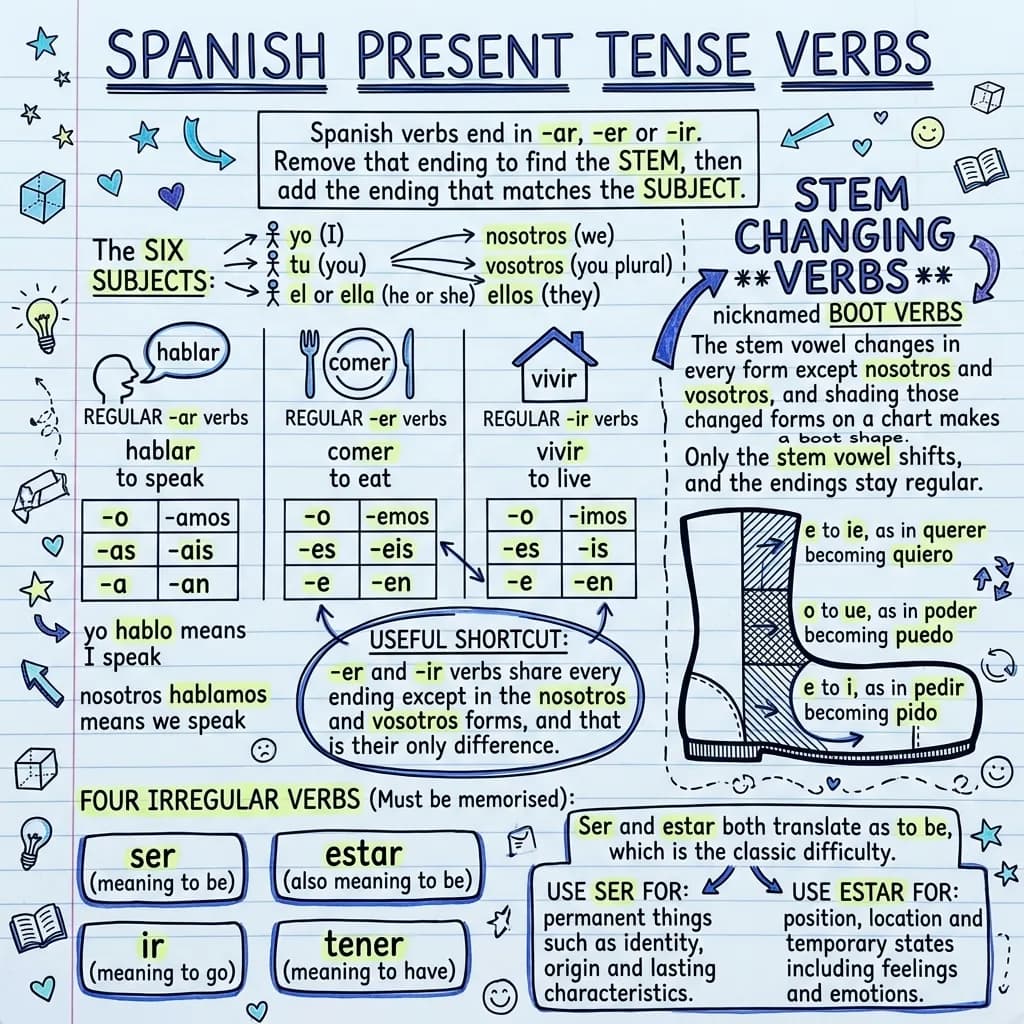
Unit 3: El presente. Spanish verbs in the infinitive end in one of three ways, -ar, -er or -ir, and to conjugate a regular verb you remove those last two letters to leave the stem and then add the ending that matches the subject. The six subjects are yo, tu, el or ella or usted, nosotros, vosotros, and ellos or ellas or ustedes. For -ar verbs such as hablar the endings are -o, -as, -a, -amos, -ais, -an. For -er verbs such as comer the endings are -o, -es, -e, -emos, -eis, -en. For -ir verbs such as vivir the endings are -o, -es, -e, -imos, -is, -en, so note that -er and -ir verbs share every form except nosotros and vosotros, which is worth remembering because it halves the work. Some verbs are stem changing and are often called boot verbs because when the six forms are written in a grid the changing forms make the shape of a boot, since the nosotros and vosotros forms keep the original stem while the other four change; the three patterns are e to ie as in querer which becomes quiero, o to ue as in poder which becomes puedo, and e to i as in pedir which becomes pido, and the endings themselves stay completely regular so only the vowel inside the stem changes. Four very common verbs are irregular and must be learned by heart: ser (soy, eres, es, somos, sois, son), estar (estoy, estas, esta, estamos, estais, estan), ir (voy, vas, va, vamos, vais, van) and tener (tengo, tienes, tiene, tenemos, teneis, tienen). Ser and estar both translate as to be in English which causes constant errors. Ser is used for permanent identity, origin, nationality, profession, and lasting characteristics such as personality; estar is used for position, location, and temporary states and conditions including feelings and health. Compare soy aburrido meaning I am a boring person with estoy aburrido meaning I am bored right now.
The flashcards from the same notes
Exports as Anki CSV, printable PDF, or plain text.
What are the six present tense endings for regular -ar verbs?
o, as, a, amos, ais, an. Example: hablo, hablas, habla, hablamos, hablais, hablan.
In which two forms do -er and -ir verb endings differ?
Only nosotros and vosotros: -emos and -eis for -er verbs, -imos and -is for -ir verbs. Every other form is identical.
Why are stem changing verbs called boot verbs?
Written in a six form grid, the four forms that change outline a boot, because nosotros and vosotros keep the original stem.
Name the three stem changing patterns with one example each.
e to ie (querer, quiero), o to ue (poder, puedo), and e to i (pedir, pido). The endings stay regular.
Conjugate ser in the present tense.
Soy, eres, es, somos, sois, son.
When do you use estar rather than ser?
For position, location and temporary states including feelings and health. Ser is for permanent identity, origin and lasting characteristics.
Make a deck from your own notes with the AI flashcard generator.
What's in this visual
Present tense conjugation is the gateway to everything else in Spanish, and it is usually taught as tables to copy out. The trouble is that tables hide the patterns: the endings repeat, the stem changers follow a shape, and only four verbs really need brute memorisation. The visual above surfaces those patterns, and the deck tests the forms that trip learners up. Here is the full breakdown.
Stem plus ending: the method behind every regular verb
Every Spanish infinitive ends in -ar, -er or -ir. Conjugating a regular verb is a two step move: drop those two letters to get the stem, then add the ending that matches your subject. Hablar becomes habl plus the ending, comer becomes com plus the ending, vivir becomes viv plus the ending. Once that method is automatic, thousands of verbs become available at once, because the vast majority of Spanish verbs are regular and follow it exactly.
The six subject pronouns and the three ending sets
The six subjects are yo, tu, el / ella / usted, nosotros, vosotros and ellos / ellas / ustedes. Their endings are: for -ar verbs, o, as, a, amos, ais, an; for -er verbs, o, es, e, emos, eis, en; for -ir verbs, o, es, e, imos, is, en. The shortcut worth writing on your hand is that -er and -ir verbs differ only in the nosotros and vosotros forms. Learn one set properly and you have effectively learned two, which is why the chart colour codes the matching rows rather than printing three separate tables.
Boot verbs: stem changers that keep regular endings
Some verbs change their stem vowel when it is stressed. Write the six forms in a grid and the four changing forms outline a boot, because nosotros and vosotros keep the original stem. There are three patterns: e to ie (querer becomes quiero), o to ue (poder becomes puedo) and e to i (pedir becomes pido). The crucial point students miss is that the endings stay completely regular. Only the vowel inside the stem moves, so a boot verb is a regular verb wearing a small disguise.
The four irregulars and the ser versus estar problem
Four high frequency verbs simply have to be learned: ser (soy, eres, es, somos, sois, son), estar (estoy, estas, esta, estamos, estais, estan), ir (voy, vas, va, vamos, vais, van) and tener (tengo, tienes, tiene, tenemos, teneis, tienen). Ser and estar both mean to be, which is where most errors live. Ser covers permanent identity: origin, nationality, profession and lasting characteristics. Estar covers position, location and temporary states including feelings and health. Soy aburrido says you are a boring person; estoy aburrido says you are bored at this moment.
Why patterns belong on a chart and forms belong on cards
The structure of the system (three ending sets, a boot shape, one comparison rule) is visual, and seeing it once beats copying tables ten times. The individual forms, though, only stick through active recall, which is what a deck is for. The flashcards under this visual were generated from the same source notes in the same pass, so the cards use the same example verbs as the chart. You can build both from your own vocabulary lists with the AI flashcard generator.
For teachers
The problem
- Copying conjugation tables fills the lesson without showing students the underlying pattern.
- Learners treat boot verbs as fully irregular and stop trusting the endings.
- Ser and estar errors persist for years because the rule is taught as a list of exceptions.
How to use it in class
- Project the chart and highlight the two forms where -er and -ir differ.
- Draw the boot shape live and let the class predict which forms change.
- Run the deck as a rapid fire warm up at the start of each lesson.
- Give the page out as the present tense reference sheet for the term.
For students & visual learners
The problem
- Three tables of endings look identical and blur together the night before a test.
- You know a verb is a boot verb but not which four forms actually change.
- You pick ser or estar by instinct and get it wrong half the time.
How to use it to study
- Learn the -er set once and get the -ir set nearly free.
- Use the boot shape to recall which forms keep the original stem.
- Test yourself on the six cards before speaking practice.
- Pin the ser versus estar panel where you write, so the rule is always in view.
Make your own visual like this
Paste your notes or upload a PDF
Drop in your own class notes, a textbook chapter or a PDF. Any subject, any language.
Pick a visual style
Choose a sketchnote, infographic or diagram style that fits the topic.
Generate and download
In about 15–40 seconds you get a one-page visual you can print, share or revise from.
Frequently asked questions
How do you conjugate a regular Spanish verb in the present tense?
Remove the -ar, -er or -ir from the infinitive to leave the stem, then add the ending for your subject: o, as, a, amos, ais, an for -ar verbs; o, es, e, emos, eis, en for -er verbs; o, es, e, imos, is, en for -ir verbs.
What is the difference between ser and estar?
Ser expresses permanent identity: origin, nationality, profession and lasting characteristics. Estar expresses position, location and temporary states including feelings. Compare soy aburrido (I am a boring person) with estoy aburrido (I am bored right now).
Can I make Spanish flashcards from my own class notes?
Yes. Paste your vocabulary or upload a worksheet and VisualNote AI produces a visual summary and a matching deck from the same source. Try the AI flashcard generator.
More visual examples
Turn your notes into a visual
Paste any notes or upload a PDF and get a sketchnote-style visual in under a minute.