
Classical vs Operant Conditioning: Visual Notes & Flashcards
Two chapters of learning theory, full of near-identical terms that students mix up under exam pressure, rebuilt as a single side-by-side visual with a matching flashcard deck you can test yourself on.
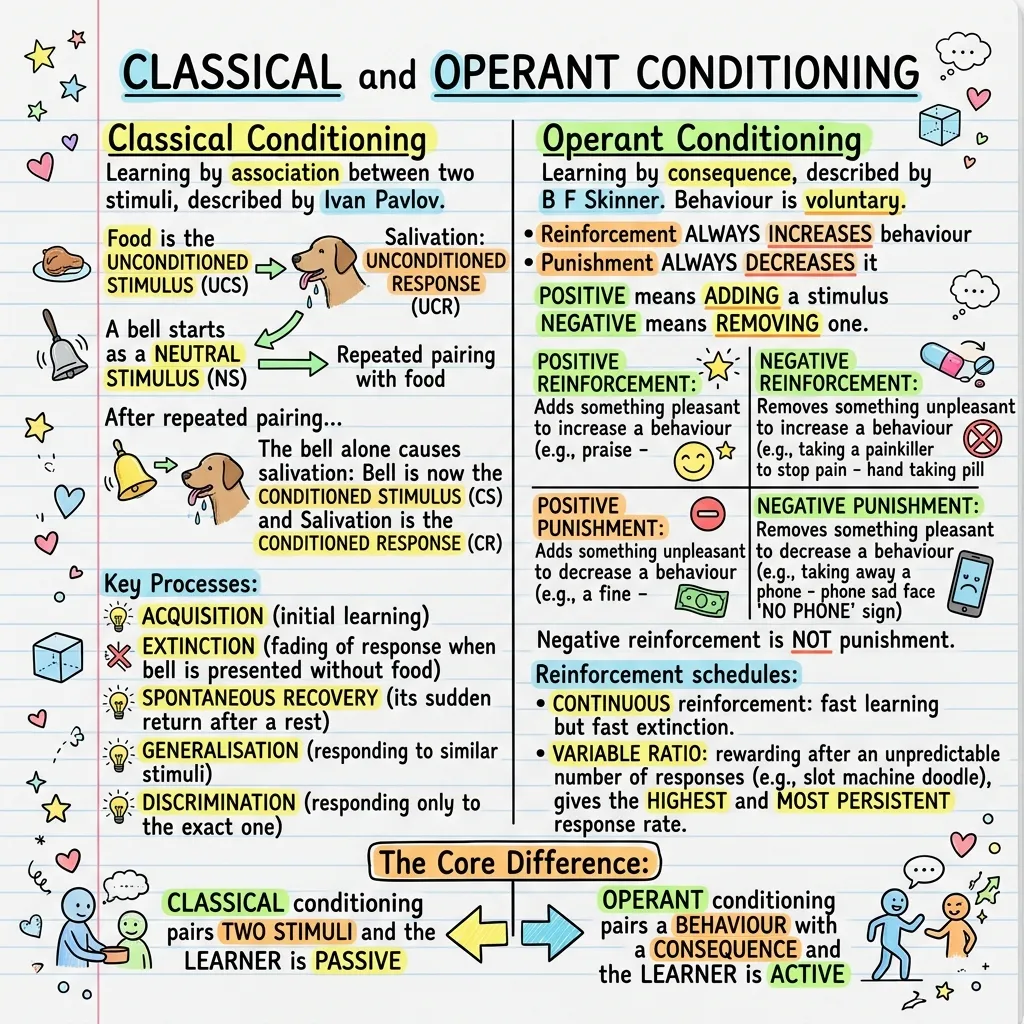
Unit 6: Learning. 6.1 Classical conditioning. Learning by association, first demonstrated by Ivan Pavlov with dogs. An unconditioned stimulus (UCS), food, produces an unconditioned response (UCR), salivation, without any learning. A neutral stimulus (NS), a bell, produces no relevant response. When the NS is repeatedly paired with the UCS it becomes a conditioned stimulus (CS) and now produces a conditioned response (CR), salivation to the bell alone. Key processes: acquisition, the stage where the association is formed; extinction, the weakening of the CR when the CS is presented repeatedly without the UCS; spontaneous recovery, the sudden reappearance of an extinguished CR after a rest period; generalisation, responding to stimuli similar to the CS; discrimination, responding only to the specific CS. 6.2 Operant conditioning. Learning by consequence, associated with B.F. Skinner and the Skinner box, building on Thorndike's law of effect. Behaviour followed by a pleasant consequence is more likely to be repeated. Positive reinforcement adds a desirable stimulus. Negative reinforcement removes an unpleasant stimulus. Positive punishment adds an unpleasant stimulus. Negative punishment removes a desirable stimulus. Reinforcement increases the frequency of behaviour, punishment decreases it. Schedules of reinforcement: continuous, fixed ratio, variable ratio, fixed interval and variable interval; variable ratio produces the highest and most persistent rate of responding and is most resistant to extinction. 6.3 Comparison. Classical conditioning associates two stimuli and the learner is passive; operant conditioning associates a behaviour with its consequence and the learner is active.
The flashcards from the same notes
Exports as Anki CSV, printable PDF, or plain text.
In Pavlov's experiment, what is the conditioned stimulus?
The bell. It starts as a neutral stimulus and becomes a conditioned stimulus only after repeated pairing with food.
What is spontaneous recovery?
The sudden reappearance of an extinguished conditioned response after a rest period, without any new pairing.
What is the difference between generalisation and discrimination?
Generalisation is responding to stimuli similar to the conditioned stimulus; discrimination is responding only to the specific conditioned stimulus.
How does negative reinforcement differ from punishment?
Negative reinforcement removes something unpleasant and increases the behaviour; punishment decreases the behaviour.
Which schedule of reinforcement produces the most persistent responding?
Variable ratio, because reinforcement arrives after an unpredictable number of responses, making it highly resistant to extinction.
What is the core difference between classical and operant conditioning?
Classical conditioning associates two stimuli with a passive learner; operant conditioning associates a behaviour with its consequence and the learner is active.
Make a deck from your own notes with the AI flashcard generator.
What's in this visual
Classical and operant conditioning are the two pillars of the learning topic, and they are also the two topics students most often blur together in the exam hall. The vocabulary overlaps, the abbreviations look alike, and negative reinforcement gets confused with punishment almost every year. The visual above puts the two theories side by side so the differences are structural rather than verbal, and the flashcard deck below drills the definitions that markers actually want. Here is the full walkthrough.
Classical conditioning: learning by association
Classical conditioning was demonstrated by Ivan Pavlov, who noticed that his laboratory dogs salivated before food arrived. The chain has four labelled parts. The unconditioned stimulus (UCS) is food, which naturally triggers the unconditioned response (UCR), salivation, with no learning involved. A neutral stimulus (NS) such as a bell produces nothing relevant at first. Pair the bell with the food often enough and the bell becomes the conditioned stimulus (CS), now producing salivation as a conditioned response (CR). The single most useful thing to remember is that the physical response never changes; only its trigger does.
The five processes examiners ask about
Once the association exists, five processes describe what happens to it. Acquisition is the stage where the pairing builds the association. Extinction is the fading of the CR when the CS keeps appearing without the UCS. Spontaneous recovery is the extinguished response returning unprompted after a rest interval, which proves the association was suppressed rather than deleted. Generalisation is responding to stimuli that resemble the CS, so a dog conditioned to one bell also salivates to a similar chime. Discrimination is the opposite: the response narrows to one specific stimulus. Laid out as a timeline in the visual, these five stop being a vocabulary list and become a sequence.
Operant conditioning and the four-way grid
Operant conditioning, associated with B.F. Skinner and his Skinner box, is learning by consequence. Behaviour that produces a good outcome gets repeated, behaviour that produces a bad one does not. The grid in the visual is the fastest way to lock this in, because it separates two independent questions. Reinforcement always increases a behaviour and punishment always decreases it. Positive means something is added and negative means something is removed. That gives four cells: positive reinforcement (praise for homework), negative reinforcement (the seatbelt alarm stops when you buckle up), positive punishment (a detention), and negative punishment (losing screen time). Negative reinforcement is not punishment, and drawing it inside a grid is what finally makes that stick.
Schedules of reinforcement
How often reinforcement arrives changes how durable the behaviour is. Continuous reinforcement builds a behaviour fastest but it also extinguishes fastest. Fixed ratio rewards every set number of responses; fixed interval rewards the first response after a set time, producing a pause straight after each reward. Variable interval gives steady, moderate responding. Variable ratio, where reinforcement arrives after an unpredictable number of responses, produces the highest and most persistent rate of responding and the strongest resistance to extinction, which is exactly why slot machines and social media feeds work the way they do. That one comparison is worth a mark on its own in most papers.
The comparison, and how to revise it
The distinction that carries the essay question is this: classical conditioning pairs two stimuli and the learner is passive, while operant conditioning pairs a behaviour with its consequence and the learner is active. Everything else follows from that one line. The deck under the visual was generated from the same source notes as the diagram, so the cards use the same wording and the same grid you already looked at, which means recall practice reinforces the layout instead of competing with it. You can build a matching pair for any chapter with the AI flashcard generator.
For teachers
The problem
- Negative reinforcement and punishment get confused every single year, no matter how clearly you explain them in class.
- Classical and operant conditioning are taught in separate lessons, so students never build the comparison the exam question asks for.
- Drawing a clean reinforcement grid and a Pavlov sequence on the board eats fifteen minutes of a fifty-minute lesson.
How to use it in class
- Project the four-way grid and have the class sort real classroom examples into the correct cell.
- Hand out the visual as a one-page revision sheet before the learning unit assessment.
- Run the flashcard deck as a five-minute retrieval starter at the top of the next lesson.
- Blank the UCS, UCR, CS and CR labels and use the empty diagram as a low-stakes quiz.
For students & visual learners
The problem
- UCS, UCR, NS, CS and CR are five abbreviations that look almost identical on a revision card.
- You know negative reinforcement is not punishment, but you cannot explain why under time pressure.
- The comparison question asks for differences and your notes only cover the two theories separately.
How to use it to study
- Learn the reinforcement grid as a picture so you can redraw it in the margin of the exam paper.
- Use the Pavlov timeline to recall acquisition, extinction, spontaneous recovery, generalisation and discrimination in order.
- Test yourself on the deck, then check any card you miss against the matching part of the visual.
- Keep the side-by-side layout open when you plan a compare-and-contrast essay.
Make your own visual like this
Paste your notes or upload a PDF
Drop in your own class notes, a textbook chapter or a PDF. Any subject, any language.
Pick a visual style
Choose a sketchnote, infographic or diagram style that fits the topic.
Generate and download
In about 15–40 seconds you get a one-page visual you can print, share or revise from.
Frequently asked questions
Is negative reinforcement the same as punishment?
No. Reinforcement always increases the frequency of a behaviour and punishment always decreases it. Negative reinforcement increases behaviour by removing something unpleasant, such as an alarm that stops once you fasten your seatbelt.
What is the quickest way to tell classical and operant conditioning apart?
Ask what is being paired. If two stimuli are paired and the learner simply reacts, it is classical conditioning. If a behaviour is paired with a consequence and the learner has to do something first, it is operant conditioning.
Can I turn my own psychology notes into a visual and a deck like this?
Yes. Paste your class notes or upload the chapter PDF and VisualNote AI builds the visual, then generates a matching deck from the same source. Try the AI flashcard generator.
More visual examples
Turn your notes into a visual
Paste any notes or upload a PDF and get a sketchnote-style visual in under a minute.