
Models of Memory: Visual Notes & Psychology Flashcards
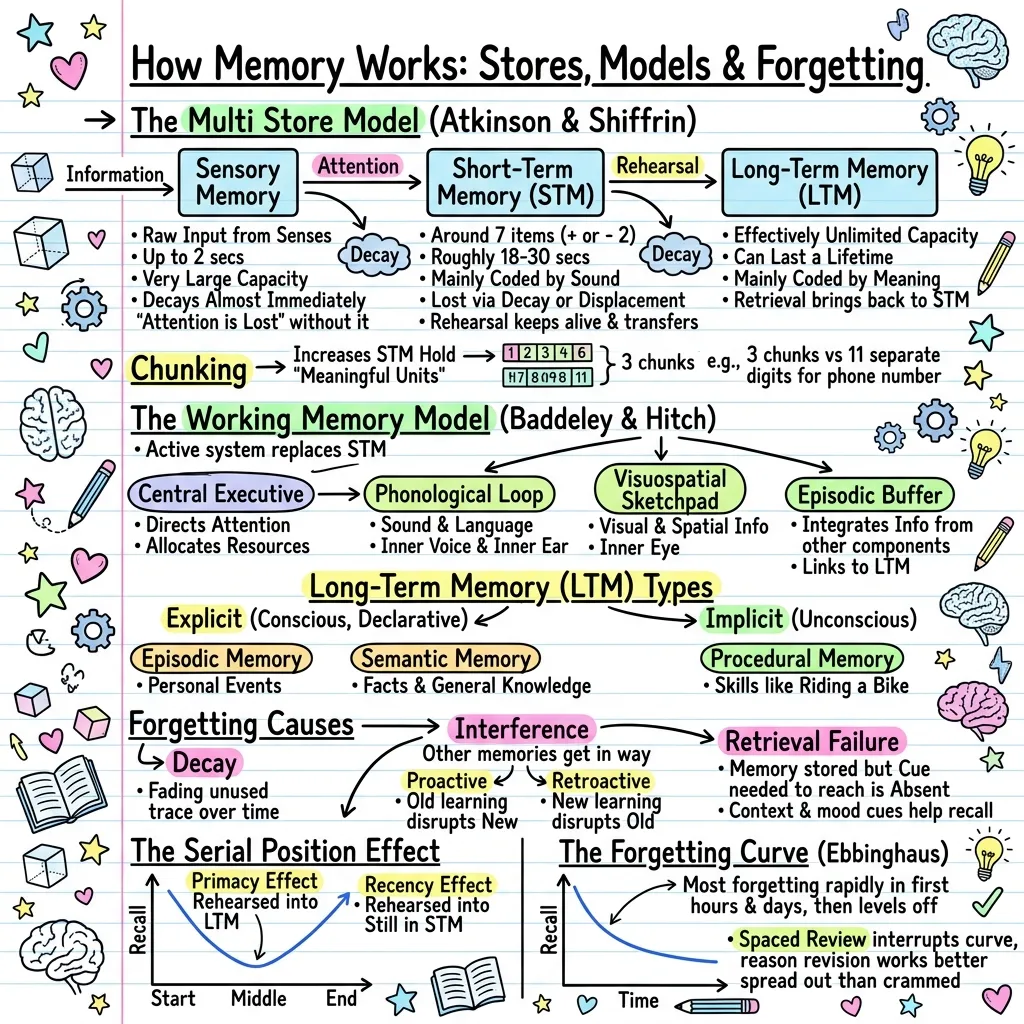
The whole memory chapter, from Atkinson and Shiffrin through Baddeley and Hitch to the forgetting curve, compressed into one diagram with a matching flashcard deck built from the same notes.
Chapter 4: Memory. 4.1 The multi store model. Proposed by Atkinson and Shiffrin (1968). Information enters sensory memory, which has a very large capacity, a duration of under two seconds and is coded in the form of the sense it arrived through. Attention transfers information to short term memory, capacity about seven items plus or minus two, duration around eighteen to thirty seconds, coded mainly acoustically. Rehearsal maintains it and transfers it to long term memory, which has a potentially unlimited capacity, a potentially lifelong duration and is coded mainly semantically. Chunking increases the effective capacity of short term memory by grouping items into larger meaningful units. 4.2 The working memory model. Proposed by Baddeley and Hitch (1974) to replace the single short term store. The central executive directs attention and allocates resources but has limited capacity. The phonological loop handles auditory and verbal information and is divided into the phonological store and the articulatory rehearsal process. The visuospatial sketchpad handles visual and spatial information. The episodic buffer, added in 2000, is a temporary store that integrates information from the other components and links to long term memory. 4.3 Types of long term memory. Episodic memory stores personal events with time and place; semantic memory stores facts, concepts and meanings; procedural memory stores skills and actions and is largely unconscious. 4.4 Forgetting. Trace decay, where the memory trace fades over time. Interference, where similar memories compete: proactive interference is old information disrupting new, retroactive interference is new information disrupting old. Retrieval failure, where the memory is stored but cues are absent. 4.5 Effects. The serial position effect: items at the start of a list are recalled well due to the primacy effect and items at the end due to the recency effect, while the middle is recalled poorly. The Ebbinghaus forgetting curve shows that most forgetting happens within the first hours and days after learning and that review spaced over time slows the curve far more effectively than a single long revision session.
The flashcards from the same notes
Exports as Anki CSV, printable PDF, or plain text.
What are the capacity, duration and coding of short term memory?
About seven items plus or minus two, roughly eighteen to thirty seconds, coded mainly acoustically.
Which component of the working memory model was added in 2000, and what does it do?
The episodic buffer. It temporarily integrates information from the other components and links working memory to long term memory.
What does the visuospatial sketchpad handle?
Visual and spatial information: what things look like and where they are located.
Which type of long term memory stores skills you perform without conscious recall?
Procedural memory, such as riding a bike or touch typing.
What is retroactive interference?
When newly learned information disrupts the recall of information learned earlier.
Why is the middle of a list recalled worst in the serial position effect?
Middle items miss both effects: they get too little rehearsal for the primacy effect and are no longer in short term memory for the recency effect.
Make a deck from your own notes with the AI flashcard generator.
What's in this visual
Memory is the chapter with the most named models, the most numbers to remember and the most opportunity to lose easy marks by mixing up capacity with duration. The visual above stacks the two models on top of the evidence about forgetting, so you can see how a piece of information travels from your eyes to long term storage and where it tends to fall out along the way. Here is what each part of the diagram is doing.
The multi store model and its three numbers
Atkinson and Shiffrin describe memory as a pipeline of three stores, each defined by capacity, duration and coding. Sensory memory holds a very large amount of raw sensory information for under two seconds, coded in the sense it arrived through. Attention moves what matters into short term memory: about seven items plus or minus two, held for roughly eighteen to thirty seconds, coded mainly acoustically. Rehearsal transfers it to long term memory, which is potentially unlimited in capacity, potentially lifelong in duration and coded mainly semantically. Those three rows of three values are the single most examinable table in the chapter, which is exactly why they belong in a grid rather than in prose.
Chunking, and why seven is not really seven
Short term capacity is measured in items, not in letters, and that distinction is the whole point of chunking. The eleven characters in a phone number exceed the span, but grouped into three or four meaningful blocks they fit comfortably. Chunking does not expand the store; it changes what counts as one unit inside it. The visual shows a long digit string breaking into blocks, which makes the idea obvious in a way that a definition never quite does.
The working memory model
Baddeley and Hitch replaced the single short term store with a system of four components, because people can clearly do a visual task and a verbal task at the same time without much interference. The central executive directs attention and allocates resources, and it has limited capacity of its own. The phonological loop handles auditory and verbal material and splits into a phonological store and an articulatory rehearsal process. The visuospatial sketchpad handles what things look like and where they are. The episodic buffer, added in 2000, is a temporary store that binds information from the other components together and links the whole system to long term memory. Drawn as one hub with three branches, the model is far easier to reproduce under exam conditions than four separate paragraphs.
Types of long term memory and why we forget
Long term memory is not one thing. Episodic memory stores personal events tagged with time and place, semantic memory stores facts and meanings, and procedural memory stores skills you can perform without being able to describe them. Forgetting has three standard explanations: decay, where the trace fades; interference, where similar memories compete, with proactive interference meaning old material disrupts new and retroactive meaning new material disrupts old; and retrieval failure, where the memory is intact but the cue is missing. The order of the words is the trick: pro comes before, retro comes after.
The forgetting curve, and how to use it this week
The serial position effect shows that the start of a list is recalled well (the primacy effect, because those items got rehearsed into long term memory) and the end is recalled well too (the recency effect, because those items are still in short term memory), while the middle sags. The Ebbinghaus forgetting curve makes the practical point: most forgetting happens in the hours and days right after learning, so short reviews spread across a week beat one long cramming session. That is also why the deck below was generated from the same source notes as the diagram: you read the visual once, then space the recall practice out over several days. The same pairing works for any chapter, and you can read how other people use it on the page for flashcards for students and teachers.
For teachers
The problem
- Capacity, duration and coding for three stores is nine facts that students consistently scramble in the exam.
- The working memory model is usually taught as a list of four components, so students never see it as a system.
- You know spaced review works, but you have no lightweight way to build the recall practice into lesson time.
How to use it in class
- Display the store comparison grid and quiz the class column by column.
- Use the working memory diagram to run a dual-task demonstration, then map what happened onto each component.
- Set the deck as a five-minute retrieval starter across three lessons instead of one long revision session.
- Blank the episodic, semantic and procedural labels and use the diagram as an exit ticket.
For students & visual learners
The problem
- You remember that short term memory holds seven items but not for how long or in what code.
- Proactive and retroactive interference sound interchangeable when you are under time pressure.
- You revise the whole memory chapter the night before and most of it is gone by morning.
How to use it to study
- Redraw the three-store pipeline from memory as a quick self-test before the exam.
- Learn the working memory model as one hub with three branches rather than four separate definitions.
- Run the deck for a few minutes on three separate days so the forgetting curve works for you.
- Use the serial position curve to explain why you should not always revise topics in the same order.
Make your own visual like this
Paste your notes or upload a PDF
Drop in your own class notes, a textbook chapter or a PDF. Any subject, any language.
Pick a visual style
Choose a sketchnote, infographic or diagram style that fits the topic.
Generate and download
In about 15–40 seconds you get a one-page visual you can print, share or revise from.
Frequently asked questions
What is the difference between the multi store model and the working memory model?
The multi store model treats short term memory as a single passive store in a three-stage pipeline. The working memory model replaces that store with an active system of four components, which explains why you can hold a picture and a sentence in mind at the same time.
What is the difference between proactive and retroactive interference?
Proactive interference is old information disrupting new learning; retroactive interference is new information disrupting an older memory. The prefix tells you which direction the disruption travels.
Why does spaced review beat cramming?
The Ebbinghaus forgetting curve is steepest in the hours right after learning, so several short reviews spread over days interrupt the drop far more effectively than one long session. A deck makes those short reviews easy to run: see flashcards for students and teachers.
More visual examples
Turn your notes into a visual
Paste any notes or upload a PDF and get a sketchnote-style visual in under a minute.