
Causes of World War One: Visual Notes and Flashcards
A dense chapter of dates, alliances and rivalries, rebuilt as one page where the forty years of long term causes sit above the six weeks that lit them, plus a deck for the names and dates.
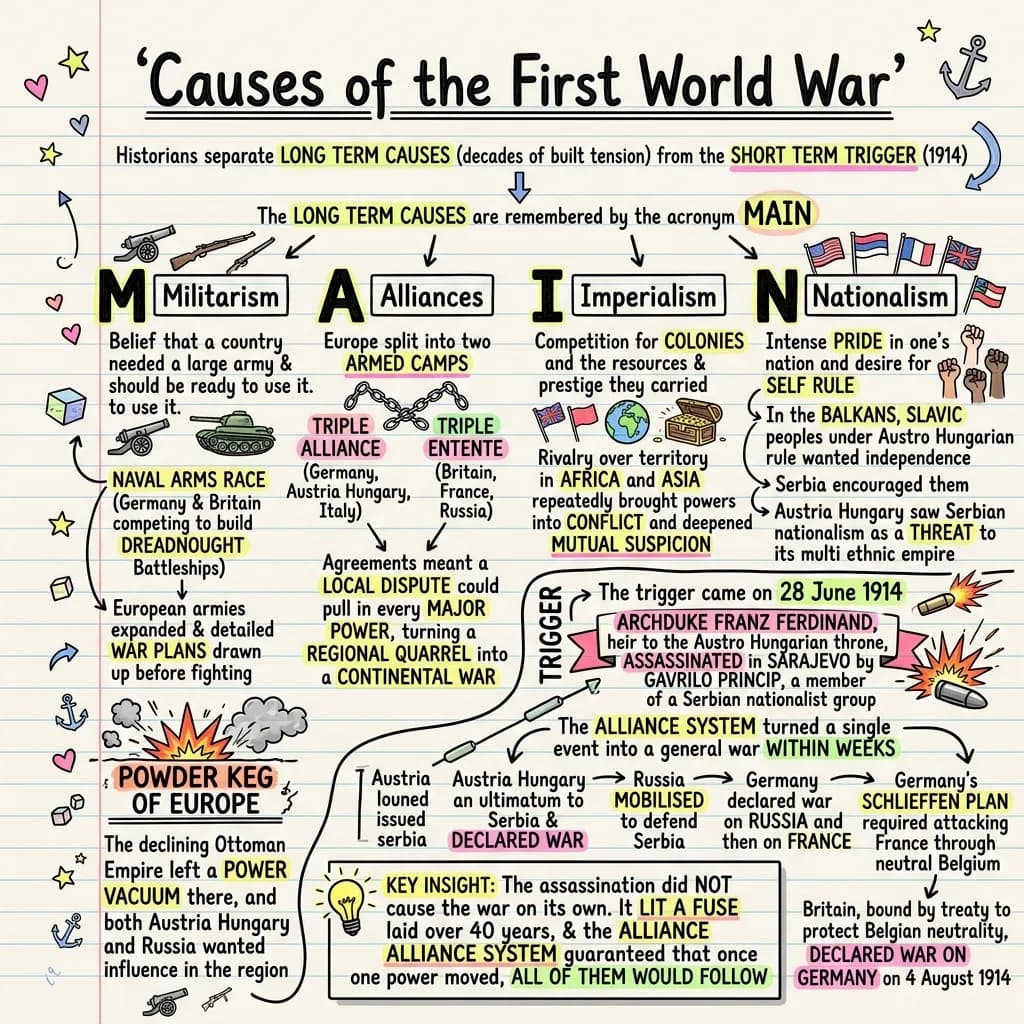
Chapter 1: The outbreak of the First World War. Historians usually divide the causes into long term causes and the immediate trigger, and the long term causes are remembered with the acronym MAIN. Militarism means the glorification of military power and the arms race, most visibly the Anglo-German naval rivalry in which Britain launched HMS Dreadnought in 1906 and Germany raced to match the new class of battleship while both powers expanded their standing armies and built detailed war plans. Alliances divided Europe into two armed camps, the Triple Alliance of Germany, Austria-Hungary and Italy, and the Triple Entente of Britain, France and Russia, which meant that any local dispute risked pulling in all the great powers. Imperialism refers to the competition for colonies and raw materials in Africa and Asia, which produced repeated crises such as those in Morocco and left Germany resentful of the older empires. Nationalism means intense national pride and, more dangerously in this period, the desire of subject peoples for independence, especially the Slavic nationalist movements in the Balkans that looked to Serbia and were supported by Russia. The Balkans were called the powder keg of Europe because the decline of the Ottoman Empire left a power vacuum that Austria-Hungary and Russia both tried to fill, and Austria-Hungary's annexation of Bosnia in 1908 enraged Serbia. The immediate trigger came on 28 June 1914 when Archduke Franz Ferdinand, heir to the Austro-Hungarian throne, was assassinated in Sarajevo by Gavrilo Princip, a member of the Black Hand. Austria-Hungary issued an ultimatum to Serbia and declared war; Russia mobilised to support Serbia; Germany declared war on Russia and then on France, and put the Schlieffen Plan into action by invading neutral Belgium in order to reach Paris quickly; Britain, bound by the 1839 treaty guaranteeing Belgian neutrality, declared war on Germany on 4 August 1914. The key point for essays is that the assassination did not cause the war on its own but lit a fuse that had been laid over the previous forty years.
The flashcards from the same notes
Exports as Anki CSV, printable PDF, or plain text.
What does the acronym MAIN stand for?
Militarism, Alliances, Imperialism and Nationalism: the four long term causes of the First World War.
Which two alliance blocs divided Europe before 1914?
The Triple Alliance (Germany, Austria-Hungary, Italy) and the Triple Entente (Britain, France, Russia).
Why were the Balkans called the powder keg of Europe?
The declining Ottoman Empire left a power vacuum that Austria-Hungary and Russia both tried to fill, while Slavic nationalist movements pushed for independence.
Who was assassinated on 28 June 1914, and by whom?
Archduke Franz Ferdinand, heir to the Austro-Hungarian throne, shot in Sarajevo by Gavrilo Princip.
What brought Britain into the war on 4 August 1914?
Germany's Schlieffen Plan sent its army through neutral Belgium, and Britain was bound by the 1839 treaty guaranteeing Belgian neutrality.
Why is the assassination called a trigger rather than a cause?
It set off a war that the forty years of militarism, alliances, imperialism and nationalism had already made possible. Without those, it would have stayed a diplomatic incident.
Make a deck from your own notes with the AI flashcard generator.
What's in this visual
Every exam board asks some version of the same question: what caused the First World War? The answer has two layers, four decades of build up and six weeks of collapse, and plain notes present them as one undifferentiated wall of dates. The visual above separates them, and the deck tests the names and dates that essays live or die on. Here is the full breakdown.
MAIN: the four long term causes
Militarism was the glorification of military strength and the arms race behind it, above all the Anglo-German naval rivalry set off when Britain launched HMS Dreadnought in 1906 and Germany built to match it. Alliances split Europe into two armed camps, the Triple Alliance (Germany, Austria-Hungary, Italy) and the Triple Entente (Britain, France, Russia), so a local quarrel could summon every great power. Imperialism was the scramble for colonies and raw materials that produced repeated crises and left Germany resentful of older empires. Nationalism was national pride turned volatile, above all the Slavic independence movements in the Balkans that looked to Serbia and to Russian backing.
The Balkans: the powder keg of Europe
The Balkans earned their nickname because a power vacuum opened there as the Ottoman Empire declined, and both Austria-Hungary and Russia moved to fill it. Austria-Hungary's annexation of Bosnia in 1908 enraged Serbia, which saw itself as the natural home of the region's Slavic peoples, and Russia positioned itself as the protector of Slavic interests. So the region combined ethnic nationalism, imperial ambition and great power rivalry in one small space. Mark it on a map in your notes: examiners reward answers that place the trigger geographically rather than treating Sarajevo as a random location.
28 June 1914: the trigger in Sarajevo
On 28 June 1914, Archduke Franz Ferdinand, heir to the Austro-Hungarian throne, was assassinated in Sarajevo by Gavrilo Princip, a Bosnian Serb linked to the Black Hand. Austria-Hungary used the killing to confront Serbia, issuing an ultimatum whose terms were designed to be refused, and then declaring war. This is the single most quoted date in the topic, and it is also the one most often misused: the assassination is the trigger, not the cause, and an answer that stops here has answered only half the question.
The chain reaction to 4 August 1914
The alliance system then did exactly what it was built to do. Russia mobilised to defend Serbia; Germany declared war on Russia and then on France; Germany executed the Schlieffen Plan, which required a fast strike on Paris through neutral Belgium; and Britain, bound by the 1839 treaty guaranteeing Belgian neutrality, declared war on Germany on 4 August 1914. Six weeks turned a regional assassination into a continental war. Laying the sequence out as a chain on the page shows the mechanism, which is far more useful in an essay than a memorised list of declarations.
The insight that separates a good answer from a top one
The key judgement is that the assassination lit a fuse that had been laid over forty years. Without militarism, the alliance blocs, imperial rivalry and Balkan nationalism, a shooting in Sarajevo would have been a diplomatic incident. Say that explicitly and the four MAIN causes stop being a list and become an argument. The flashcard deck under this visual was generated from the same source notes in the same pass, so the cards test the exact dates and names the page labels. See how the pairing works in flashcards for students and teachers.
For teachers
The problem
- Students recite MAIN as four words without being able to explain any of them.
- The July 1914 sequence gets taught as a list of declarations that nobody can reconstruct.
- Essays stop at the assassination and never reach the long term causes.
How to use it in class
- Project the page and unpack one MAIN cause per ten minutes of the lesson.
- Blank the chain reaction and have students order the declarations themselves.
- Use the deck as a starter quiz on dates and names before essay practice.
- Print it as the revision sheet for the outbreak of war unit.
For students & visual learners
The problem
- You remember the acronym MAIN but freeze when asked what imperialism meant here.
- The dates of July and August 1914 run together into one blur.
- Your essays describe the assassination and never explain why it mattered so much.
How to use it to study
- Revise the whole cause chapter from one page in exam week.
- Follow the chain reaction visually so the sequence of declarations sticks.
- Drill the six cards until the dates and names are automatic.
- Use the fuse framing as the opening line of your essay plan.
Make your own visual like this
Paste your notes or upload a PDF
Drop in your own class notes, a textbook chapter or a PDF. Any subject, any language.
Pick a visual style
Choose a sketchnote, infographic or diagram style that fits the topic.
Generate and download
In about 15–40 seconds you get a one-page visual you can print, share or revise from.
Frequently asked questions
What were the four long term causes of World War One?
Militarism (the arms race, especially the Anglo-German naval rivalry), alliances (the Triple Alliance and the Triple Entente), imperialism (competition for colonies) and nationalism (above all Slavic independence movements in the Balkans). They are remembered as MAIN.
How did the assassination of Franz Ferdinand lead to a world war?
Austria-Hungary confronted Serbia, Russia mobilised in Serbia's defence, Germany declared war on Russia and France, and Germany's Schlieffen Plan took its army through neutral Belgium, which brought Britain in on 4 August 1914.
Can I turn my history notes into a visual and flashcards?
Yes. Upload your notes or a textbook chapter and VisualNote AI builds the one page visual and the matching deck from the same source. See flashcards for students and teachers.
More visual examples
Turn your notes into a visual
Paste any notes or upload a PDF and get a sketchnote-style visual in under a minute.