
The Luxembourg Question — Visual History Notes
A tangle of 19th-century Dutch political history — king, parliament and the 1867 Luxembourg crisis — turned into a single cause-and-effect visual.
The Luxembourg Question. Situation after 1848: in 1849 William III became king of the Netherlands; he disagreed with the constitution and wanted more power, creating tension between king and parliament. Cause of the conflict in 1867: William III wanted to sell Luxembourg to France; the German Confederation protested and war threatened. Solution: Luxembourg would not be sold and remained independent. Reaction of parliament: parliament felt the king and ministers had endangered Dutch neutrality and demanded that the ministers resign. Means of power of parliament: the king was inviolable and could not be forced, but parliament could refuse money, so the ministers could not govern and had to resign. Important rule: from this a new rule emerged — a government must resign if it loses the confidence of parliament.
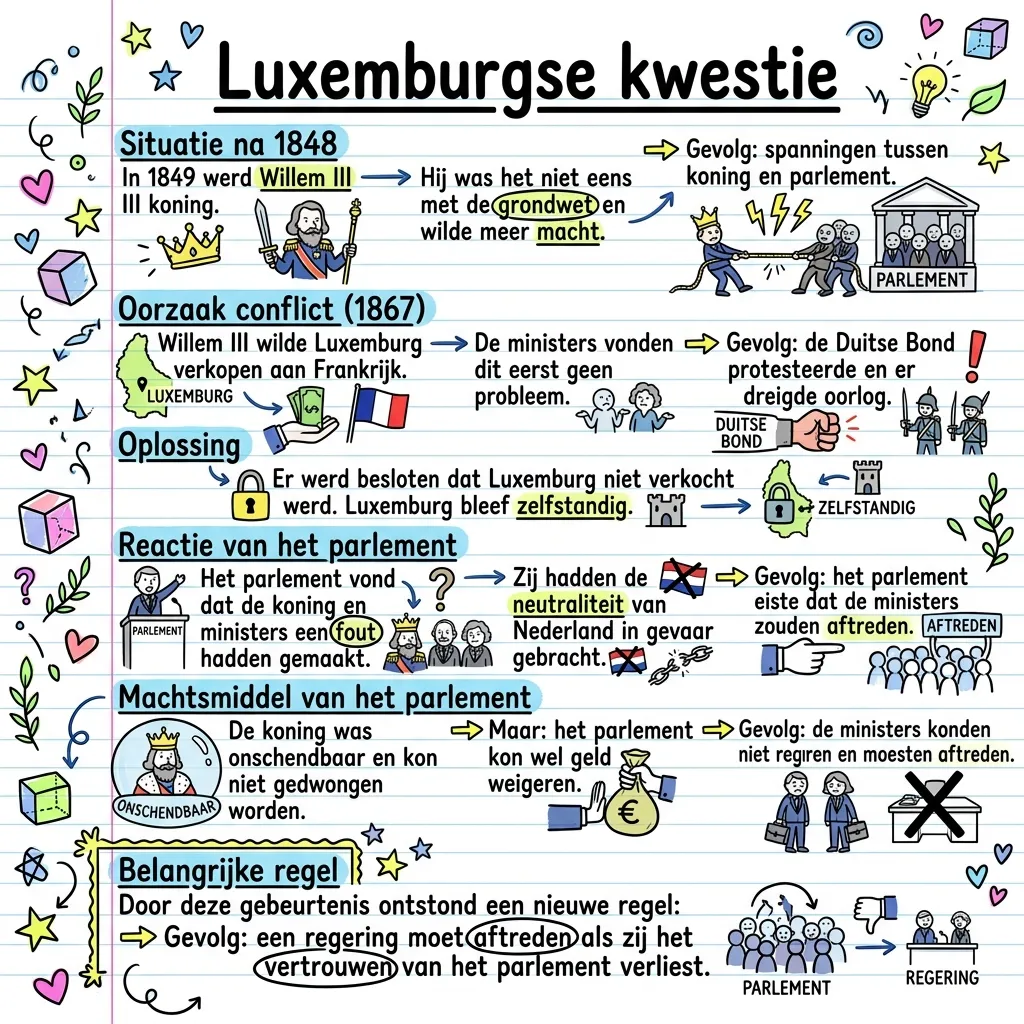
What's in this visual
The Luxembourg Question is a small story with a large consequence, and that is exactly why it is hard to revise from notes — it is a chain of cause and effect where each step only matters because of the one before it. The visual above keeps that chain intact: the tension after 1848, the 1867 crisis, parliament's response, and the constitutional rule that resulted. Here is the full breakdown.
What the Luxembourg Question was
The Luxembourg Question was an 1867 diplomatic crisis over the future of the Grand Duchy of Luxembourg, then ruled in personal union by the Dutch king William III. For Dutch history its importance is not really diplomatic but constitutional: the way the crisis was handled triggered a clash between the king and the Dutch parliament. That clash settled, in practice, who actually governs the Netherlands — and produced the principle of ministerial responsibility that still underpins Dutch parliamentary democracy today.
The conflict between king and parliament after 1848
The crisis did not appear from nowhere. The liberal constitution of 1848, drafted by Thorbecke, had shifted real power towards parliament and ministers. When William III became king in 1849 he disliked these limits and wanted to govern more directly, in the older royal style. That mismatch — a monarch who wanted personal power against a constitution that no longer granted it — created a standing tension between king and parliament. The Luxembourg affair simply gave that long-running friction a concrete event to break over.
The 1867 crisis: selling Luxembourg
In 1867 William III moved to sell Luxembourg to France, partly to raise money and resolve a personal financial interest. His ministers initially raised no objection. The plan badly misjudged the wider situation: Luxembourg sat inside the German Confederation, and Prussia, newly dominant after 1866, would not accept a French gain on its border. The Confederation protested sharply and war between France and Prussia suddenly loomed. An international conference in London defused it — Luxembourg was not sold and was declared a neutral, independent state.
How parliament won — the power of the purse
Although war was avoided, parliament held the king and ministers responsible for recklessly endangering Dutch neutrality, and demanded that the ministers resign. The constitution, however, declared the king inviolable — he could not be forced or prosecuted. Parliament could not remove the monarch, but it controlled something decisive: the budget. By refusing to approve the money the government needed, parliament made it impossible for the ministers to govern at all. With no funds and no confidence, the ministers had no choice but to resign — the power of the purse proving stronger than royal authority.
The lasting rule: ministerial responsibility
The resignation set a constitutional precedent that outlasted the crisis itself. From the Luxembourg Question emerged the rule of ministerial responsibility: a government must resign once it loses the confidence of parliament. Because the king is inviolable, it is the ministers — not the monarch — who answer for policy and who must go when parliament withdraws its support. This is the foundation of the Dutch parliamentary system, and the reason a small dispute about a tiny grand duchy still appears in every history syllabus.
Why cause-and-effect history needs a visual
Some history is a list of facts; this is not. The Luxembourg Question is a sequence where removing any link breaks the explanation — no 1848 constitution, no royal frustration; no sale plan, no protest; no protest, no parliamentary backlash; no budget power, no resignation. Written as paragraphs, those links sit end to end and are easy to recite out of order. A visual draws the arrows themselves, so cause leads visibly to effect. You revise the logic of the event, which is exactly what an essay question rewards.
For teachers
The problem
- The Luxembourg Question only makes sense as a causal chain, yet a textbook presents it as four or five separate paragraphs.
- Students can name the 1867 crisis but cannot explain why a foreign-policy blunder ended in a domestic constitutional rule.
- The leap from 'parliament was angry' to 'parliament refused the budget' is the crux of the topic and the easiest step to skip.
How to use it in class
- Open the lesson with the visual and have students predict each next link before you reveal it.
- Walk the class along the arrows from the 1848 constitution to ministerial responsibility as one connected story.
- Use it to model essay structure — each box is a paragraph, each arrow a 'this led to' sentence.
- Cover the final box and ask students to deduce the constitutional rule from the crisis themselves.
For students & visual learners
The problem
- You can recall the events of 1867 but lose marks because you cannot link them into a single argument.
- It is unclear why parliament — unable to touch an inviolable king — still managed to force the ministers out.
- The phrase 'ministerial responsibility' sounds abstract until you see the crisis that actually produced it.
How to use it to study
- Trace the arrows from cause to effect so the whole event becomes one story you can retell.
- Use the budget step to explain, in your own words, how parliament beat an untouchable monarch.
- Turn each box into an essay paragraph when you practise the exam question.
- Quiz yourself by hiding the consequences and rebuilding the chain from the causes.
Make your own visual like this
Paste your notes or upload a PDF
Drop in your own class notes, a textbook chapter or a PDF. Any subject, any language.
Pick a visual style
Choose a sketchnote, infographic or diagram style that fits the topic.
Generate and download
In about 15–40 seconds you get a one-page visual you can print, share or revise from.
Frequently asked questions
What was the Luxembourg Question?
The Luxembourg Question was an 1867 crisis triggered when the Dutch king William III tried to sell the Grand Duchy of Luxembourg to France. The plan provoked protest from the German Confederation and nearly caused war; in the Netherlands it set off a decisive clash between the king and parliament.
Why did the ministers have to resign?
Parliament held the ministers responsible for endangering Dutch neutrality. The king himself was constitutionally inviolable and could not be forced out, but parliament controlled the budget — by refusing the money the government needed, it made governing impossible, so the ministers had to resign.
Does VisualNote AI work with notes in Dutch or other languages?
Yes. The source notes for this very visual were written in Dutch, and the page was generated in English — VisualNote AI reads many languages and can translate as it summarises. Paste your notes in any language and get a clear visual back.
More visual examples

Turn your notes into a visual
Paste any notes or upload a PDF and get a sketchnote-style visual in under a minute.