
Photosynthesis vs Cellular Respiration: Visual Notes and Flashcards
Two long textbook sections that students learn separately and then confuse in the exam, rebuilt as one side by side visual with the shared equations facing each other, plus a deck for the numbers and locations.
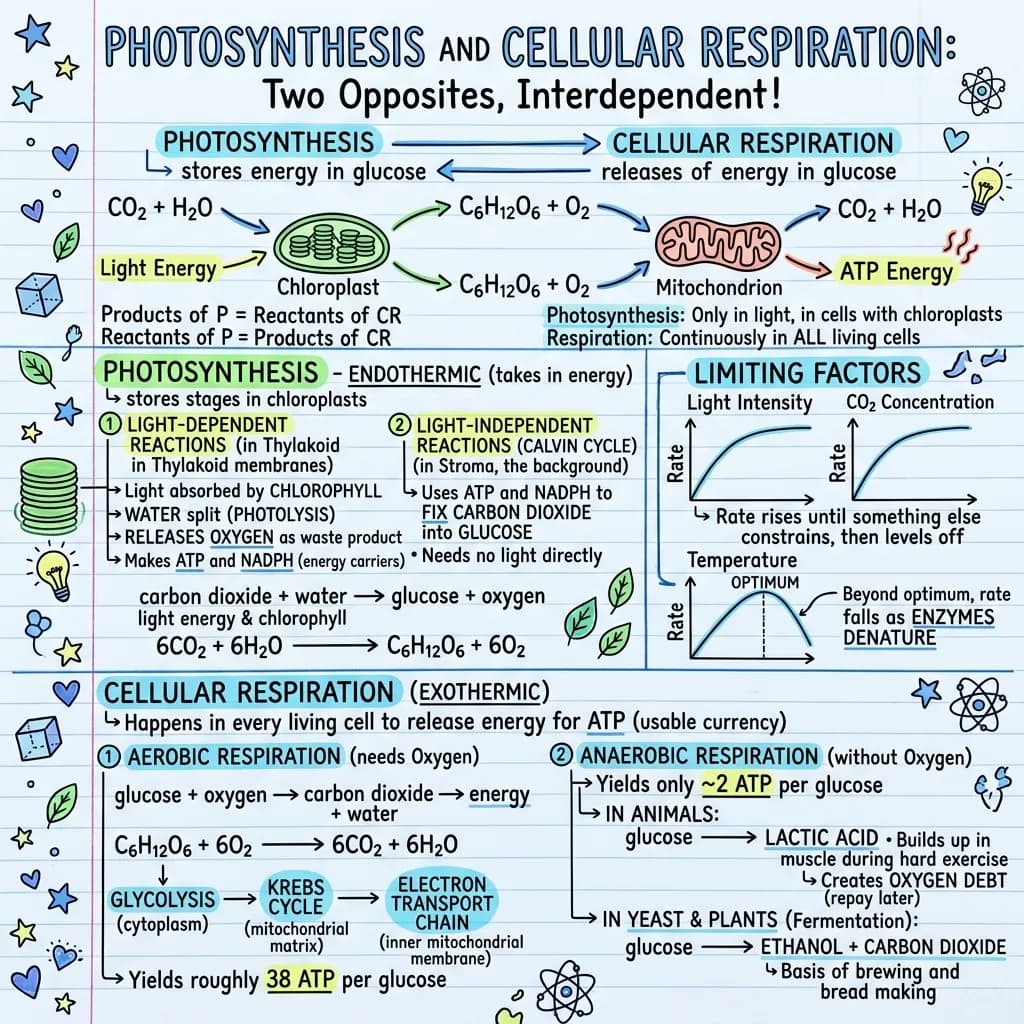
Topic 4: Bioenergetics. Photosynthesis is the process by which green plants make glucose using light energy and it is endothermic because energy is taken in; the word equation is carbon dioxide plus water in the presence of light and chlorophyll gives glucose plus oxygen, and the balanced symbol equation is 6CO2 plus 6H2O gives C6H12O6 plus 6O2. It takes place in the chloroplasts and is split into two stages. The light dependent reactions happen in the thylakoid membranes where light is absorbed by chlorophyll and used to split water in photolysis, releasing oxygen as a waste product and producing ATP and NADPH. The light independent reactions, also called the Calvin cycle, happen in the stroma and use the ATP and NADPH to fix carbon dioxide into glucose, and they do not need light directly. Three limiting factors control the rate: light intensity, carbon dioxide concentration and temperature. For light and carbon dioxide the rate rises and then plateaus when another factor becomes limiting, but the temperature graph is different because the rate rises to an optimum and then falls sharply as the enzymes denature and lose their active site shape. Cellular respiration is the process that releases energy from glucose to make ATP, the usable energy currency of the cell, and it happens in all living cells all of the time. Aerobic respiration needs oxygen; the word equation is glucose plus oxygen gives carbon dioxide plus water plus energy and the symbol equation is C6H12O6 plus 6O2 gives 6CO2 plus 6H2O. It has three stages: glycolysis in the cytoplasm splits glucose into pyruvate, the Krebs cycle in the mitochondrial matrix releases carbon dioxide and electron carriers, and the electron transport chain on the inner mitochondrial membrane produces most of the ATP, with a total yield of about 38 ATP per glucose molecule. Anaerobic respiration happens without oxygen and yields only about 2 ATP; in animal muscle cells it produces lactic acid causing an oxygen debt, while in yeast and plant cells it produces ethanol and carbon dioxide, which is the basis of brewing and baking. Note that the products of photosynthesis are the reactants of respiration and vice versa.
The flashcards from the same notes
Exports as Anki CSV, printable PDF, or plain text.
Where in the chloroplast do the light dependent reactions take place?
In the thylakoid membranes, where chlorophyll absorbs light and water is split by photolysis.
Which process releases the oxygen given off by photosynthesis?
Photolysis: the splitting of water during the light dependent reactions.
Why does the rate of photosynthesis fall after the optimum temperature?
The enzymes controlling the reactions denature, so their active sites change shape and stop working.
Name the three stages of aerobic respiration and where each occurs.
Glycolysis in the cytoplasm, the Krebs cycle in the mitochondrial matrix, and the electron transport chain on the inner mitochondrial membrane.
How many ATP does aerobic respiration yield per glucose compared with anaerobic?
About 38 ATP aerobically, against about 2 ATP anaerobically.
What are the products of anaerobic respiration in animal muscle and in yeast?
Lactic acid in animal muscle cells; ethanol and carbon dioxide in yeast.
Make a deck from your own notes with the AI flashcard generator.
What's in this visual
Photosynthesis and cellular respiration are usually taught in separate lessons, which is exactly why students mix up the equations, the organelles and the stages under exam pressure. The visual above puts them face to face so the mirror relationship is obvious at a glance, and the deck below drills the details that only recall can fix. Here is the full breakdown.
Two processes that are opposites, not rivals
The fastest way to stop confusing these is to notice that the products of one are the reactants of the other. Photosynthesis takes in carbon dioxide and water and gives out glucose and oxygen; respiration takes in glucose and oxygen and gives out carbon dioxide and water. Photosynthesis is endothermic, storing light energy in chemical bonds. Respiration is exothermic, releasing that stored energy as ATP. Placing the two equations facing each other on one page turns the whole topic into a single loop instead of two lists.
Photosynthesis: two stages inside the chloroplast
Photosynthesis happens in the chloroplasts and splits into two stages that many students merge by accident. The light dependent reactions occur in the thylakoid membranes: chlorophyll absorbs light, water is split in photolysis (this is where the released oxygen comes from), and the energy is captured as ATP and NADPH. The light independent reactions, or the Calvin cycle, occur in the stroma and spend that ATP and NADPH fixing carbon dioxide into glucose. The Calvin cycle needs no light directly, but it stops quickly without the products of the first stage.
Limiting factors and the graph that falls
Three factors limit the rate of photosynthesis: light intensity, carbon dioxide concentration and temperature. The first two produce the same graph shape, rising and then flattening once a different factor becomes the constraint. Temperature behaves differently and this is the classic exam trap: the rate climbs to an optimum and then falls sharply, because the enzymes controlling the reactions denature and their active sites lose shape. A rising then plateauing curve and a rising then falling curve look nothing alike on the page, which is why the graphs belong in the visual.
Cellular respiration: three aerobic stages and the anaerobic shortcut
Respiration releases energy from glucose as ATP, the cell's usable energy currency. Aerobic respiration runs in three stages: glycolysis in the cytoplasm splits glucose into pyruvate, the Krebs cycle in the mitochondrial matrix releases carbon dioxide and loaded electron carriers, and the electron transport chain on the inner mitochondrial membrane generates the bulk of the yield, roughly 38 ATP per glucose molecule. Anaerobic respiration skips the mitochondria and yields only about 2 ATP, producing lactic acid in animal muscle (creating an oxygen debt) and ethanol plus carbon dioxide in yeast, which is what brewing and baking rely on.
Why a comparison visual plus a deck beats rereading
Locations and stage names are spatial, so they belong on a diagram where the thylakoid, the stroma, the matrix and the inner membrane each have a place. Equations, ATP yields and products are recall facts, so they need testing. The deck under this visual was generated from the same source notes in the same pass, so every card matches a label you can point to on the image. See how the two formats work together in flashcards for students and teachers.
For teachers
The problem
- Students learn the two processes weeks apart and then swap the equations in the exam.
- The stage names get memorised without their organelle locations attached.
- The temperature limiting factor graph is drawn as a plateau year after year.
How to use it in class
- Project the side by side layout as the bridging lesson between the two topics.
- Blank one equation and have students derive it from the other.
- Use the deck as a low stakes recall quiz at the start of the revision lesson.
- Print the page as the bioenergetics revision sheet before the unit test.
For students & visual learners
The problem
- The two equations look almost identical and you write the wrong one under pressure.
- You know the stages but not which happens in the stroma and which in the matrix.
- ATP yields and the anaerobic products never survive the walk to the exam hall.
How to use it to study
- Revise both processes from one page instead of two chapters.
- Use the mirrored layout to check your equations against each other.
- Drill the six cards until locations and yields come back instantly.
- Cover the labels and rebuild the chloroplast and mitochondrion from memory.
Make your own visual like this
Paste your notes or upload a PDF
Drop in your own class notes, a textbook chapter or a PDF. Any subject, any language.
Pick a visual style
Choose a sketchnote, infographic or diagram style that fits the topic.
Generate and download
In about 15–40 seconds you get a one-page visual you can print, share or revise from.
Frequently asked questions
What is the balanced equation for photosynthesis?
6CO2 plus 6H2O gives C6H12O6 plus 6O2, in the presence of light and chlorophyll. Aerobic respiration is the reverse: C6H12O6 plus 6O2 gives 6CO2 plus 6H2O plus energy.
How are photosynthesis and cellular respiration connected?
They are opposites that feed each other. The glucose and oxygen produced by photosynthesis are the reactants of aerobic respiration, and the carbon dioxide and water respiration produces are the reactants of photosynthesis.
Can I generate flashcards from my own biology notes?
Yes. Upload your notes or a textbook chapter and VisualNote AI builds the visual and the deck from the same source in one pass. See how flashcards work for students and teachers.
More visual examples
Turn your notes into a visual
Paste any notes or upload a PDF and get a sketchnote-style visual in under a minute.