
The work energy theorem says that the net work done on an object equals the change in its kinetic energy. It connects the forces acting on an object over a distance to how its speed changes.
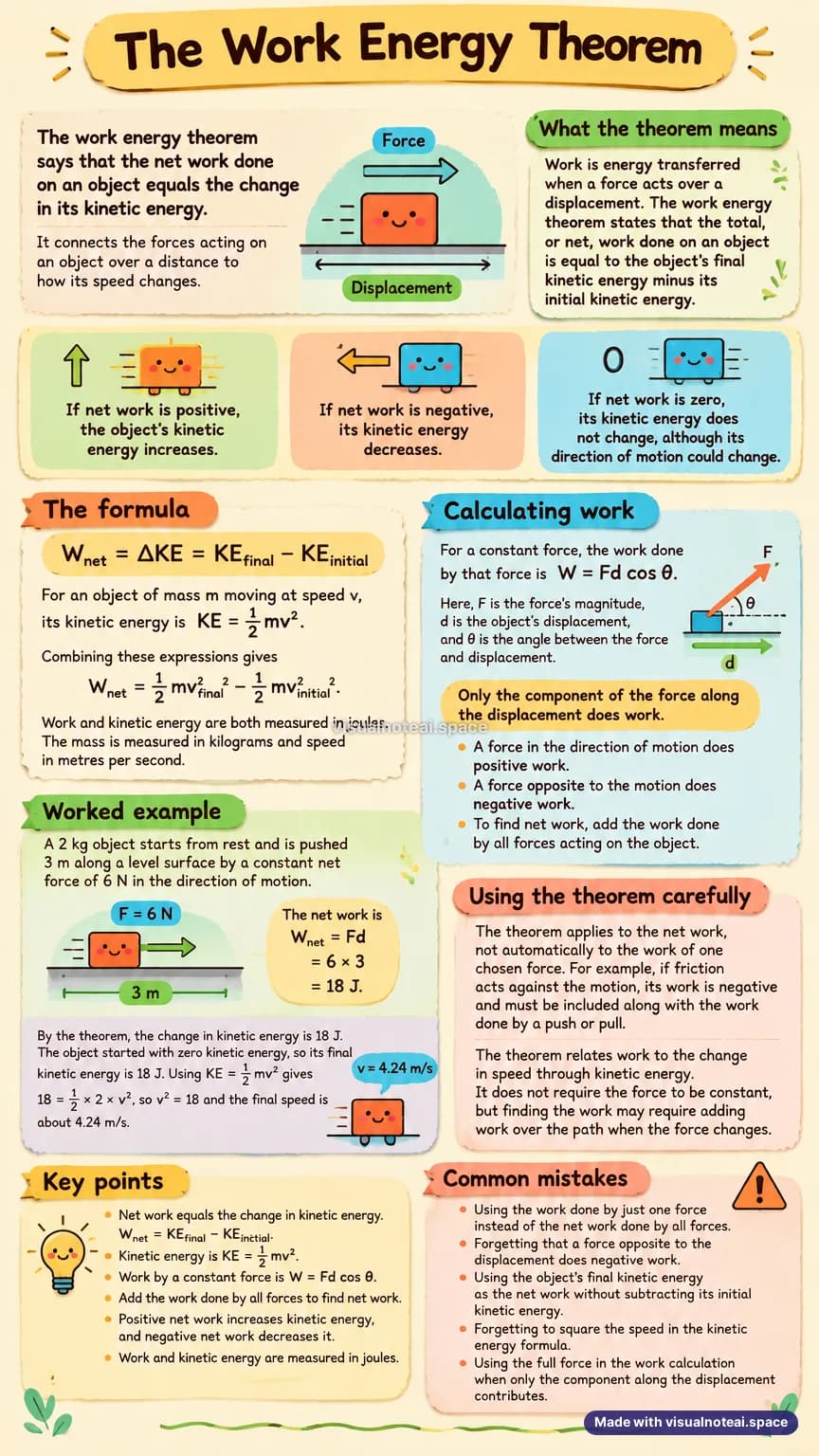
The whole topic on one page. Made with VisualNote.
★What to remember
- Net work equals the change in kinetic energy.
- W_net = KE_final − KE_initial.
- Kinetic energy is KE = 1/2 mv².
- Work by a constant force is W = Fd cos θ.
- Add the work done by all forces to find net work.
- Positive net work increases kinetic energy, and negative net work decreases it.
- Work and kinetic energy are measured in joules.
🎧Listen2:50 · transcript
AnnaLet’s start with the central idea. The work energy theorem says that the net work done on an object equals the change in its kinetic energy. Marco, what does that connect for us?
MarcoIt connects forces acting over a distance with changes in motion. Work is energy transferred when a force acts through a displacement. And the key word is net: we add the work done by all the forces.
AnnaSo it isn’t always enough to look at the push alone. If friction acts too, we have to count its work as well, right?
MarcoExactly. Friction often acts opposite to the motion, so it does negative work. A force in the direction of displacement does positive work. And if the net work is negative, kinetic energy decreases.
AnnaWhat if the net work is zero? Does that mean the object has stopped?
MarcoNo. It means kinetic energy hasn’t changed. The object’s direction could still change, even though its kinetic energy stays the same.
AnnaLet’s say the equation out loud. Net work equals final kinetic energy minus initial kinetic energy. And kinetic energy is one half times mass times speed squared.
MarcoThat squared speed matters. When we compare the final and initial kinetic energies, we use one half times mass times final speed squared, minus one half times mass times initial speed squared. Work and kinetic energy are measured in joules. Mass is in kilograms, and speed is in metres per second.
AnnaHow do we calculate the work from a constant force?
MarcoTake the force’s magnitude times the displacement times the cosine of the angle between them. Only the part of the force along the displacement contributes. So using the whole force when it points at an angle can give the wrong answer.
AnnaCan we walk through the example? A two kilogram object starts from rest. A constant net force of six newtons pushes it three metres along a level surface, in the direction of motion.
MarcoSince the force and displacement point the same way, the angle is zero, and the net work is six times three, or eighteen joules. The theorem says the kinetic energy changes by eighteen joules. Since it started from rest, its initial kinetic energy was zero, so its final kinetic energy is eighteen joules.
AnnaThen we put that into the kinetic energy formula. Eighteen equals one half times two times the final speed squared. That gives speed squared equal to eighteen, so the final speed is about four point two four metres per second.
MarcoRight. And one careful point: the theorem applies to net work, not automatically to one chosen force. Also, the theorem itself doesn’t require a constant force. But if a force changes, finding the work may mean adding its contributions along the path.
AnnaSo the checks are: include every force, give opposite forces negative work, subtract the initial kinetic energy, and remember to square speed. That keeps the theorem tied to what actually changes: kinetic energy.
Study in Paper · The Work Energy TheoremWatch on YouTube
!Common mistakes
- Using the work done by just one force instead of the net work done by all forces.
- Forgetting that a force opposite to the displacement does negative work.
- Using the object's final kinetic energy as the net work without subtracting its initial kinetic energy.
- Forgetting to square the speed in the kinetic energy formula.
- Using the full force in the work calculation when only the component along the displacement contributes.
🧠Explore the map32 ideas
The mind map VisualNote made for this topic. Drag to pan, scroll to zoom.
- Work Energy Theorem
- Core Meaning
- Net work equals change in kinetic energy
- Positive net work increases kinetic energy
- Negative net work decreases kinetic energy
- Zero net work leaves kinetic energy unchanged
- Equations and Units
- W_net = ΔKE = KE_final − KE_initial
- KE = ½mv²
- W_net = ½mv_final² − ½mv_initial²
- Work and kinetic energy: joules
- Mass: kilograms; speed: metres per second
- Calculating Work
- Constant-force work: W = Fd cos θ
- θ is the angle between force and displacement
- Only the force component along displacement does work
- Add work from all forces to find net work
- Work by a force along motion is positive
- Work by a force opposite motion is negative
- Worked Example
- Mass: 2 kg; initial speed: 0 m/s
- Net force: 6 N over 3 m
- Net work: 6 × 3 = 18 J
- Final kinetic energy: 18 J
- Final speed: approximately 4.24 m/s
- Careful Application and Common Errors
- Use net work, not just one force's work
- Include friction and other forces
- Subtract initial kinetic energy from final kinetic energy
- Square the speed in the kinetic energy formula
- Use only the force component along displacement
- Variable forces may require summing work along the path
- Core Meaning
🃏Flashcards12 cards
- What does the work-energy theorem state?
- The net work done on an object equals its change in kinetic energy: W_net = KE_final − KE_initial.
- What is kinetic energy?
- Kinetic energy is the energy of motion. For mass m moving at speed v, KE = ½mv².
- What does positive net work mean for an object's kinetic energy?
- Positive net work increases the object's kinetic energy.
- What does negative net work mean for an object's kinetic energy?
- Negative net work decreases the object's kinetic energy.
- What happens when net work is zero?
- The object's kinetic energy does not change, though its direction of motion may change.
- How is work by a constant force calculated?
- W = Fd cos θ, where F is force magnitude, d is displacement, and θ is the angle between them.
- Which part of a force contributes to work?
- Only the component of the force along the displacement contributes to work.
- What is the sign of work when a force acts opposite to motion?
- The work is negative because the force opposes the displacement.
- How do you calculate net work when several forces act?
- Add the work done by all forces acting on the object, including negative work such as friction.
- Does the work-energy theorem require a constant force?
- No. The theorem applies even if the force changes, though calculating work may require summing it along the path.
- What are the SI units of work and kinetic energy?
- Both are measured in joules (J). Mass is measured in kilograms and speed in metres per second.
- A 2 kg object starts from rest and receives 18 J of net work. What is its final speed?
- Its final kinetic energy is 18 J. Using 18 = ½(2)v² gives a final speed of about 4.24 m/s.
✅Test yourself5 questions
What quantity is equal to the net work done on an object?
The work-energy theorem states that net work equals final kinetic energy minus initial kinetic energy.
A force acts directly opposite to an object's displacement. What is the work done by that force?
A force opposite to the displacement has a negative component along the direction of motion, so it does negative work.
A constant force of magnitude F acts through displacement d at an angle θ to the displacement. Which expression gives its work?
Only the force component parallel to the displacement contributes to work, giving W = Fd cos θ.
Which expression gives the kinetic energy of an object of mass m moving at speed v?
Kinetic energy is calculated as one-half the mass multiplied by the square of the speed.
A push does positive work on an object while friction does negative work. To apply the work-energy theorem, what should you use?
The theorem uses net work, which is the sum of the work done by every force acting on the object.
📝The notes
What the theorem means
Work is energy transferred when a force acts over a displacement. The work energy theorem states that the total, or net, work done on an object is equal to the object's final kinetic energy minus its initial kinetic energy.
If net work is positive, the object's kinetic energy increases. If net work is negative, its kinetic energy decreases. If net work is zero, its kinetic energy does not change, although its direction of motion could change.
The formula
The theorem is written as W_net = ΔKE = KE_final − KE_initial. For an object of mass m moving at speed v, its kinetic energy is KE = 1/2 mv².
Combining these expressions gives W_net = 1/2 mv_final² − 1/2 mv_initial². Work and kinetic energy are both measured in joules. The mass is measured in kilograms and speed in metres per second.
Calculating work
For a constant force, the work done by that force is W = Fd cos θ. Here, F is the force's magnitude, d is the object's displacement, and θ is the angle between the force and displacement.
Only the component of the force along the displacement does work. A force in the direction of motion does positive work, while a force opposite to the motion does negative work. To find net work, add the work done by all forces acting on the object.
Worked example
A 2 kg object starts from rest and is pushed 3 m along a level surface by a constant net force of 6 N in the direction of motion. The net work is W_net = Fd = 6 × 3 = 18 J.
By the theorem, the change in kinetic energy is 18 J. The object started with zero kinetic energy, so its final kinetic energy is 18 J. Using KE = 1/2 mv² gives 18 = 1/2 × 2 × v², so v² = 18 and the final speed is about 4.24 m/s.
Using the theorem carefully
The theorem applies to the net work, not automatically to the work of one chosen force. For example, if friction acts against the motion, its work is negative and must be included along with the work done by a push or pull.
The theorem relates work to the change in speed through kinetic energy. It does not require the force to be constant, but finding the work may require adding work over the path when the force changes.
Make this for your own notes
Paste a chapter or a PDF and get the sheet, map, cards, quiz and episode back in about a minute. No credit card.