
The Photosynthesis Equation
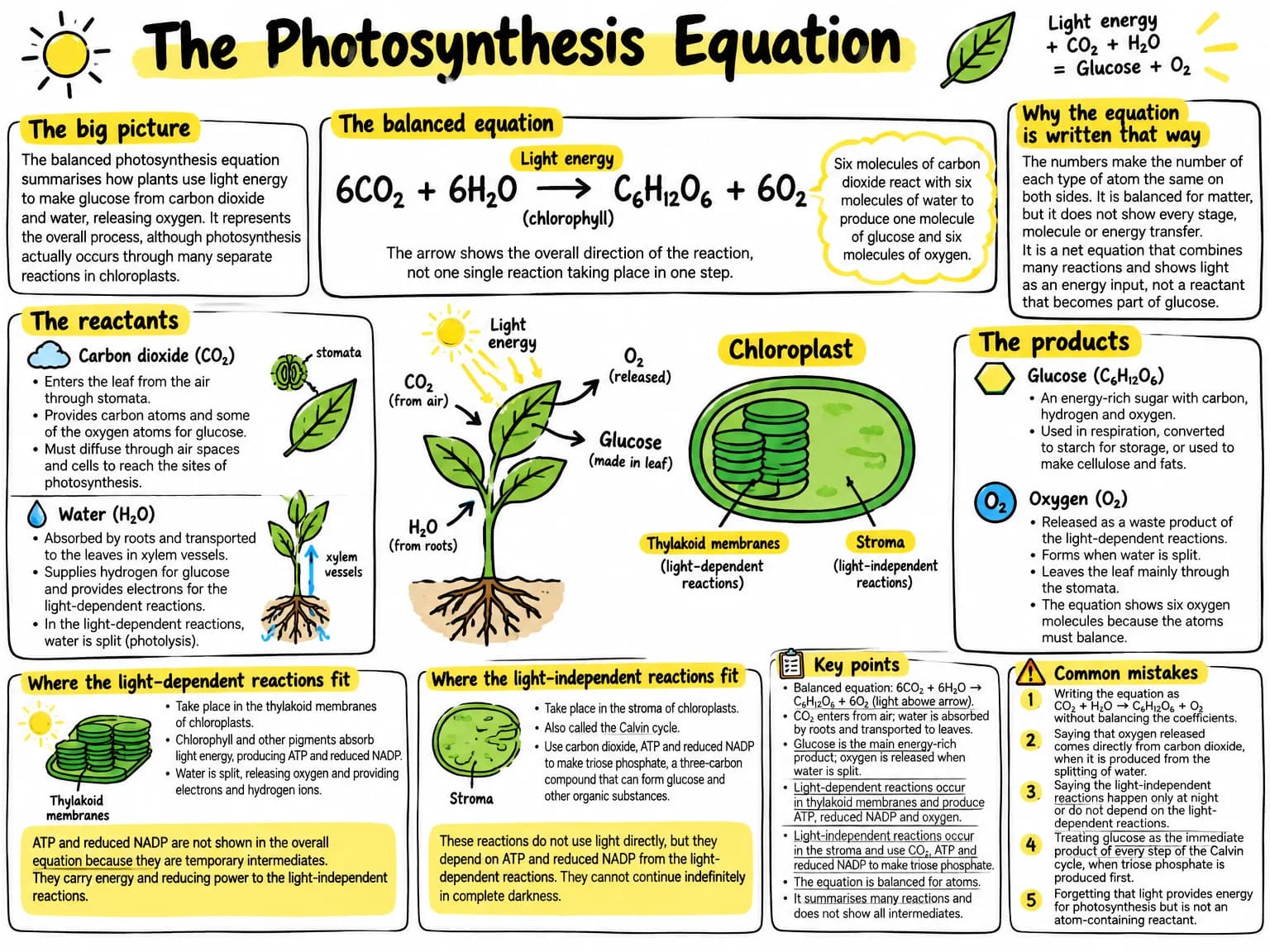
The balanced photosynthesis equation summarises how plants use light energy to make glucose from carbon dioxide and water, releasing oxygen. It represents the overall process, although photosynthesis actually occurs through many separate reactions in chloroplasts.
The Photosynthesis Equation at a glance
Listen: The Photosynthesis Equation
Two hosts talking it through, 2:57. The full transcript is below, so you can read along or skip the audio.
Transcript
AnnaToday we’re unpacking the photosynthesis equation. Marco, what does the equation actually summarise?
MarcoIt summarises how plants use light energy to make glucose from carbon dioxide and water, while releasing oxygen. The balanced equation is: six carbon dioxide molecules plus six water molecules produce one glucose molecule and six oxygen molecules. Light energy is usually written above the arrow, and chlorophyll may be shown too.
AnnaWhy is it important to call it a summary rather than one single reaction?
MarcoBecause photosynthesis happens through many separate reactions inside chloroplasts. The arrow shows the overall direction, not one step taking place all at once.
AnnaLet’s take the reactants separately. Where does the carbon dioxide come from?
MarcoIt comes from the air and enters the leaf through tiny openings called stomata. Then it diffuses through air spaces and cells to reach the sites of photosynthesis. It supplies the carbon atoms, and some oxygen atoms, used to build glucose.
AnnaAnd water follows a different route, right?
MarcoYes. Roots absorb water from the soil, and xylem vessels transport it to the leaves. Water supplies hydrogen used in making glucose. It also provides electrons for the light-dependent reactions, where water is split in a process called photolysis.
AnnaThat splitting explains the oxygen product. What happens to the glucose?
MarcoGlucose is an energy-rich sugar containing carbon, hydrogen and oxygen. Plants can use it in respiration, convert it into starch for storage, or use it to make substances such as cellulose and fats.
AnnaSo oxygen is released when water is split, not directly from carbon dioxide?
MarcoExactly. Oxygen is a waste product of the light-dependent reactions. It mainly diffuses out through the stomata. Six oxygen molecules appear in the equation because the atoms have to balance.
AnnaWhere do those light-dependent reactions occur?
MarcoIn the thylakoid membranes of chloroplasts. Chlorophyll and other pigments absorb light energy. The reactions produce ATP and reduced NADP, while splitting water and releasing oxygen.
AnnaAnd what happens in the stroma?
MarcoThe light-independent reactions, also called the Calvin cycle, occur there. They use carbon dioxide, ATP and reduced NADP to make triose phosphate, a three-carbon compound. Triose phosphate can then be used to form glucose and other organic substances.
AnnaWhy can’t we say those reactions happen only at night?
MarcoBecause light-independent means they do not use light directly. They still depend on ATP and reduced NADP made by the light-dependent reactions, so they cannot continue indefinitely in complete darkness.
AnnaFinally, what makes the equation balanced?
MarcoBoth sides contain six carbon atoms, twelve hydrogen atoms and eighteen oxygen atoms. So it balances matter, but it does not show every intermediate or energy transfer. Light supplies energy, but it is not an atom-containing reactant that becomes part of glucose.
The notes
The balanced equation
The standard balanced equation is: 6CO2 + 6H2O → C6H12O6 + 6O2. Light energy is often written above the arrow, and chlorophyll may also be shown because chlorophyll absorbs some of the light energy needed for the process.
This equation means that six molecules of carbon dioxide react with six molecules of water to produce one molecule of glucose and six molecules of oxygen. The arrow shows the overall direction of the reaction, not one single reaction taking place in one step.
The reactants
Carbon dioxide is a reactant taken into the leaf from the air. It provides the carbon atoms and some of the oxygen atoms used to build glucose. Carbon dioxide enters through small openings called stomata, although it must then diffuse through air spaces and cells to reach the sites of photosynthesis.
Water is the other reactant. It is absorbed from the soil by the roots and transported to the leaves in xylem vessels. Water supplies hydrogen used in making glucose and provides electrons for the light-dependent reactions. In the light-dependent reactions, water is split, a process called photolysis.
The products
Glucose is an energy-rich sugar containing carbon, hydrogen and oxygen. It is produced using carbon dioxide and the products of the light-dependent reactions. The glucose made by photosynthesis can be used in respiration, converted into starch for storage, or used to make substances such as cellulose and fats.
Oxygen is released as a waste product of the light-dependent reactions. It forms when water molecules are split, and it leaves the leaf mainly by diffusing out through the stomata. The equation shows six oxygen molecules because the atoms must balance in the overall reaction.
Where the light-dependent reactions fit
The light-dependent reactions take place in the thylakoid membranes of chloroplasts. Chlorophyll and other pigments absorb light energy, which is used to produce ATP and reduced NADP. Water is split during these reactions, releasing oxygen and providing electrons and hydrogen ions.
ATP and reduced NADP are not shown in the overall photosynthesis equation because they are temporary intermediates. They carry energy and reducing power from the light-dependent reactions to the light-independent reactions.
Where the light-independent reactions fit
The light-independent reactions take place in the stroma of chloroplasts. They are also called the Calvin cycle. They use carbon dioxide, ATP and reduced NADP to make triose phosphate, a three-carbon compound that can be used to form glucose and other organic substances.
These reactions do not use light directly, but they depend on ATP and reduced NADP made by the light-dependent reactions. Calling them light-independent does not mean they can continue indefinitely in complete darkness, because they require products supplied by the light-dependent reactions.
Why the equation is written that way
The numbers in the equation make the number of each type of atom the same on both sides. On the left, six carbon dioxide molecules provide six carbon atoms, six water molecules provide twelve hydrogen atoms, and together they provide eighteen oxygen atoms. On the right, one glucose molecule contains six carbon atoms, twelve hydrogen atoms and six oxygen atoms, while six oxygen molecules contain the remaining twelve oxygen atoms.
The equation is therefore balanced for matter, but it does not show every stage, molecule or energy transfer in photosynthesis. It is a net equation that combines the many reactions into one summary. It also shows light as an energy input rather than as a reactant that becomes part of glucose.
What to remember
- The balanced photosynthesis equation is 6CO2 + 6H2O → C6H12O6 + 6O2, with light energy usually shown above the arrow.
- Carbon dioxide enters the leaf from the air, while water is absorbed by the roots and transported to the leaves.
- Glucose is the main energy-rich organic product, and oxygen is released when water is split.
- The light-dependent reactions occur in the thylakoid membranes and produce ATP, reduced NADP and oxygen.
- The light-independent reactions occur in the stroma and use carbon dioxide, ATP and reduced NADP to make triose phosphate.
- The equation is balanced because the number of carbon, hydrogen and oxygen atoms is the same on both sides.
- The equation summarises many reactions and does not show all the intermediate substances.
The Photosynthesis Equation as a mind map
- Photosynthesis Equation
- Balanced Equation
- 6CO2 + 6H2O → C6H12O6 + 6O2
- Light energy above the arrow
- Chlorophyll absorbs light energy
- Overall direction, not one reaction
- Reactants
- Carbon dioxide
- Enters leaves through stomata
- Provides carbon and some oxygen atoms
- Water
- Absorbed by roots and transported in xylem
- Provides hydrogen and electrons
- Carbon dioxide
- Products
- Glucose
- Energy-rich organic sugar
- Used in respiration, storage, and synthesis
- Oxygen
- Released when water is split
- Diffuses out through stomata
- Glucose
- Light-Dependent Reactions
- Location: thylakoid membranes
- Pigments absorb light energy
- Water undergoes photolysis
- Produces ATP and reduced NADP
- Light-Independent Reactions
- Location: chloroplast stroma
- Also called the Calvin cycle
- Uses carbon dioxide, ATP, and reduced NADP
- Produces triose phosphate
- Triose phosphate forms glucose and other organic substances
- Equation Meaning and Limitations
- Atoms balanced on both sides
- Six carbon dioxide and six water molecules
- One glucose and six oxygen molecules
- Net summary of many reactions
- Light is an energy input, not a reactant
- ATP and reduced NADP are temporary intermediates
- Light-independent reactions depend on light-dependent products
- Balanced Equation
Flashcards
- What is the balanced equation for photosynthesis?
- 6CO₂ + 6H₂O → C₆H₁₂O₆ + 6O₂. Light energy is usually shown above the arrow.
- What does the photosynthesis equation summarize?
- It summarizes many reactions in which plants use light energy to make glucose from carbon dioxide and water, releasing oxygen.
- What are the reactants in photosynthesis?
- The reactants are carbon dioxide and water. Light provides energy but is not an atom-containing reactant in the equation.
- How does carbon dioxide enter the leaf?
- Carbon dioxide enters from the air through stomata and diffuses through air spaces and cells to the sites of photosynthesis.
- How does water reach the leaves?
- Water is absorbed from the soil by the roots and transported to the leaves through xylem vessels.
- What happens to water during the light-dependent reactions?
- Water is split in a process called photolysis, providing electrons and hydrogen ions and releasing oxygen.
- What are the main products of photosynthesis?
- The main products are glucose and oxygen. Glucose is an energy-rich sugar, while oxygen is released as a waste product.
- How can glucose produced by photosynthesis be used?
- It can be used in respiration, converted into starch for storage, or used to make substances such as cellulose and fats.
- Where do the light-dependent reactions occur, and what do they produce?
- They occur in the thylakoid membranes of chloroplasts and produce ATP, reduced NADP and oxygen.
- Where do the light-independent reactions occur, and what do they use?
- They occur in the stroma and use carbon dioxide, ATP and reduced NADP to make triose phosphate.
- Why are the light-independent reactions dependent on light?
- They do not use light directly, but they require ATP and reduced NADP produced by the light-dependent reactions.
- Why is the photosynthesis equation balanced?
- The numbers ensure that carbon, hydrogen and oxygen atoms are equal on both sides: six CO₂ and six H₂O form one glucose molecule and six O₂ molecules.
Test yourself
Which equation correctly represents balanced photosynthesis?
Six carbon dioxide and six water molecules provide the same numbers of carbon, hydrogen, and oxygen atoms as one glucose molecule and six oxygen molecules.
From which substance does the oxygen released during photosynthesis mainly come?
Water is split by photolysis during the light-dependent reactions, producing oxygen as a released product.
Where do the light-dependent and light-independent reactions mainly occur, respectively?
The light-dependent reactions occur in thylakoid membranes, while the Calvin cycle occurs in the chloroplast stroma.
What is produced first in the light-independent reactions and can later be used to form glucose?
The Calvin cycle produces triose phosphate first, which can then be used to make glucose and other organic substances.
Why can the light-independent reactions not continue indefinitely in complete darkness?
Although they do not use light directly, the light-independent reactions require ATP and reduced NADP supplied by the light-dependent reactions.
Common mistakes
- Writing the equation as CO2 + H2O → C6H12O6 + O2 without balancing the coefficients.
- Saying that oxygen released by photosynthesis comes directly from carbon dioxide, when it is produced from the splitting of water in the light-dependent reactions.
- Saying that the light-independent reactions happen only at night or do not depend on the light-dependent reactions.
- Treating glucose as the immediate product of every step of the Calvin cycle, when triose phosphate is produced first and can then be used to form glucose.
- Forgetting that light provides energy for photosynthesis but is not an atom-containing reactant in the balanced equation.
Make this for your own notes
Everything on this page came from one source, generated in about a minute. Paste a chapter, upload a PDF or photograph your notes and get the same set back.
Try it freeNo credit card. Free every month.