
Mitosis vs Meiosis
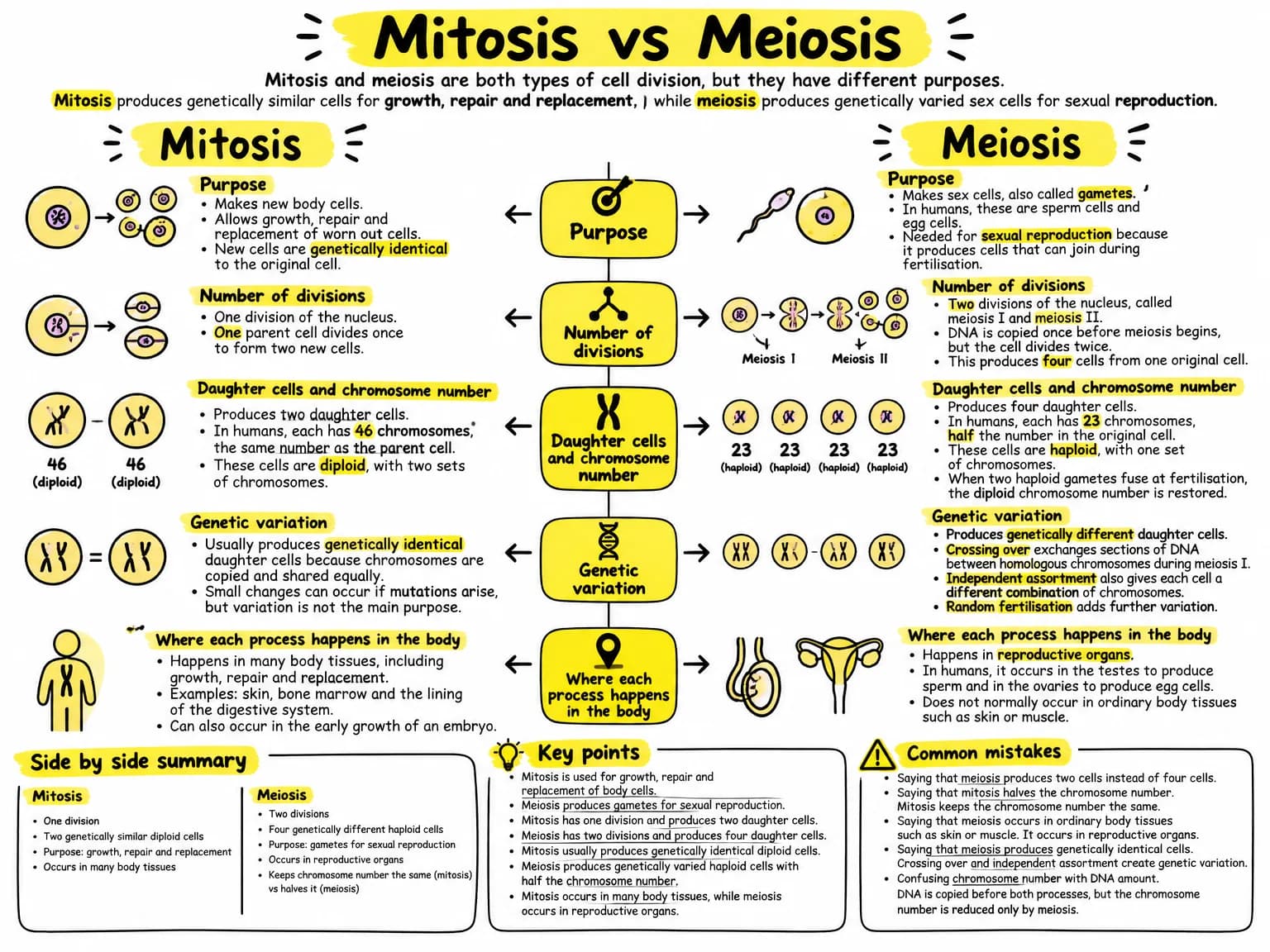
Mitosis and meiosis are both types of cell division, but they have different purposes. Mitosis produces genetically similar cells for growth, repair, and replacement, while meiosis produces genetically varied sex cells for sexual reproduction.
Mitosis vs Meiosis at a glance
Listen: Mitosis vs Meiosis
Two hosts talking it through, 2:45. The full transcript is below, so you can read along or skip the audio.
Transcript
AnnaWhen people compare mitosis and meiosis, what is the main difference we should remember?
MarcoTheir purposes are different. Mitosis makes new body cells for growth, repair, and replacement. Meiosis makes sex cells, or gametes, for sexual reproduction. In humans, those gametes are sperm cells and egg cells.
AnnaSo mitosis helps the body maintain itself, while meiosis supports reproduction. But how many times does the cell actually divide in each process?
MarcoMitosis involves one division of the nucleus. One parent cell divides once and forms two daughter cells. Meiosis involves two divisions, called meiosis one and meiosis two. The DNA is copied once before meiosis starts, but the cell divides twice, producing four cells.
AnnaThat gives us a useful warning. Meiosis does not produce two cells. It produces four. What about chromosome numbers in those daughter cells?
MarcoIn human mitosis, each of the two daughter cells has forty-six chromosomes, the same number as the parent cell. These cells are diploid, meaning they have two sets of chromosomes. In meiosis, each of the four daughter cells has twenty-three chromosomes, which is half the original number. These cells are haploid, meaning they have one set.
AnnaWhy does meiosis need to halve the number?
MarcoBecause the haploid gametes can join during fertilisation. When two haploid gametes fuse, the diploid chromosome number is restored. Mitosis, by contrast, keeps the chromosome number the same.
AnnaAre the new cells genetically alike in both processes?
MarcoUsually, mitosis produces genetically similar, often identical, cells. The chromosomes are copied and shared equally between the two new cells. Mutations can cause small changes, but variation is not the main purpose. Meiosis is different. Crossing over exchanges sections of DNA between homologous chromosomes during meiosis one. Independent assortment also creates different chromosome combinations. Random fertilisation can add still more variation.
AnnaWhere do these processes happen in the body?
MarcoMitosis happens in many body tissues, including skin, bone marrow, and the lining of the digestive system. It also occurs during early embryo growth. Meiosis happens in reproductive organs. In humans, it occurs in the testes to produce sperm and in the ovaries to produce egg cells. It does not normally happen in ordinary tissues such as skin or muscle.
AnnaWhat is the simplest final comparison?
MarcoMitosis is one division, two genetically similar diploid cells, and growth or repair. Meiosis is two divisions, four genetically varied haploid cells, and sexual reproduction. Also, DNA is copied before both processes, but only meiosis reduces the chromosome number.
The notes
Purpose
Mitosis makes new body cells. It allows an organism to grow, replace worn out cells, and repair damaged tissues. The new cells are usually genetically identical to the original cell.
Meiosis makes sex cells, also called gametes. In humans, these are sperm cells and egg cells. Meiosis is needed for sexual reproduction because it produces cells that can join during fertilisation.
Number of divisions
Mitosis involves one division of the nucleus. One parent cell divides once to form two new cells.
Meiosis involves two divisions of the nucleus, called meiosis I and meiosis II. DNA is copied once before meiosis begins, but the cell divides twice. This produces four cells from one original cell.
Daughter cells and chromosome number
Mitosis produces two daughter cells. In humans, each daughter cell has 46 chromosomes, the same number as the parent cell. These cells are diploid, meaning they have two sets of chromosomes.
Meiosis produces four daughter cells. In humans, each daughter cell has 23 chromosomes, half the number in the original cell. These cells are haploid, meaning they have one set of chromosomes. When two haploid gametes fuse at fertilisation, the diploid chromosome number is restored.
Genetic variation
Mitosis usually produces genetically identical daughter cells because the chromosomes are copied and shared equally between the two new cells. Small changes can occur if mutations arise, but variation is not the main purpose of mitosis.
Meiosis produces genetically different daughter cells. Crossing over exchanges sections of DNA between homologous chromosomes during meiosis I. Independent assortment also gives each cell a different combination of chromosomes. Random fertilisation adds further variation when meiosis is part of sexual reproduction.
Where each process happens in the body
Mitosis happens in many body tissues, including tissues involved in growth, repair, and cell replacement. Examples include cells in the skin, bone marrow, and the lining of the digestive system. Mitosis can also occur in the early growth of an embryo.
Meiosis happens in reproductive organs. In humans, it occurs in the testes to produce sperm and in the ovaries to produce egg cells. It does not normally occur in ordinary body tissues such as skin or muscle.
Side by side summary
Mitosis has one division and produces two genetically similar diploid cells. Its purpose is growth, repair, and replacement, and it occurs in many body tissues.
Meiosis has two divisions and produces four genetically different haploid cells. Its purpose is to make gametes for sexual reproduction, and it occurs in reproductive organs. The key chromosome difference is that mitosis keeps the chromosome number the same, while meiosis halves it.
What to remember
- Mitosis is used for growth, repair, and replacement of body cells.
- Meiosis produces gametes for sexual reproduction.
- Mitosis has one division and produces two daughter cells.
- Meiosis has two divisions and produces four daughter cells.
- Mitosis usually produces genetically identical diploid cells.
- Meiosis produces genetically varied haploid cells with half the chromosome number.
- Mitosis occurs in many body tissues, while meiosis occurs in reproductive organs.
Mitosis vs Meiosis as a mind map
- Mitosis vs Meiosis
- Purpose
- Mitosis: growth, repair, and replacement
- Meiosis: gamete production for sexual reproduction
- Divisions and Outcomes
- Mitosis: one nuclear division
- Two daughter cells
- Meiosis: meiosis I and meiosis II
- Four daughter cells
- Mitosis: one nuclear division
- Chromosome Number
- Mitosis: diploid cells with 46 chromosomes in humans
- Chromosome number stays the same
- Meiosis: haploid cells with 23 chromosomes in humans
- Chromosome number is halved
- Fertilisation restores the diploid number
- Mitosis: diploid cells with 46 chromosomes in humans
- Genetic Variation
- Mitosis: usually genetically identical cells
- Meiosis: genetically varied cells
- Crossing over
- Independent assortment
- Random fertilisation
- Where It Occurs
- Mitosis: many body tissues
- Skin, bone marrow, and digestive lining
- Early embryo growth
- Meiosis: reproductive organs
- Testes produce sperm
- Ovaries produce eggs
- Mitosis: many body tissues
- Key Distinctions
- DNA is copied once before both processes
- Mitosis keeps chromosome number unchanged
- Meiosis halves chromosome number
- Meiosis does not normally occur in skin or muscle
- Purpose
Flashcards
- What is the main purpose of mitosis?
- Mitosis produces new body cells for growth, tissue repair, and replacement of worn-out cells.
- What is the main purpose of meiosis?
- Meiosis produces sex cells, or gametes, for sexual reproduction. In humans, these are sperm and egg cells.
- How many nuclear divisions occur in mitosis and meiosis?
- Mitosis involves one nuclear division, while meiosis involves two divisions: meiosis I and meiosis II.
- How many daughter cells does each process produce?
- Mitosis produces two daughter cells, while meiosis produces four daughter cells from one original cell.
- What happens to chromosome number during mitosis?
- Mitosis keeps the chromosome number the same. In humans, it produces diploid cells with 46 chromosomes.
- What happens to chromosome number during meiosis?
- Meiosis halves the chromosome number. In humans, it produces haploid cells with 23 chromosomes.
- What does diploid mean?
- Diploid means having two sets of chromosomes. Human body cells are diploid and contain 46 chromosomes.
- What does haploid mean?
- Haploid means having one set of chromosomes. Human gametes are haploid and contain 23 chromosomes.
- How do the daughter cells of mitosis and meiosis differ genetically?
- Mitosis usually produces genetically similar or identical daughter cells. Meiosis produces genetically varied daughter cells.
- How does meiosis create genetic variation?
- Crossing over exchanges DNA between homologous chromosomes, and independent assortment creates different chromosome combinations. Random fertilisation adds further variation.
- Where does mitosis occur compared with meiosis?
- Mitosis occurs in many body tissues, such as skin, bone marrow, and the digestive lining. Meiosis occurs in reproductive organs: the testes and ovaries.
- What is a common misconception about DNA copying and chromosome number?
- DNA is copied before both mitosis and meiosis, but only meiosis reduces the chromosome number. Mitosis maintains the original chromosome number.
Test yourself
Which process is primarily responsible for growth, tissue repair, and replacing worn-out body cells?
Mitosis produces genetically similar body cells used for growth, repair, and replacement.
How many daughter cells are produced from one original cell by meiosis?
Meiosis includes two nuclear divisions and produces four daughter cells.
What happens to the chromosome number during human mitosis?
Mitosis preserves the chromosome number, so each human daughter cell normally has 46 chromosomes.
Which combination best explains why meiosis produces genetically varied cells?
Crossing over and independent assortment create different chromosome combinations during meiosis.
Where does meiosis normally occur in humans?
Meiosis occurs in reproductive organs to produce sperm and egg cells.
Common mistakes
- Saying that meiosis produces two cells instead of four cells.
- Saying that mitosis halves the chromosome number. Mitosis keeps the chromosome number the same.
- Saying that meiosis occurs in ordinary body tissues such as skin or muscle. It occurs in reproductive organs.
- Saying that meiosis produces genetically identical cells. Crossing over and independent assortment create genetic variation.
- Confusing chromosome number with DNA amount. DNA is copied before both processes, but the chromosome number is reduced only by meiosis.
Make this for your own notes
Everything on this page came from one source, generated in about a minute. Paste a chapter, upload a PDF or photograph your notes and get the same set back.
Try it freeNo credit card. Free every month.