
In autumn, shorter days and changing temperatures lead many trees to prepare for winter by shutting down their leaves. As green chlorophyll breaks down, other pigments become visible, and some trees also make red pigments before their leaves fall.
★What to remember
- Chlorophyll is the green pigment used in photosynthesis.
- In autumn, chlorophyll breaks down and green color fades.
- Yellow and orange colors usually come from carotenoids that were already in the leaf.
- Some trees make anthocyanins in autumn, producing red or purplish colors.
- Tree species and weather conditions affect the colors leaves show.
- Before a leaf falls, a separation layer forms at the base of its stalk.
- A tree reclaims some materials from its leaves and seals the attachment point before the leaves drop.
🎧Listen2:40 · transcript
AnnaWhen autumn arrives, leaves seem to change color almost overnight. But what is actually changing?
MarcoMostly, the balance of pigments we can see. In spring and summer, leaves contain lots of chlorophyll. It gives them their green color and helps them use light energy to make sugars from carbon dioxide and water.
AnnaSo chlorophyll is doing useful work, not just making leaves look green. Why does that green fade in autumn?
MarcoShorter days and seasonal conditions lead many trees to slow down chlorophyll production. The chlorophyll already in the leaves breaks down, and the tree does not replace it as quickly. Once the green fades, other colors become visible.
AnnaThose yellow and orange leaves are a good example, right? People sometimes assume those colors are newly made in autumn.
MarcoRight, but yellow and orange usually come from carotenoids that were already in the leaves during the growing season. Chlorophyll had been masking them. When the green pigment breaks down, the carotenoids show through.
AnnaThen what about red leaves? Are those pigments hiding there all summer too?
MarcoOften, no. Red and purplish colors commonly come from anthocyanins, which are made in the leaf during autumn. Their production depends on the tree species and conditions inside the leaf. Bright light and cool, but not freezing, conditions can favor stronger red colors. Sugars left in a leaf can help provide material for making those pigments.
AnnaSo that explains why a red color can vary from one autumn to another. But why do different trees show such different palettes?
MarcoTree species do not all make the same pigments or change color in the same way. Some commonly turn yellow. Others may show orange, red, or purple. And a single leaf can contain more than one pigment, so the color can be a mixture. Weather matters too. Light, temperature, and moisture affect how vivid the colors are and how long they last. The same tree can look different in different years.
AnnaThe colors are striking, but the leaves are also preparing to come off. Does a tree just let them fall when they die?
MarcoThere is a process. Before a deciduous tree drops a leaf, a separation layer forms at the base of its stalk. That layer gradually cuts the leaf off from the tree. While this happens, the tree can reclaim useful materials, including nutrients, from the leaf.
AnnaAnd the tree is protected at the point where the leaf comes away?
MarcoYes. The separation layer helps seal that spot, which reduces water loss and limits damage to the branch. Then the leaf falls. With fewer leaf surfaces losing water, the tree is better prepared for winter, when water may be frozen or hard to take up. So falling leaves are part of a larger process: the tree reclaims some materials and seals the attachment point before winter.
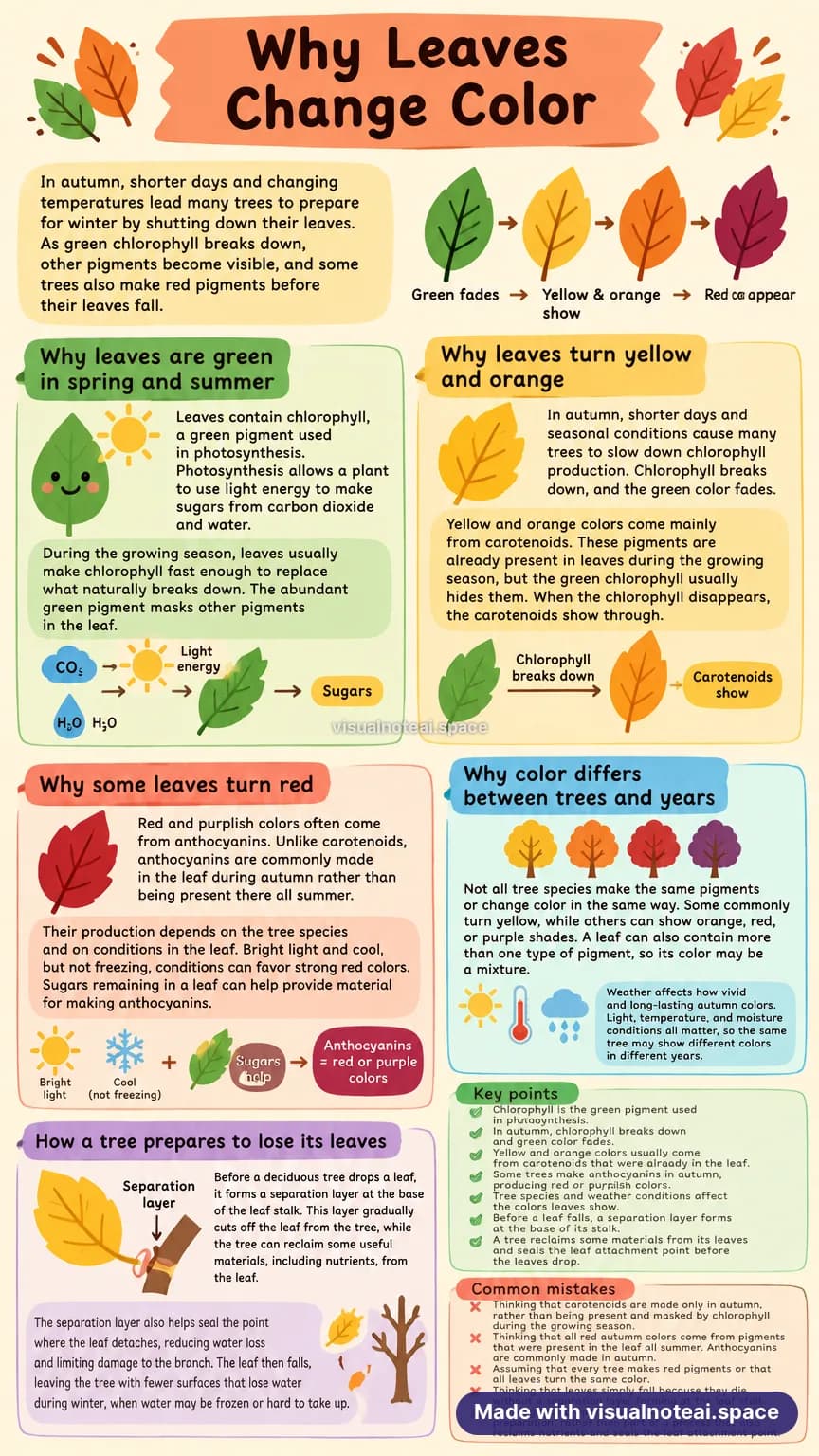
The whole topic on one page. Made with VisualNote.
!Common mistakes
- Thinking that carotenoids are made only in autumn, rather than being present and masked by chlorophyll during the growing season.
- Thinking that all red autumn colors come from pigments that were present in the leaf all summer. Anthocyanins are commonly made in autumn.
- Assuming that every tree makes red pigments or that all leaves turn the same color.
- Thinking that leaves simply fall because they die, without a separation layer forming at the leaf stalk.
- Thinking that dropping leaves is the tree's only winter preparation, rather than part of a process that also reclaims nutrients and seals the leaf attachment point.
🧠Explore the map30 ideas
The mind map VisualNote made for this topic. Drag to pan, scroll to zoom.
- Why Leaves Change Color
- Green Leaves in Growing Season
- Chlorophyll
- Green pigment used in photosynthesis
- Photosynthesis makes sugars from light, carbon dioxide, and water
- Chlorophyll is continually replaced
- Green masks other pigments
- Chlorophyll
- Yellow and Orange Autumn Colors
- Shorter days and seasonal conditions slow chlorophyll production
- Chlorophyll breaks down; green fades
- Carotenoids
- Present during growing season
- Become visible when chlorophyll fades
- Red and Purple Autumn Colors
- Anthocyanins
- Commonly produced in leaves during autumn
- Bright light and cool, nonfreezing conditions favor vivid red
- Remaining sugars provide material for production
- Anthocyanins
- Species and Yearly Color Differences
- Species vary in pigments and color patterns
- Leaves may contain multiple pigments
- Weather affects color vividness and duration
- Light, temperature, and moisture matter
- Leaf Separation and Fall
- Separation layer forms at base of leaf stalk
- Cuts off leaf from tree
- Tree reclaims nutrients and other useful materials
- Layer seals detachment point
- Reduces water loss and branch damage
- Fewer water-losing surfaces help winter survival
- Separation layer forms at base of leaf stalk
- Green Leaves in Growing Season
🃏Flashcards12 cards
- What is chlorophyll?
- Chlorophyll is the green pigment in leaves that captures light energy for photosynthesis.
- What does photosynthesis do?
- It uses light energy to make sugars from carbon dioxide and water.
- Why are leaves usually green in spring and summer?
- Leaves contain abundant chlorophyll, which masks other pigments. During the growing season, they replace chlorophyll as it breaks down.
- Why does green color fade in autumn?
- Shorter days and seasonal conditions slow chlorophyll production, while existing chlorophyll breaks down.
- What causes yellow and orange autumn colors?
- Carotenoids, which are already present in leaves during the growing season, become visible when green chlorophyll fades.
- What causes red and purplish autumn colors?
- These colors often come from anthocyanins, pigments commonly produced in leaves during autumn.
- What conditions can favor strong red leaf colors?
- Bright light and cool, but not freezing, conditions can favor anthocyanin production. Sugars remaining in the leaf can provide material for making these pigments.
- Why do autumn colors differ among tree species?
- Species vary in which pigments they make and how their leaves change color. A leaf may contain multiple pigments, creating mixed shades.
- How does weather affect autumn colors?
- Light, temperature, and moisture influence how vivid and long-lasting colors are; the same tree may look different from year to year.
- What is the leaf separation layer?
- It is a layer that forms at the base of the leaf stalk before a deciduous leaf falls, gradually cutting the leaf off from the tree.
- What happens to useful materials before a leaf falls?
- The tree can reclaim nutrients and other useful materials from the leaf as the separation layer forms.
- How does leaf drop help a tree prepare for winter?
- The separation layer seals the leaf’s attachment point, reducing water loss and branch damage. Dropping leaves also leaves fewer surfaces losing water when winter water is difficult to take up.
✅Test yourself5 questions
What role does chlorophyll play in a leaf?
Chlorophyll is the green pigment that helps capture light energy for photosynthesis.
Why do yellow and orange pigments become visible in many leaves during autumn?
Carotenoids are usually present during the growing season, but abundant chlorophyll masks their colors.
Which statement best describes anthocyanins in autumn leaves?
Anthocyanins are commonly produced during autumn, and bright light and cool, nonfreezing conditions can encourage strong red colors.
Why might the same tree show different autumn colors in different years?
Differences in light, temperature, and moisture can change how vivid and long-lasting a tree's colors are.
What happens before a deciduous tree leaf detaches?
A separation layer forms at the leaf stalk, allowing the tree to reclaim some materials and helping seal the point where the leaf detaches.
📝The notes
Why leaves are green in spring and summer
Leaves contain chlorophyll, a green pigment used in photosynthesis. Photosynthesis allows a plant to use light energy to make sugars from carbon dioxide and water.
During the growing season, leaves usually make chlorophyll fast enough to replace what naturally breaks down. The abundant green pigment masks other pigments in the leaf.
Why leaves turn yellow and orange
In autumn, shorter days and seasonal conditions cause many trees to slow down chlorophyll production. Chlorophyll breaks down, and the green color fades.
Yellow and orange colors come mainly from carotenoids. These pigments are already present in leaves during the growing season, but the green chlorophyll usually hides them. When the chlorophyll disappears, the carotenoids show through.
Why some leaves turn red
Red and purplish colors often come from anthocyanins. Unlike carotenoids, anthocyanins are commonly made in the leaf during autumn rather than being present there all summer.
Their production depends on the tree species and on conditions in the leaf. Bright light and cool, but not freezing, conditions can favor strong red colors. Sugars remaining in a leaf can help provide material for making anthocyanins.
Why color differs between trees and years
Not all tree species make the same pigments or change color in the same way. Some commonly turn yellow, while others can show orange, red, or purple shades. A leaf can also contain more than one type of pigment, so its color may be a mixture.
Weather affects how vivid and long-lasting autumn colors are. Light, temperature, and moisture conditions all matter, so the same tree may show different colors in different years.
How a tree prepares to lose its leaves
Before a deciduous tree drops a leaf, it forms a separation layer at the base of the leaf stalk. This layer gradually cuts off the leaf from the tree, while the tree can reclaim some useful materials, including nutrients, from the leaf.
The separation layer also helps seal the point where the leaf detaches, reducing water loss and limiting damage to the branch. The leaf then falls, leaving the tree with fewer surfaces that lose water during winter, when water may be frozen or hard to take up.
Make this for your own notes
Paste a chapter or a PDF and get the sheet, map, cards, quiz and episode back in about a minute. No credit card.