
Punnett Squares
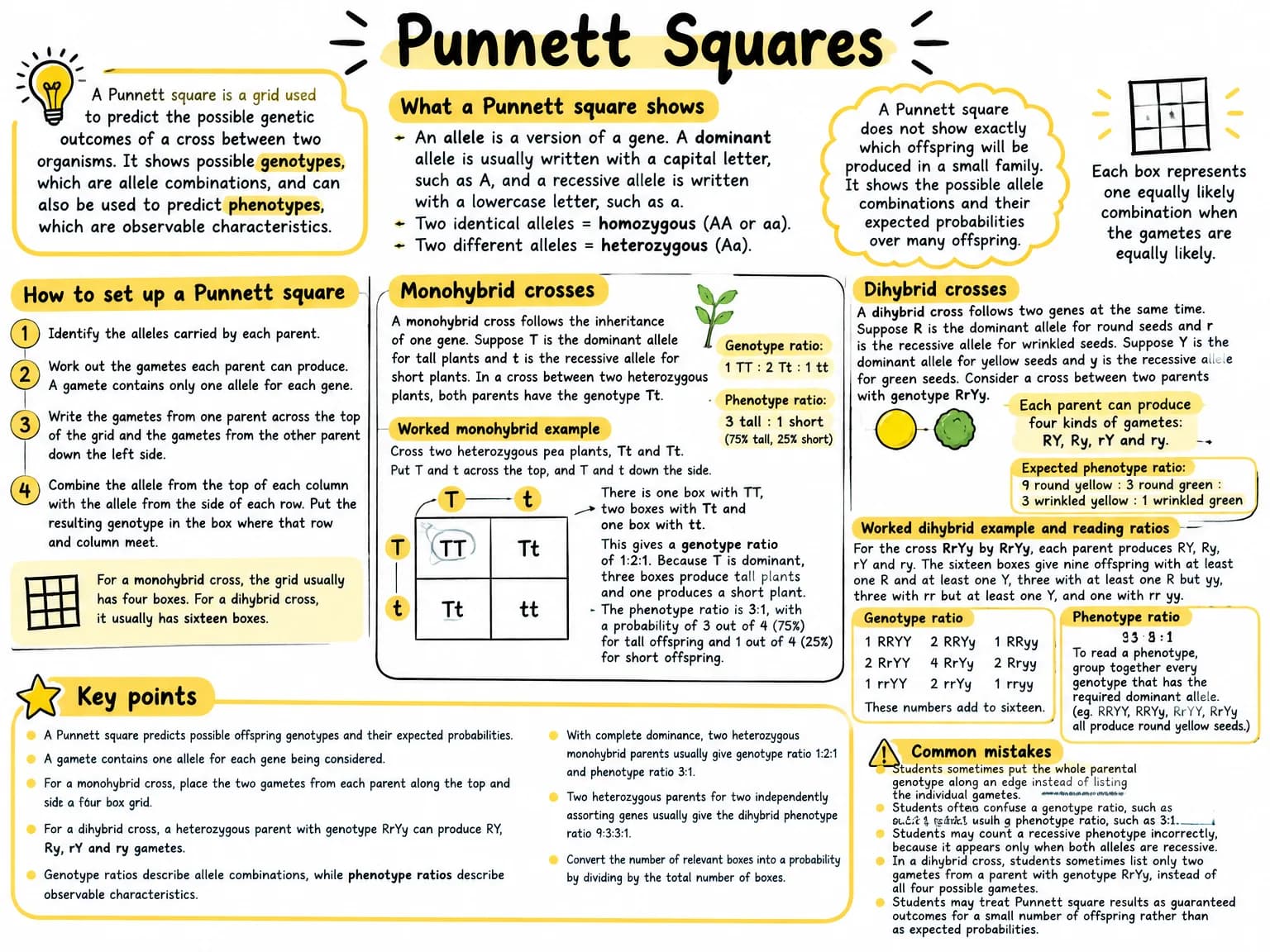
A Punnett square is a grid used to predict the possible genetic outcomes of a cross between two organisms. It shows possible genotypes, which are allele combinations, and can also be used to predict phenotypes, which are observable characteristics.
Punnett Squares at a glance
Listen: Punnett Squares
Two hosts talking it through, 3:03. The full transcript is below, so you can read along or skip the audio.
Transcript
AnnaMarco, what exactly is a Punnett square?
MarcoIt is a grid used to predict possible genetic outcomes when two organisms are crossed. It shows genotypes, meaning allele combinations, and it can also help predict phenotypes, or observable characteristics. But it does not tell us exactly which offspring a small family will have. It gives possible combinations and expected probabilities over many offspring.
AnnaSo the boxes represent possibilities, not guarantees. Before making the grid, what do we need to identify?
MarcoWe identify the alleles each parent carries, then work out the gametes each parent can produce. An allele is a version of a gene. A gamete contains one allele for each gene being considered. We put one parent’s gametes across the top and the other parent’s gametes down the side. Then we combine the allele at the top of each column with the allele at the side of each row.
AnnaAnd how do dominant and recessive alleles fit in?
MarcoA dominant allele is usually written with a capital letter, such as A. A recessive allele uses the matching lowercase letter, such as a. Two identical alleles make an organism homozygous, like AA or aa. Two different alleles make it heterozygous, like Aa.
AnnaLet’s use the one-gene example. What happens when two heterozygous tall plants, both Tt, are crossed?
MarcoEach parent can produce T or t gametes. That gives a four-box grid. The boxes are TT, Tt, Tt and tt. So the genotype ratio is one TT to two Tt to one tt, or one to two to one.
AnnaIf T is completely dominant, how do we translate that into characteristics?
MarcoTT and Tt are tall, while tt is short. Three boxes therefore show tall plants, and one shows a short plant. The phenotype ratio is three tall to one short. That means three out of four, or seventy-five percent, are expected to be tall, and one out of four, or twenty-five percent, short.
AnnaWhat changes in a dihybrid cross, where two genes are followed?
MarcoThe grid becomes larger. For parents with genotype RrYy, and assuming independent assortment, each parent can produce RY, Ry, rY and ry gametes. We place those four across the top and down the side, making sixteen boxes.
AnnaHow do we read those sixteen boxes?
MarcoWith complete dominance, the phenotype ratio is nine round yellow, three round green, three wrinkled yellow, and one wrinkled green: nine to three to three to one. For example, round yellow includes every genotype with at least one R and at least one Y. Several different genotypes can produce that same phenotype.
AnnaSo genotype and phenotype ratios must not be confused. What mistakes should we watch for?
MarcoDo not place a whole parental genotype along an edge; list individual gametes. Do not leave out two gametes in the RrYy case. Remember that a recessive characteristic appears only with two recessive alleles. Finally, divide relevant boxes by the total number of boxes for a probability, and remember that the result is expected likelihood, not a guaranteed small-family outcome.
The notes
What a Punnett square shows
An allele is a version of a gene. In a simple inheritance problem, a dominant allele is usually written with a capital letter, such as A, and a recessive allele is written with the matching lowercase letter, such as a. An organism with two identical alleles is homozygous, such as AA or aa. An organism with two different alleles is heterozygous, such as Aa.
A Punnett square does not show exactly which offspring will be produced in a small family. It shows the possible allele combinations and their expected probabilities over many offspring. Each box represents one equally likely combination when the gametes are equally likely.
How to set up a Punnett square
First, identify the alleles carried by each parent. Then work out the gametes each parent can produce. A gamete contains only one allele for each gene. Write the gametes from one parent across the top of the grid and the gametes from the other parent down the left side.
Combine the allele from the top of each column with the allele from the side of each row. Put the resulting genotype in the box where that row and column meet. For a monohybrid cross, the grid usually has four boxes. For a dihybrid cross, it usually has sixteen boxes.
Monohybrid crosses
A monohybrid cross follows the inheritance of one gene. For example, suppose T is the dominant allele for tall plants and t is the recessive allele for short plants. In a cross between two heterozygous plants, both parents have the genotype Tt.
Each parent can produce gametes carrying either T or t. The four boxes contain TT, Tt, Tt and tt. The genotype ratio is 1 TT to 2 Tt to 1 tt. If T is completely dominant, TT and Tt are tall, while tt is short. The phenotype ratio is therefore 3 tall to 1 short, or 75 percent tall and 25 percent short.
Worked monohybrid example
Cross two heterozygous pea plants, Tt and Tt. Put T and t across the top, and T and t down the side. Combining the alleles gives TT in the first box, Tt in the second, Tt in the third and tt in the fourth.
There is one box with TT, two boxes with Tt and one box with tt. This gives a genotype ratio of 1:2:1. Because T is dominant, three boxes produce tall plants and one produces a short plant. The phenotype ratio is 3:1, with a probability of 3 out of 4, or 75 percent, for tall offspring and 1 out of 4, or 25 percent, for short offspring.
Dihybrid crosses
A dihybrid cross follows two genes at the same time. Suppose R is the dominant allele for round seeds and r is the recessive allele for wrinkled seeds. Suppose Y is the dominant allele for yellow seeds and y is the recessive allele for green seeds. Consider a cross between two parents with genotype RrYy.
Each parent can produce four kinds of gametes, assuming the genes assort independently: RY, Ry, rY and ry. Place these four gametes across the top and down the side of a sixteen box grid. Each box receives one allele for the seed shape gene and one allele for the seed colour gene from each parent. In the usual complete dominance case, the expected phenotype ratio is 9 round yellow to 3 round green to 3 wrinkled yellow to 1 wrinkled green.
Worked dihybrid example and reading ratios
For the cross RrYy by RrYy, each parent produces RY, Ry, rY and ry. The sixteen boxes give nine offspring with at least one R and at least one Y, three with at least one R but yy, three with rr but at least one Y, and one with rr yy. The phenotype ratio is therefore 9:3:3:1.
The genotype ratio is more detailed because several boxes can contain the same genotype. The possible genotype groups are 1 RRYY, 2 RRYy, 1 RRyy, 2 RrYY, 4 RrYy, 2 Rryy, 1 rrYY, 2 rrYy and 1 rryy. These numbers add to sixteen. To read a phenotype, group together every genotype that has the required dominant allele. For example, RRYY, RRYy, RrYY and RrYy all produce round yellow seeds.
What to remember
- A Punnett square predicts possible offspring genotypes and their expected probabilities.
- A gamete contains one allele for each gene being considered.
- For a monohybrid cross, place the two gametes from each parent along the top and side of a four box grid.
- For a dihybrid cross, a heterozygous parent with genotype RrYy can produce RY, Ry, rY and ry gametes.
- Genotype ratios describe allele combinations, while phenotype ratios describe observable characteristics.
- With complete dominance, two heterozygous monohybrid parents usually give genotype ratio 1:2:1 and phenotype ratio 3:1.
- Two heterozygous parents for two independently assorting genes usually give the dihybrid phenotype ratio 9:3:3:1.
- Convert the number of relevant boxes into a probability by dividing by the total number of boxes.
Punnett Squares as a mind map
- Punnett Squares
- Purpose and Predictions
- Predicts possible genotypes
- Predicts phenotypes and expected probabilities
- Not guaranteed outcomes for a small family
- Genetic Terminology
- Allele: version of a gene
- Dominant allele: capital letter, such as A
- Recessive allele: lowercase letter, such as a
- Homozygous: two identical alleles
- Heterozygous: two different alleles
- Gamete: one allele for each gene
- Setting Up a Punnett Square
- Identify parental alleles
- Determine possible gametes
- Place one parent's gametes across the top
- Place the other parent's gametes down the side
- Combine alleles at each intersection
- Monohybrid Crosses
- Tracks one gene
- Example: Tt × Tt
- Genotypes: TT, Tt, Tt, tt
- Genotype ratio: 1:2:1
- Phenotype ratio: 3 tall:1 short
- Tall probability: 75%; short probability: 25%
- Dihybrid Crosses
- Tracks two genes simultaneously
- Example: RrYy × RrYy
- Gametes: RY, Ry, rY, ry
- Sixteen-box grid
- Independent assortment
- Phenotype ratio: 9:3:3:1
- Reading Results and Avoiding Mistakes
- Genotype ratio: allele combinations
- Phenotype ratio: observable characteristics
- Probability = relevant boxes ÷ total boxes
- Recessive phenotype requires two recessive alleles
- List individual gametes, not whole parental genotypes
- Include all four gametes for RrYy
- Group genotypes with the required dominant alleles
- Purpose and Predictions
Flashcards
- What is a Punnett square?
- A Punnett square is a grid used to predict possible offspring genotypes and their expected probabilities from a genetic cross. It can also help predict phenotypes.
- What is an allele?
- An allele is a version of a gene. Dominant alleles are commonly written with capital letters, while recessive alleles are written with lowercase letters.
- What do homozygous and heterozygous mean?
- Homozygous means having two identical alleles, such as AA or aa. Heterozygous means having two different alleles, such as Aa.
- What does each box in a Punnett square represent?
- Each box represents one possible allele combination from the two parents. When gametes are equally likely, the boxes represent equally likely outcomes.
- What is a gamete?
- A gamete is a sex cell containing one allele for each gene being considered.
- How is a Punnett square set up?
- List one parent’s gametes across the top and the other parent’s gametes down the side. Combine the alleles at each row-column intersection.
- What is a monohybrid cross?
- A monohybrid cross follows the inheritance of one gene and usually uses a four-box grid.
- What are the genotype and phenotype ratios for Tt × Tt with complete dominance?
- The genotype ratio is 1 TT : 2 Tt : 1 tt. The phenotype ratio is 3 tall : 1 short, or 75% tall and 25% short.
- What is a dihybrid cross?
- A dihybrid cross follows the inheritance of two genes at the same time and usually uses a sixteen-box grid.
- What gametes can an RrYy parent produce?
- Assuming independent assortment, an RrYy parent can produce four gametes: RY, Ry, rY, and ry.
- What is the expected phenotype ratio for RrYy × RrYy?
- With complete dominance and independent assortment, the expected phenotype ratio is 9 round yellow : 3 round green : 3 wrinkled yellow : 1 wrinkled green.
- How are genotype and phenotype ratios different?
- A genotype ratio describes allele combinations, while a phenotype ratio describes observable characteristics. Multiple genotypes may produce the same phenotype when dominance is present.
Test yourself
What does a Punnett square predict most accurately?
A Punnett square shows possible genotypes and expected probabilities over many offspring, not guaranteed results for a small family.
Which gametes can a parent with genotype RrYy produce if the genes assort independently?
A gamete receives one allele for each gene, giving four possible combinations from RrYy.
In a Tt × Tt cross, which pair gives the genotype ratio and phenotype ratio, respectively, when T is completely dominant?
The genotypes are TT:Tt:tt in a 1:2:1 ratio, while the dominant phenotype appears in three of four boxes, producing 3:1.
In a Tt × Tt cross, what is the probability that an offspring will show the recessive phenotype?
The recessive phenotype requires tt, which occupies one of the four equally likely boxes.
In an RrYy × RrYy cross with independent assortment and complete dominance, what phenotype ratio is expected?
Two heterozygous parents for two independently assorting genes produce the standard dihybrid phenotype ratio of 9:3:3:1.
Common mistakes
- Students sometimes put the whole parental genotype along an edge instead of listing the individual gametes.
- Students often confuse a genotype ratio, such as 1:2:1, with a phenotype ratio, such as 3:1.
- Students may count a recessive phenotype incorrectly, because it appears only when both alleles are recessive.
- In a dihybrid cross, students sometimes list only two gametes from a parent with genotype RrYy, instead of all four possible gametes.
- Students may treat Punnett square results as guaranteed outcomes for a small number of offspring rather than as expected probabilities.
Make this for your own notes
Everything on this page came from one source, generated in about a minute. Paste a chapter, upload a PDF or photograph your notes and get the same set back.
Try it freeNo credit card. Free every month.