
Balancing Chemical Equations
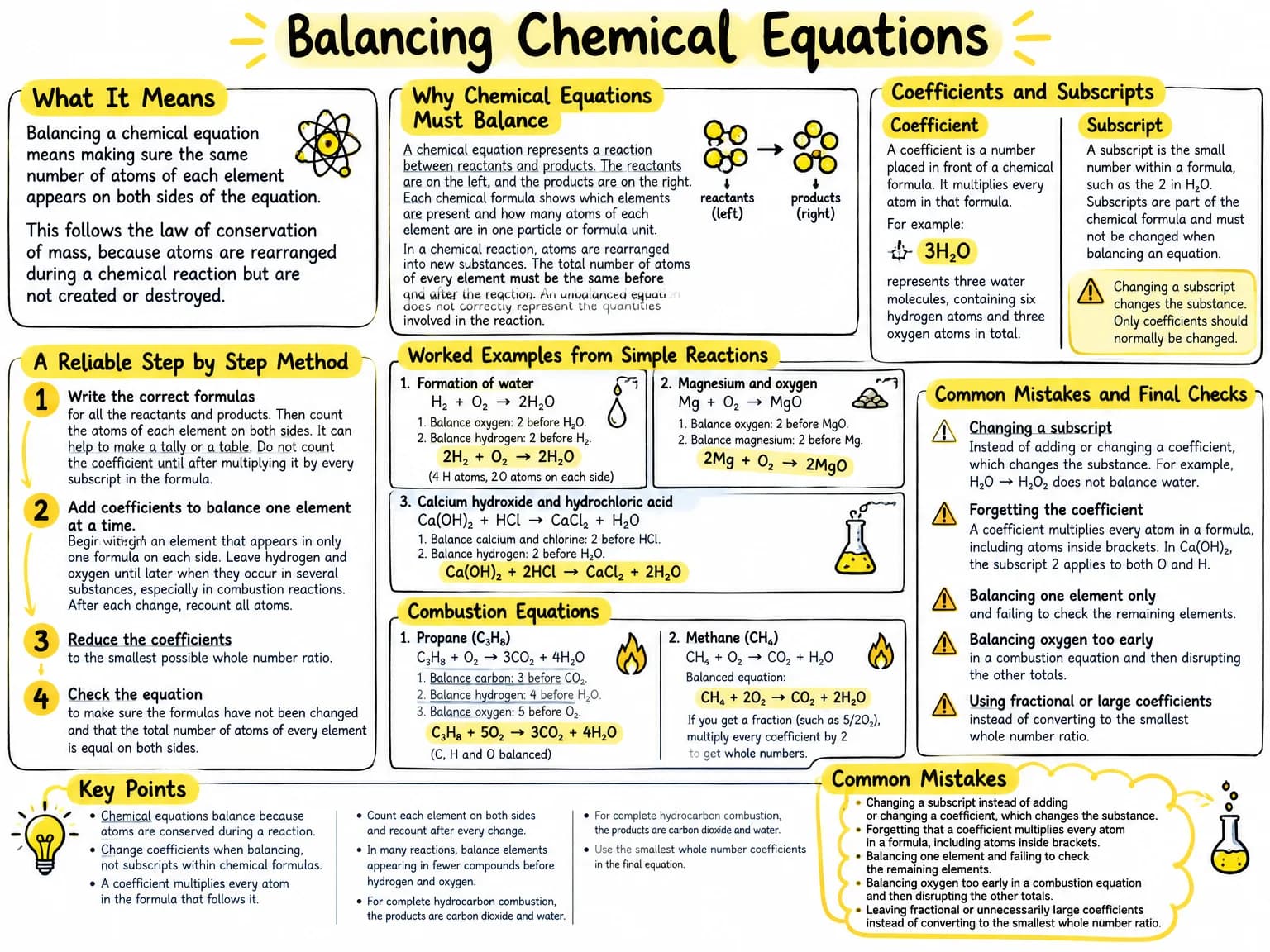
Balancing a chemical equation means making sure the same number of atoms of each element appears on both sides of the equation. This follows the law of conservation of mass, because atoms are rearranged during a chemical reaction but are not created or destroyed.
Balancing Chemical Equations at a glance
Listen: Balancing Chemical Equations
Two hosts talking it through, 2:56. The full transcript is below, so you can read along or skip the audio.
Transcript
AnnaWhy do chemical equations have to be balanced?
MarcoBecause atoms are conserved. During a reaction, atoms are rearranged into new substances, but they are not created or destroyed. So the number of atoms of every element must be the same among the reactants on the left and the products on the right. An unbalanced equation gives the wrong quantities.
AnnaWhat exactly can we change when balancing?
MarcoWe change coefficients, which are numbers placed before formulas. A coefficient multiplies every atom in the formula. Three H two O means three water molecules, so it contains six hydrogen atoms and three oxygen atoms. We should not change subscripts, the small numbers inside formulas. Changing a subscript changes the substance itself.
AnnaWhat method would you use for a new equation?
MarcoFirst, write the correct formulas for every reactant and product. Then count each element on both sides. A tally or table can help. Next, add coefficients one element at a time. It is useful to begin with an element appearing in only one formula on each side. Usually, leave hydrogen and oxygen until later when they occur in several substances. After every change, recount all the atoms.
AnnaCan we test that with the formation of water?
MarcoYes. Start with H two plus O two produces H two O. There are two oxygen atoms on the left and one on the right, so put a two before H two O. Now there are four hydrogen atoms on the right, so put a two before H two. The result is two H two plus O two produces two H two O. Both sides have four hydrogen atoms and two oxygen atoms.
AnnaDoes the same reasoning work for magnesium and oxygen?
MarcoIt does. Magnesium plus O two produces MgO. Put a two before MgO to match the two oxygen atoms. That gives two magnesium atoms on the right, so put a two before magnesium. The balanced equation is two Mg plus O two produces two MgO.
AnnaWhat changes when we balance combustion?
MarcoComplete combustion of a hydrocarbon produces carbon dioxide and water. For propane, start with C three H eight plus O two produces carbon dioxide plus water. Balance carbon with three carbon dioxides, then hydrogen with four waters. That creates ten oxygen atoms on the right, so use five O two. The final equation is C three H eight plus five O two produces three carbon dioxides plus four waters.
AnnaWhat mistakes should we watch for?
MarcoNever change a subscript, such as turning water into H two O two. Also remember that a coefficient affects the whole formula, including atoms inside brackets. In calcium hydroxide, the two applies to both oxygen and hydrogen. Finally, recount every element, balance oxygen last in combustion, and reduce the coefficients to the smallest whole-number ratio. If a fraction appears, multiply every coefficient to obtain whole numbers.
The notes
Why chemical equations must balance
A chemical equation represents a reaction between reactants and products. The reactants are written on the left, and the products are written on the right. Each chemical formula shows which elements are present and how many atoms of each element are in one particle or formula unit.
In a chemical reaction, atoms are rearranged into new substances. The total number of atoms of every element must therefore be the same before and after the reaction. An unbalanced equation does not correctly represent the quantities involved in the reaction.
Coefficients and subscripts
A coefficient is a number placed in front of a chemical formula. It multiplies every atom in that formula. For example, 3H2O represents three water molecules, containing six hydrogen atoms and three oxygen atoms in total.
A subscript is the small number within a formula, such as the 2 in H2O. Subscripts are part of the chemical formula and must not be changed when balancing an equation. Changing a subscript changes the substance itself. Only coefficients should normally be changed.
A reliable step by step method
First, write the correct formulas for all the reactants and products. Then count the atoms of each element on both sides. It can help to make a tally or a table. Do not count the coefficient until after multiplying it by every subscript in the formula.
Next, add coefficients to balance one element at a time. Begin with an element that appears in only one formula on each side. Leave hydrogen and oxygen until later when they occur in several substances, especially in combustion reactions. After each change, recount all atoms.
When all elements balance, reduce the coefficients to the smallest possible whole number ratio. Finally, check that the formulas have not been changed and that the total number of atoms of every element is equal on both sides.
Worked examples from simple reactions
Consider the formation of water: H2 + O2 → H2O. There are two oxygen atoms on the left but only one on the right, so place a 2 before H2O: H2 + O2 → 2H2O. There are now four hydrogen atoms on the right, so place a 2 before H2: 2H2 + O2 → 2H2O. The equation is balanced, with four hydrogen atoms and two oxygen atoms on each side.
For magnesium reacting with oxygen, start with Mg + O2 → MgO. Oxygen occurs as O2 on the left, so place a 2 before MgO: Mg + O2 → 2MgO. This gives two magnesium atoms on the right, so place a 2 before Mg: 2Mg + O2 → 2MgO.
For calcium hydroxide reacting with hydrochloric acid, use Ca(OH)2 + HCl → CaCl2 + H2O. Calcium and chlorine can be balanced by placing a 2 before HCl: Ca(OH)2 + 2HCl → CaCl2 + H2O. There are then four hydrogen atoms on the left, so place a 2 before H2O: Ca(OH)2 + 2HCl → CaCl2 + 2H2O. Oxygen is also balanced, so the equation is complete.
Combustion equations
Complete combustion of a hydrocarbon produces carbon dioxide and water. For example, balance propane burning in oxygen: C3H8 + O2 → CO2 + H2O. Balance carbon first by placing a 3 before CO2, then hydrogen by placing a 4 before H2O: C3H8 + O2 → 3CO2 + 4H2O.
There are now ten oxygen atoms on the right, six in carbon dioxide and four in water. Place a 5 before O2: C3H8 + 5O2 → 3CO2 + 4H2O. Carbon, hydrogen and oxygen are now balanced.
For methane, CH4 + O2 → CO2 + H2O becomes CH4 + 2O2 → CO2 + 2H2O. If balancing produces a fraction such as 5/2O2, multiply every coefficient by 2 to obtain whole numbers.
Common mistakes and final checks
A frequent mistake is changing a subscript to make the numbers match. For example, changing H2O into H2O2 does not balance water, because it changes water into hydrogen peroxide. Another mistake is changing only one part of a compound containing brackets. In Ca(OH)2, the subscript 2 applies to both O and H, so the formula contains two oxygen atoms and two hydrogen atoms.
Students also often forget that a coefficient multiplies the entire formula, or stop after balancing one element without checking the others. In combustion equations, oxygen should usually be balanced last. Before accepting an answer, count every element on both sides, check that all coefficients are whole numbers, and simplify them to the smallest ratio if possible.
What to remember
- Chemical equations balance because atoms are conserved during a reaction.
- Change coefficients when balancing, not subscripts within chemical formulas.
- A coefficient multiplies every atom in the formula that follows it.
- Count each element on both sides and recount after every change.
- In many reactions, balance elements appearing in fewer compounds before hydrogen and oxygen.
- For complete hydrocarbon combustion, the products are carbon dioxide and water.
- Use the smallest whole number coefficients in the final equation.
Balancing Chemical Equations as a mind map
- Balancing Chemical Equations
- Conservation of Mass
- Equal atoms of each element on both sides
- Atoms rearranged, not created or destroyed
- Reactants left; products right
- Coefficients and Subscripts
- Coefficient multiplies every atom in a formula
- Example: 3H2O contains 6 hydrogen and 3 oxygen atoms
- Subscripts are part of the formula
- Change coefficients, not subscripts
- Balancing Method
- Write correct formulas
- Count atoms on both sides
- Use a tally or table
- Balance one element at a time
- Balance elements in fewer compounds first
- Leave hydrogen and oxygen until later when needed
- Recount after every change
- Reduce to the smallest whole-number ratio
- Check formulas and atom totals
- Worked Examples
- Water: 2H2 + O2 → 2H2O
- Magnesium and oxygen: 2Mg + O2 → 2MgO
- Calcium hydroxide and hydrochloric acid: Ca(OH)2 + 2HCl → CaCl2 + 2H2O
- Combustion Equations
- Hydrocarbon combustion produces carbon dioxide and water
- Balance carbon, then hydrogen, then oxygen
- Propane: C3H8 + 5O2 → 3CO2 + 4H2O
- Methane: CH4 + 2O2 → CO2 + 2H2O
- Multiply all coefficients to remove fractions
- Common Mistakes and Checks
- Changing a subscript changes the substance
- Bracketed subscripts apply to every enclosed atom
- Remember that coefficients multiply the entire formula
- Check every element, not just one
- Balance oxygen last in combustion reactions
- Use whole numbers and simplify coefficients
- Conservation of Mass
Flashcards
- What does it mean to balance a chemical equation?
- It means ensuring that the same number of atoms of each element appears on both sides of the equation.
- Why must chemical equations be balanced?
- They follow the law of conservation of mass: atoms are rearranged during a reaction but are not created or destroyed.
- Where are reactants and products written in a chemical equation?
- Reactants are written on the left, and products are written on the right.
- What is a coefficient in a chemical equation?
- A coefficient is a number placed before a chemical formula. It multiplies every atom in that formula.
- What is a subscript, and why must it not be changed when balancing?
- A subscript is the small number within a chemical formula, such as the 2 in H₂O. Changing it changes the substance itself, so coefficients should be changed instead.
- How many atoms are represented by 3H₂O?
- It represents three water molecules containing six hydrogen atoms and three oxygen atoms in total.
- What is the first step in balancing a chemical equation?
- Write the correct formulas for all reactants and products, then count each element’s atoms on both sides.
- Which elements are often balanced last, especially in combustion reactions?
- Hydrogen and oxygen are often balanced last, with oxygen usually balanced after the other elements in combustion reactions.
- What is the balanced equation for forming water from hydrogen and oxygen?
- 2H₂ + O₂ → 2H₂O.
- What is the balanced equation for magnesium reacting with oxygen?
- 2Mg + O₂ → 2MgO.
- What are the products of complete hydrocarbon combustion?
- Complete combustion of a hydrocarbon produces carbon dioxide and water.
- What final checks should be made after balancing an equation?
- Confirm that every element has equal atom totals on both sides, formulas were not changed, coefficients are whole numbers, and the ratio is reduced to the smallest possible whole numbers.
Test yourself
Why must a chemical equation be balanced?
Balancing ensures that the number of atoms of each element is the same before and after the reaction, reflecting conservation of mass.
Which change correctly balances an equation without changing the substances involved?
A coefficient changes the number of particles while preserving the identity of the chemical formula.
How many hydrogen and oxygen atoms are present in 3Ca(OH)₂?
Each Ca(OH)₂ unit contains two hydrogen and two oxygen atoms, and the coefficient 3 multiplies both totals to six.
What is the balanced equation for the complete combustion of propane, C₃H₈?
Three carbon atoms require 3CO₂, eight hydrogen atoms require 4H₂O, and the resulting ten oxygen atoms require 5O₂.
If balancing an equation gives 5/2O₂ as a coefficient, what should be done?
Multiplying every coefficient by 2 removes the fraction while preserving the balanced ratio and producing whole numbers.
Common mistakes
- Changing a subscript instead of adding or changing a coefficient, which changes the substance.
- Forgetting that a coefficient multiplies every atom in a formula, including atoms inside brackets.
- Balancing one element and failing to check the remaining elements.
- Balancing oxygen too early in a combustion equation and then disrupting the other totals.
- Leaving fractional or unnecessarily large coefficients instead of converting to the smallest whole number ratio.
Make this for your own notes
Everything on this page came from one source, generated in about a minute. Paste a chapter, upload a PDF or photograph your notes and get the same set back.
Try it freeNo credit card. Free every month.