
The sky looks blue because molecules in Earth's atmosphere scatter blue light from sunlight in many directions, including toward your eyes. At sunset, sunlight travels through more atmosphere, so much of its blue light is scattered away before the remaining direct light reaches you, making the Sun and nearby sky look red or orange.
★What to remember
- Sunlight contains all the visible colours mixed together.
- Blue light has a shorter wavelength than red light.
- Air molecules scatter short wavelength light more strongly than long wavelength light.
- Scattered blue light reaches your eyes from across the sky, making the sky look blue.
- Violet is scattered strongly, but the sky still looks blue partly because our eyes are less sensitive to violet.
- Sunlight travels through more atmosphere when the Sun is near the horizon.
- At sunset, much of the blue light is scattered out of the direct beam, leaving more red and orange light.
🎧Listen2:31 · transcript
AnnaWhen you look up on a clear day, the sky seems simply blue. But what’s actually making it look that way?
MarcoIt isn’t the ocean reflecting its colour, and it isn’t because sunlight is blue. Sunlight looks white, but it contains many visible colours mixed together. Blue light has a shorter wavelength than red light.
AnnaSo if sunlight contains all those colours, what does the air do to them?
MarcoSunlight interacts with tiny molecules in the atmosphere, mainly nitrogen and oxygen. Those molecules scatter light in many directions. The effect is called Rayleigh scattering, and it affects different wavelengths unequally.
AnnaUnequally meaning the shorter wavelengths get scattered more?
MarcoExactly. Air molecules scatter blue light much more strongly than red light. Some of that scattered blue light travels toward your eyes from many parts of the sky. That’s why the whole sky can look blue, not just the patch around the Sun.
AnnaBut violet has an even shorter wavelength than blue. If it scatters so strongly, why don’t we see a violet sky?
MarcoGood question. Violet is scattered strongly, but the Sun produces less violet light. Some violet light is absorbed in the atmosphere, too. And our eyes are less sensitive to violet than to blue. Together, those things help explain why the sky looks blue to us.
AnnaThen the sky’s colour isn’t just about the light. It’s also about what reaches our eyes and how we see it.
MarcoRight. And the path sunlight takes through the atmosphere matters, especially at sunset. When the Sun is low near the horizon, its light passes through more atmosphere before it reaches you than when the Sun is high.
AnnaWhat happens to the blue light along that longer path?
MarcoMuch of it gets scattered out of the direct beam. So the sunlight that continues straight toward your eyes has more of the longer wavelengths, such as red and orange. That’s why the Sun and nearby sky can look red or orange. The Sun itself hasn’t changed colour; its light has travelled through more atmosphere.
AnnaCan the atmosphere make the sky look different for other reasons, too?
MarcoYes. Dust, water droplets, smoke, and clouds can scatter or absorb light differently from the small air molecules behind Rayleigh scattering. Clouds often look white because their much larger water droplets scatter many visible wavelengths in similar amounts.
AnnaSo the short version is: sunlight has many colours, air scatters blue more strongly, and that scattered light reaches us from across the sky. At sunset, more blue is scattered away from the direct sunlight.
MarcoThat’s it. And one detail worth keeping: violet is scattered too. It just contributes less to the colour we perceive, for several reasons.
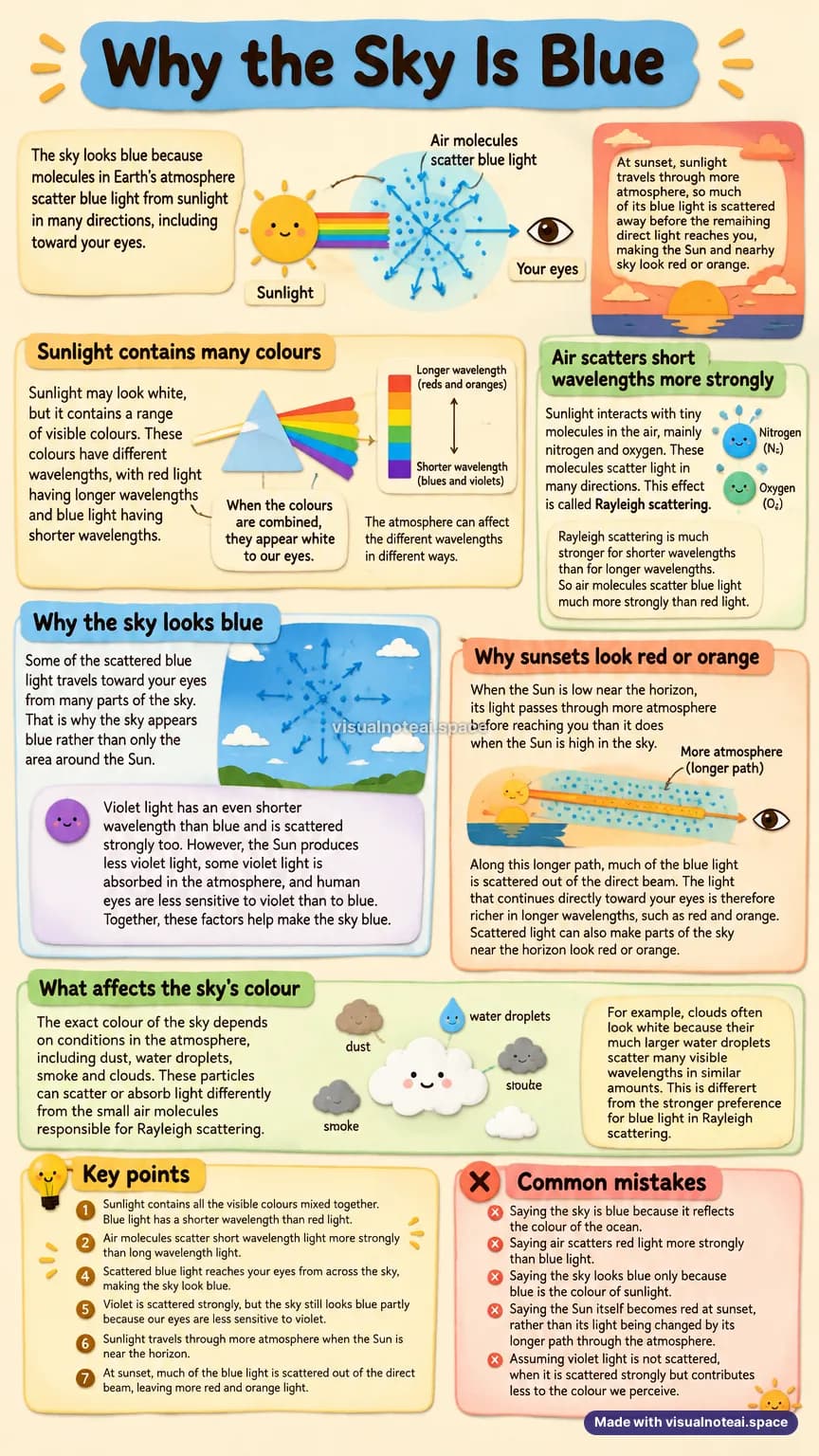
The whole topic on one page. Made with VisualNote.
!Common mistakes
- Saying the sky is blue because it reflects the colour of the ocean.
- Saying air scatters red light more strongly than blue light.
- Saying the sky looks blue only because blue is the colour of sunlight.
- Saying the Sun itself becomes red at sunset, rather than its light being changed by its longer path through the atmosphere.
- Assuming violet light is not scattered, when it is scattered strongly but contributes less to the colour we perceive.
🧠Explore the map25 ideas
The mind map VisualNote made for this topic. Drag to pan, scroll to zoom.
- Why the Sky Is Blue
- Sunlight and Wavelengths
- Visible colours combined appear white
- Blue has a shorter wavelength than red
- Rayleigh Scattering
- Nitrogen and oxygen molecules scatter sunlight
- Short wavelengths scatter more strongly
- Blue light scatters more than red light
- Why the Sky Looks Blue
- Scattered blue light reaches eyes from across the sky
- Violet also scatters strongly
- Less violet sunlight; some absorbed by atmosphere
- Human eyes are less sensitive to violet
- Why Sunsets Look Red or Orange
- Low Sun means a longer path through atmosphere
- Blue light scatters out of the direct beam
- Remaining direct light is richer in red and orange
- Atmospheric Conditions
- Dust, droplets, smoke, and clouds affect colour
- Cloud droplets scatter visible wavelengths similarly
- Common Misconceptions
- Sky colour is not reflected from the ocean
- Air scatters blue more strongly than red
- The Sun's light changes along its longer sunset path
- Violet is scattered but contributes less to perceived colour
- Sunlight and Wavelengths
🃏Flashcards12 cards
- Why does the sky look blue?
- Air molecules scatter blue light from sunlight in many directions, including toward our eyes, so blue light reaches us from across the sky.
- What colours does sunlight contain?
- Sunlight contains a range of visible colours that combine to appear white to our eyes.
- How do blue and red wavelengths compare?
- Blue light has a shorter wavelength than red light.
- What is Rayleigh scattering?
- It is the scattering of light in many directions by tiny air molecules, mainly nitrogen and oxygen.
- How does Rayleigh scattering vary with wavelength?
- It scatters shorter wavelengths much more strongly than longer wavelengths, so blue is scattered more strongly than red.
- Why does the whole sky appear blue, not just the area around the Sun?
- Scattered blue light reaches our eyes from many parts of the sky.
- Why does the sky look blue rather than violet?
- Although violet is scattered strongly, the Sun produces less violet, some is absorbed in the atmosphere, and human eyes are less sensitive to it than to blue.
- Why does sunlight take a longer atmospheric path at sunset?
- When the Sun is near the horizon, its light passes through more atmosphere before reaching an observer.
- Why do the Sun and nearby sky look red or orange at sunset?
- Much of the blue light is scattered out of the direct beam along its longer path, leaving light richer in red and orange wavelengths.
- Does the Sun itself become red at sunset?
- No. Its light is changed by traveling through more atmosphere, which scatters much of the blue light away.
- What conditions can affect the sky’s colour?
- Dust, water droplets, smoke, and clouds can scatter or absorb light differently from air molecules.
- Why do clouds often look white?
- Their much larger water droplets scatter many visible wavelengths in similar amounts, rather than strongly favouring blue light.
✅Test yourself5 questions
Why do air molecules scatter blue light more strongly than red light?
Rayleigh scattering affects shorter wavelengths more strongly, and blue light has a shorter wavelength than red light.
Why does the sky look blue across many directions, rather than only near the Sun?
Scattered blue light reaches our eyes from many parts of the sky.
Violet light is scattered strongly, so why does the sky generally appear blue rather than violet?
The Sun produces less violet, the atmosphere absorbs some, and human eyes are less sensitive to violet than to blue.
Why does direct sunlight often look red or orange near sunset?
At sunset, sunlight travels through more atmosphere, so much of its blue light is scattered away from the direct beam.
Why do clouds often look white rather than blue?
Cloud droplets are much larger than air molecules and scatter many visible wavelengths in similar amounts, making clouds appear white.
📝The notes
Sunlight contains many colours
Sunlight may look white, but it contains a range of visible colours. These colours have different wavelengths, with red light having longer wavelengths and blue light having shorter wavelengths.
When the colours are combined, they appear white to our eyes. The atmosphere can affect the different wavelengths in different ways.
Air scatters short wavelengths more strongly
Sunlight interacts with tiny molecules in the air, mainly nitrogen and oxygen. These molecules scatter light in many directions. This effect is called Rayleigh scattering.
Rayleigh scattering is much stronger for shorter wavelengths than for longer ones. So air molecules scatter blue light much more strongly than red light.
Why the sky looks blue
Some of the scattered blue light travels toward your eyes from many parts of the sky. That is why the sky appears blue rather than only the area around the Sun.
Violet light has an even shorter wavelength than blue and is scattered strongly too. However, the Sun produces less violet light, some violet light is absorbed in the atmosphere, and human eyes are less sensitive to violet than to blue. Together, these factors help make the sky look blue.
Why sunsets look red or orange
When the Sun is low near the horizon, its light passes through more atmosphere before reaching you than it does when the Sun is high in the sky. Along this longer path, much of the blue light is scattered out of the direct beam.
The light that continues directly toward your eyes is therefore richer in longer wavelengths, such as red and orange. Scattered light can also make parts of the sky near the horizon look red or orange.
What affects the sky's colour
The exact colour of the sky depends on conditions in the atmosphere, including dust, water droplets, smoke, and clouds. These particles can scatter or absorb light differently from the small air molecules responsible for Rayleigh scattering.
For example, clouds often look white because their much larger water droplets scatter many visible wavelengths in similar amounts. This is different from the stronger preference for blue light in Rayleigh scattering.
Make this for your own notes
Paste a chapter or a PDF and get the sheet, map, cards, quiz and episode back in about a minute. No credit card.