
Popcorn pops because each kernel contains a small amount of water sealed inside a tough outer hull. When heated, the water becomes steam and pressure rises until the hull breaks, allowing softened starch to expand into a light, foamy shape.
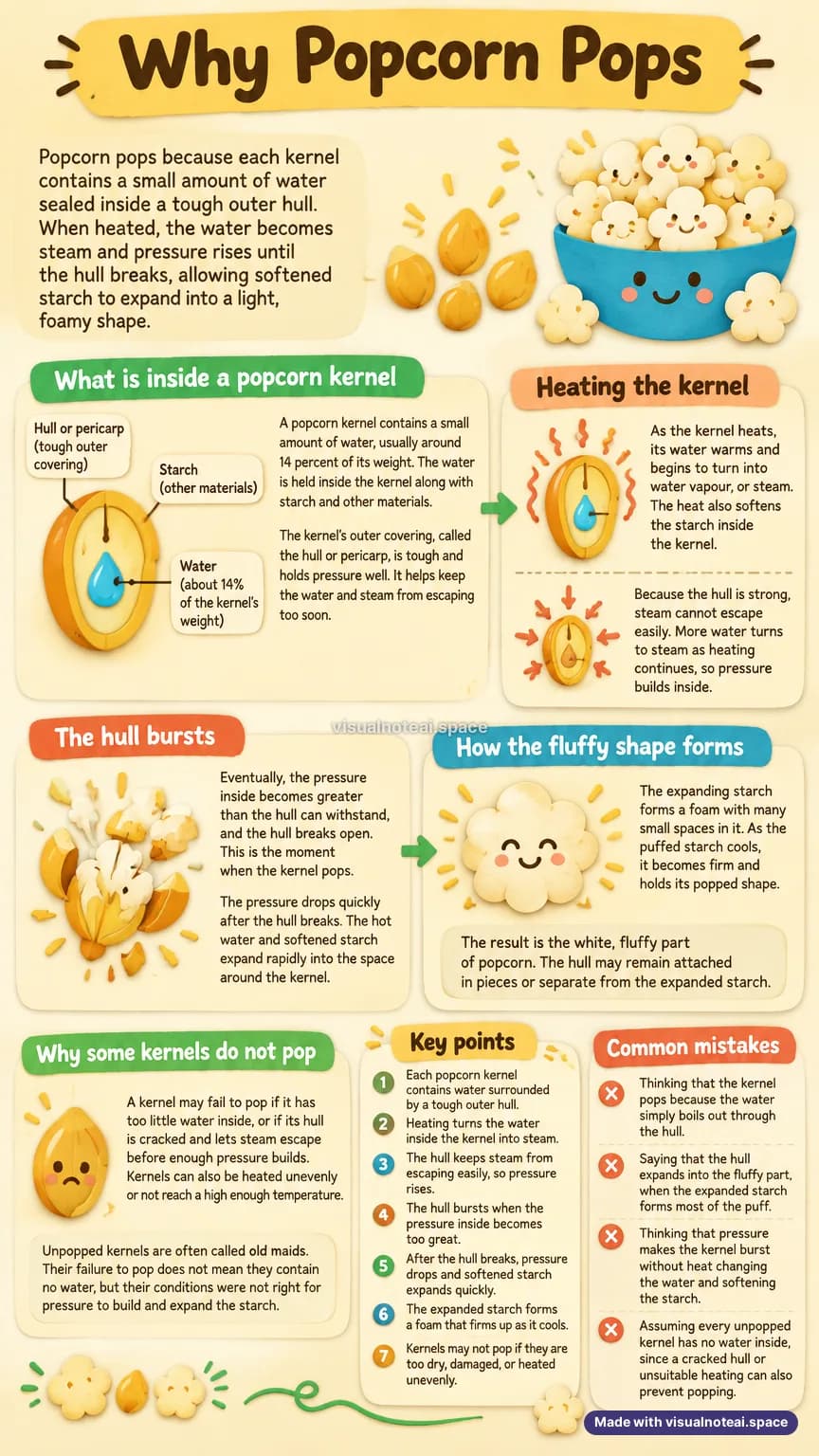
The whole topic on one page. Made with VisualNote.
★What to remember
- Each popcorn kernel contains water surrounded by a tough outer hull.
- Heating turns the water inside the kernel into steam.
- The hull keeps steam from escaping easily, so pressure rises.
- The hull bursts when the pressure inside becomes too great.
- After the hull breaks, pressure drops and softened starch expands quickly.
- The expanded starch forms a foam that firms up as it cools.
- Kernels may not pop if they are too dry, damaged, or heated unevenly.
🎧Listen2:16 · transcript
AnnaWhy does a popcorn kernel pop? Is it just the water inside boiling until it bursts out?
MarcoNot quite. The water does turn into steam as the kernel heats, but the steam does not simply boil out through the hull. The hull is tough, so it holds the steam in and lets pressure build.
AnnaSo the hull is like a little pressure container. How much water are we talking about?
MarcoUsually around fourteen percent of the kernel’s weight. It sits inside with starch and other materials. As the kernel warms, the water becomes water vapour, or steam, and the heat softens the starch too.
AnnaBoth things matter, then: pressure rising and starch softening. What finally makes the hull break?
MarcoThe pressure eventually becomes greater than the hull can withstand. Then the hull breaks open, and the pressure drops quickly.
AnnaAnd that sudden drop is when the fluffy part takes shape?
MarcoYes. The hot water and softened starch expand rapidly into the space around the kernel. The expanding starch forms a foam, with many small spaces inside it. As it cools, that puffed starch firms up and holds its shape.
AnnaSo it is the starch that makes most of the white, fluffy popcorn, not the hull expanding. Does the hull disappear?
MarcoNo. It may stay attached in pieces, or it may separate from the expanded starch. But the hull is not the main material in the puff.
AnnaThen why do some kernels stay hard at the bottom of the bowl? People call those old maids, right?
MarcoRight. A kernel can have too little water, or its hull might be cracked and let steam escape before enough pressure builds. It might also be heated unevenly or never get hot enough.
AnnaSo an unpopped kernel does not necessarily have no water inside. It could have water, but the conditions were wrong for pressure to build and the starch to expand.
MarcoExactly. And that helps correct another common idea: pressure alone is not the whole story. Heat has to turn the water into steam and soften the starch. Then, when the hull gives way, the starch can expand quickly and form that foam.
AnnaIt is a neat sequence. Heat changes the water and starch, the hull holds pressure, then the burst lets the starch puff up and set as it cools.
MarcoThat is the process. A small amount of water, a sturdy hull, and the right heating conditions turn a hard kernel into fluffy popcorn.
Study in Paper · Why Popcorn PopsWatch on YouTube
!Common mistakes
- Thinking that the kernel pops because the water simply boils out through the hull.
- Saying that the hull expands into the fluffy part, when the expanded starch forms most of the puff.
- Thinking that pressure makes the kernel burst without heat changing the water and softening the starch.
- Assuming every unpopped kernel has no water inside, since a cracked hull or unsuitable heating can also prevent popping.
🧠Explore the map24 ideas
The mind map VisualNote made for this topic. Drag to pan, scroll to zoom.
- Why Popcorn Pops
- Kernel Structure
- Water: About 14% of kernel weight
- Starch and other materials
- Tough hull (pericarp) traps steam
- Heating and Pressure
- Water heats and becomes steam
- Starch softens
- Hull limits steam escape
- Pressure builds inside kernel
- Hull Bursts
- Pressure exceeds hull strength
- Hull breaks open
- Pressure drops rapidly
- Puff Formation
- Hot softened starch expands
- Expanded starch forms a foam
- Cooling firms the fluffy shape
- Hull may stay attached or separate
- Why Kernels Do Not Pop
- Too little water
- Cracked hull leaks steam
- Uneven or insufficient heating
- Unpopped kernels: old maids
- Kernel Structure
🃏Flashcards12 cards
- What causes a popcorn kernel to pop?
- Heat turns water inside the kernel into steam, building pressure until the tough hull breaks. The softened starch then expands rapidly.
- What is the hull of a popcorn kernel?
- The hull, or pericarp, is the kernel’s tough outer covering. It helps hold water and steam inside.
- About how much of a popcorn kernel’s weight is water?
- Usually around 14 percent.
- What happens to the water as a kernel heats?
- It warms and turns into water vapour, or steam.
- What happens to the starch during heating?
- The heat softens the starch inside the kernel, preparing it to expand when the hull breaks.
- Why does pressure build inside a heating kernel?
- The tough hull prevents steam from escaping easily, so more steam accumulates as heating continues.
- When does the hull burst?
- It breaks when the pressure inside the kernel becomes greater than the hull can withstand.
- What happens to pressure after the hull breaks?
- It drops quickly, allowing hot water and softened starch to expand rapidly into the surrounding space.
- What forms the fluffy part of popcorn?
- Expanded starch forms most of the white, fluffy popcorn; the hull does not form the puff.
- How does popped starch hold its shape?
- The expanding starch forms a foam with many small spaces. As it cools, it firms up and holds its shape.
- What are unpopped kernels often called?
- They are often called old maids.
- Why might a kernel fail to pop?
- It may contain too little water, have a cracked hull that leaks steam, or be heated unevenly or insufficiently. It can still contain water and fail to pop.
✅Test yourself5 questions
Why does pressure build inside a heating popcorn kernel?
The tough hull prevents steam from escaping easily, so pressure rises as more water becomes steam.
What causes the kernel to pop?
The kernel pops when internal pressure becomes greater than the hull can withstand.
What forms most of the white, fluffy part of popped popcorn?
After the hull breaks, softened starch expands into a foam that becomes the fluffy popcorn.
Which condition can prevent a kernel from popping even if it contains some water?
A cracked hull can let steam escape too early for sufficient pressure to build.
Which description best explains how heating prepares a kernel to pop?
Heating converts the kernel’s water to steam while also softening its starch.
📝The notes
What is inside a popcorn kernel
A popcorn kernel contains a small amount of water, usually around 14 percent of its weight. The water is held inside the kernel along with starch and other materials.
The kernel’s outer covering, called the hull or pericarp, is tough and holds pressure well. It helps keep the water and steam from escaping too soon.
Heating the kernel
As the kernel heats, its water warms and begins to turn into water vapour, or steam. The heat also softens the starch inside the kernel.
Because the hull is strong, steam cannot escape easily. More water turns to steam as heating continues, so pressure builds inside.
The hull bursts
Eventually, the pressure inside becomes greater than the hull can withstand, and the hull breaks open. This is the moment when the kernel pops.
The pressure drops quickly after the hull breaks. The hot water and softened starch expand rapidly into the space around the kernel.
How the fluffy shape forms
The expanding starch forms a foam with many small spaces in it. As the puffed starch cools, it becomes firm and holds its popped shape.
The result is the white, fluffy part of popcorn. The hull may remain attached in pieces or separate from the expanded starch.
Why some kernels do not pop
A kernel may fail to pop if it has too little water inside, or if its hull is cracked and lets steam escape before enough pressure builds. Kernels can also be heated unevenly or not reach a high enough temperature.
Unpopped kernels are often called old maids. Their failure to pop does not mean they contain no water, but their conditions were not right for pressure to build and expand the starch.
Make this for your own notes
Paste a chapter or a PDF and get the sheet, map, cards, quiz and episode back in about a minute. No credit card.