
Onions make you cry because cutting them releases a gas that irritates the surface of your eyes. Your eyes respond by producing tears, which help wash the irritant away.
★What to remember
- Cutting an onion breaks its cells and lets enzymes mix with sulfur-containing compounds.
- Enzymatic reactions produce the volatile eye irritant syn-propanethial-S-oxide.
- The irritant gas can drift from the onion to the moist surface of the eyes.
- Nerves on the eye's surface detect irritation and trigger a reflex.
- The tear glands produce extra tears in response to that reflex.
- Tears help dilute and wash away the irritant.
🎧Listen2:26 · transcript
AnnaWhy does chopping an onion make your eyes water? Is it because onion juice somehow splashes into them?
MarcoUsually, no. The main cause is a gas released into the air when the onion is cut. It reaches the moist surface of your eyes and irritates it. Your eyes respond by making tears.
AnnaSo the gas is already sitting inside the onion, waiting to escape?
MarcoThat’s a common idea, but it’s not quite right. An onion has many cells containing sulfur-containing compounds and enzymes. Cutting or crushing breaks those cells, bringing the substances together. Then chemical reactions produce new substances, including the irritating gas.
AnnaAnd what is that gas called?
MarcoIt’s called syn-propanethial-S-oxide. It’s volatile, which means it evaporates easily. That lets it drift away from the cut onion and reach your eyes.
AnnaPeople sometimes say it’s sulfur that makes you cry. Is that accurate?
MarcoNot exactly. Sulfur-containing compounds are part of the starting materials, but sulfur itself isn’t the gas that makes your eyes water. Enzymes help transform those compounds. One enzyme involved is lachrymatory-factor synthase. It helps form syn-propanethial-S-oxide from a sulfur compound produced as an onion precursor breaks down.
AnnaOnce the gas reaches the eye, does it have to get inside the eye to cause a reaction?
MarcoNo. It can dissolve in the tear film on the eye’s surface and stimulate sensitive nerves there. Those nerves signal irritation. The gas doesn’t need to enter the inside of the eye.
AnnaThen the tears are a protective response, not a sign that the onion has made us sad?
MarcoExactly. Irritation triggers a reflex. The tear glands produce extra tears, which spread over the eye’s surface and help dilute and wash away the irritant. That response protects the eye, even though it makes chopping uncomfortable.
AnnaCan we do anything to reduce the irritation without changing that basic process?
MarcoA few things can reduce how much gas reaches you. Keeping the onion cool can slow the chemical reactions and reduce how quickly the gas forms. A sharp knife may damage fewer cells than a blunt one, though it can’t prevent the gas completely. And good ventilation can carry some of the gas away from your face.
AnnaSo those methods lower our exposure, rather than making the onion’s chemistry disappear?
MarcoRight. The key sequence stays the same: cutting breaks cells, enzymes and sulfur-containing compounds react, and an irritating gas forms. It reaches the eye’s surface, nerves detect irritation, and the tear glands produce extra tears to help wash it away.
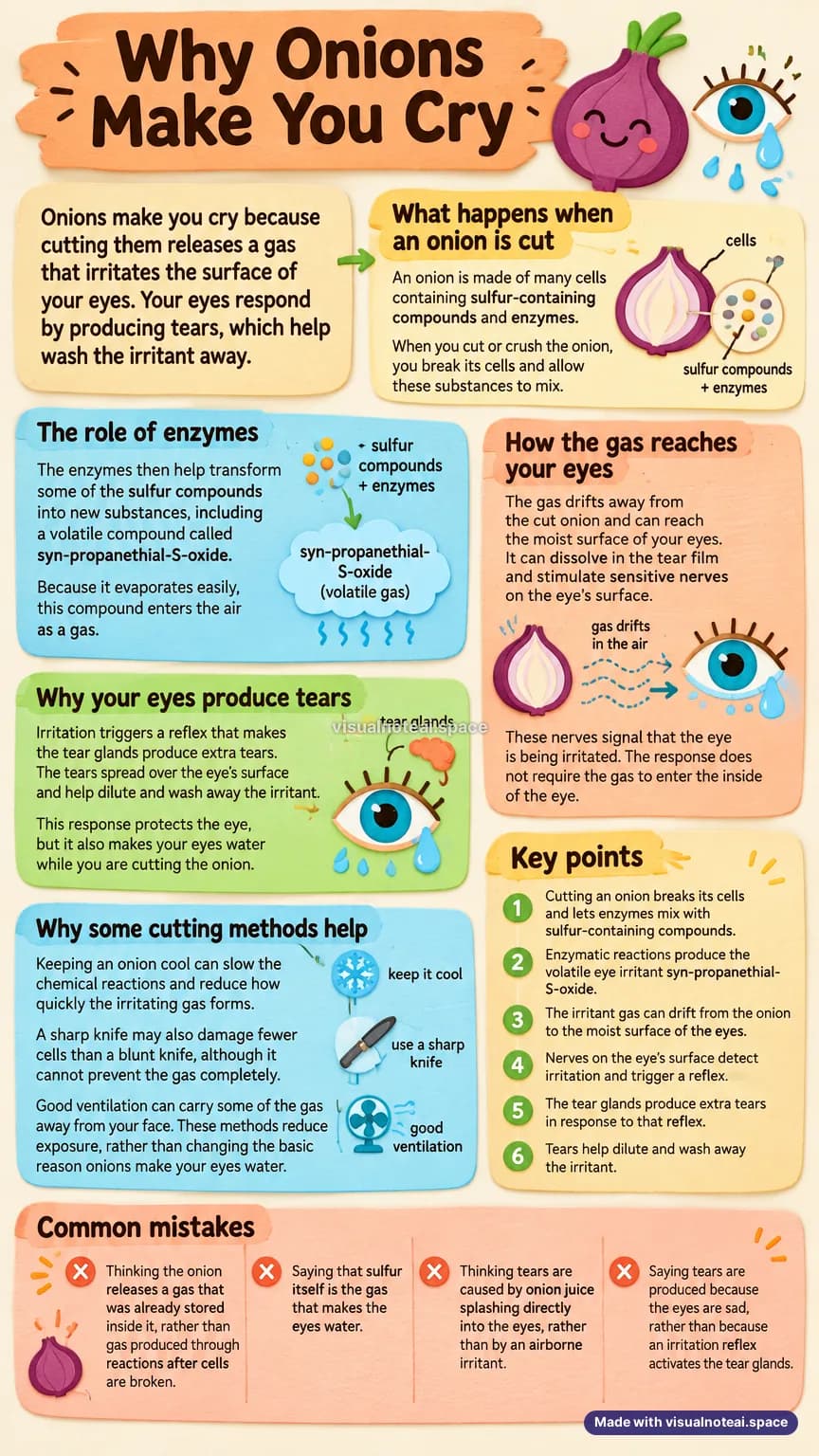
The whole topic on one page. Made with VisualNote.
!Common mistakes
- Thinking the onion releases a gas that was already stored inside it, rather than gas produced through reactions after cells are broken.
- Saying that sulfur itself is the gas that makes the eyes water.
- Thinking tears are caused by onion juice splashing directly into the eyes, rather than by an airborne irritant.
- Saying tears are produced because the eyes are sad, rather than because an irritation reflex activates the tear glands.
🧠Explore the map22 ideas
The mind map VisualNote made for this topic. Drag to pan, scroll to zoom.
- Why Onions Make You Cry
- Cell Damage
- Cutting breaks onion cells
- Sulfur compounds mix with enzymes
- Gas Formation
- Enzymatic reactions transform sulfur compounds
- Lachrymatory-factor synthase
- Produces syn-propanethial-S-oxide
- Volatile gas evaporates into the air
- Eye Irritation
- Gas reaches the moist eye surface
- Gas dissolves in the tear film
- Sensitive surface nerves detect irritation
- Tear Reflex
- Nerve signals trigger a reflex
- Tear glands produce extra tears
- Tears dilute and wash away the irritant
- Reducing Exposure
- Cool onions to slow reactions
- Use a sharp knife to damage fewer cells
- Ventilation carries gas away
- Methods reduce exposure, not gas formation entirely
- Cell Damage
🃏Flashcards12 cards
- Why do onions make your eyes water?
- Cutting an onion leads to the formation of an airborne irritant that reaches the eye’s surface. The eye responds by producing tears to dilute and wash it away.
- What happens to onion cells when an onion is cut or crushed?
- The cells break, allowing enzymes to mix with sulfur-containing compounds inside the onion.
- What is syn-propanethial-S-oxide?
- It is a volatile, eye-irritating compound produced by reactions involving onion enzymes and sulfur-containing compounds.
- Why can syn-propanethial-S-oxide travel from the onion to your eyes?
- It evaporates easily and enters the air as a gas, which can drift to the moist surface of the eyes.
- How does the irritant affect the eyes?
- It can dissolve in the tear film and stimulate sensitive nerves on the eye’s surface; it does not need to enter the inside of the eye.
- What triggers the eye’s tear response?
- Nerves on the eye’s surface detect irritation and signal a reflex that activates the tear glands.
- How do tears help protect the eyes?
- Extra tears spread over the eye’s surface, diluting and washing away the irritant.
- What is the role of onion enzymes in producing the irritant gas?
- After cells are broken, enzymes react with sulfur-containing starting compounds to help form the eye-irritating gas.
- What does lachrymatory-factor synthase do?
- It helps form syn-propanethial-S-oxide from a sulfur compound produced during the breakdown of an onion precursor.
- Is the irritating gas simply stored inside the onion and released unchanged?
- No. It is produced through chemical reactions after cutting brings enzymes into contact with sulfur-containing compounds.
- How can cooling an onion reduce eye irritation?
- Cooling can slow the chemical reactions, reducing how quickly the irritating gas forms.
- How can a sharp knife and good ventilation help when cutting onions?
- A sharp knife may damage fewer cells, while ventilation can carry some gas away from your face. Both can reduce exposure but cannot eliminate the basic cause.
✅Test yourself5 questions
What causes the eye-irritating gas to form when an onion is cut?
Breaking onion cells allows enzymes and sulfur-containing compounds to mix and form the irritant.
Which compound is identified as the volatile irritant that reaches the eyes?
Syn-propanethial-S-oxide evaporates easily and travels through the air from the cut onion.
How does the airborne onion irritant trigger extra tear production?
The irritant stimulates nerves on the eye's surface, and those nerves signal a reflex that activates the tear glands.
What is the main protective role of the extra tears produced while cutting an onion?
Tears spread across the eye's surface and help dilute and wash away the irritant.
Why can cooling an onion or using good ventilation reduce watery eyes?
Cooling can slow the reactions, while ventilation carries some gas away, reducing exposure without changing the basic cause.
📝The notes
What happens when an onion is cut
An onion is made of many cells containing sulfur-containing compounds and enzymes. When you cut or crush the onion, you break its cells and allow these substances to mix.
The enzymes then help transform some of the sulfur compounds into new substances, including a volatile compound called syn-propanethial-S-oxide. Because it evaporates easily, this compound enters the air as a gas.
How the gas reaches your eyes
The gas drifts away from the cut onion and can reach the moist surface of your eyes. It can dissolve in the tear film and stimulate sensitive nerves on the eye's surface.
These nerves signal that the eye is being irritated. The response does not require the gas to enter the inside of the eye.
Why your eyes produce tears
Irritation triggers a reflex that makes the tear glands produce extra tears. The tears spread over the eye's surface and help dilute and wash away the irritant.
This response protects the eye, but it also makes your eyes water while you are cutting the onion.
The role of enzymes
The gas is not simply stored inside the onion and released unchanged. Cutting brings onion enzymes into contact with sulfur-containing starting compounds, allowing reactions to produce the eye-irritating gas.
One enzyme involved is lachrymatory-factor synthase. It helps form syn-propanethial-S-oxide from a sulfur compound produced during the breakdown of an onion precursor.
Why some cutting methods help
Keeping an onion cool can slow the chemical reactions and reduce how quickly the irritating gas forms. A sharp knife may also damage fewer cells than a blunt knife, although it cannot prevent the gas completely.
Good ventilation can carry some of the gas away from your face. These methods reduce exposure, rather than changing the basic reason onions make your eyes water.
Make this for your own notes
Paste a chapter or a PDF and get the sheet, map, cards, quiz and episode back in about a minute. No credit card.