
Ionic and covalent bonds both involve attractions between charged particles, but they differ in what happens to the electrons. These differences help explain how compounds form and why their properties can vary.
★What to remember
- Ionic bonding involves electron transfer and attraction between oppositely charged ions.
- Covalent bonding involves atoms sharing pairs of electrons.
- A metal and a nonmetal often form an ionic compound, while two nonmetals often form a covalent compound.
- A large electronegativity difference tends to favor ionic bonding, but bonding can have mixed character.
- Ionic compounds form lattices, and their formulas show the simplest ratio of ions.
- Molten or dissolved ionic compounds can conduct electricity because their ions can move.
- Many small molecular covalent substances have low melting points, but network covalent substances can have very high melting points.
🎧Listen3:17 · transcript
AnnaWhen people compare ionic and covalent bonds, they often start with a simple question: what happens to the electrons? Marco, how would you explain the difference?
MarcoIn an ionic bond, one atom transfers electrons to another. The atom that loses electrons becomes a positively charged ion. The one that gains them becomes negatively charged. Opposite charges attract. In a covalent bond, atoms share pairs of electrons, and those shared electrons are attracted to both atoms’ nuclei.
AnnaSo transfer on one side, sharing on the other. Is there a quick way to predict which kind of bond will form?
MarcoA useful guide is the elements involved. A metal with a nonmetal usually forms an ionic compound. Two nonmetals usually form a covalent compound. Sodium chloride is ionic, and water is covalent. But it’s a guide, not an absolute rule.
AnnaBecause the atoms’ attraction for electrons matters too, right?
MarcoRight. That attraction is described by electronegativity. A large difference in electronegativity tends to favor electron transfer and ionic bonding. A smaller difference tends to favor sharing. The boundary isn’t perfectly sharp, so some bonds have both ionic and covalent character.
AnnaWhat about the way the compounds are built? Is an ionic compound like a collection of little molecules?
MarcoUsually, no. Ionic compounds form a repeating three-dimensional arrangement called a crystal lattice. The attractions extend throughout it. The formula gives the simplest ratio of ions, not a separate molecule. Sodium chloride, written as N A C L, has a one-to-one ratio of sodium ions to chloride ions.
AnnaAnd covalent substances often do have separate molecules?
MarcoMany do. Water and oxygen are examples. Covalent bonds hold atoms together inside each molecule. Attractions between separate molecules are usually weaker than those bonds. But not every covalent substance is made of separate molecules. Diamond and silicon dioxide have atoms joined in large, continuous network structures.
AnnaThat difference helps explain melting points, doesn’t it?
MarcoYes. Ionic compounds often have high melting and boiling points because many strong attractions across the lattice must be overcome. They’re commonly solids at room temperature. Small molecular covalent substances often have lower melting and boiling points. Melting or boiling usually overcomes attractions between molecules, rather than breaking the covalent bonds inside them. Network covalent substances are an important exception, and often have very high melting points.
AnnaWhat about electrical conductivity? Ionic solids contain charged ions, so why don’t they conduct?
MarcoBecause the ions are fixed in place in the solid. When an ionic compound is molten or dissolved in water, the ions can move and carry charge. Molecular covalent substances generally don’t conduct because they lack freely moving charged particles.
AnnaAnd solubility doesn’t follow one guaranteed rule?
MarcoExactly. Many ionic compounds dissolve in water, and some molecular substances do too. It depends on the substance and the solvent. So the safest summary is to look at electron behavior, structure, and whether charged particles can move. The usual element guide helps, but it shouldn’t be treated as absolute.
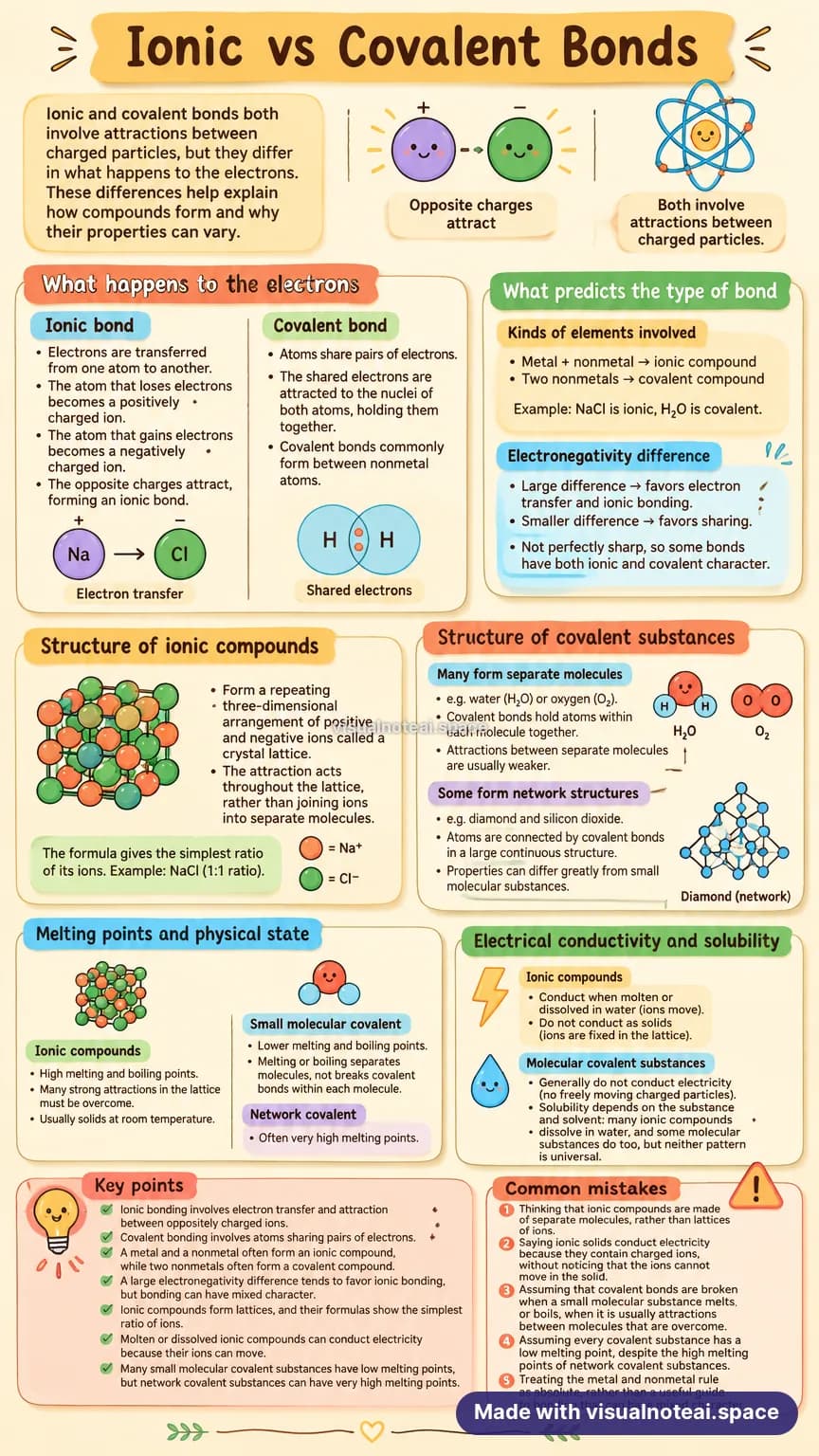
The whole topic on one page. Made with VisualNote.
!Common mistakes
- Thinking that ionic compounds are made of separate molecules, rather than lattices of ions.
- Saying ionic solids conduct electricity because they contain charged ions, without noticing that the ions cannot move in the solid.
- Assuming that covalent bonds are broken when a small molecular substance melts or boils, when it is usually attractions between molecules that are overcome.
- Assuming every covalent substance has a low melting point, despite the high melting points of network covalent substances.
- Treating the metal and nonmetal rule as absolute, rather than a useful guide to bonding that can have mixed character.
🧠Explore the map37 ideas
The mind map VisualNote made for this topic. Drag to pan, scroll to zoom.
- Ionic vs. Covalent Bonds
- How Bonds Form
- Ionic: electron transfer
- Electron-losing atom becomes positive ion
- Electron-gaining atom becomes negative ion
- Opposite charges attract
- Covalent: shared electron pairs
- Shared electrons attract both nuclei
- Ionic: electron transfer
- Bond Type Predictors
- Metal + nonmetal usually ionic
- Two nonmetals usually covalent
- Electronegativity difference
- Large difference favors electron transfer
- Small difference favors sharing
- Bonding can have mixed character
- Compound Structures
- Ionic compounds form crystal lattices
- Lattice attractions extend throughout structure
- Formula gives simplest ion ratio
- Molecular covalent substances
- Covalent bonds hold atoms within molecules
- Intermolecular attractions are usually weaker
- Network covalent structures
- Continuous bonded structures, such as diamond
- Ionic compounds form crystal lattices
- Melting and Boiling Points
- Ionic compounds often have high melting and boiling points
- Small molecular covalent substances often have low melting and boiling points
- Molecular melting usually overcomes intermolecular attractions
- Network covalent substances often have very high melting points
- Conductivity and Solubility
- Molten or dissolved ionic compounds conduct electricity
- Mobile ions carry charge
- Solid ionic compounds usually do not conduct
- Lattice ions are fixed in place
- Molecular covalent substances generally do not conduct
- Solubility depends on substance and solvent
- Many ionic compounds dissolve in water; some molecular substances do too
- Molten or dissolved ionic compounds conduct electricity
- How Bonds Form
🃏Flashcards12 cards
- What happens to electrons in an ionic bond?
- Electrons transfer from one atom to another. The resulting oppositely charged ions attract each other.
- What happens to electrons in a covalent bond?
- Atoms share pairs of electrons, which are attracted to both atoms’ nuclei and hold the atoms together.
- Which element combinations usually form ionic and covalent compounds?
- A metal and a nonmetal usually form an ionic compound; two nonmetals usually form a covalent compound. This is a useful guide, not an absolute rule.
- How does electronegativity difference help predict bonding?
- A large difference in electronegativity tends to favor electron transfer and ionic bonding, while a smaller difference tends to favor sharing. Some bonds have both ionic and covalent character.
- What is the structure of an ionic compound?
- Ionic compounds usually form repeating three-dimensional crystal lattices of positive and negative ions, rather than separate molecules.
- What does the formula of an ionic compound represent?
- It gives the simplest ratio of its ions. For example, NaCl represents a one-to-one ratio of sodium ions to chloride ions.
- How are atoms arranged in molecular covalent substances?
- Covalent bonds hold atoms together within separate molecules, such as water or oxygen molecules. Attractions between separate molecules are usually weaker than the covalent bonds within them.
- What is a network covalent substance?
- It is a substance whose atoms are linked by covalent bonds in a large continuous structure, rather than separate molecules. Diamond and silicon dioxide are examples.
- Why do ionic compounds often have high melting and boiling points?
- Many strong attractions throughout the ionic lattice must be overcome to separate the ions. Ionic compounds are commonly solids at room temperature.
- Why do small molecular covalent substances often have low melting and boiling points?
- Melting or boiling usually overcomes attractions between molecules, rather than breaking the covalent bonds within each molecule.
- Why can ionic compounds conduct electricity when molten or dissolved, but not as solids?
- Molten or dissolved ions can move and carry charge. In a solid ionic lattice, the ions are held in fixed positions.
- What are common conductivity and melting-point patterns for covalent substances?
- Molecular covalent substances generally do not conduct electricity and often have low melting points. Network covalent substances are important exceptions, often having very high melting points.
✅Test yourself5 questions
What happens to electrons when an ionic bond forms?
Ionic bonding involves electron transfer, leaving one atom positive and the other negative.
Which description best represents the structure of solid sodium chloride?
Ionic compounds form repeating lattices of oppositely charged ions rather than separate molecules.
Why does solid sodium chloride generally not conduct electricity, while molten sodium chloride can?
Ions carry charge only when they are free to move, as they are in molten sodium chloride.
When a small molecular covalent substance melts, what is usually overcome?
Melting a small molecular substance usually separates molecules by overcoming intermolecular attractions, not their covalent bonds.
Which statement explains why diamond can have a very high melting point despite being covalent?
Diamond is a network covalent substance with covalent bonds extending throughout a continuous structure.
📝The notes
What happens to the electrons
In an ionic bond, electrons are transferred from one atom to another. The atom that loses electrons becomes a positively charged ion, and the atom that gains electrons becomes a negatively charged ion. The opposite charges attract, forming an ionic bond.
In a covalent bond, atoms share pairs of electrons. The shared electrons are attracted to the nuclei of both atoms, holding them together. Covalent bonds commonly form between nonmetal atoms.
What predicts the type of bond
A useful first guide is the kinds of elements involved. A metal combined with a nonmetal usually forms an ionic compound, while two nonmetals usually form a covalent compound. For example, sodium chloride is ionic, while water is covalent.
The difference in how strongly the atoms attract electrons also matters. A large difference in electronegativity, a measure of an atom's attraction for shared electrons, tends to favor electron transfer and ionic bonding. A smaller difference tends to favor sharing. The distinction is not perfectly sharp, so some bonds have both ionic and covalent character.
Structure of ionic compounds
Ionic compounds usually form a repeating three-dimensional arrangement of positive and negative ions called a crystal lattice. The attraction acts throughout the lattice, rather than joining ions into separate molecules.
The formula of an ionic compound gives the simplest ratio of its ions. For example, sodium chloride has a one-to-one ratio of sodium ions to chloride ions, so its formula is NaCl.
Structure of covalent substances
Many covalent substances consist of separate molecules, such as water molecules or oxygen molecules. The covalent bonds hold the atoms within each molecule together. Attractions between separate molecules are usually weaker than the covalent bonds within them.
Some covalent substances do not form separate molecules. In network covalent substances, such as diamond and silicon dioxide, atoms are connected by covalent bonds in a large continuous structure. Their properties can therefore differ greatly from those of small molecular substances.
Melting points and physical state
Ionic compounds often have high melting and boiling points because many strong attractions throughout the lattice must be overcome to separate the ions. They are commonly solids at room temperature.
Small molecular covalent substances often have lower melting and boiling points because melting or boiling usually separates molecules by overcoming attractions between them, not by breaking the covalent bonds within each molecule. Network covalent substances are an important exception and often have very high melting points.
Electrical conductivity and solubility
Ionic compounds conduct electricity when molten or dissolved in water because their ions can move and carry charge. They generally do not conduct electricity as solids because their ions are held in fixed positions in the lattice.
Molecular covalent substances generally do not conduct electricity because they lack freely moving charged particles. Solubility depends on the substance and the solvent: many ionic compounds dissolve in water, and some molecular substances do too, but neither pattern is universal.
Make this for your own notes
Paste a chapter or a PDF and get the sheet, map, cards, quiz and episode back in about a minute. No credit card.