
Thermochemistry equations describe how much heat is absorbed or released when a chemical reaction happens, usually at constant pressure, and they express that energy change as an enthalpy change ΔH in kilojoules per mole. To revise this topic well you need three tools: the heat equation q = m × c × ΔT for measuring energy with a calorimeter, the sign convention that tells you whether a reaction is exothermic or endothermic, and Hess's law for combining known reactions to find an unknown enthalpy change.
★What to remember
- The heat equation is q = m × c × ΔT, with m in grams, c in J g⁻¹ °C⁻¹ and q in joules.
- For water in a calorimeter, c is 4.18 J g⁻¹ °C⁻¹ and the solution is usually assumed to have the density of water.
- The enthalpy change of a reaction is ΔH = −q(surroundings) / n, quoted in kJ mol⁻¹ for the equation as written.
- A negative ΔH means an exothermic reaction and a positive ΔH means an endothermic reaction.
- Reversing an equation changes the sign of ΔH, and multiplying an equation by a factor multiplies ΔH by that factor.
- Hess's law states that the enthalpy change for a reaction is the same whatever route is taken between the same reactants and products.
- ΔH of reaction equals the sum of formation enthalpies of products minus the sum of formation enthalpies of reactants, each multiplied by stoichiometric coefficients.
- Heat losses to the surroundings make measured calorimetry values smaller in magnitude than true enthalpy changes.
🎧Listen2:28 · transcript
AnnaMarco, let's talk about thermochemistry equations. Where would you even start with this topic?
MarcoHonestly, I'd start with the heat equation. q equals m times c times delta T. Mass in grams, specific heat in joules per gram per degree Celsius, and the temperature change. You get q in joules.
AnnaAnd for water, the specific heat is four point one eight, right? Why do people assume a solution behaves like water?
MarcoBecause in a calorimeter, the solution is usually treated as having the density and specific heat of water unless the question says otherwise. It's a simplifying assumption, and it's what the exam expects.
AnnaSo the heat measured for the solution is equal in size to the reaction's heat, but opposite in sign. That's the trick people trip over, isn't it?
MarcoYes. If the water warms up, it has gained heat, so the reaction must have released it. Energy is conserved, so the sign flips when you get to the enthalpy change.
AnnaLet's test that. A student burns half a gram of ethanol and heats two hundred grams of water from twenty to thirty-six degrees. What do you get?
MarcoThe water gains about thirteen point four kilojoules. Divide by the moles of ethanol, roughly zero point zero one oh eight seven, and you get about minus twelve hundred and thirty kilojoules per mole.
AnnaAnd the negative sign tells us it's exothermic. But is that number close to the real value?
MarcoNot quite. Heat escapes to the air and the apparatus, so the measured figure is smaller in magnitude than the true value. That's a systematic error worth mentioning in an exam.
AnnaOkay, now the harder part. How does Hess's law help when you don't have the enthalpy you need directly?
MarcoYou combine known reactions. Reverse an equation and its enthalpy change changes sign. Multiply an equation by a factor and the enthalpy scales by the same factor. Then add them so the species cancel to give your target.
AnnaLet's use the carbon monoxide case. Carbon with oxygen to carbon dioxide is minus three ninety three point five. What do we do with the second one?
MarcoWe reverse the carbon monoxide combustion and halve it. That gives plus two eighty three. Add it to the first, cancel the carbon dioxide and half an oxygen, and you're left with minus one ten point five kilojoules per mole.
AnnaSo what's the quickest sanity check before you trust your answer?
MarcoMake sure your adjusted equations add up exactly to the target before you touch the enthalpy values. And always write the final answer with its sign and units. That habit saves a lot of marks.
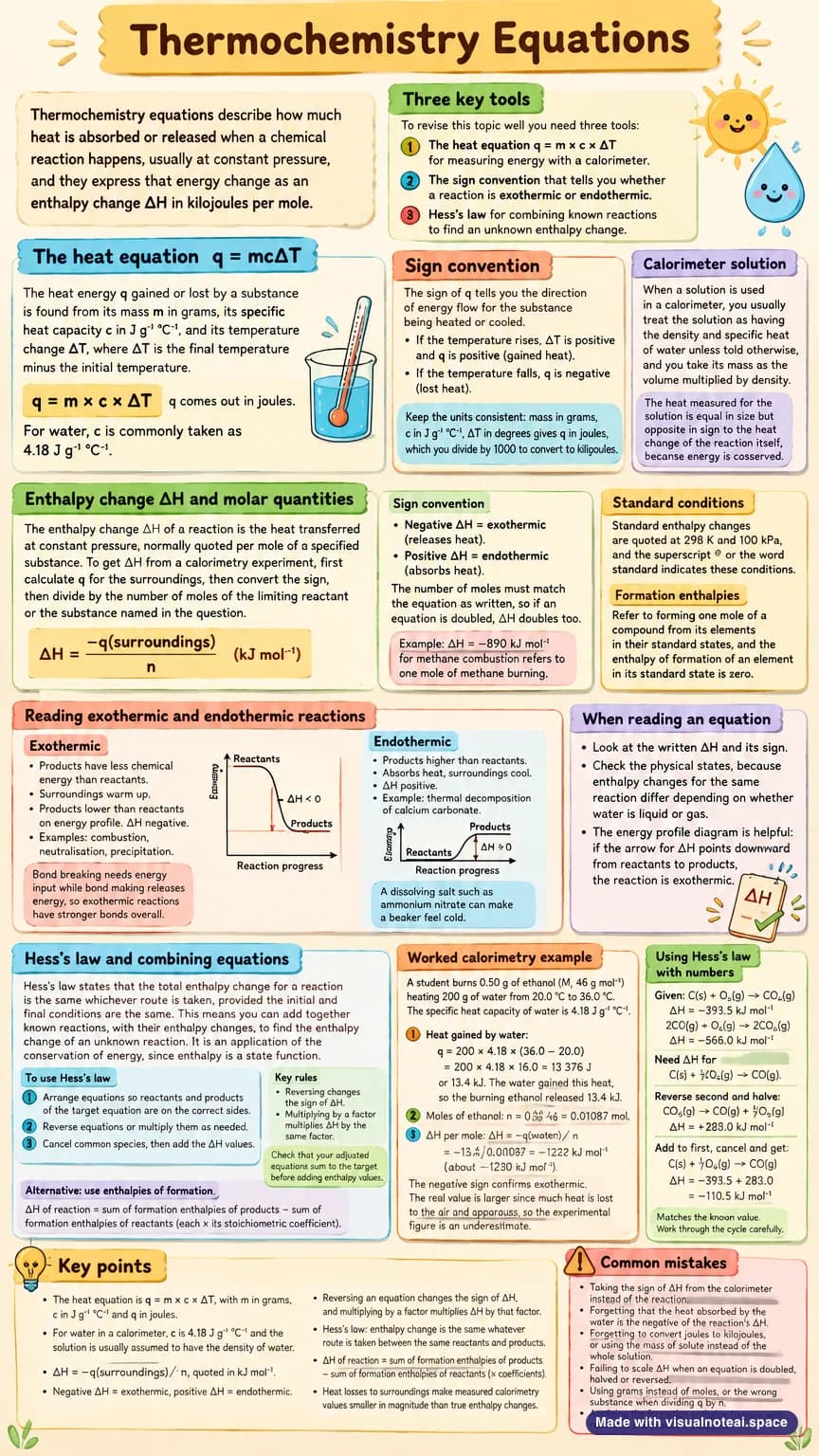
The whole topic on one page. Made with VisualNote.
!Common mistakes
- Taking the sign of ΔH from the calorimeter instead of the reaction, forgetting that the heat absorbed by the water is the negative of the reaction's ΔH, so a warming solution means an exothermic reaction.
- Forgetting to convert joules to kilojoules, or using the mass of solute rather than the mass of the whole solution in the q = mcΔT calculation.
- Failing to scale ΔH when an equation is doubled, halved or reversed, which leads to answers that are off by a factor or have the wrong sign.
- Using the number of grams instead of moles when dividing q by n to find ΔH per mole, or using moles of the wrong substance rather than the one named in the question.
- Applying the formation enthalpy formula with reactants and products swapped, so the answer has the wrong sign.
🧠Explore the map26 ideas
The mind map VisualNote made for this topic. Drag to pan, scroll to zoom.
- Thermochemistry Equations
- Heat equation q = mcΔT
- q = m × c × ΔT
- m in grams
- c = 4.18 J g⁻¹ °C⁻¹ for water
- ΔT = final − initial temperature
- Sign of q shows heat gained or lost
- Enthalpy change ΔH
- ΔH = −q(surroundings) / n
- Quoted in kJ mol⁻¹
- Standard conditions 298 K, 100 kPa
- Exothermic vs endothermic
- Negative ΔH = exothermic
- Positive ΔH = endothermic
- Combustion, neutralisation
- Thermal decomposition of CaCO3
- Hess's law
- Total ΔH independent of route
- Reversing equation changes sign
- Multiplying scales ΔH
- ΔH = ΣΔHf(products) − ΣΔHf(reactants)
- Worked calorimetry example
- Heat gained by water = 13.4 kJ
- Moles of ethanol = 0.01087 mol
- ΔH ≈ −1230 kJ mol⁻¹
- Heat loss causes underestimate
- Heat equation q = mcΔT
🃏Flashcards14 cards
- What is the heat equation used in calorimetry?
- $q = m \times c \times \Delta T$, where m is mass in grams, c is specific heat capacity in J g⁻¹ °C⁻¹, and ΔT is the final minus initial temperature; q is in joules.
- What specific heat capacity is commonly used for water?
- $c = 4.18$ J g⁻¹ °C⁻¹. Solutions in calorimeters are usually assumed to have the density and specific heat of water.
- What does a positive q mean for the substance being heated?
- The temperature rose, so ΔT and q are positive and the substance has gained heat.
- How is the enthalpy change ΔH calculated from a calorimetry experiment?
- $\Delta H = -\dfrac{q_{\text{surroundings}}}{n}$, giving kJ mol⁻¹ for the equation as written, where n is the number of moles of the named substance.
- What does a negative ΔH indicate?
- The reaction is exothermic: it releases heat to the surroundings and the products have less chemical energy than the reactants.
- What does a positive ΔH indicate?
- The reaction is endothermic: it absorbs heat from the surroundings, the products lie higher in energy than the reactants, and the surroundings cool.
- How does doubling or reversing a thermochemical equation affect ΔH?
- Doubling (multiplying by a factor) multiplies ΔH by that factor; reversing the equation changes the sign of ΔH.
- What does Hess's law state?
- The total enthalpy change for a reaction is the same whichever route is taken, provided the initial and final conditions are the same, so known equations can be added to find an unknown ΔH.
- What is the formula for ΔH of reaction using enthalpies of formation?
- $\Delta H_{\text{reaction}} = \sum n\,\Delta H_f(\text{products}) - \sum n\,\Delta H_f(\text{reactants})$, with n the stoichiometric coefficients.
- What are standard conditions for standard enthalpy changes?
- 298 K and 100 kPa, indicated by the superscript ⦵ or the word standard.
- What is the enthalpy of formation of an element in its standard state?
- Zero.
- Give two common examples of exothermic reactions.
- Combustion, neutralisation and most precipitation reactions release heat, so the surroundings warm up.
- Give a common example of an endothermic reaction.
- Thermal decomposition of calcium carbonate absorbs heat; dissolving ammonium nitrate also feels cold because it is endothermic.
- Why does heat loss make the measured calorimetry ΔH too small in magnitude?
- Heat escapes to the air and apparatus, so the water records less heat than the reaction released, giving a less negative (underestimated) ΔH.
✅Test yourself5 questions
A calorimeter contains 150 g of water that warms from 18.0 °C to 30.0 °C. Using c = 4.18 J g⁻¹ °C⁻¹, what heat q is gained by the water?
q = m × c × ΔT = 150 × 4.18 × 12.0 = 7524 J, which is 7.52 kJ.
A reaction makes the surrounding solution colder. What is the sign of q for the solution, and what does it mean?
A falling temperature gives a negative ΔT and so a negative q, showing the solution has lost heat to the reaction.
In a calorimetry experiment the water gains 6.80 kJ of heat when 0.0250 mol of a reagent reacts. What is ΔH for the reaction per mole of reagent?
The reaction releases the 6.80 kJ the water gains, so ΔH = −6.80 / 0.0250 = −272 kJ mol⁻¹.
The equation H₂(g) + ½O₂(g) → H₂O(l) has ΔH = −286 kJ mol⁻¹. What is ΔH for the equation 2H₂(g) + O₂(g) → 2H₂O(l)?
Doubling every coefficient doubles the enthalpy change, so −286 × 2 = −572 kJ mol⁻¹ for the equation as written.
Equation A has ΔH = +75 kJ mol⁻¹. What is ΔH if equation A is reversed?
Reversing an equation changes the sign of its enthalpy change, giving −75 kJ mol⁻¹ for the reverse reaction.
📝The notes
The heat equation q = mcΔT
The heat energy q gained or lost by a substance is found from its mass m in grams, its specific heat capacity c in joules per gram per degree Celsius, and its temperature change ΔT, where ΔT is the final temperature minus the initial temperature. The equation is q = m × c × ΔT, and q comes out in joules. For water, c is commonly taken as 4.18 J g⁻¹ °C⁻¹.
The sign of q tells you the direction of energy flow for the substance being heated or cooled. If the temperature rises, ΔT is positive and q is positive, meaning the substance has gained heat. If the temperature falls, q is negative, meaning the substance has lost heat. Keep the units consistent: mass in grams, c in J g⁻¹ °C⁻¹, and ΔT in degrees gives q in joules, which you divide by 1000 to convert to kilojoules.
When a solution is used in a calorimeter, you usually treat the solution as having the density and specific heat of water unless told otherwise, and you take its mass as the volume multiplied by density. The heat measured for the solution is equal in size but opposite in sign to the heat change of the reaction itself, because energy is conserved.
Enthalpy change ΔH and molar quantities
The enthalpy change ΔH of a reaction is the heat transferred at constant pressure, normally quoted per mole of a specified substance. To get ΔH from a calorimetry experiment, first calculate q for the surroundings, then convert the sign, then divide by the number of moles of the limiting reactant or the substance named in the question. The result is ΔH = −q(surroundings) / n, with ΔH in kJ mol⁻¹.
The sign convention is fixed. A negative ΔH means the reaction releases heat to the surroundings and is exothermic; a positive ΔH means the reaction absorbs heat from the surroundings and is endothermic. The number of moles must match the equation as written, so if an equation is doubled, ΔH doubles too. A quoted value such as ΔH = −890 kJ mol⁻¹ for methane combustion refers to the equation with one mole of methane burning as written.
Standard enthalpy changes are quoted at 298 K and 100 kPa, and the superscript ⦵ or the word standard indicates these conditions. Formation enthalpies refer to forming one mole of a compound from its elements in their standard states, and the enthalpy of formation of an element in its standard state is zero.
Reading exothermic and endothermic reactions
In an exothermic reaction, the products have less chemical energy than the reactants, so the difference is released as heat and the surroundings warm up. On an energy profile diagram, the products sit lower than the reactants and ΔH is negative. Combustion, neutralisation and most precipitation reactions are typical exothermic examples. Bond breaking requires energy input while bond making releases energy, so exothermic reactions are those where bonds formed are stronger overall than bonds broken.
In an endothermic reaction, the products lie higher than the reactants, the reaction absorbs heat, and the surroundings cool down, which is why a dissolving salt such as ammonium nitrate can make a beaker feel cold. The enthalpy change ΔH is positive. Thermal decomposition of calcium carbonate is a common endothermic example.
When reading an equation, look at the written ΔH and its sign, and also check the physical states, because enthalpy changes for the same reaction differ depending on whether water is liquid or gas. The energy profile diagram is a helpful check: if the arrow for ΔH points downward from reactants to products, the reaction is exothermic.
Hess's law and combining equations
Hess's law states that the total enthalpy change for a reaction is the same whichever route is taken, provided the initial and final conditions are the same. This means you can add together known reactions, with their enthalpy changes, to find the enthalpy change of an unknown reaction. It is an application of the conservation of energy, since enthalpy is a state function that depends only on the start and end points.
To use Hess's law, arrange the given equations so that the reactants and products of the target equation appear on the correct sides, then reverse equations or multiply them by whole numbers as needed. Reversing an equation changes the sign of its ΔH; multiplying an equation by a factor multiplies its ΔH by the same factor. Cancel any species that appear on both sides, then add the adjusted ΔH values to get the answer.
A useful check is to confirm that your adjusted equations sum exactly to the target equation before adding the enthalpy values. An alternative method uses enthalpies of formation: ΔH of reaction equals the sum of formation enthalpies of products minus the sum of formation enthalpies of reactants, each multiplied by its stoichiometric coefficient.
Worked calorimetry example
A student burns 0.50 g of ethanol (molar mass 46 g mol⁻¹) under a spirit burner, heating 200 g of water from 20.0 °C to 36.0 °C. The specific heat capacity of water is 4.18 J g⁻¹ °C⁻¹. First calculate the heat gained by the water: q = 200 × 4.18 × (36.0 − 20.0) = 200 × 4.18 × 16.0 = 13 376 J, or 13.4 kJ. The water gained this heat, so the burning ethanol released 13.4 kJ.
Next find the moles of ethanol: n = 0.50 / 46 = 0.01087 mol. The enthalpy change per mole of ethanol is ΔH = −q(water) / n = −13.376 / 0.01087 = −1231 kJ mol⁻¹, rounded to about −1230 kJ mol⁻¹. The negative sign confirms the reaction is exothermic. The real value of the combustion enthalpy is larger, since much heat is lost to the air and the apparatus, so the experimental figure is an underestimate of the magnitude.
A common exam extension asks you to comment on the error. Heat loss to the surroundings, incomplete combustion and evaporation of water all make the measured value less negative than the true value, and these are worth stating as sources of systematic error.
Using Hess's law with numbers
Suppose you are given C(s) + O2(g) → CO2(g) with ΔH = −393.5 kJ mol⁻¹, and 2CO(g) + O2(g) → 2CO2(g) with ΔH = −566.0 kJ mol⁻¹, and you need ΔH for C(s) + ½O2(g) → CO(g). Reverse the second equation and halve it: CO2(g) → CO(g) + ½O2(g) has ΔH = +283.0 kJ mol⁻¹. Add it to the first equation: C(s) + O2(g) + CO2(g) → CO2(g) + CO(g) + ½O2(g). Cancelling CO2 and one half O2 leaves C(s) + ½O2(g) → CO(g).
The enthalpy change is therefore −393.5 + 283.0 = −110.5 kJ mol⁻¹. This matches the known value for carbon monoxide formation. Working through a cycle like this carefully, with the sign changes shown explicitly, is the most reliable method in exams.
When the question involves formation enthalpies, write out the balanced equation, multiply each formation value by its coefficient, sum for products, sum for reactants, and subtract reactants from products. Always state your final answer with its sign and units.
Make this for your own notes
Paste a chapter or a PDF and get the sheet, map, cards, quiz and episode back in about a minute. No credit card.