
The Western Roman Empire did not collapse in a single moment. Political instability, economic strain and military pressures weakened it over centuries, and historians debate how much weight to give each cause.
★What to remember
- The date 476 marks the removal of the last western emperor, not the end of the eastern Roman Empire.
- The empire was divided between eastern and western courts in 395, after Theodosius I died.
- Civil wars and short reigns weakened political stability and diverted resources from defence.
- The loss of North Africa in the fifth century damaged the western government's revenue and grain supply.
- Rome faced military pressure from groups such as the Goths, Vandals and Huns, whose relations with Rome varied.
- The sack of Rome in 410 was important, but it did not by itself cause the western empire to fall.
- Political, economic and military pressures reinforced one another, and historians disagree about which mattered most.
🎧Listen3:23 · transcript
AnnaWhen people say the Roman Empire fell in four hundred seventy-six, what exactly ended?
MarcoThe western emperors ended. In that year, the Germanic commander Odoacer removed the young emperor Romulus Augustulus from power. But the whole Roman Empire did not end. The eastern empire continued for almost a thousand years, later known as the Byzantine Empire.
AnnaSo four hundred seventy-six is a useful marker, but not a sudden collapse of everything Roman?
MarcoExactly. Roman institutions and ways of life continued in some western regions, too. The process had been going on for centuries. The empire was vast and hard to govern, and after Theodosius the First died in three hundred ninety-five, it was divided between eastern and western courts.
AnnaWhat made the western government so vulnerable? Was politics the main problem?
MarcoIt was a major one. From the third century onward, armies and rival groups often made or removed emperors. Civil wars used up soldiers and money that could have gone to frontier defence. And when rulers had short reigns, it was harder to plan reforms or build lasting ties with officials and commanders.
AnnaAnd dividing the empire may have made it easier to govern, but it also meant the two courts did not always agree?
MarcoRight. Communication was slow, and the courts could have different priorities. Disagreements over resources and strategy sometimes made a joint response to threats harder. Then there was the cost of government and the army. The state relied on taxes, but collecting them became harder as territory was lost or disrupted.
AnnaThe loss of North Africa seems especially important in that story.
MarcoIt was. Losing it in the fifth century deprived the western government of a major source of tax revenue and grain. But we should not describe the economy as collapsing everywhere in the same way. Some places stayed prosperous. Inflation, currency changes, and insecurity harmed trade or farming at different times and in different areas.
AnnaWhat about the groups pressing on Rome’s frontiers? Were they all simply enemies?
MarcoNo. Goths, Vandals and Huns had varied aims and relationships with Rome. Some fought Rome; others sought land, protection or service within the empire. Roman leaders sometimes settled groups in imperial territory or recruited them as soldiers and allies. That could help in the short term, but it could also make control more difficult.
AnnaWhich events best show the danger?
MarcoAt Adrianople in three hundred seventy-eight, Goths defeated a Roman army and killed Emperor Valens. Later, Visigoths under Alaric sacked Rome in four hundred ten, and Vandals did so in four hundred fifty-five. Those were serious shocks. But the city was not the whole empire, and Rome had been sacked before. Losing provinces and central authority had longer-lasting effects.
AnnaSo the causes fed into one another. Is that why historians still disagree about which mattered most?
MarcoYes. Civil war weakened defences; defeats could undermine emperors and invite rivals. Meanwhile, conflict damaged land, trade and tax collection. Less income meant less ability to pay troops and protect resources. Some historians put political weakness first, others military pressure or economic limits. A strong explanation shows how they interacted. Military pressure was often the immediate challenge, but instability and limited resources made it harder to meet. The balance changed over time and from region to region.
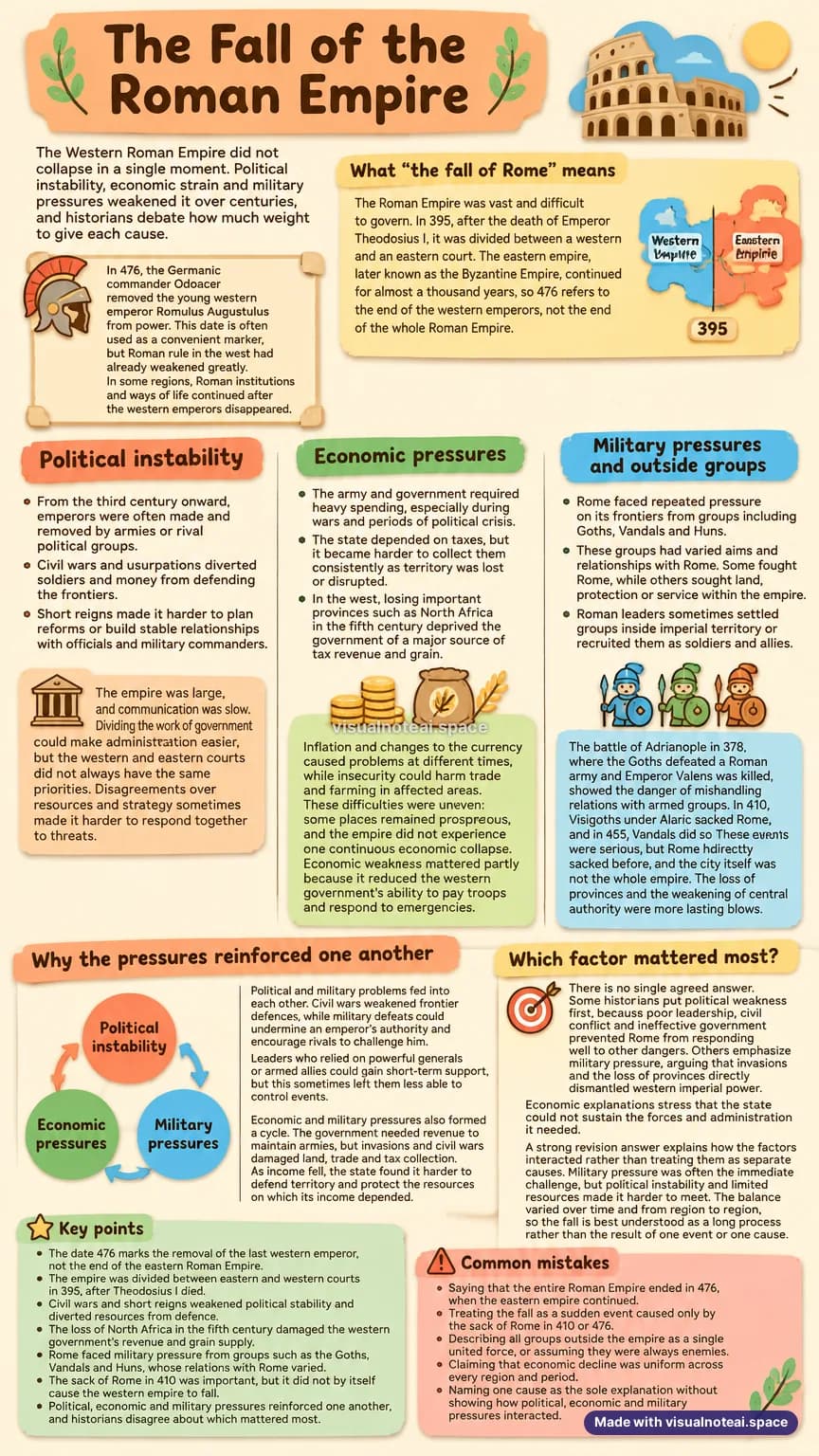
The whole topic on one page. Made with VisualNote.
!Common mistakes
- Saying that the entire Roman Empire ended in 476, when the eastern empire continued.
- Treating the fall as a sudden event caused only by the sack of Rome in 410 or 476.
- Describing all groups outside the empire as a single united force, or assuming they were always enemies.
- Claiming that economic decline was uniform across every region and period.
- Naming one cause as the sole explanation without showing how political, economic and military pressures interacted.
🧠Explore the map31 ideas
The mind map VisualNote made for this topic. Drag to pan, scroll to zoom.
- Fall of the Western Roman Empire
- Meaning and Timeline
- Division in 395
- Eastern Empire continued as Byzantine Empire
- 476: Odoacer removed Romulus Augustulus
- Long process, not a single event
- Political Instability
- Emperors made and removed by armies or rivals
- Civil wars and usurpations diverted resources from defence
- Short reigns hindered stable reforms and planning
- Western and eastern courts had differing priorities
- Economic Pressures
- High costs of government and armies
- Territorial losses disrupted tax collection
- Loss of North Africa weakened revenue and grain supply
- Inflation, currency changes, and insecurity affected trade
- Economic conditions varied by region and period
- Military Pressures and Outside Groups
- Goths, Vandals, and Huns pressured frontiers
- Groups had varied aims and relations with Rome
- Some groups settled within the empire or served as allies
- Adrianople in 378: Gothic victory; Valens killed
- Sacks of Rome in 410 and 455
- Sacks mattered, but did not alone cause the fall
- Interacting Causes and Historical Debate
- Civil wars weakened frontier defence
- Military defeats undermined emperors and encouraged rivals
- Invasions and civil wars damaged land, trade, and tax income
- Lower revenue made armies and defence harder to sustain
- Historians emphasize political, military, or economic causes
- Best explanations show how causes reinforced one another
- Meaning and Timeline
🃏Flashcards12 cards
- What does the date 476 signify?
- Odoacer removed the last western emperor, Romulus Augustulus, from power. It marks the end of the western emperors, not the end of the entire Roman Empire.
- What happened to the Roman Empire in 395?
- After Theodosius I died, the empire was divided between eastern and western courts. The eastern empire continued for almost a thousand years as the Byzantine Empire.
- Why is the fall of the Western Roman Empire considered a long process?
- Political instability, economic strain, and military pressures weakened it over centuries. Roman institutions and ways of life also continued in some western regions after the emperors disappeared.
- How did political instability weaken the empire?
- Civil wars, usurpations, and short reigns diverted resources from frontier defence and made long-term planning difficult.
- How did the division between eastern and western courts create difficulties?
- The division could ease administration, but the courts sometimes had different priorities. Disagreements over resources and strategy could hinder a coordinated response to threats.
- Why was the loss of North Africa damaging to the Western Empire?
- In the fifth century, losing North Africa deprived the western government of major tax revenue and grain supplies.
- How did economic weakness affect the Western Empire's military capacity?
- Reduced revenue made it harder for the government to pay troops, defend territory, and respond to emergencies.
- How did groups such as the Goths, Vandals, and Huns relate to Rome?
- Their aims and relationships varied: some fought Rome, while others sought land or protection or served as soldiers and allies within the empire.
- Why was the Battle of Adrianople in 378 significant?
- The Goths defeated a Roman army, and Emperor Valens was killed. The battle highlighted the dangers of mishandling relations with armed groups.
- What happened to Rome in 410 and 455, and why were these events not the sole cause of the empire's fall?
- Visigoths under Alaric sacked Rome in 410, and Vandals sacked it in 455. These were serious events, but the city was not the whole empire; the loss of provinces and weakening of central authority had more lasting effects.
- How did political and military pressures reinforce each other?
- Civil wars weakened frontier defences, while military defeats could undermine emperors and encourage rivals to challenge them.
- How should historians explain the fall of the Western Roman Empire?
- There is no single agreed cause: political, economic, and military pressures interacted, with their importance varying over time and across regions. A strong explanation treats the fall as a long process rather than the result of one event.
✅Test yourself5 questions
What does the year 476 most commonly mark?
In 476, Odoacer removed Romulus Augustulus, while the eastern Roman Empire continued for centuries.
When and why were the western and eastern courts divided?
The empire was divided between western and eastern courts in 395 after Theodosius I's death.
Why was the loss of North Africa especially damaging to the western government?
North Africa had been an important source of both revenue and grain for the western government.
Which statement best describes the relationships between groups such as Goths, Vandals and Huns and Rome?
These groups had differing relationships with Rome, including conflict, settlement, and military service.
Which explanation best reflects the account of the western empire's decline?
The decline was a long process in which political instability, economic limits and military pressures intensified one another.
📝The notes
What “the fall of Rome” means
The Roman Empire was vast and difficult to govern. In 395, after the death of Emperor Theodosius I, it was divided between a western and an eastern court. The eastern empire, later known as the Byzantine Empire, continued for almost a thousand years, so 476 refers to the end of the western emperors, not the end of the whole Roman Empire.
In 476, the Germanic commander Odoacer removed the young western emperor Romulus Augustulus from power. This date is often used as a convenient marker, but Roman rule in the west had already weakened greatly. In some regions, Roman institutions and ways of life continued after the western emperors disappeared.
Political instability
From the third century onward, emperors were often made and removed by armies or rival political groups. Civil wars and usurpations diverted soldiers and money from defending the frontiers. Short reigns also made it harder to plan reforms or build stable relationships with officials and military commanders.
The empire was large, and communication was slow. Dividing the work of government could make administration easier, but the western and eastern courts did not always have the same priorities. Disagreements over resources and strategy sometimes made it harder to respond together to threats.
Economic pressures
The army and government required heavy spending, especially during wars and periods of political crisis. The state depended on taxes, but it became harder to collect them consistently as territory was lost or disrupted. In the west, losing important provinces such as North Africa in the fifth century deprived the government of a major source of tax revenue and grain.
Inflation and changes to the currency caused problems at different times, while insecurity could harm trade and farming in affected areas. These difficulties were uneven: some places remained prosperous, and the empire did not experience one continuous economic collapse. Economic weakness mattered partly because it reduced the western government's ability to pay troops and respond to emergencies.
Military pressures and outside groups
Rome faced repeated pressure on its frontiers from groups including Goths, Vandals and Huns. These groups had varied aims and relationships with Rome. Some fought Rome, while others sought land, protection or service within the empire. Roman leaders sometimes settled groups inside imperial territory or recruited them as soldiers and allies.
The battle of Adrianople in 378, where the Goths defeated a Roman army and Emperor Valens was killed, showed the danger of mishandling relations with armed groups. In 410, Visigoths under Alaric sacked Rome, and in 455, Vandals did so. These events were serious, but Rome had been sacked before, and the city itself was not the whole empire. The loss of provinces and the weakening of central authority were more lasting blows.
Why the pressures reinforced one another
Political and military problems fed into each other. Civil wars weakened frontier defences, while military defeats could undermine an emperor's authority and encourage rivals to challenge him. Leaders who relied on powerful generals or armed allies could gain short-term support, but this sometimes left them less able to control events.
Economic and military pressures also formed a cycle. The government needed revenue to maintain armies, but invasions and civil wars damaged land, trade and tax collection. As income fell, the state found it harder to defend territory and protect the resources on which its income depended.
Which factor mattered most?
There is no single agreed answer. Some historians put political weakness first, because poor leadership, civil conflict and ineffective government prevented Rome from responding well to other dangers. Others emphasize military pressure, arguing that invasions and the loss of provinces directly dismantled western imperial power. Economic explanations stress that the state could not sustain the forces and administration it needed.
A strong revision answer explains how the factors interacted rather than treating them as separate causes. Military pressure was often the immediate challenge, but political instability and limited resources made it harder to meet. The balance varied over time and from region to region, so the fall is best understood as a long process rather than the result of one event or one cause.
Make this for your own notes
Paste a chapter or a PDF and get the sheet, map, cards, quiz and episode back in about a minute. No credit card.