
The American Revolution grew from a conflict over who had the right to govern and tax the colonies. British taxes and the Coercive Acts, which colonists called the Intolerable Acts, increased resentment and helped unite the colonies, but war followed only after years of escalating disputes and failed attempts at compromise.
★What to remember
- Colonists objected to being taxed by Parliament because they elected no members of it.
- The Stamp Act taxed printed materials, while the Townshend Acts taxed imported goods.
- Parliament repealed the Stamp Act but asserted its authority over the colonies in the Declaratory Act.
- The Tea Act kept the tea tax in place and gave the East India Company advantages in selling tea.
- The Boston Tea Party led Parliament to punish Massachusetts with the Coercive Acts, called the Intolerable Acts by colonists.
- The Coercive Acts increased colonial solidarity, and the First Continental Congress organized resistance.
- Fighting began at Lexington and Concord in 1775 after years of escalating political conflict.
🎧Listen3:33 · transcript
AnnaWhen people talk about the causes of the American Revolution, they often point to taxes. But was the argument really just about paying more?
MarcoNo. The deeper issue was who had the right to govern and tax the colonies. The thirteen colonies had elected assemblies that handled local affairs. But the king and Parliament claimed authority over them. Colonists elected no members of Parliament, so many rejected its power to tax them.
AnnaAnd Britain had its own reason for asking the colonies to contribute, right?
MarcoYes. After the Seven Years’ War ended in seventeen sixty-three, Britain had a large debt and the cost of keeping troops in North America. British supporters argued that colonists were represented virtually in Parliament. Colonial critics said that was not enough. They argued only their elected assemblies could tax them. That’s where “No taxation without representation” came from.
AnnaHow did that disagreement turn into protests?
MarcoParliament passed the Sugar Act in seventeen sixty-four, placing duties on certain imports and enforcing trade rules. Then the Stamp Act required paid stamps on printed materials, including newspapers and legal documents. Colonists protested and boycotted goods. Parliament repealed the Stamp Act in seventeen sixty-six, but the Declaratory Act that same year asserted Parliament’s authority to make laws for the colonies.
AnnaSo even after a repeal, the central dispute stayed alive. What happened next?
MarcoThe Townshend Acts of seventeen sixty-seven added duties on imported goods such as glass, paper, paint, and tea. Boycotts and clashes with officials raised tensions. Parliament removed most of those duties in seventeen seventy, but kept the tea tax. That kept the question of Parliament’s authority in view.
AnnaAnd the Tea Act is often described inaccurately. What did it actually do?
MarcoIt gave the East India Company advantages in selling tea in the colonies. It did not create a new tea tax. It kept the existing tax in place. Many colonists thought accepting the cheaper company tea would mean accepting Parliament’s right to tax them. In December seventeen seventy-three, protesters in Boston threw tea from the company’s ships into the harbor. That became the Boston Tea Party.
AnnaBritain answered with the laws colonists called the Intolerable Acts. Why did those matter beyond Massachusetts?
MarcoThey punished Massachusetts and seemed to warn the other colonies. The Boston Port Act closed the port until the tea was paid for. Another law reduced local self-government. Other measures changed trials for some accused officials and expanded requirements for housing troops. Many colonists saw the laws as a threat to them all. The Quebec Act passed that year, but it was not punishment for the Boston Tea Party. Some colonists grouped it with the other measures because they feared its provisions and Quebec’s expanded boundaries.
AnnaDid everyone immediately want independence after that?
MarcoNo. Many still hoped to avoid war and independence. In September seventeen seventy-four, delegates from twelve colonies met at the First Continental Congress. They opposed the Coercive Acts and organized a boycott of British goods. The laws helped unite the colonies rather than isolate Massachusetts.
AnnaAnd when did protest become armed conflict?
MarcoIn April seventeen seventy-five, British troops and colonial militiamen fought at Lexington and Concord. That followed years of disputes and failed efforts at compromise. It wasn’t one tax or one law alone. The struggle was about taxation, political authority, self-government, and the use of force. The colonies declared independence in seventeen seventy-six.
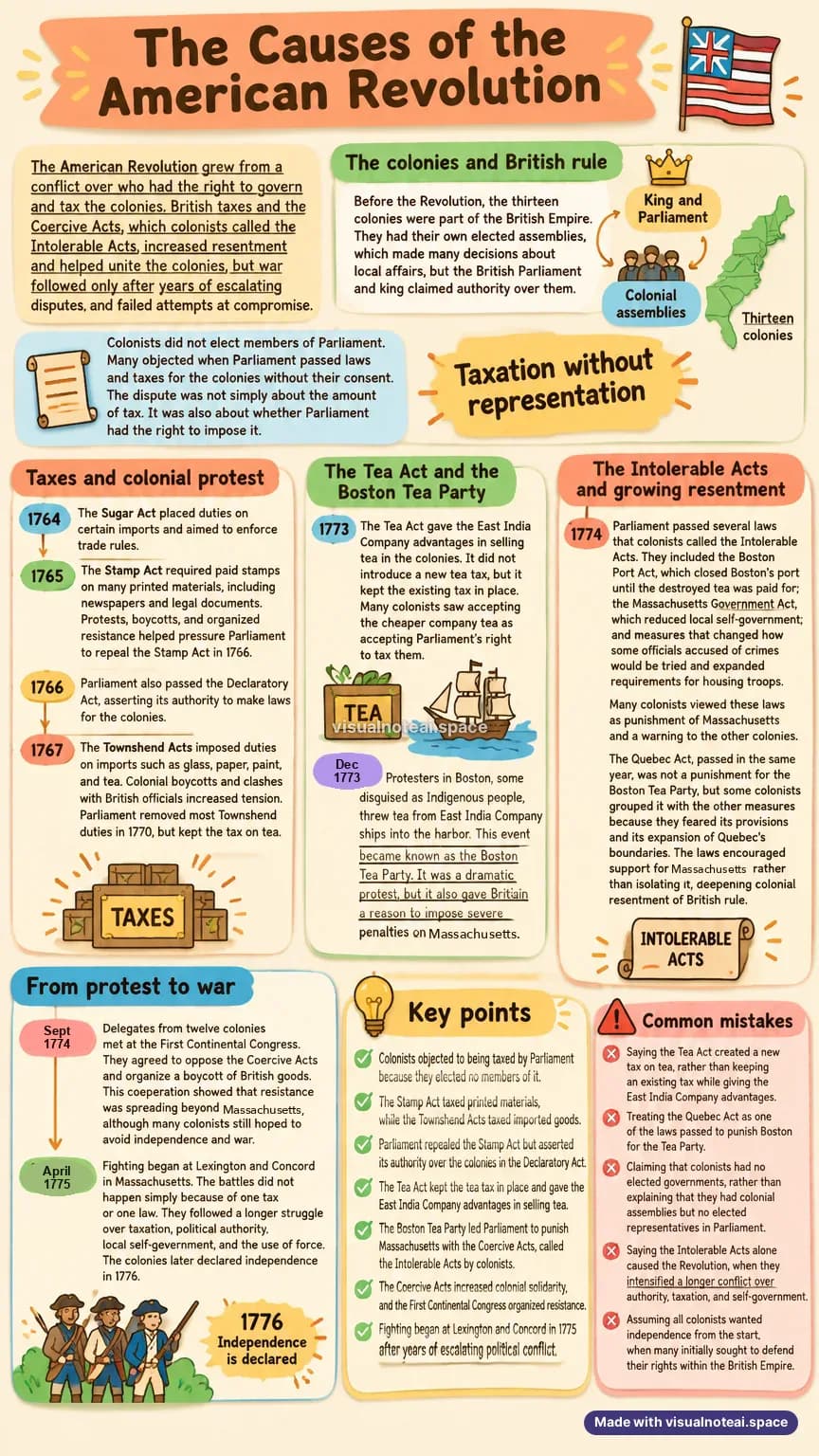
The whole topic on one page. Made with VisualNote.
!Common mistakes
- Saying the Tea Act created a new tax on tea, rather than keeping an existing tax while giving the East India Company advantages.
- Treating the Quebec Act as one of the laws passed to punish Boston for the Tea Party.
- Claiming that colonists had no elected governments, rather than explaining that they had colonial assemblies but no elected representatives in Parliament.
- Saying the Intolerable Acts alone caused the Revolution, when they intensified a longer conflict over authority, taxation, and self-government.
- Assuming all colonists wanted independence from the start, when many initially sought to defend their rights within the British Empire.
🧠Explore the map38 ideas
The mind map VisualNote made for this topic. Drag to pan, scroll to zoom.
- Causes of the American Revolution
- Colonial Government and Authority
- Thirteen colonies within British Empire
- Elected colonial assemblies
- No elected representatives in Parliament
- Dispute over Parliament's authority
- Taxation and Colonial Protest
- Postwar British debt and troop costs
- No taxation without representation
- Virtual representation rejected
- Sugar Act (1764)
- Stamp Act (1765)
- Protests and boycotts
- Stamp Act repealed (1766)
- Declaratory Act asserted Parliament's authority
- Townshend Acts taxed imports
- Most Townshend duties repealed; tea tax remained
- Tea Act and Coercive Acts
- Tea Act (1773) favored East India Company
- Existing tea tax retained
- Boston Tea Party (1773)
- Coercive Acts / Intolerable Acts (1774)
- Boston Port closed
- Massachusetts self-government reduced
- Officials' trials and troop housing changed
- Quebec Act grouped with measures, not Boston punishment
- Colonial Cooperation and Resistance
- Punitive laws increased resentment
- Massachusetts gained support from other colonies
- First Continental Congress (1774)
- Boycott of British goods
- Many still hoped to avoid independence and war
- Escalation to War
- Long conflict over taxation and political authority
- Local self-government and use of force
- Lexington and Concord (1775)
- Armed conflict began
- Declaration of Independence (1776)
- Colonial Government and Authority
🃏Flashcards12 cards
- What was the central conflict behind the American Revolution?
- Britain and the colonies disputed who had authority to govern and tax the colonies. The conflict involved political authority and self-government, not just the amount of taxes.
- Why did colonists object to taxes imposed by Parliament?
- Colonists elected no members of Parliament, so they argued that it had no right to tax them without their consent. They believed their elected colonial assemblies should tax them.
- What did “virtual representation” mean, and why did colonists reject it?
- British supporters claimed Parliament represented colonists’ interests even though they did not elect its members. Colonial critics rejected this and argued that only their own elected assemblies could tax them.
- What did “No taxation without representation” express?
- It expressed the colonial argument that people should not be taxed by a legislature in which they had no elected representatives.
- What were the Stamp Act and the Townshend Acts?
- The Stamp Act of 1765 taxed printed materials, while the Townshend Acts of 1767 imposed duties on imported goods such as glass, paper, paint, and tea.
- What was the significance of the Declaratory Act?
- After repealing the Stamp Act in 1766, Parliament passed the Declaratory Act to assert its authority to make laws for the colonies.
- What did the Tea Act of 1773 do?
- It gave the East India Company advantages in selling tea in the colonies while keeping the existing tea tax in place; it did not create a new tea tax.
- What was the Boston Tea Party?
- In December 1773, protesters in Boston dumped East India Company tea into the harbor. The protest challenged Parliament’s authority to tax the colonies.
- What were the Intolerable Acts?
- They were laws Parliament passed in 1774 in response to the Boston Tea Party, including measures that closed Boston’s port and reduced Massachusetts’s self-government. Colonists viewed them as punishment and a threat to other colonies.
- How was the Quebec Act related to the Intolerable Acts?
- The Quebec Act was passed in 1774, but it was not a punishment for the Boston Tea Party. Some colonists grouped it with the other measures because they feared its provisions and Quebec’s expanded boundaries.
- What was the First Continental Congress, and what did it do?
- Delegates from twelve colonies met in September 1774. They opposed the Coercive Acts and organized a boycott of British goods, showing wider colonial cooperation.
- When did armed conflict begin, and what led to it?
- Fighting began at Lexington and Concord in April 1775. It followed years of escalating disputes over taxation, political authority, self-government, and the use of force, not one law alone.
✅Test yourself5 questions
Why did many colonists object to taxes imposed by Parliament?
Colonists argued that a legislature in which they elected no representatives had no right to tax them.
What did the Tea Act of 1773 do?
The Tea Act gave the East India Company advantages in selling tea while leaving the existing tea tax in place.
How was the Quebec Act related to the Boston Tea Party?
The Quebec Act was passed in 1774 but was not a punishment for the Boston Tea Party.
Which statement best describes the colonists' political situation before the Revolution?
Colonies had elected assemblies for local affairs, but colonists did not elect members of Parliament.
Which statement best explains how the conflict led to fighting at Lexington and Concord?
The battles at Lexington and Concord followed years of disputes over taxation, authority, and self-government.
📝The notes
The colonies and British rule
Before the Revolution, the thirteen colonies were part of the British Empire. They had their own elected assemblies, which made many decisions about local affairs, but the British Parliament and king claimed authority over them.
Colonists did not elect members of Parliament. Many objected when Parliament passed laws and taxes for the colonies without their consent. The dispute was not simply about the amount of tax. It was also about whether Parliament had the right to impose it.
Taxation without representation
After the Seven Years' War ended in 1763, Britain faced a large national debt and the cost of keeping troops in North America. The British government argued that the colonies should contribute to these costs. Colonists answered that they should not be taxed by a legislature in which they had no elected representatives.
Britain's supporters claimed that colonists were represented virtually, along with other people whose interests Parliament said it considered. Colonial critics rejected this idea. They argued that only their own elected assemblies could tax them, giving rise to the slogan, "No taxation without representation."
Taxes and colonial protest
The Sugar Act of 1764 placed duties on certain imports and aimed to enforce trade rules. The Stamp Act of 1765 required paid stamps on many printed materials, including newspapers and legal documents. Protests, boycotts, and organized resistance helped pressure Parliament to repeal the Stamp Act in 1766.
Parliament also passed the Declaratory Act in 1766, asserting its authority to make laws for the colonies. In 1767, the Townshend Acts imposed duties on imports such as glass, paper, paint, and tea. Colonial boycotts and clashes with British officials increased tension. Parliament removed most Townshend duties in 1770, but kept the tax on tea, preserving the central argument about its authority to tax.
The Tea Act and the Boston Tea Party
The Tea Act of 1773 gave the East India Company advantages in selling tea in the colonies. It did not introduce a new tea tax, but it kept the existing tax in place. Many colonists saw accepting the cheaper company tea as accepting Parliament's right to tax them.
In December 1773, protesters in Boston, some disguised as Indigenous people, threw tea from East India Company ships into the harbor. This event became known as the Boston Tea Party. It was a dramatic protest, but it also gave Britain a reason to impose severe penalties on Massachusetts.
The Intolerable Acts and growing resentment
In 1774, Parliament passed several laws that colonists called the Intolerable Acts. They included the Boston Port Act, which closed Boston's port until the destroyed tea was paid for; the Massachusetts Government Act, which reduced local self-government; and measures that changed how some officials accused of crimes would be tried and expanded requirements for housing troops.
Many colonists viewed these laws as punishment of Massachusetts and a warning to the other colonies. The Quebec Act, passed in the same year, was not a punishment for the Boston Tea Party, but some colonists grouped it with the other measures because they feared its provisions and its expansion of Quebec's boundaries. The laws encouraged support for Massachusetts rather than isolating it, deepening colonial resentment of British rule.
From protest to war
In September 1774, delegates from twelve colonies met at the First Continental Congress. They agreed to oppose the Coercive Acts and organize a boycott of British goods. This cooperation showed that resistance was spreading beyond Massachusetts, although many colonists still hoped to avoid independence and war.
The dispute turned into armed conflict in April 1775, when British troops and colonial militiamen fought at Lexington and Concord in Massachusetts. The battles did not happen simply because of one tax or one law. They followed a longer struggle over taxation, political authority, local self-government, and the use of force. The colonies later declared independence in 1776.
Make this for your own notes
Paste a chapter or a PDF and get the sheet, map, cards, quiz and episode back in about a minute. No credit card.