
The Columbian Exchange was the movement of plants, animals, people, diseases, and ideas between the Americas and the Old World after sustained contact began in 1492. It transformed societies and environments on both sides of the Atlantic, but its effects were profoundly unequal, especially because Indigenous American populations suffered catastrophic losses and European empires expanded through conquest and forced labor.
★What to remember
- The Columbian Exchange began with sustained contact between the Americas and the Old World after 1492.
- American crops such as maize, potatoes, tomatoes, and cassava spread to Europe, Africa, and Asia.
- Old World crops such as wheat, rice, and sugar cane, along with animals such as horses, cattle, and pigs, were introduced to the Americas.
- Smallpox, measles, and other infections caused devastating epidemics among Indigenous Americans.
- Disease, conquest, displacement, and forced labor together contributed to Indigenous population decline.
- Millions of enslaved Africans were forcibly transported to the Americas and made to labor, especially on plantations.
- The exchange changed diets, economies, and environments across the world, but its gains and costs were distributed unequally.
🎧Listen3:29 · transcript
AnnaWhen people hear “Columbian Exchange,” they might picture a simple swap of food. But the story is much bigger, isn’t it?
MarcoMuch bigger, and not a single event. The term describes the movement of plants, animals, people, diseases, and ideas between the Americas and the Old World. Sustained contact began after Columbus’s voyage in fourteen ninety-two, but the exchange unfolded over centuries.
AnnaAnd the Old World means more than Europe. It includes Africa and Asia, too. What moved from the Americas?
MarcoCrops such as maize, potatoes, sweet potatoes, tomatoes, cassava, peanuts, cacao, beans, and peppers. They spread at different rates. Potatoes and maize eventually became important foods in parts of Europe, Africa, and Asia. In some places, these crops grew where established foods did less well, and they helped support population growth. But local conditions mattered.
AnnaSo it wasn’t the same benefit everywhere. And cacao and tobacco became valuable commodities. What arrived in the Americas?
MarcoWheat, rice, sugar cane, coffee, citrus fruits, and animals such as horses, cattle, pigs, sheep, and goats. Horses changed travel, hunting, and warfare for some Indigenous societies, especially on the Great Plains. Livestock supplied food and materials, but grazing animals also damaged crops and competed with local wildlife.
AnnaSugar cane had a particularly brutal connection to the way colonial economies worked, right?
MarcoYes. Plantations became important in the Caribbean and elsewhere in the Americas. Their owners relied heavily on the forced labor of enslaved Africans. Millions of Africans were captured or sold into the Atlantic slave trade and compelled to work, especially on plantations and in mines. Their labor and knowledge shaped American economies and cultures, while the slave trade caused immense suffering and lasting effects in African societies.
AnnaAnd millions of Europeans also crossed the Atlantic, as settlers, soldiers, officials, and missionaries. That brought colonization, land seizure, and new colonial societies. What was the human cost for Indigenous people?
MarcoCatastrophic. Travelers brought diseases including smallpox, measles, and influenza. Many Indigenous people had no previous exposure and little immunity, so epidemics caused very high death rates. But disease was not the only cause. Warfare, displacement, famine, and forced labor also contributed to population decline.
AnnaCan historians give one precise figure for that decline across the Americas?
MarcoNo. The scale and timing varied by region. Disease also traveled along routes ahead of Europeans themselves. And while some diseases may have moved from the Americas to the Old World, claims that syphilis had a specific American origin remain debated.
AnnaThe exchange changed environments as well as populations. How?
MarcoNew crops and animals reshaped diets and farming. Clearing land for plantations, ranching, and settlement altered ecosystems, and introduced species sometimes spread rapidly. Meanwhile, Atlantic trade in crops, precious metals, manufactured goods, and enslaved people expanded. European states and merchants gained wealth and power through conquest and colonial trade. Indigenous communities lost land and political independence.
AnnaSo the key is to hold both sides in view: lasting changes across the world, but gains and harms distributed profoundly unequally.
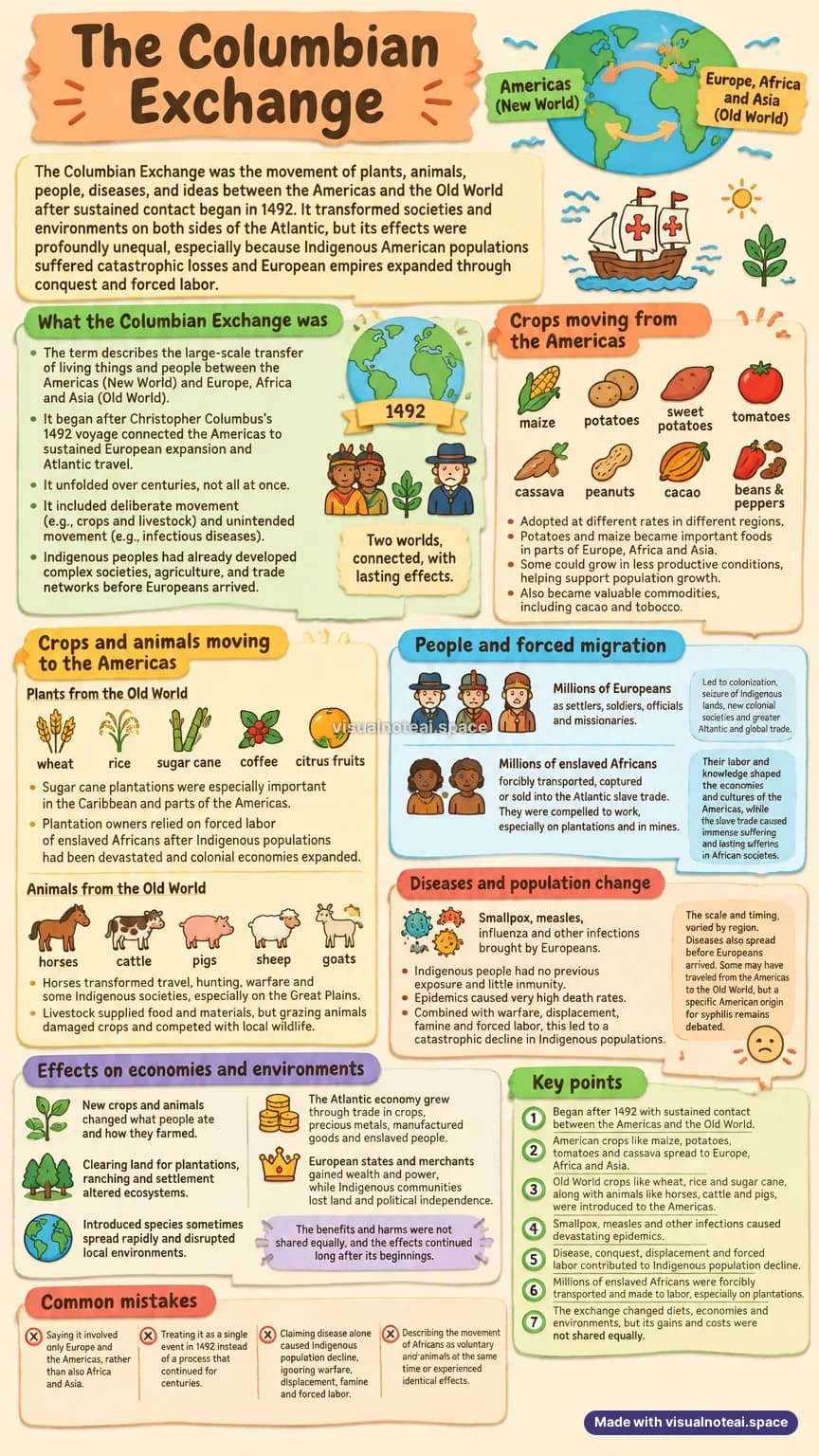
The whole topic on one page. Made with VisualNote.
!Common mistakes
- Saying the exchange involved only Europe and the Americas, rather than also Africa and Asia.
- Treating the exchange as a single event in 1492 instead of a process that continued for centuries.
- Claiming that disease alone caused Indigenous population decline, while ignoring warfare, displacement, famine, and forced labor.
- Describing the movement of Africans to the Americas as voluntary migration rather than forced enslavement.
- Assuming every region adopted the same crops and animals at the same time or experienced identical effects.
🧠Explore the map33 ideas
The mind map VisualNote made for this topic. Drag to pan, scroll to zoom.
- The Columbian Exchange
- Origins and Scope
- After sustained contact in 1492
- Centuries-long process
- Americas, Europe, Africa, and Asia
- Plants, animals, people, diseases, and ideas
- Crops and Animals
- American crops to the Old World
- Maize, potatoes, tomatoes, cassava, beans, and peppers
- Population growth and changing diets
- Old World crops to the Americas
- Wheat, rice, sugar cane, coffee, and citrus
- Horses, cattle, pigs, sheep, and goats
- New uses and environmental disruption
- American crops to the Old World
- People and Labor
- European settlers and colonization
- Land seizure and colonial societies
- Forced migration of enslaved Africans
- Plantation and mine labor
- Economic and cultural contributions
- European settlers and colonization
- Diseases and Population Change
- Smallpox, measles, and influenza
- Epidemics and limited Indigenous immunity
- Catastrophic Indigenous population decline
- Disease, warfare, displacement, famine, and forced labor
- Regional variation in loss
- Smallpox, measles, and influenza
- Economic and Environmental Effects
- Atlantic trade and colonial wealth
- Crops, metals, goods, and enslaved people
- Plantations, ranching, and land clearing
- Changed landscapes and disrupted ecosystems
- Unequal gains and harms
- European power expanded; Indigenous land and independence lost
- Atlantic trade and colonial wealth
- Origins and Scope
🃏Flashcards12 cards
- What was the Columbian Exchange?
- The large-scale movement of plants, animals, people, diseases, and ideas between the Americas and the Old World. It reshaped societies and environments across the Atlantic.
- When did the Columbian Exchange begin, and how long did it last?
- It began after sustained contact followed Christopher Columbus’s 1492 voyage. It unfolded over centuries, not as a single event.
- Which regions were connected by the Columbian Exchange?
- The Americas were connected with Europe, Africa, and Asia. The exchange involved more than Europe and the Americas alone.
- Name several important American crops that spread to the Old World.
- Maize, potatoes, sweet potatoes, tomatoes, cassava, peanuts, cacao, beans, and peppers spread to Europe, Africa, and Asia.
- How did American crops affect some Old World regions?
- Crops such as potatoes and maize became important foods and helped support population growth in some regions. Their effects varied according to local conditions.
- Which crops were introduced to the Americas from the Old World?
- Wheat, rice, sugar cane, coffee, and citrus fruits were among the plants brought to the Americas.
- What impact did horses have in the Americas?
- Horses transformed travel, hunting, and warfare. Some Indigenous societies, particularly on the Great Plains, adopted them over time.
- How did livestock affect the Americas?
- Cattle, pigs, sheep, and goats provided food and materials, but their grazing sometimes damaged crops and competed with local wildlife.
- How did enslaved Africans become part of the Columbian Exchange?
- Millions of Africans were forcibly transported across the Atlantic and compelled to work, especially on plantations and in mines. Their labor and knowledge shaped American economies and cultures.
- What caused catastrophic Indigenous population decline?
- Smallpox, measles, influenza, and other diseases caused devastating epidemics. Disease combined with warfare, displacement, famine, and forced labor; its effects varied by region.
- How did the Columbian Exchange change economies and environments?
- New crops and animals changed diets and farming, while plantations, ranching, and settlement transformed landscapes. Atlantic trade grew, and introduced species sometimes disrupted local ecosystems.
- Why were the effects of the Columbian Exchange unequal?
- European states and merchants gained wealth and power through conquest and colonial trade, while Indigenous communities lost land and political independence. Enslaved Africans endured forced migration and labor, and the benefits and harms were not shared equally.
✅Test yourself5 questions
Which description best captures the geographic scope of the Columbian Exchange?
The exchange moved living things and people between the Americas and the Old World, including Europe, Africa, and Asia.
Which statement best describes when and how the Columbian Exchange unfolded?
Sustained contact began after 1492, but the movement of crops, animals, people, and diseases continued for centuries.
Which explanation best accounts for the catastrophic decline in Indigenous American populations?
Epidemics caused very high death rates, while warfare, displacement, famine, and forced labor also contributed to population loss.
How did millions of Africans come to the Americas during the Columbian Exchange?
Millions of Africans were captured or sold and forcibly transported to work, especially on plantations and in mines.
Which statement best describes how the Columbian Exchange affected different groups?
European states and merchants gained wealth and power through conquest and trade, while Indigenous communities suffered land loss and political subordination.
📝The notes
What the Columbian Exchange was
The term Columbian Exchange describes the large-scale transfer of living things and people between the Americas, often called the New World, and Europe, Africa, and Asia, often grouped as the Old World. It began after Christopher Columbus's 1492 voyage connected the Americas to sustained European expansion and Atlantic travel.
The exchange unfolded over centuries rather than happening all at once. It included deliberate movement, such as transporting crops and livestock, as well as unintended movement, such as the spread of infectious diseases. Indigenous peoples had already developed complex societies, agriculture, and trade networks before Europeans arrived.
Crops moving from the Americas
American crops that spread to the Old World included maize, potatoes, sweet potatoes, tomatoes, cassava, peanuts, cacao, and several varieties of beans and peppers. These crops were adopted at different rates in different regions. Potatoes and maize, for example, eventually became important foods in parts of Europe, Africa, and Asia.
Several of these crops could grow in places or conditions where established foods were less productive. Their use helped support population growth in some regions, although the effects depended on local farming, politics, and access to food. American crops also became valuable commodities, including cacao and tobacco.
Crops and animals moving to the Americas
Plants brought from the Old World included wheat, rice, sugar cane, coffee, and citrus fruits. Sugar cane plantations became especially important in the Caribbean and parts of the Americas. Plantation owners relied heavily on the forced labor of enslaved Africans after Indigenous populations had been devastated and colonial economies expanded.
Europeans introduced horses, cattle, pigs, sheep, and goats to the Americas. Horses transformed travel, hunting, warfare, and some Indigenous societies, particularly on the Great Plains, where communities adopted them over time. Livestock also supplied food and materials, but grazing animals damaged crops and competed with local wildlife in some areas.
People and forced migration
Millions of Europeans crossed the Atlantic as settlers, soldiers, officials, and religious missionaries. Their arrival led to colonization, the seizure of Indigenous lands, and the creation of new colonial societies. European expansion also connected the Americas more closely to Atlantic and global trade.
The exchange included the forced migration of millions of enslaved Africans to the Americas. They were captured or sold into the Atlantic slave trade and compelled to work, especially on plantations and in mines. Their labor and knowledge shaped the economies and cultures of the Americas, while the slave trade caused immense suffering and lasting effects in African societies as well.
Diseases and population change
Europeans and other travelers brought diseases such as smallpox, measles, and influenza to the Americas. Many Indigenous people had no previous exposure to these infections and little immunity, so epidemics caused very high death rates. Disease, combined with warfare, displacement, famine, and forced labor, contributed to a catastrophic decline in Indigenous populations.
The scale and timing of population loss varied across regions, and historians cannot give one precise figure for all the Americas. Disease also spread along routes that reached communities before Europeans arrived in person. Some diseases may have traveled from the Americas to the Old World, but claims about a specific American origin for syphilis remain debated.
Effects on economies and environments
The exchange reshaped farming, diets, and landscapes. New crops and animals changed what people ate and how they farmed, while clearing land for plantations, ranching, and settlement altered ecosystems. Introduced species sometimes spread rapidly and disrupted local environments.
The Atlantic economy grew through trade in crops, precious metals, manufactured goods, and enslaved people. European states and merchants gained wealth and power from conquest and colonial trade, while Indigenous communities lost land and political independence. The benefits and harms were not shared equally, and the exchange's effects continued long after its beginnings in the late fifteenth century.
Make this for your own notes
Paste a chapter or a PDF and get the sheet, map, cards, quiz and episode back in about a minute. No credit card.