
Stoichiometry lets you predict how much of a product you can make from a given amount of reactant, using a balanced chemical equation as the recipe. The core idea is that the coefficients in a balanced equation give the ratio of moles of substances that react and form, and every calculation is a chain of conversions that passes through moles.
★What to remember
- A balanced equation must be obtained before any stoichiometry calculation can be done.
- The coefficients in a balanced equation give mole ratios between reactants and products.
- The standard route is grams to moles, then moles to moles by mole ratio, then moles to grams.
- Molar mass converts between grams and moles and is calculated from relative atomic masses.
- The limiting reactant gives the smallest amount of product and therefore determines the theoretical yield.
- Percentage yield compares actual yield with the theoretical yield calculated from stoichiometry.
- Units should be written and cancelled at every step so that the final unit is correct.
🎧Listen2:39 · transcript
AnnaMarco, when we get a stoichiometry problem, where do we even start?
MarcoAlways with a balanced chemical equation. Balancing means adjusting the coefficients until each element has the same number of atoms on both sides, because mass is conserved. You never change the subscripts, since those define the substance itself.
AnnaSo the coefficients are the recipe. But why do they matter so much?
MarcoBecause they give the ratio of moles that react and form. Take two H2 plus O2 giving two H2O. Two moles of hydrogen react with one mole of oxygen to make two moles of water. And those ratios are exact, whatever masses you happen to be using.
AnnaRight, so the mole ratio is the heart of it. Where does it actually show up in the calculation?
MarcoIn one specific step. You multiply by a fraction with the wanted substance's coefficient on top and the given substance's coefficient on the bottom. Molar mass only moves you between grams and moles. The chemistry of changing one substance into another always comes from that coefficient ratio.
AnnaWalk me through the full route then, from grams of reactant to grams of product.
MarcoThree steps. Divide the starting mass by its molar mass to get moles. Apply the mole ratio to get moles of product. Multiply by the product's molar mass to get grams. Keep several significant figures along the way and round only at the end.
AnnaLet's try it. Ten point zero grams of hydrogen gas, how much water could form?
MarcoTen point zero divided by two point zero two gives about four point nine five moles of H2. The ratio is two to two, so one, meaning four point nine five moles of water. Times eighteen point zero two gives about eighty-nine point two grams.
AnnaAnd that assumes oxygen is in excess, right? What if both reactants are given?
MarcoThen you find the limiting reactant. Run the three-step conversion for each reactant, see how much product each could make, and take the smaller value. That smaller value is the theoretical yield.
AnnaSo theoretical yield is not what you actually get in the lab?
MarcoCorrect. Actual yield is usually lower. Percentage yield is actual divided by theoretical, times one hundred. Stoichiometry gives you the ceiling, not the measurement.
AnnaWhat are the common ways people go wrong with this?
MarcoInverting the mole ratio is a big one. Also converting grams straight to grams without passing through moles, which skips the ratio entirely. Writing units at every step and cancelling them on purpose catches most of those slips.
AnnaSo if I remember one rule, it's that every step passes through moles?
MarcoThat, and check your units. If the chain of units cancels cleanly to grams, you are very likely right.
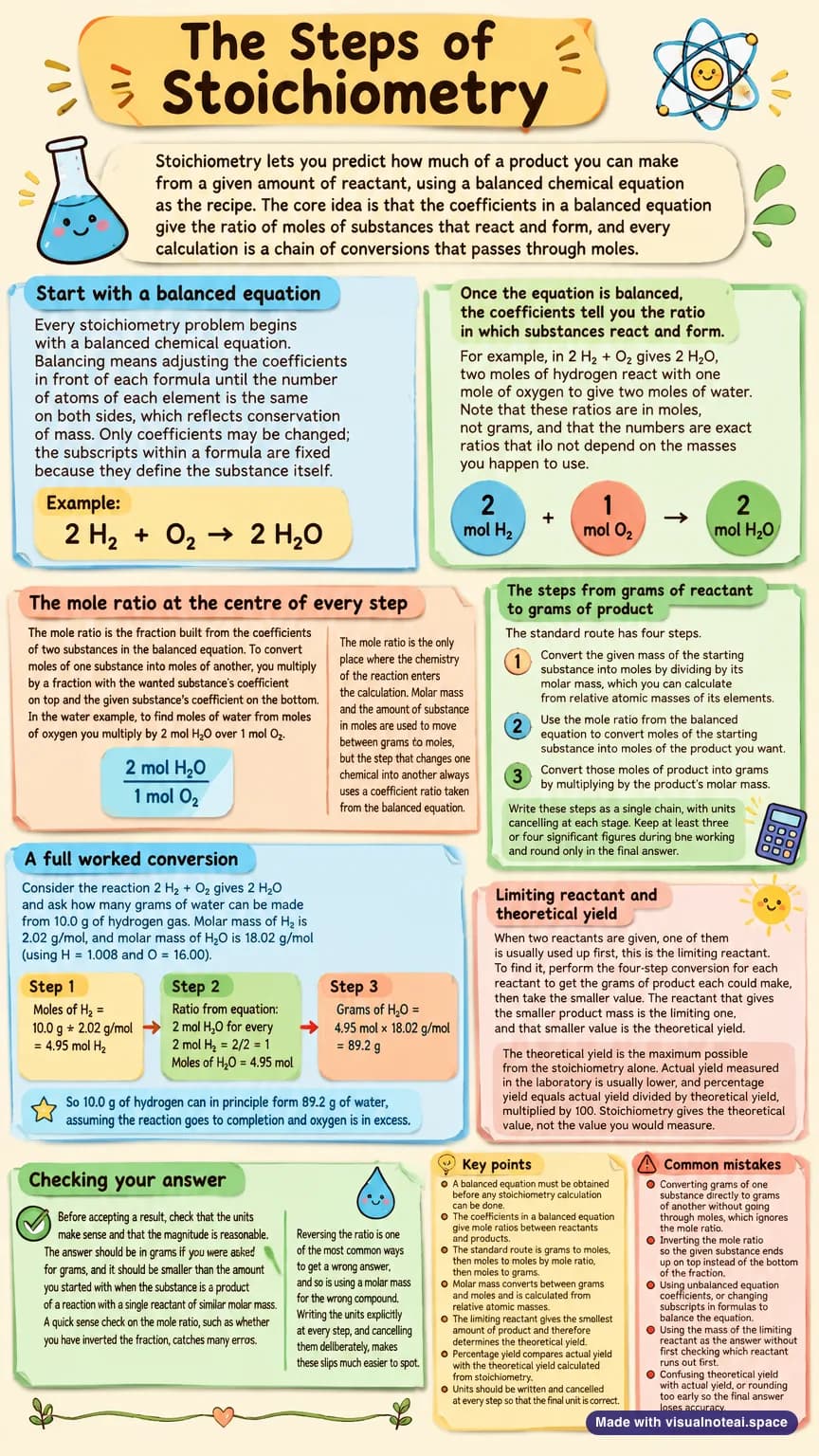
The whole topic on one page. Made with VisualNote.
!Common mistakes
- Converting grams of one substance directly to grams of another without going through moles, which ignores the mole ratio.
- Inverting the mole ratio so that the given substance ends up on top instead of the bottom of the fraction.
- Using unbalanced equation coefficients, or changing subscripts in formulas to balance the equation.
- Using the mass of the limiting reactant as the answer without first checking which reactant runs out first.
- Confusing theoretical yield with actual yield, or rounding too early so the final answer loses accuracy.
🧠Explore the map24 ideas
The mind map VisualNote made for this topic. Drag to pan, scroll to zoom.
- Stoichiometry: predicting product from reactant
- Balanced chemical equation
- Balance by adjusting coefficients only
- Conservation of mass
- Subscripts are fixed
- Coefficients give mole ratios
- Example: 2 H2 + O2 gives 2 H2O
- Balance by adjusting coefficients only
- Mole ratio
- Fraction from coefficients
- Wanted coefficient on top
- Given coefficient on bottom
- Only step where chemistry enters
- Fraction from coefficients
- Three-step conversion route
- Grams to moles using molar mass
- Moles to moles via mole ratio
- Moles to grams using molar mass
- Worked example: 10.0 g H2 gives 89.2 g H2O
- Limiting reactant and yield
- Limiting reactant gives smallest product
- Theoretical yield
- Percentage yield = actual / theoretical x 100
- Common mistakes
- Skipping moles or inverting ratio
- Wrong molar mass or unbalanced equation
- Balanced chemical equation
🃏Flashcards14 cards
- What must be obtained before any stoichiometry calculation can be done?
- A balanced chemical equation, with coefficients adjusted so that the number of atoms of each element is the same on both sides.
- What do the coefficients in a balanced equation give?
- The mole ratios in which substances react and form, e.g. in $2\,\mathrm{H_2} + \mathrm{O_2} \to 2\,\mathrm{H_2O}$, two moles of hydrogen react with one mole of oxygen.
- What is a mole ratio?
- A fraction built from the balanced-equation coefficients of two substances, with the wanted substance's coefficient on top and the given substance's coefficient on the bottom.
- What is the standard three-step route in a stoichiometry calculation?
- Grams of the given substance to moles (divide by molar mass), moles to moles using the mole ratio, moles of product to grams (multiply by molar mass).
- How is molar mass calculated?
- From the relative atomic masses of the elements in the compound, summed according to the formula.
- What is the limiting reactant?
- The reactant that is used up first; it is identified as the one giving the smaller mass of product when each reactant's possible product is calculated.
- What is the theoretical yield?
- The maximum possible mass of product from stoichiometry, equal to the smaller product mass calculated from the limiting reactant.
- How is percentage yield calculated?
- Percentage yield equals $\frac{\text{actual yield}}{\text{theoretical yield}} \times 100$.
- Why must subscripts never be changed when balancing an equation?
- Subscripts define the identity of the substance itself, so only coefficients may be changed to balance an equation.
- Using the worked example, how many grams of water form from 10.0 g of hydrogen?
- About 89.2 g of water, assuming complete reaction and excess oxygen; $10.0 \div 2.02 = 4.95\,\mathrm{mol}$, then $4.95 \times 18.02 \approx 89.2\,\mathrm{g}$.
- Why must stoichiometry never convert grams of one substance directly to grams of another?
- Because it ignores the mole ratio from the balanced equation, which is the only step where the reaction's chemistry enters the calculation.
- What is a common error when setting up the mole ratio fraction?
- Inverting it so the given substance ends up on top instead of the bottom, which gives a wrong answer.
- Why should significant figures be kept during working?
- Keeping at least three or four significant figures and rounding only in the final answer avoids accumulated rounding error.
- What should be checked to sense-test a stoichiometry answer?
- That the units are correct for the question asked, the magnitude is reasonable, and the mole ratio was not inverted.
✅Test yourself5 questions
Which change is allowed when balancing a chemical equation?
Only coefficients may be adjusted because subscripts define the substance itself, so changing them would make a different compound.
To convert moles of O2 into moles of H2O in 2 H2 + O2 gives 2 H2O, which fraction should be used?
The wanted substance's coefficient goes on top and the given substance's coefficient on the bottom, so the fraction is 2 mol H2O over 1 mol O2.
What is the first step when converting a given mass of reactant into a mass of product?
Grams are converted to moles by dividing by molar mass, because the mole ratio from the equation only applies to amounts in moles.
How is the limiting reactant identified when two reactants are given?
The reactant that yields less product runs out first, and the smaller product mass it gives is the theoretical yield.
Which expression gives the percentage yield of a reaction?
Percentage yield compares what was actually obtained in the lab with the maximum possible from stoichiometry, so actual yield goes on top.
📝The notes
Start with a balanced equation
Every stoichiometry problem begins with a balanced chemical equation. Balancing means adjusting the coefficients in front of each formula until the number of atoms of each element is the same on both sides, which reflects conservation of mass. Only coefficients may be changed; the subscripts within a formula are fixed because they define the substance itself.
Once the equation is balanced, the coefficients tell you the ratio in which substances react and form. For example, in 2 H2 + O2 gives 2 H2O, two moles of hydrogen react with one mole of oxygen to give two moles of water. Note that these ratios are in moles, not grams, and that the numbers are exact ratios that do not depend on the masses you happen to use.
The mole ratio at the centre of every step
The mole ratio is the fraction built from the coefficients of two substances in the balanced equation. To convert moles of one substance into moles of another, you multiply by a fraction with the wanted substance's coefficient on top and the given substance's coefficient on the bottom. In the water example, to find moles of water from moles of oxygen you multiply by 2 mol H2O over 1 mol O2.
The mole ratio is the only place where the chemistry of the reaction enters the calculation. Molar mass and the amount of substance in moles are used to move between grams and moles, but the step that changes one chemical into another always uses a coefficient ratio taken from the balanced equation. If you remember that one rule, most stoichiometry problems become predictable.
The steps from grams of reactant to grams of product
The standard route has three steps. First, convert the given mass of the starting substance into moles by dividing by its molar mass, which you can calculate from relative atomic masses of its elements. Second, use the mole ratio from the balanced equation to convert moles of the starting substance into moles of the product you want. Third, convert those moles of product into grams by multiplying by the product's molar mass.
It is good practice to write these steps as a single chain, with units cancelling at each stage, so that you can check that you end with grams. Keep at least three or four significant figures during the working and round only in the final answer. Calculators make it easy to lose track of units, so check that each fraction is set up so that the unit you want to cancel appears once on top and once on the bottom.
A full worked conversion
Consider the reaction 2 H2 + O2 gives 2 H2O and ask how many grams of water can be made from 10.0 g of hydrogen gas. Molar mass of H2 is 2.02 g/mol, and molar mass of H2O is 18.02 g/mol (using H = 1.008 and O = 16.00).
Step one: moles of H2 = 10.0 g divided by 2.02 g/mol, giving 4.95 mol H2. Step two: the ratio from the equation is 2 mol H2O for every 2 mol H2, so the ratio is 2/2 = 1, and moles of H2O = 4.95 mol. Step three: grams of H2O = 4.95 mol multiplied by 18.02 g/mol, giving 89.2 g of water. So 10.0 g of hydrogen can in principle form 89.2 g of water, assuming the reaction goes to completion and oxygen is in excess.
Limiting reactant and theoretical yield
When two reactants are given, one of them is usually used up first; this is the limiting reactant. To find it, perform the three-step conversion for each reactant to get the grams of product each could make, then take the smaller value. The reactant that gives the smaller product mass is the limiting one, and that smaller value is the theoretical yield.
The theoretical yield is the maximum possible from the stoichiometry alone. Actual yield measured in the laboratory is usually lower, and percentage yield equals actual yield divided by theoretical yield, multiplied by 100. Stoichiometry gives the theoretical value, not the value you would measure.
Checking your answer
Before accepting a result, check that the units make sense and that the magnitude is reasonable. The answer should be in grams if you were asked for grams, and it should be smaller than the amount you started with when the substance is a product of a reaction with a single reactant of similar molar mass. A quick sense check on the mole ratio, such as whether you have inverted the fraction, catches many errors.
Reversing the ratio is one of the most common ways to get a wrong answer, and so is using a molar mass for the wrong compound. Writing the units explicitly at every step, and cancelling them deliberately, makes these slips much easier to spot.
Make this for your own notes
Paste a chapter or a PDF and get the sheet, map, cards, quiz and episode back in about a minute. No credit card.