
Plant and animal cells share many structures, but they differ in features that suit their different ways of living. Plant cell walls and chloroplasts support structure and photosynthesis, while animal cells commonly have centrioles that help organise cell division.
★What to remember
- Plant and animal cells are eukaryotic and share structures such as a nucleus, mitochondria, ribosomes, cytoplasm, and a cell membrane.
- Plant cell walls are mainly made of cellulose and provide support and protection.
- Chloroplasts contain chlorophyll and carry out photosynthesis, but they are not found in every plant cell.
- A large central vacuole in many mature plant cells stores cell sap and helps maintain turgor pressure.
- Animal cells do not have cell walls or chloroplasts.
- Most animal cells have centrioles in a centrosome, which helps organise microtubules during cell division.
- Most higher plant cells lack centrioles but can still divide.
🎧Listen3:00 · transcript
AnnaWhen people compare plant and animal cells, they often focus on what looks different. But what do they have in common first?
MarcoBoth are eukaryotic cells. They have a cell membrane, cytoplasm, and a nucleus containing DNA. They also share mitochondria for aerobic respiration and ribosomes for making proteins. And both have internal membranes, including the endoplasmic reticulum and Golgi apparatus, which help make, process, and transport substances.
AnnaSo the basics are shared. The membrane controls what enters and leaves, and the nucleus helps control cell activities. What’s a major plant-cell feature that animals lack?
MarcoThe cell wall, outside the membrane. It is made mainly of cellulose. It supports and protects the cell, and helps it keep its shape. It is strong but porous, though, so it does not control movement in and out the way the membrane does.
AnnaThat distinction matters. The wall supports the plant, especially when water enters and creates pressure. Plants don’t have a skeleton, so that support is important. Animal cells have no wall, which lets them take on more varied shapes and change shape more easily. What about chloroplasts?
MarcoThey contain chlorophyll, which absorbs light energy used in photosynthesis. That process makes sugars from carbon dioxide and water, and releases oxygen as a by-product. But it would be a mistake to say every plant cell has chloroplasts. Many leaf cells do, while most root cells usually lack them because they don’t photosynthesise.
AnnaAnd animal cells don’t have chloroplasts at all, so animals get the organic food they need by eating other organisms or their products. There’s another plant feature tied to support: the vacuole. What does it do?
MarcoMany mature plant cells have one large central vacuole filled with cell sap. It stores water and dissolved substances. Its contents press outward against the wall. That pressure is called turgor pressure, and it helps keep the plant firm.
AnnaAnimal cells can still have small vacuoles or other membrane-bound storage compartments, right? They just don’t usually have that one large central vacuole, and their support doesn’t depend on turgor pressure in the same way.
MarcoExactly. A different contrast is centrioles. Most animal cells have a centrosome containing a pair of them. The centrosome helps organise microtubules, including spindle fibres that separate chromosomes during cell division.
AnnaBut most higher plant cells lack centrioles. That doesn’t mean they can’t divide, does it?
MarcoNo. They can still organise microtubules and divide their chromosomes using other structures and processes. Centrioles are common in animal cells, but they aren’t essential for cell division in every eukaryotic cell.
AnnaSo the differences fit the way these organisms live. Plant cells combine photosynthesis in suitable cells with a wall and vacuole for support. Animal cells lack walls and chloroplasts, and their flexible shapes suit different needs. And centrioles help organise division in many animal cells, though not every animal cell is dividing.
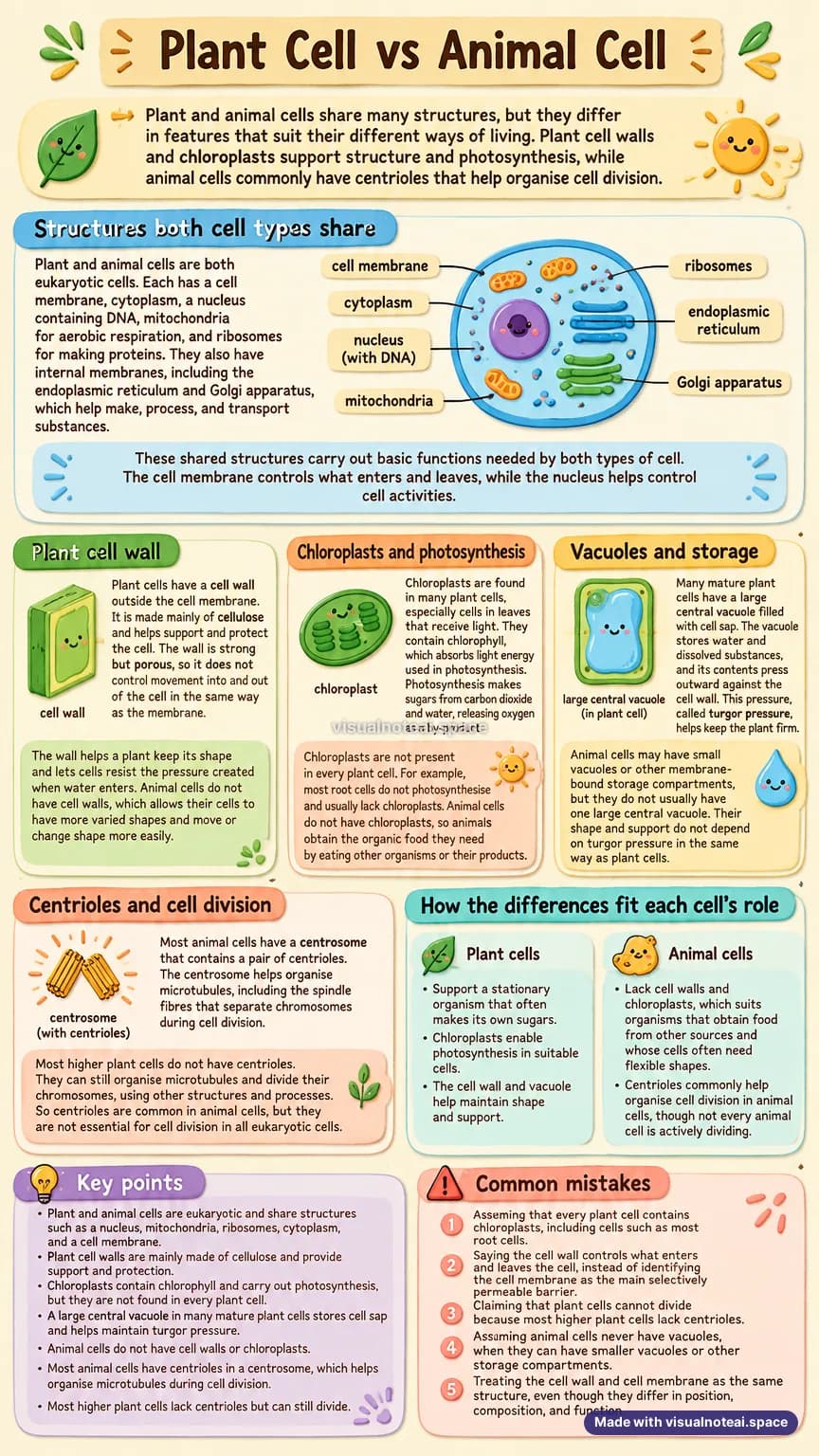
The whole topic on one page. Made with VisualNote.
!Common mistakes
- Assuming that every plant cell contains chloroplasts, including cells such as most root cells.
- Saying the cell wall controls what enters and leaves the cell, instead of identifying the cell membrane as the main selectively permeable barrier.
- Claiming that plant cells cannot divide because most higher plant cells lack centrioles.
- Assuming animal cells never have vacuoles, when they can have smaller vacuoles or other storage compartments.
- Treating the cell wall and cell membrane as the same structure, even though they differ in position, composition, and function.
🧠Explore the map35 ideas
The mind map VisualNote made for this topic. Drag to pan, scroll to zoom.
- Plant and Animal Cell Comparison
- Shared Eukaryotic Structures
- Cell membrane
- Controls entry and exit
- Nucleus and DNA
- Mitochondria and aerobic respiration
- Ribosomes and protein synthesis
- Endoplasmic reticulum and Golgi apparatus
- Cell membrane
- Plant Cell Wall
- Outside the cell membrane
- Mainly cellulose
- Support, protection, and shape
- Porous; does not control cell entry and exit
- Animal cells lack cell walls
- Chloroplasts and Photosynthesis
- Chlorophyll absorbs light
- Photosynthesis makes sugars from carbon dioxide and water
- Oxygen released as a by-product
- Present in many plant cells, not all
- Most root cells lack chloroplasts
- Animal cells lack chloroplasts
- Vacuoles and Storage
- Large central vacuole in many mature plant cells
- Stores water and dissolved substances in cell sap
- Turgor pressure helps keep plants firm
- Animal cells may have smaller vacuoles or storage compartments
- Large central vacuole in many mature plant cells
- Centrioles and Cell Division
- Most animal cells have a centrosome with centrioles
- Organises microtubules and spindle fibres
- Most higher plant cells lack centrioles
- Plant cells can still divide using other structures and processes
- Most animal cells have a centrosome with centrioles
- Features Fit Cell Roles
- Plant cells: support and often make their own sugars
- Animal cells: flexible shapes and food from other organisms
- Cell wall and membrane are distinct structures
- Shared Eukaryotic Structures
🃏Flashcards12 cards
- What structures do plant and animal cells share?
- Both are eukaryotic and have a cell membrane, cytoplasm, a nucleus containing DNA, mitochondria, ribosomes, endoplasmic reticulum, and Golgi apparatus.
- What is the main role of the cell membrane?
- It acts as a selectively permeable barrier, controlling what enters and leaves the cell.
- What is the plant cell wall made of, and what does it do?
- It is made mainly of cellulose and helps support, protect, and maintain the shape of the cell.
- How is the cell wall different from the cell membrane?
- The cell wall is a strong, porous outer layer that provides support; the cell membrane controls movement into and out of the cell.
- Why can plant cells resist pressure as water enters?
- Their cell walls provide strength and resist the outward pressure caused by water entering the cells.
- What do chloroplasts contain, and what is their role?
- Chloroplasts contain chlorophyll, which absorbs light energy used in photosynthesis.
- What is photosynthesis?
- It is the process that uses light energy to make sugars from carbon dioxide and water, releasing oxygen as a by-product.
- Do all plant cells have chloroplasts?
- No. Chloroplasts occur in many plant cells, especially those exposed to light; most root cells usually lack them.
- What is the function of the large central vacuole in many mature plant cells?
- It stores cell sap, including water and dissolved substances, and helps maintain turgor pressure that keeps the plant firm.
- How do vacuoles in animal cells compare with those in many plant cells?
- Animal cells may have small vacuoles or other storage compartments, but they usually lack one large central vacuole.
- What do centrioles do in most animal cells?
- Located in the centrosome, they help organise microtubules, including spindle fibres that separate chromosomes during cell division.
- Can plant cells divide without centrioles?
- Yes. Most higher plant cells lack centrioles but can still organise microtubules and divide their chromosomes.
✅Test yourself5 questions
Which set contains structures found in both plant and animal cells?
Both plant and animal cells have a nucleus, mitochondria, and ribosomes.
Which structure is the main selectively permeable barrier controlling what enters and leaves a plant cell?
The cell membrane controls movement into and out of the cell, while the porous cell wall mainly provides support and protection.
Why do most root cells usually lack chloroplasts?
Most root cells do not receive light and therefore usually do not photosynthesise.
How does the large central vacuole help support many mature plant cells?
Water and dissolved substances in the vacuole create turgor pressure by pressing outward against the cell wall.
What is true about cell division in most higher plant cells?
Most higher plant cells lack centrioles but can still organise microtubules and divide their chromosomes.
📝The notes
Structures both cell types share
Plant and animal cells are both eukaryotic cells. Each has a cell membrane, cytoplasm, a nucleus containing DNA, mitochondria for aerobic respiration, and ribosomes for making proteins. They also have internal membranes, including the endoplasmic reticulum and Golgi apparatus, which help make, process, and transport substances.
These shared structures carry out basic functions needed by both types of cell. The cell membrane controls what enters and leaves, while the nucleus helps control cell activities.
Plant cell wall
Plant cells have a cell wall outside the cell membrane. It is made mainly of cellulose and helps support and protect the cell. The wall is strong but porous, so it does not control movement into and out of the cell in the same way as the membrane.
The wall helps a plant keep its shape and lets cells resist the pressure created when water enters. This support is important because plants do not have a skeleton. Animal cells do not have cell walls, which allows their cells to have more varied shapes and move or change shape more easily.
Chloroplasts and photosynthesis
Chloroplasts are found in many plant cells, especially cells in leaves that receive light. They contain chlorophyll, which absorbs light energy used in photosynthesis. Photosynthesis makes sugars from carbon dioxide and water, releasing oxygen as a by-product.
Chloroplasts are not present in every plant cell. For example, most root cells do not photosynthesise and usually lack chloroplasts. Animal cells do not have chloroplasts, so animals obtain the organic food they need by eating other organisms or their products.
Vacuoles and storage
Many mature plant cells have a large central vacuole filled with cell sap. The vacuole stores water and dissolved substances, and its contents press outward against the cell wall. This pressure, called turgor pressure, helps keep the plant firm.
Animal cells may have small vacuoles or other membrane-bound storage compartments, but they do not usually have one large central vacuole. Their shape and support do not depend on turgor pressure in the same way as plant cells.
Centrioles and cell division
Most animal cells have a centrosome that contains a pair of centrioles. The centrosome helps organise microtubules, including the spindle fibres that separate chromosomes during cell division.
Most higher plant cells do not have centrioles. They can still organise microtubules and divide their chromosomes, using other structures and processes. So centrioles are common in animal cells, but they are not essential for cell division in all eukaryotic cells.
How the differences fit each cell's role
Plant cell features work together to support a stationary organism that often makes its own sugars. Chloroplasts enable photosynthesis in suitable cells, while the cell wall and vacuole help maintain shape and support.
Animal cells lack cell walls and chloroplasts, which suits organisms that obtain food from other sources and whose cells often need flexible shapes. Centrioles commonly help organise cell division in animal cells, though not every animal cell is actively dividing.
Make this for your own notes
Paste a chapter or a PDF and get the sheet, map, cards, quiz and episode back in about a minute. No credit card.