
The right-hand rule links the direction of conventional current to the direction of the magnetic field it produces. For a straight wire, your curled fingers show the field circling the wire; for a loop, they show the current around the loop and your thumb shows the field through its centre.
★What to remember
- For a straight wire, point your right thumb along the conventional current.
- For a straight wire, your curled fingers show the direction of the magnetic field around it.
- With upward current in a vertical wire on the page, the field is into the page on the right and out of the page on the left.
- Current into the page gives a clockwise magnetic field when viewed from in front of the page.
- For a loop, curl your right-hand fingers in the direction of the conventional current.
- For a loop, your thumb points in the field direction through the centre.
- A counterclockwise current viewed face-on gives a field out of the page through the loop's centre.
- Reversing the current reverses the magnetic field direction.
🎧Listen2:32 · transcript
AnnaLet’s make the right-hand rule practical. What does it help us figure out?
MarcoIt connects the direction of conventional current to the direction of the magnetic field that current produces. The hand position depends on whether we’re looking at a straight wire or a loop.
AnnaStart with a straight wire. How should I hold my hand?
MarcoGrip the wire with your right hand. Point your thumb along the conventional current, which is the direction positive charge flows. Your curled fingers show the direction of the magnetic field circling the wire.
AnnaSo the field doesn’t point the same way all around the wire?
MarcoExactly. It forms circles centred on the wire, and its direction changes as you move around those circles. That means you need to say where you’re checking the field.
AnnaLet’s use the vertical wire example. Current flows upward on the page. What happens on either side?
MarcoPoint your right thumb upward. At a point to the right of the wire, the field goes into the page. At a point to the left, it comes out of the page.
AnnaAnd if the wire goes through the page, with current directed away from us?
MarcoPoint your right thumb into the page. Looking at the page, your fingers curl clockwise, so the field circles clockwise from our viewpoint. If the current comes out of the page toward us, the field circles counterclockwise.
AnnaThat viewpoint matters a lot, doesn’t it?
MarcoIt does. Clockwise and counterclockwise only make sense once we know which way we’re looking. Keeping the viewpoint clear helps avoid mixing them up.
AnnaNow how does the hand rule change for a current loop?
MarcoFor a loop, curl your right-hand fingers in the direction of conventional current around the loop. Your extended thumb points in the direction of the magnetic field through the centre.
AnnaSo if I look face-on and the current goes counterclockwise, where does the field point?
MarcoYour thumb points toward you. The field through the centre comes out of the page. If the current goes clockwise, your thumb points away from you, and the field through the centre goes into the page.
AnnaDoes that thumb direction describe the field everywhere around the loop?
MarcoNo. It gives the field direction through the centre. Outside the loop, the field curves around, so don’t treat the thumb direction as the direction at every point.
AnnaWhat’s a reliable way to apply the rule without getting turned around?
MarcoFirst identify conventional current, not electron flow. Then decide where you need the field direction. For a wire, point your thumb along the current and check your curled fingers at that location. For a loop, curl your fingers along the current and read the direction from your thumb.
AnnaAnd the rule tells us direction, but not strength?
MarcoRight. It gives direction only. Use your right hand, keep the viewpoint clear, and remember that reversing the current reverses the magnetic field direction.
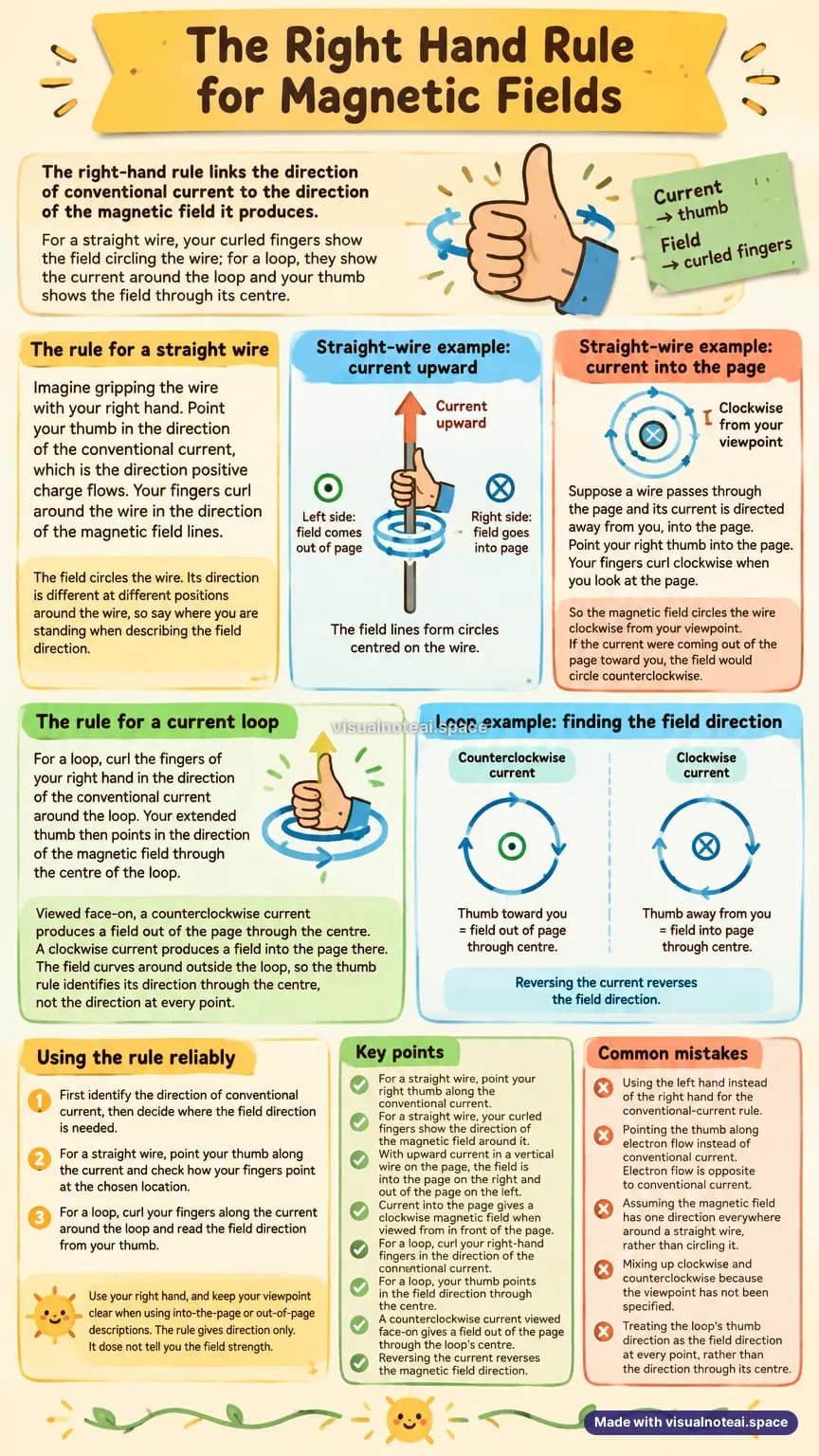
The whole topic on one page. Made with VisualNote.
!Common mistakes
- Using the left hand instead of the right hand for the conventional-current rule.
- Pointing the thumb along electron flow instead of conventional current. Electron flow is opposite to conventional current.
- Assuming the magnetic field has one direction everywhere around a straight wire, rather than circling it.
- Mixing up clockwise and counterclockwise because the viewpoint has not been specified.
- Treating the loop's thumb direction as the field direction at every point, rather than the direction through its centre.
🧠Explore the map27 ideas
The mind map VisualNote made for this topic. Drag to pan, scroll to zoom.
- Right-Hand Rule for Magnetic Fields
- Straight Wire
- Thumb follows conventional current
- Curled fingers show field direction
- Field lines circle the wire
- Upward current: right side into page
- Upward current: left side out of page
- Into-page current: clockwise field from front
- Current Loop
- Curl fingers along conventional current
- Thumb shows field through loop centre
- Counterclockwise current: field out of page
- Clockwise current: field into page
- Reversing current reverses field
- Field curves around loop outside
- Applying the Rule
- Identify conventional current direction
- Choose the location where field is needed
- Use right hand, not left
- Specify viewpoint for page directions
- Rule gives direction, not field strength
- Common Errors
- Using electron flow instead of conventional current
- Electron flow opposes conventional current
- Assuming one field direction everywhere around wire
- Confusing clockwise and counterclockwise viewpoints
- Applying loop thumb direction to every point
- Straight Wire
🃏Flashcards12 cards
- What does the right-hand rule relate?
- It relates the direction of conventional current to the direction of the magnetic field it produces.
- How do you use the right-hand rule for a straight wire?
- Point your right thumb along the conventional current. Your curled fingers show the magnetic field circling the wire.
- What is conventional current?
- It is the direction positive charge flows. Electron flow is in the opposite direction.
- What shape do magnetic field lines make around a straight wire?
- They form circles centered on the wire, so the field direction changes depending on the position around it.
- A vertical wire carries current upward. What is the field direction to its right and left?
- To the right of the wire, the field goes into the page; to the left, it comes out of the page.
- A wire carries current into the page. Which way does the field circle when viewed from in front?
- The magnetic field circles clockwise. If the current comes out of the page, it circles counterclockwise.
- How do you use the right-hand rule for a current loop?
- Curl your right-hand fingers in the direction of conventional current around the loop. Your thumb points in the field direction through the loop’s centre.
- What field direction through a loop’s centre is produced by counterclockwise current?
- Viewed face-on, the field comes out of the page, toward you.
- What field direction through a loop’s centre is produced by clockwise current?
- Viewed face-on, the field goes into the page, away from you.
- What happens to the magnetic field direction when current is reversed?
- The magnetic field direction reverses.
- Does the loop’s thumb direction describe the field everywhere?
- No. It gives the field direction through the centre; the field curves around outside the loop.
- What does the right-hand rule tell you, and what does it not tell you?
- It tells you the magnetic field’s direction, not its strength. Use the right hand and specify your viewpoint for into- or out-of-the-page directions.
✅Test yourself5 questions
When applying the right-hand rule to a straight wire, which direction should your thumb point?
For a straight wire, the right thumb points in the direction of conventional current, not electron flow.
A vertical wire carries conventional current upward on the page; which way does the field point at a position to the right of the wire?
With upward current, the curled fingers show that the field is into the page on the wire’s right side.
A straight wire carries current into the page; viewed from in front of the page, which way does its magnetic field circle?
Pointing the right thumb into the page makes the fingers curl clockwise from the stated viewpoint.
A circular loop carries counterclockwise conventional current when viewed face-on; what is the field direction through its centre?
Curling the right-hand fingers counterclockwise makes the thumb point toward the viewer, out of the page.
What does the right-hand rule determine about the magnetic field produced by a current?
The right-hand rule identifies field direction; it does not provide information about field strength.
📝The notes
The rule for a straight wire
Imagine gripping the wire with your right hand. Point your thumb in the direction of the conventional current, which is the direction positive charge flows. Your fingers curl around the wire in the direction of the magnetic field lines.
The field circles the wire. Its direction is different at different positions around the wire, so say where you are standing when describing the field direction.
Straight-wire example: current upward
Draw a straight wire running vertically on the page, with conventional current flowing upward. Point your right thumb upward and let your fingers curl around the wire.
At a point to the right of the wire, the field goes into the page. At a point to the left of the wire, it comes out of the page. The field lines form circles centred on the wire.
Straight-wire example: current into the page
Suppose a wire passes through the page and its current is directed away from you, into the page. Point your right thumb into the page. Your fingers curl clockwise when you look at the page.
So the magnetic field circles the wire clockwise from your viewpoint. If the current were coming out of the page toward you, the field would circle counterclockwise.
The rule for a current loop
For a loop, curl the fingers of your right hand in the direction of the conventional current around the loop. Your extended thumb then points in the direction of the magnetic field through the centre of the loop.
Viewed face-on, a counterclockwise current produces a field out of the page through the centre. A clockwise current produces a field into the page there. The field curves around outside the loop, so the thumb rule identifies its direction through the centre, not the direction at every point.
Loop example: finding the field direction
Imagine looking directly at a circular loop, with conventional current flowing counterclockwise. Curl your right-hand fingers to follow that current. Your thumb points toward you, so the magnetic field through the centre comes out of the page.
If the current is clockwise instead, curl your fingers clockwise. Your thumb points away from you, so the field through the centre goes into the page. Reversing the current reverses the field direction.
Using the rule reliably
First identify the direction of conventional current, then decide where the field direction is needed. For a straight wire, point your thumb along the current and check how your fingers point at the chosen location. For a loop, curl your fingers along the current around the loop and read the field direction from your thumb.
Use your right hand, and keep your viewpoint clear when using into-the-page or out-of-the-page descriptions. The rule gives direction only. It does not tell you the field strength.
Make this for your own notes
Paste a chapter or a PDF and get the sheet, map, cards, quiz and episode back in about a minute. No credit card.