
The lens equation links a lens's focal length with the distances of an object and its image. To use it correctly, choose a sign convention and apply it consistently to all three distances.
★What to remember
- The Cartesian lens equation is 1/f = 1/v - 1/u.
- Measure object and image distances from the optical centre of the lens.
- For light travelling left to right, distances to the right are positive and distances to the left are negative.
- A real object in front of the lens has negative u.
- A real image has positive v, and a virtual image has negative v.
- A converging lens has positive focal length, while a diverging lens has negative focal length.
- Keep the same units for focal length, object distance, and image distance.
🎧Listen2:46 · transcript
AnnaLet’s talk about the lens equation. Marco, what does it connect?
MarcoIt connects a lens’s focal length with the distances of an object and its image. The important thing is to choose a sign convention and use it consistently. With the Cartesian convention, the equation is one over f equals one over v minus one over u.
AnnaSo f is focal length, u is object distance, and v is image distance? And where do we measure them from?
MarcoExactly. All three distances are measured from the optical centre of the lens, along the principal axis. The equation assumes a thin lens, and we need to use the same units for all three distances.
AnnaHow does the Cartesian convention assign the signs?
MarcoTake the direction light travels as positive. If light travels from left to right, distances to the right of the lens are positive, and distances to the left are negative. So a real object in front of the lens has a negative u.
AnnaThat’s easy to miss. What about the signs for focal length and image distance?
MarcoA converging lens has a positive focal length, because its principal focus is on the positive side. A diverging lens has a negative focal length. For images, a real image forms where refracted rays actually meet, on the positive side, so v is positive. A virtual image appears to come from the negative side, so v is negative.
AnnaAnd heights above or below the principal axis have signs too, right?
MarcoYes. Heights above are positive, and heights below are negative. That helps describe images, though height doesn’t appear in the lens equation.
AnnaLet’s rearrange it to find the image distance. What do we get?
MarcoOne over v equals one over f plus one over u. Then we substitute the signed values of f and u before calculating. A positive answer for v means a real image, and a negative answer means a virtual image. Negative doesn’t mean the calculation failed.
AnnaCan we walk through the example?
MarcoSure. A converging lens has a focal length of plus ten centimetres. The object is thirty centimetres to the left, so u is minus thirty centimetres. The equation gives one over ten equals one over v minus one over negative thirty. That becomes one over ten equals one over v plus one over thirty.
AnnaThen one over v is one over ten minus one over thirty, which is one over fifteen. So v is plus fifteen centimetres. What does that tell us?
MarcoThe image is fifteen centimetres to the right of the lens, and it’s real. The main traps are mixing sign conventions, entering a real object’s distance as positive, or treating a negative image distance as an error. Also, don’t give a diverging lens a positive focal length under this convention, and don’t mix units.
AnnaSo the signs aren’t extra decoration. They tell us where things are and what kind of image we have.
MarcoExactly. Keep the convention, equation, and units consistent, and the signs become part of the answer.
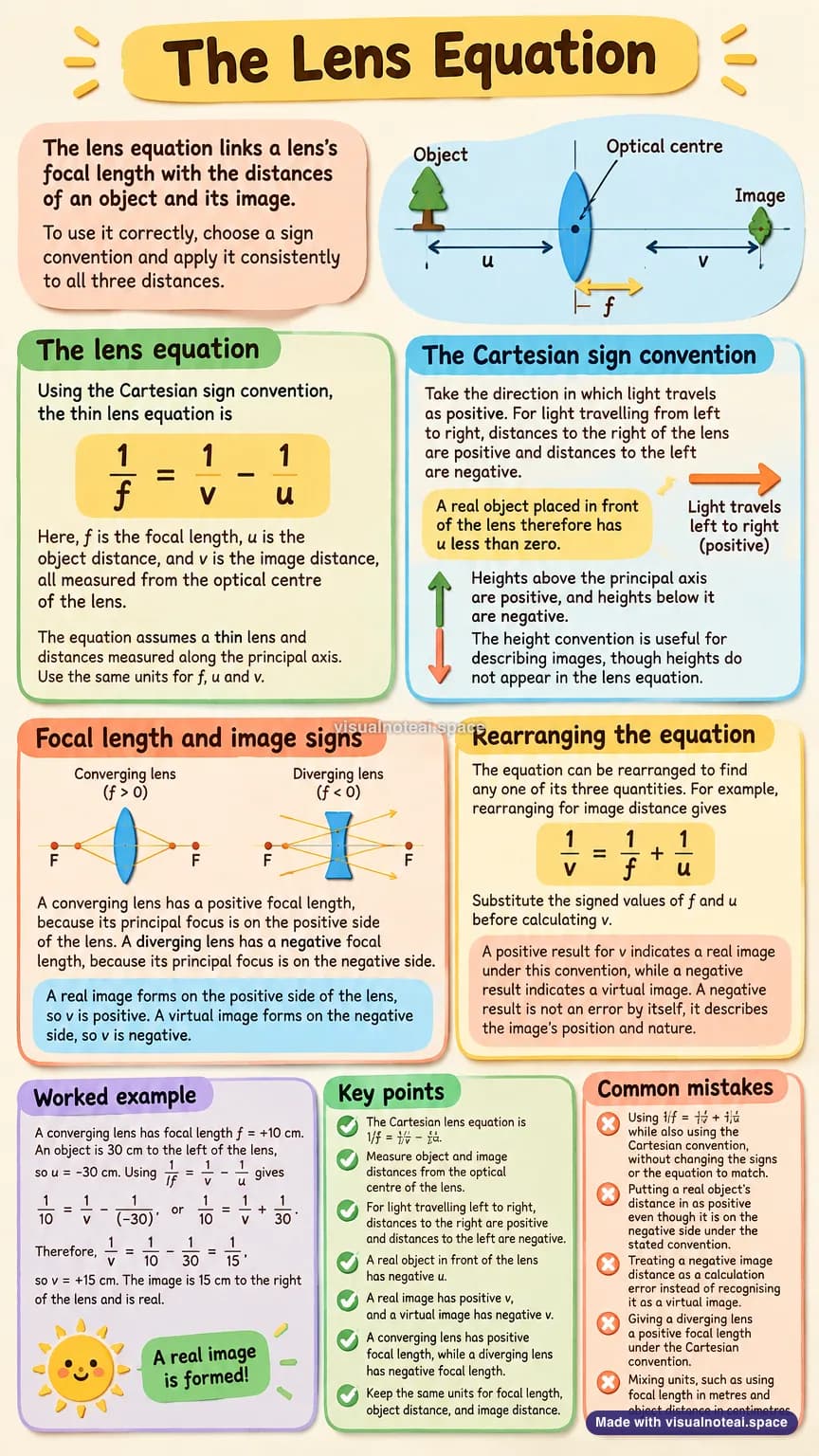
The whole topic on one page. Made with VisualNote.
!Common mistakes
- Using 1/f = 1/v + 1/u while also using the Cartesian convention, without changing the signs or the equation to match.
- Putting a real object's distance in as positive even though it is on the negative side under the stated convention.
- Treating a negative image distance as a calculation error instead of recognising it as a virtual image.
- Giving a diverging lens a positive focal length under the Cartesian convention.
- Mixing units, such as using focal length in metres and object distance in centimetres.
🧠Explore the map27 ideas
The mind map VisualNote made for this topic. Drag to pan, scroll to zoom.
- Thin Lens Equation
- Equation and Conditions
- Cartesian Equation: 1/f = 1/v - 1/u
- f: focal length; u: object distance; v: image distance
- Distances measured from optical centre along principal axis
- Thin lens assumption; use consistent units
- Cartesian Sign Convention
- Light travels left to right: right is positive, left is negative
- Real object in front of lens: u is negative
- Above principal axis: positive height; below: negative height
- Focal Length and Image Signs
- Converging lens: positive f
- Diverging lens: negative f
- Real image: positive v; rays meet on positive side
- Virtual image: negative v; rays appear to come from negative side
- Rearrangement and Calculation
- Image distance form: 1/v = 1/f + 1/u
- Substitute signed values before calculating
- Positive v means real image; negative v means virtual image
- Example: f = +10 cm, u = -30 cm
- Calculation gives v = +15 cm; real image to the right
- Common Mistakes
- Mixing equation forms and sign conventions
- Entering a real object's distance as positive
- Treating negative v as an error
- Giving a diverging lens positive f
- Mixing units for f, u, and v
- Equation and Conditions
🃏Flashcards12 cards
- What does the thin lens equation relate?
- It relates a lens’s focal length to the object and image distances, all measured from the lens’s optical centre.
- What is the Cartesian thin lens equation?
- 1/f = 1/v − 1/u, where f is focal length, u is object distance, and v is image distance.
- What assumptions and units apply to the lens equation?
- It assumes a thin lens and distances measured along the principal axis. Use the same units for f, u, and v.
- What is the Cartesian sign convention for distances when light travels left to right?
- Distances to the right of the lens are positive; distances to the left are negative.
- What sign does a real object in front of the lens have for u?
- Its object distance is negative because the object is to the left of the lens.
- What are the height signs under the Cartesian convention?
- Heights above the principal axis are positive, and heights below it are negative.
- What is the focal-length sign for a converging lens?
- Positive, because its principal focus lies on the positive side of the lens.
- What is the focal-length sign for a diverging lens?
- Negative, because its principal focus lies on the negative side of the lens.
- What signs indicate real and virtual images?
- A real image has positive v; a virtual image has negative v.
- How can the lens equation be rearranged to find image distance?
- 1/v = 1/f + 1/u. Substitute the signed values of f and u before calculating.
- What does a negative calculated image distance mean?
- It indicates a virtual image on the negative side of the lens; it is not necessarily a calculation error.
- A converging lens has f = +10 cm and an object has u = −30 cm. What are v and the image type?
- v = +15 cm, so the image forms 15 cm to the right of the lens and is real.
✅Test yourself5 questions
Which equation represents the thin lens equation using the Cartesian sign convention?
With the Cartesian convention, the thin lens equation is 1/f = 1/v - 1/u.
Light travels from left to right, and a real object is placed to the left of a lens. What is the sign of its object distance u?
Distances to the left of the lens are negative under this convention, so a real object in front of the lens has negative u.
What is the sign of the focal length of a diverging lens under the Cartesian sign convention?
A diverging lens has its principal focus on the negative side, so its focal length is negative.
Under the Cartesian convention, what does a negative image distance v indicate?
A virtual image appears to come from the negative side of the lens, so its image distance is negative.
A converging lens has f = +10 cm and an object has u = -30 cm. Using 1/f = 1/v - 1/u, what is the image distance v?
Substitution gives 1/10 = 1/v + 1/30, so 1/v = 1/15 and v = +15 cm.
📝The notes
The lens equation
Using the Cartesian sign convention, the thin lens equation is 1/f = 1/v - 1/u. Here, f is the focal length, u is the object distance, and v is the image distance, all measured from the optical centre of the lens.
The equation assumes a thin lens and distances measured along the principal axis. Use the same units for f, u, and v.
The Cartesian sign convention
Take the direction in which light travels as positive. For light travelling from left to right, distances to the right of the lens are positive and distances to the left are negative. A real object placed in front of the lens therefore has u less than zero.
Heights above the principal axis are positive, and heights below it are negative. The height convention is useful for describing images, though heights do not appear in the lens equation.
Focal length and image signs
A converging lens has a positive focal length, because its principal focus is on the positive side of the lens. A diverging lens has a negative focal length, because its principal focus is on the negative side.
A real image forms on the positive side of the lens, where the refracted rays actually meet, so v is positive. A virtual image forms on the negative side, where the rays appear to come from, so v is negative.
Rearranging the equation
The equation can be rearranged to find any one of its three quantities. For example, rearranging for image distance gives 1/v = 1/f + 1/u. Substitute the signed values of f and u before calculating v.
A positive result for v indicates a real image under this convention, while a negative result indicates a virtual image. A negative result is not an error by itself; it describes the image's position and nature.
Worked example
A converging lens has focal length f = +10 cm. An object is 30 cm to the left of the lens, so u = -30 cm. Using 1/f = 1/v - 1/u gives 1/10 = 1/v - 1/(-30), or 1/10 = 1/v + 1/30.
Therefore, 1/v = 1/10 - 1/30 = 1/15, so v = +15 cm. The image is 15 cm to the right of the lens and is real.
Make this for your own notes
Paste a chapter or a PDF and get the sheet, map, cards, quiz and episode back in about a minute. No credit card.