
A half life is the time it takes for half of the radioactive nuclei in a sample to decay. Half life calculations use repeated halving, or an exponential decay formula, to find how much remains or how much time has passed.
★What to remember
- A half life is the time taken for half the radioactive nuclei in a sample to decay.
- After each half life, half of the amount that remained at the start of that interval is left.
- The amount remaining after time t is N = N₀(1/2)^(t/T).
- The exponent t/T is the number of half lives that have passed.
- The time and half life must be expressed in the same units before using the formula.
- To find elapsed time, compare the remaining amount with the starting amount and determine how many half lives have passed.
- Radioactive decay is random for individual nuclei, but the decay pattern of a large sample is predictable.
🎧Listen3:09 · transcript
AnnaWhen people hear “half life,” they sometimes think a sample loses the same amount every time. Is that right?
MarcoNo. A half life is the time it takes for half the radioactive nuclei in a sample to decay. After each interval, you halve what remains, not the original amount again. So the amount falls by the same fraction, not by the same fixed quantity.
AnnaAnd it is not only about counting nuclei, is it?
MarcoRight. Under the same measuring conditions, the activity or count rate also falls to half its starting value over one half life. The half life is a fixed property of an isotope. It does not depend on how much is in the sample, or on ordinary changes in temperature and pressure.
AnnaIndividual nuclei decay randomly, so how can we use a predictable calculation?
MarcoThe pattern for a large sample is predictable, even though the decay of any one nucleus is random. For a whole number of half lives, repeated halving is usually quickest. One half life leaves one half. Two leave one quarter. Three leave one eighth.
AnnaLet’s make that practical. If I start with two hundred and forty milligrams, and the half life is five days, what remains after twenty days?
MarcoFirst, make sure the units match. Twenty days divided by five days gives four half lives. Halve two hundred and forty four times: one hundred and twenty, sixty, thirty, then fifteen milligrams.
AnnaSo the general formula handles that, and times that are not whole numbers of half lives too?
MarcoExactly. Spoken aloud, it is: N equals N zero times one half raised to the power t over T. N is the amount remaining, N zero is the starting amount, t is elapsed time, and T is the half life. The exponent, t divided by T, tells you how many half lives have passed. Keep t and T in the same units.
AnnaWhat if the quantity is an activity rather than a mass?
MarcoThe same calculation applies, as long as you measure consistently. Say the starting activity is eight hundred counts per minute, with a half life of three hours. After nine hours, three half lives have passed, so one hundred counts per minute remain.
AnnaAnd a fractional number of half lives?
MarcoUse the formula directly. For one hundred grams with a ten-year half life, after fifteen years the calculation is one hundred times one half to the power of one point five. That is about thirty-five point four grams. It is below fifty, because more than one half life passed, but above twenty-five, because fewer than two passed.
AnnaCan we work backwards from what remains to find the time?
MarcoYes. Compare the remaining amount with the starting amount. If eighty grams falls to ten, one eighth remains. That is three halvings. With a six-hour half life, three times six gives eighteen hours.
AnnaAnd if the fraction is not a neat one eighth?
MarcoRearrange the formula: t equals T times the log of N over N zero, divided by the log of one half. For example, if thirty percent remains, use zero point three as N over N zero. The result gives elapsed time in units matching the half life. The common traps are subtracting a fixed amount, mixing units, reversing t over T, or mixing up what has decayed with what remains.
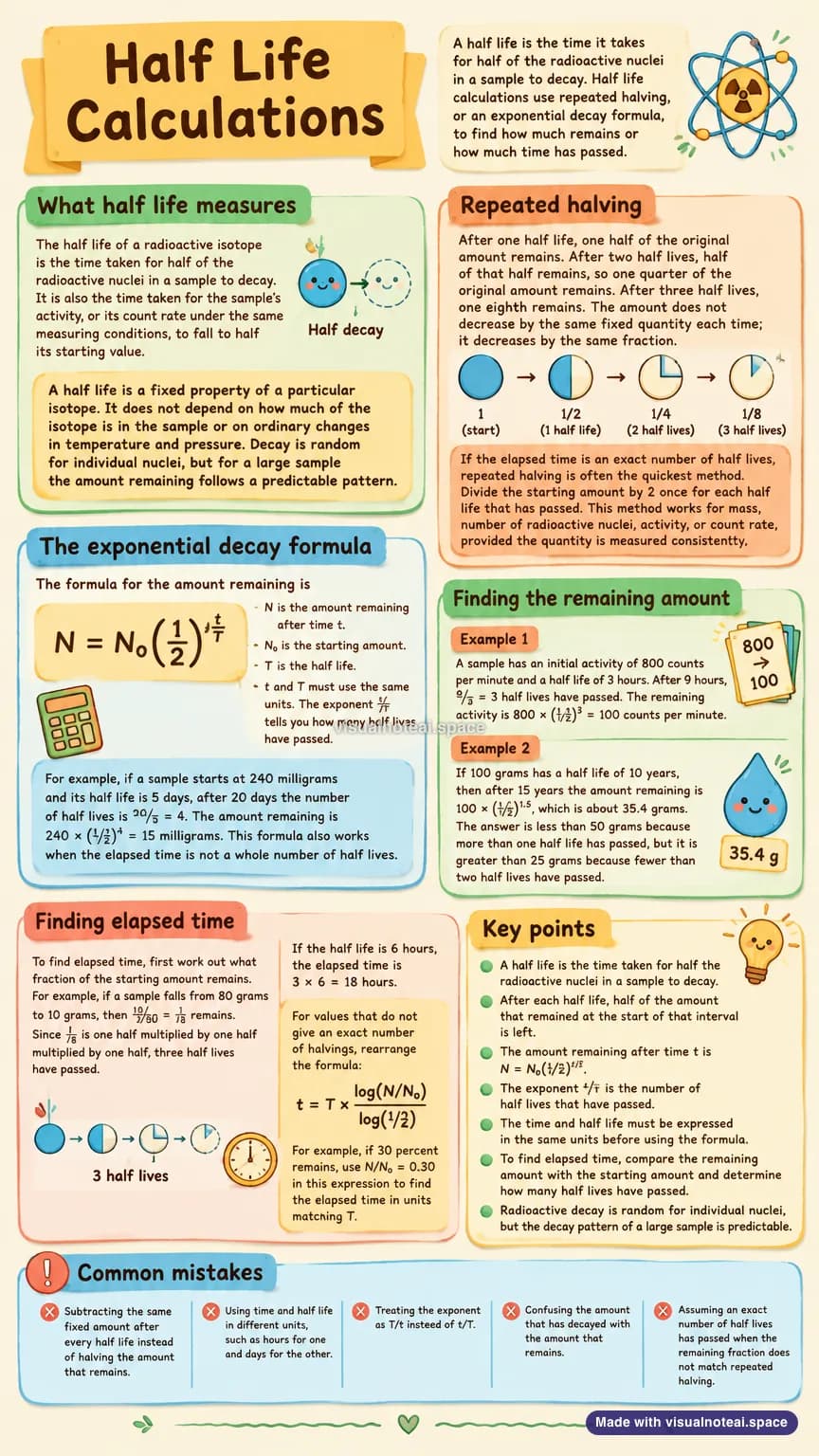
The whole topic on one page. Made with VisualNote.
!Common mistakes
- Subtracting the same fixed amount after every half life instead of halving the amount that remains.
- Using time and half life in different units, such as hours for one and days for the other.
- Treating the exponent as T/t instead of t/T.
- Confusing the amount that has decayed with the amount that remains.
- Assuming an exact number of half lives has passed when the remaining fraction does not match repeated halving.
🧠Explore the map30 ideas
The mind map VisualNote made for this topic. Drag to pan, scroll to zoom.
- Radioactive Half-Life Calculations
- Meaning of Half-Life
- Time for half the nuclei to decay
- Activity and count rate also halve
- Fixed property of each isotope
- Large-sample decay is predictable
- Repeated Halving
- One half-life: 1/2 remains
- Two half-lives: 1/4 remains
- Three half-lives: 1/8 remains
- Same fraction decreases, not fixed quantity
- Works for mass, nuclei, activity, or count rate
- Remaining-Amount Formula
- N = N₀(1/2)^(t/T)
- N: amount remaining; N₀: starting amount
- t: elapsed time; T: half-life duration
- t and T must use matching units
- t/T gives number of half-lives
- Use formula for fractional half-lives
- Finding Elapsed Time
- Calculate remaining fraction N/N₀
- Recognize repeated-halving fractions
- Elapsed time = half-lives × T
- For other fractions: t = T × log(N/N₀) / log(1/2)
- Common Errors
- Subtracting a fixed amount instead of halving
- Mixing time units
- Using T/t instead of t/T
- Confusing amount decayed with amount remaining
- Assuming whole half-lives without checking the fraction
- Meaning of Half-Life
🃏Flashcards12 cards
- What is the half-life of a radioactive isotope?
- The time it takes for half of the radioactive nuclei in a sample to decay.
- How does a sample’s activity change after one half-life?
- Its activity or count rate falls to half its starting value, provided measurements use the same conditions.
- Is half-life affected by sample size or ordinary temperature and pressure changes?
- No. Half-life is a fixed property of a particular isotope.
- How does the amount remaining change with each half-life?
- It is halved each time: after one, one-half remains; after two, one-quarter; after three, one-eighth.
- What is the radioactive decay formula for amount remaining?
- N = N₀(1/2)^(t/T), where N is the remaining amount, N₀ is the starting amount, t is elapsed time, and T is the half-life.
- What does the exponent t/T represent?
- The number of half-lives that have passed. The elapsed time and half-life must use the same units.
- When is repeated halving a convenient method?
- When the elapsed time is an exact whole number of half-lives; divide the starting amount by 2 once for each half-life.
- What quantities can be calculated using half-life methods?
- Mass, number of radioactive nuclei, activity, or count rate, as long as the quantity is measured consistently.
- A 240 mg sample has a 5-day half-life. How much remains after 20 days?
- Four half-lives pass, so 240 × (1/2)^4 = 15 mg remains.
- A sample falls from 80 g to 10 g. How many half-lives have passed?
- 10/80 = 1/8 remains, which is three successive halvings, so three half-lives have passed.
- How do you find elapsed time when the remaining fraction is not an exact power of one-half?
- Use t = T × log(N/N₀) / log(1/2), with N/N₀ as the fraction remaining.
- What are common mistakes in half-life calculations?
- Subtracting a fixed amount instead of halving what remains, mixing time units, using T/t instead of t/T, or confusing the amount decayed with the amount remaining.
✅Test yourself5 questions
What does the half life of a radioactive isotope measure?
A half life is the time taken for half the radioactive nuclei in a sample to decay.
What fraction of the original amount remains after three half lives?
The remaining amount halves three times, leaving (1/2)³, or one eighth, of the original.
In N = N₀(1/2)^(t/T), what does the exponent t/T represent?
Dividing elapsed time t by half life T gives the number of half lives that have passed.
A half life is given in days and elapsed time in hours; what should you do before using the decay formula?
The elapsed time and half life must use the same units for t/T to be meaningful.
A sample decreases from 80 grams to 10 grams, and its half life is 6 hours; how long has passed?
Ten grams is one eighth of 80 grams, so three half lives have passed, giving 3 × 6 = 18 hours.
📝The notes
What half life measures
The half life of a radioactive isotope is the time taken for half of the radioactive nuclei in a sample to decay. It is also the time taken for the sample's activity, or its count rate under the same measuring conditions, to fall to half its starting value.
A half life is a fixed property of a particular isotope. It does not depend on how much of the isotope is in the sample or on ordinary changes in temperature and pressure. Decay is random for individual nuclei, but for a large sample the amount remaining follows a predictable pattern.
Repeated halving
After one half life, one half of the original amount remains. After two half lives, half of that half remains, so one quarter of the original amount remains. After three half lives, one eighth remains. The amount does not decrease by the same fixed quantity each time; it decreases by the same fraction.
If the elapsed time is an exact number of half lives, repeated halving is often the quickest method. Divide the starting amount by 2 once for each half life that has passed. This method works for mass, number of radioactive nuclei, activity, or count rate, provided the quantity is measured consistently.
The exponential decay formula
The formula for the amount remaining is N = N₀(1/2)^(t/T). Here, N is the amount remaining after time t, N₀ is the starting amount, T is the half life, and t and T must use the same units. The exponent t/T tells you how many half lives have passed.
For example, if a sample starts at 240 milligrams and its half life is 5 days, after 20 days the number of half lives is 20/5 = 4. The amount remaining is 240 × (1/2)^4 = 15 milligrams. This formula also works when the elapsed time is not a whole number of half lives.
Finding the remaining amount
Suppose a sample has an initial activity of 800 counts per minute and a half life of 3 hours. After 9 hours, 9/3 = 3 half lives have passed. The remaining activity is 800 × (1/2)^3 = 100 counts per minute.
For an elapsed time that is not a whole number of half lives, use the formula directly. If 100 grams has a half life of 10 years, then after 15 years the amount remaining is 100 × (1/2)^1.5, which is about 35.4 grams. The answer is less than 50 grams because more than one half life has passed, but it is greater than 25 grams because fewer than two half lives have passed.
Finding elapsed time
To find elapsed time, first work out what fraction of the starting amount remains. For example, if a sample falls from 80 grams to 10 grams, then 10/80 = 1/8 remains. Since 1/8 is one half multiplied by one half multiplied by one half, three half lives have passed.
If the half life is 6 hours, the elapsed time is 3 × 6 = 18 hours. For values that do not give an exact number of halvings, rearrange the formula: t = T × log(N/N₀) / log(1/2). For example, if 30 percent remains, use N/N₀ = 0.30 in this expression to find the elapsed time in units matching T.
Make this for your own notes
Paste a chapter or a PDF and get the sheet, map, cards, quiz and episode back in about a minute. No credit card.