
The gas laws describe how pressure, volume, and temperature change for a fixed amount of gas. The main difference between them is which variables are allowed to change and which are held constant.
★What to remember
- Boyle’s law is P₁V₁ = P₂V₂, with temperature and amount of gas constant.
- Charles’s law is V₁/T₁ = V₂/T₂, with pressure and amount of gas constant.
- Gay-Lussac’s law is P₁/T₁ = P₂/T₂, with volume and amount of gas constant.
- The combined gas law is P₁V₁/T₁ = P₂V₂/T₂, with amount of gas constant.
- Use kelvins for temperature in gas-law calculations.
- The ideal gas law, PV = nRT, includes the amount of gas in moles.
- Use absolute pressure, not gauge pressure, in gas-law calculations.
🎧Listen2:44 · transcript
AnnaWhen a gas problem gives you pressure, volume, and temperature, how do you know which formula to use?
MarcoI start by asking what changes and what stays constant. The amount of gas must stay fixed for Boyle’s law, Charles’s law, Gay-Lussac’s law, and the combined gas law. Then I look at which of the other variables are changing.
AnnaSo if only pressure and volume change, and temperature stays constant, that points to Boyle’s law?
MarcoExactly. It says pressure times volume at the start equals pressure times volume at the end. At constant temperature, pressure and volume move in opposite directions. Compress the gas to a smaller volume, and its pressure rises.
AnnaThat’s an easy relationship to get backwards. What if pressure stays constant instead?
MarcoThen, if volume and temperature are changing, use Charles’s law. Volume divided by absolute temperature at the start equals volume divided by absolute temperature at the end. Volume is directly proportional to temperature. Heat the gas, and its volume increases, as long as pressure and the amount of gas stay constant.
AnnaAnd if the container’s volume stays fixed, we’re looking at pressure and temperature?
MarcoRight. Gay-Lussac’s law says pressure divided by absolute temperature stays in the same ratio between the two states. The volume and amount of gas are constant. So heating the gas in a fixed volume makes its pressure increase.
AnnaWhat if more than one of those variables changes?
MarcoIf the amount of gas is fixed, the combined gas law can handle pressure, volume, and temperature changing between an initial and final state. Pressure times volume, divided by temperature, has the same value for both states. It brings together the relationships in those three simpler laws.
AnnaBut what if the amount of gas changes too?
MarcoThen the combined gas law isn’t the right choice in its usual form. The ideal gas law includes the amount of gas: pressure times volume equals the number of moles times the gas constant times temperature. It can connect pressure, volume, temperature, and amount, as long as the gas behaves closely enough to be ideal. Choose a gas constant that matches your pressure and volume units.
AnnaBefore using any of them, what checks should we make?
MarcoUse kelvins, not degrees Celsius. To convert, add two hundred seventy-three point one five. Keep pressure units consistent, and volume units consistent. Also use absolute pressure. If the value is gauge pressure, add atmospheric pressure first.
AnnaSo the safest habit is to identify the constants, convert the units, and then choose the law. And never treat Boyle’s pressure and volume as directly proportional.
MarcoThat’s it. Those checks prevent the most common mistakes: using Celsius, choosing a law without checking what stays constant, using the combined law when the amount changes, or putting gauge pressure straight into a calculation.
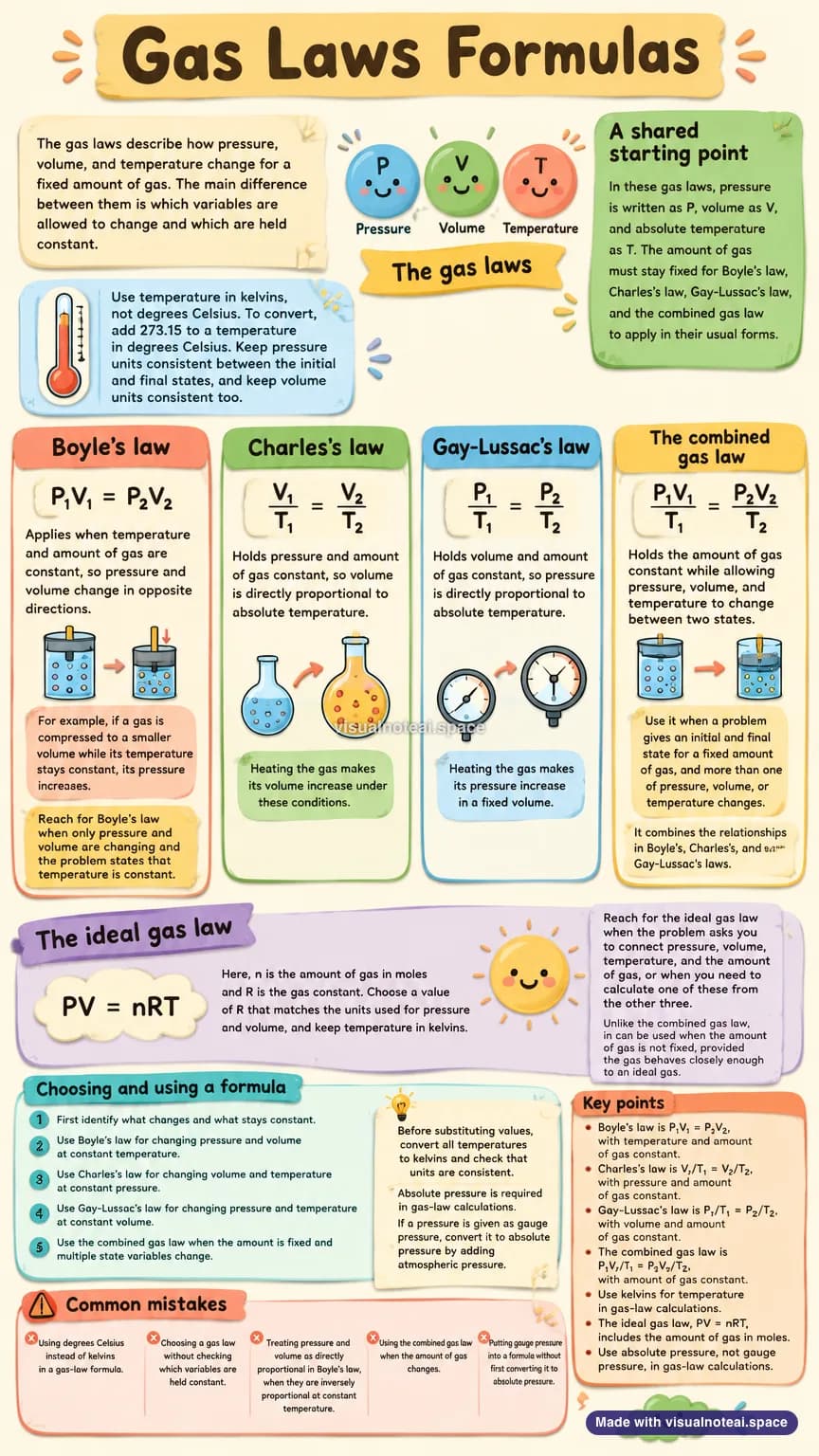
The whole topic on one page. Made with VisualNote.
!Common mistakes
- Using degrees Celsius instead of kelvins in a gas-law formula.
- Choosing a gas law without checking which variables are held constant.
- Treating pressure and volume as directly proportional in Boyle’s law, when they are inversely proportional at constant temperature.
- Using the combined gas law when the amount of gas changes.
- Putting gauge pressure into a formula without first converting it to absolute pressure.
🧠Explore the map31 ideas
The mind map VisualNote made for this topic. Drag to pan, scroll to zoom.
- Gas Laws
- Shared Variables and Conditions
- Pressure (P), Volume (V), Temperature (T)
- Fixed amount of gas for common gas laws
- Use kelvins; K = °C + 273.15
- Keep pressure and volume units consistent
- Boyle's Law
- P₁V₁ = P₂V₂
- Constant temperature and amount of gas
- Pressure and volume are inversely related
- Charles's and Gay-Lussac's Laws
- Charles's Law: V₁/T₁ = V₂/T₂
- Constant pressure and amount; volume rises with temperature
- Gay-Lussac's Law: P₁/T₁ = P₂/T₂
- Constant volume and amount; pressure rises with temperature
- Charles's Law: V₁/T₁ = V₂/T₂
- Combined Gas Law
- P₁V₁/T₁ = P₂V₂/T₂
- Constant amount; pressure, volume, and temperature may change
- Use for initial and final states with multiple changing variables
- Ideal Gas Law
- PV = nRT
- n is amount in moles; R is the gas constant
- Choose R to match pressure and volume units
- Can apply when amount of gas changes
- Choosing and Applying a Formula
- Identify changing and constant variables
- Use Boyle's, Charles's, or Gay-Lussac's law for the matching constant
- Use combined law for fixed amount and multiple changing variables
- Use absolute pressure, not gauge pressure
- Convert gauge pressure by adding atmospheric pressure
- Check units and convert temperatures before substitution
- Shared Variables and Conditions
🃏Flashcards12 cards
- What do the gas laws describe?
- They describe how pressure (P), volume (V), and temperature (T) change for a gas. In the usual forms of Boyle’s, Charles’s, Gay-Lussac’s, and the combined gas laws, the amount of gas stays fixed.
- What temperature scale is used in gas-law calculations?
- Use absolute temperature in kelvins, not degrees Celsius. Convert Celsius to kelvins by adding 273.15.
- Boyle’s law: formula and constant variables
- P₁V₁ = P₂V₂. Temperature and amount of gas are constant.
- How are pressure and volume related in Boyle’s law?
- They are inversely related at constant temperature: compressing a gas to a smaller volume increases its pressure.
- Charles’s law: formula and constant variables
- V₁/T₁ = V₂/T₂. Pressure and amount of gas are constant.
- How are volume and temperature related in Charles’s law?
- Volume is directly proportional to absolute temperature at constant pressure. Heating the gas increases its volume.
- Gay-Lussac’s law: formula and constant variables
- P₁/T₁ = P₂/T₂. Volume and amount of gas are constant.
- How are pressure and temperature related in Gay-Lussac’s law?
- Pressure is directly proportional to absolute temperature at constant volume. Heating the gas increases its pressure.
- Combined gas law: formula and when to use it
- P₁V₁/T₁ = P₂V₂/T₂. Use it for initial and final states when the amount of gas is fixed and multiple state variables change.
- Ideal gas law: formula and symbols
- PV = nRT, where n is the amount of gas in moles and R is the gas constant. Choose an R value that matches the pressure and volume units.
- How does the ideal gas law differ from the combined gas law?
- The ideal gas law includes the amount of gas, n, and can be used when that amount changes. The combined gas law assumes a fixed amount of gas.
- What pressure and unit checks are important in gas-law calculations?
- Use absolute pressure and keep pressure units consistent between states; keep volume units consistent too. Convert gauge pressure to absolute pressure by adding atmospheric pressure.
✅Test yourself5 questions
At constant temperature and with a fixed amount of gas, what happens to pressure when volume decreases?
Boyle’s law states that pressure and volume are inversely related when temperature and amount of gas are constant.
A gas-law calculation gives a temperature of 25 °C; which value should be used in the formula?
Gas-law formulas require absolute temperature, so 273.15 must be added to 25 °C.
Which gas law applies when pressure and temperature change while volume and amount of gas remain constant?
Gay-Lussac’s law relates pressure and absolute temperature at constant volume and fixed amount of gas.
A problem involves changing pressure, volume, temperature, and amount of gas; which equation is best suited to relate them?
The ideal gas law includes the amount of gas as n, whereas the combined gas law assumes the amount stays fixed.
A gas-law problem gives pressure as gauge pressure; what should be done before using it in the calculation?
Gas-law calculations require absolute pressure, which is obtained by adding atmospheric pressure to gauge pressure.
📝The notes
A shared starting point
In these gas laws, pressure is written as P, volume as V, and absolute temperature as T. The amount of gas must stay fixed for Boyle’s law, Charles’s law, Gay-Lussac’s law, and the combined gas law to apply in their usual forms.
Use temperature in kelvins, not degrees Celsius. To convert, add 273.15 to a temperature in degrees Celsius. Keep pressure units consistent between the initial and final states, and keep volume units consistent too.
Boyle’s law
Boyle’s law is P₁V₁ = P₂V₂. It applies when temperature and amount of gas are constant, so pressure and volume change in opposite directions.
For example, if a gas is compressed to a smaller volume while its temperature stays constant, its pressure increases. Reach for Boyle’s law when only pressure and volume are changing and the problem states that temperature is constant.
Charles’s law and Gay-Lussac’s law
Charles’s law is V₁/T₁ = V₂/T₂. It holds pressure and amount of gas constant, so volume is directly proportional to absolute temperature. Heating the gas makes its volume increase under these conditions.
Gay-Lussac’s law is P₁/T₁ = P₂/T₂. It holds volume and amount of gas constant, so pressure is directly proportional to absolute temperature. Heating the gas makes its pressure increase in a fixed volume.
The combined gas law
The combined gas law is P₁V₁/T₁ = P₂V₂/T₂. It holds the amount of gas constant while allowing pressure, volume, and temperature to change between two states.
Use it when a problem gives an initial and final state for a fixed amount of gas, and more than one of pressure, volume, or temperature changes. It combines the relationships in Boyle’s, Charles’s, and Gay-Lussac’s laws.
The ideal gas law
The ideal gas law is PV = nRT. Here, n is the amount of gas in moles and R is the gas constant. Choose a value of R that matches the units used for pressure and volume, and keep temperature in kelvins.
Reach for the ideal gas law when the problem asks you to connect pressure, volume, temperature, and the amount of gas, or when you need to calculate one of these from the other three. Unlike the combined gas law, it can be used when the amount of gas is not fixed, provided the gas behaves closely enough to an ideal gas.
Choosing and using a formula
First identify what changes and what stays constant. Use Boyle’s law for changing pressure and volume at constant temperature, Charles’s law for changing volume and temperature at constant pressure, and Gay-Lussac’s law for changing pressure and temperature at constant volume. Use the combined gas law when the amount is fixed and multiple state variables change.
Before substituting values, convert all temperatures to kelvins and check that units are consistent. Absolute pressure is required in gas-law calculations. If a pressure is given as gauge pressure, convert it to absolute pressure by adding atmospheric pressure.
Make this for your own notes
Paste a chapter or a PDF and get the sheet, map, cards, quiz and episode back in about a minute. No credit card.