
A food chain shows one simplified route by which energy passes between organisms, while a food web shows many connected routes in an ecosystem. Food webs are usually closer to reality because most organisms have more than one food source or predator.
★What to remember
- A food chain shows one simplified route for energy transfer between organisms.
- A food web shows many overlapping feeding relationships.
- Food webs are generally closer to real ecosystems because organisms often have several food sources or predators.
- In both diagrams, arrows point from the organism eaten to the organism that eats it.
- A removed link can affect its predators and prey, and the effects may spread through the web.
- Other feeding relationships may partly compensate for a lost link, but not always.
- Energy flows through an ecosystem and is eventually released as heat, while nutrients can be recycled.
🎧Listen2:55 · transcript
AnnaWhen people hear “food chain” and “food web,” they may picture two names for the same thing. Are they really that different?
MarcoThey describe feeding relationships, but at different levels of detail. A food chain shows one simplified route for energy to pass between organisms. A food web brings together many overlapping routes. Why might that second picture be more realistic?
AnnaBecause most organisms have more than one food source or predator. Take a rabbit. It may eat several kinds of plants, and more than one predator may eat it. So it can appear in several feeding relationships, not just one straight line.
MarcoRight. A simple chain might show grass, then rabbit, then fox. But that is one possible path for energy, not a full account of what eats what. Does that mean a food web shows everything?
AnnaNot necessarily. It is closer to how energy moves in an ecosystem, but it is still a simplified model. It may leave out organisms or interactions. And whether it is a chain or a web, the arrows need careful reading. What do they show?
MarcoThey point from the organism being eaten to the organism that eats it. So in grass to rabbit to fox, the first arrow points from grass to rabbit. Energy passes from the grass to the rabbit when the rabbit eats it. It is easy to reverse that if you think of the arrow as saying who eats whom, starting with the eater.
AnnaSo the useful habit is to follow each arrow from food to consumer. Energy moves from producers to consumers, and eventually to decomposers when organisms produce waste or die. What happens if one link disappears?
MarcoOther organisms connected to it can be affected. If a prey species becomes less common, its predators may have less food. They might decline, move elsewhere, or switch to other prey. If a predator becomes less common, some of its prey may increase. But those effects are not guaranteed to be simple or immediate.
AnnaAnd a web can sometimes soften the change. Other food sources or predators may partly make up for the lost link. But it depends on the species and the ecosystem. A major change can spread through several connections and alter the web’s balance. So removing one organism does not automatically mean the whole web collapses.
MarcoThere’s another distinction worth keeping straight: energy and matter do not move in the same way. How does energy travel through an ecosystem?
AnnaEnergy enters most ecosystems as sunlight, passes through producers and consumers, and is eventually released to the surroundings as heat. Organisms use energy for life processes, too, so less is available to pass on at each step. Nutrients, by contrast, can be recycled through ecosystems.
MarcoSo chains and webs mainly show feeding relationships and energy movement, not every route matter takes. If listeners remember one thing, it might be this: arrows run from food to eater, and a web shows more connections than a chain. But neither diagram tells the whole story.
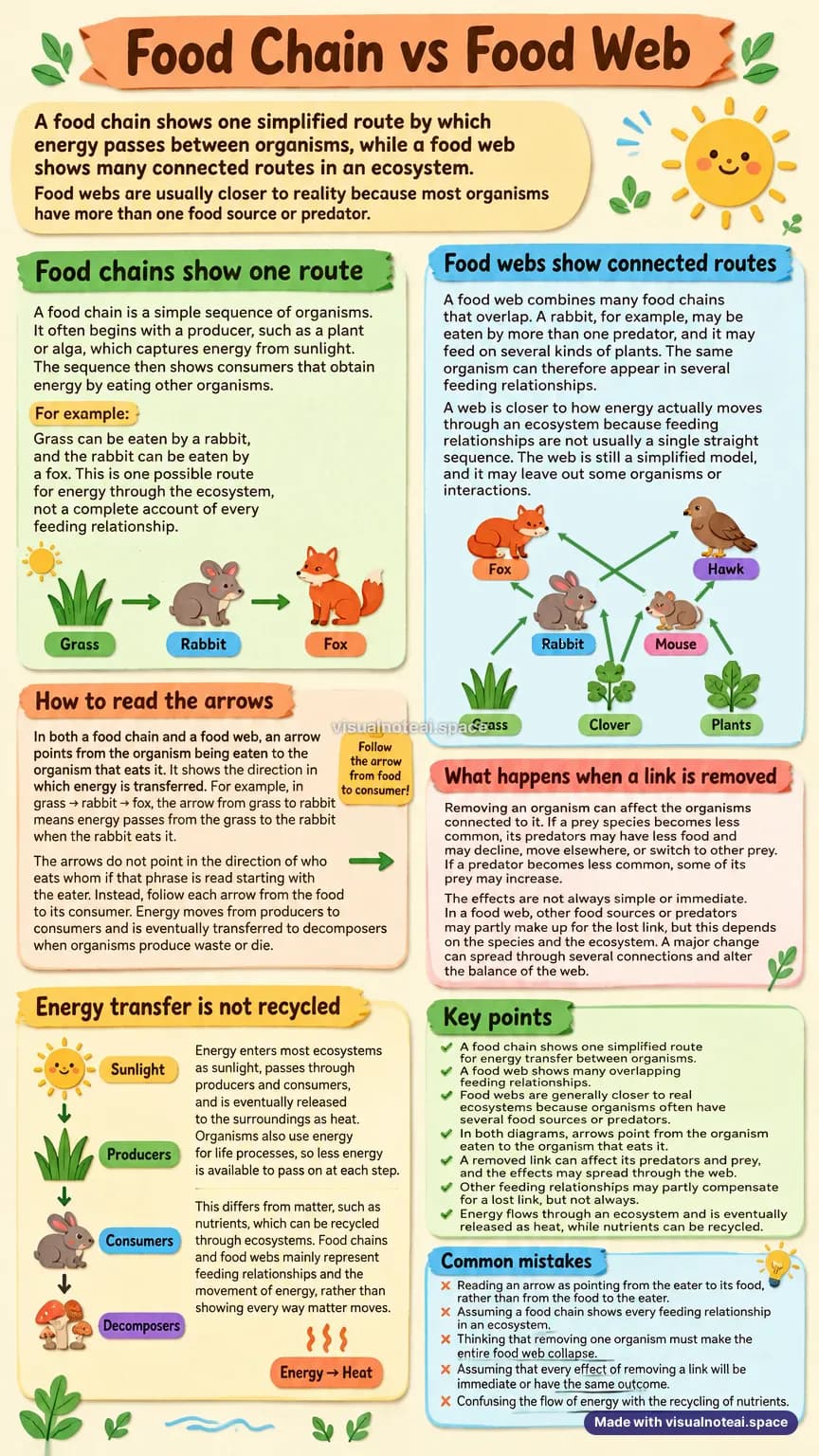
The whole topic on one page. Made with VisualNote.
!Common mistakes
- Reading an arrow as pointing from the eater to its food, rather than from the food to the eater.
- Assuming a food chain shows every feeding relationship in an ecosystem.
- Thinking that removing one organism must make the entire food web collapse.
- Assuming that every effect of removing a link will be immediate or have the same outcome.
- Confusing the flow of energy with the recycling of nutrients.
🧠Explore the map32 ideas
The mind map VisualNote made for this topic. Drag to pan, scroll to zoom.
- Food Chains and Food Webs
- Food Chains
- One simplified energy pathway
- Often begins with a producer
- Consumers eat other organisms
- Example: grass → rabbit → fox
- Food Webs
- Many overlapping food chains
- Organisms have multiple food sources or predators
- Closer to real ecosystem relationships
- Still a simplified model
- Reading Arrows
- Point from food to consumer
- Show direction of energy transfer
- Energy moves from producers to consumers
- Eventually reaches decomposers
- Removing a Link
- Prey decline may affect predators
- Predator decline may increase prey
- Other relationships may partly compensate
- Effects can spread through the web
- Effects vary and may not be immediate
- Energy and Matter
- Energy enters mainly as sunlight
- Energy decreases at each transfer
- Energy is eventually released as heat
- Nutrients can be recycled
- Common Misconceptions
- Arrows do not point from eater to food
- A chain does not show every feeding relationship
- One lost link does not always collapse the web
- Energy flow differs from nutrient cycling
- Food Chains
🃏Flashcards12 cards
- What does a food chain show?
- One simplified route by which energy passes between organisms.
- What does a food web show?
- Many overlapping and connected feeding relationships in an ecosystem.
- Why are food webs generally closer to reality than food chains?
- Most organisms have more than one food source or predator, so energy moves along multiple routes.
- What is a producer, and where does it usually get its energy?
- A producer, such as a plant or alga, makes food and usually captures energy from sunlight.
- How do consumers obtain energy?
- Consumers obtain energy by eating other organisms.
- Which way do arrows point in food chains and food webs?
- From the organism being eaten to the organism that eats it; the arrow shows the direction of energy transfer.
- What does grass → rabbit → fox mean?
- Energy passes from grass to the rabbit, then from the rabbit to the fox as each is eaten.
- What may happen when a prey species becomes less common?
- Its predators may have less food and decline, move elsewhere, or switch to other prey.
- What may happen when a predator becomes less common?
- Some of its prey may increase.
- Do food webs always collapse when one organism is removed?
- No. Other food sources or predators may partly compensate, though effects can spread and outcomes vary.
- How does energy move through an ecosystem?
- It enters mainly as sunlight, passes through producers and consumers, and is eventually released to the surroundings as heat. Less energy is available at each step because organisms use energy for life processes.
- How does energy flow differ from nutrient movement?
- Energy flows through ecosystems and is eventually released as heat, while nutrients and other matter can be recycled.
✅Test yourself5 questions
What is the main difference between a food chain and a food web?
A food chain represents one simplified route, whereas a food web combines overlapping feeding relationships.
In a food web, what does an arrow from a rabbit to a fox indicate?
Arrows point from the organism being eaten toward the organism that eats it, showing energy transfer.
Why is a food web generally closer to reality than a food chain?
Most organisms have more than one food source or predator, and a web can represent these connected routes.
What may happen when a prey species becomes less common in a food web?
Predators may lose a food source, although other prey or feeding connections can partly compensate.
Which statement correctly distinguishes energy flow from nutrient movement in ecosystems?
Energy passes through organisms and is eventually released as heat, whereas nutrients can cycle through ecosystems.
📝The notes
Food chains show one route
A food chain is a simple sequence of organisms. It often begins with a producer, such as a plant or alga, which captures energy from sunlight. The sequence then shows consumers that obtain energy by eating other organisms.
For example, grass can be eaten by a rabbit, and the rabbit can be eaten by a fox. This is one possible route for energy through the ecosystem, not a complete account of every feeding relationship.
Food webs show connected routes
A food web combines many food chains that overlap. A rabbit, for example, may be eaten by more than one predator, and it may feed on several kinds of plants. The same organism can therefore appear in several feeding relationships.
A web is closer to how energy actually moves through an ecosystem because feeding relationships are not usually a single straight sequence. The web is still a simplified model, and it may leave out some organisms or interactions.
How to read the arrows
In both a food chain and a food web, an arrow points from the organism being eaten to the organism that eats it. It shows the direction in which energy is transferred. For example, in grass → rabbit → fox, the arrow from grass to rabbit means energy passes from the grass to the rabbit when the rabbit eats it.
The arrows do not point in the direction of who eats whom if that phrase is read starting with the eater. Instead, follow each arrow from the food to its consumer. Energy moves from producers to consumers and is eventually transferred to decomposers when organisms produce waste or die.
What happens when a link is removed
Removing an organism can affect the organisms connected to it. If a prey species becomes less common, its predators may have less food and may decline, move elsewhere, or switch to other prey. If a predator becomes less common, some of its prey may increase.
The effects are not always simple or immediate. In a food web, other food sources or predators may partly make up for the lost link, but this depends on the species and the ecosystem. A major change can spread through several connections and alter the balance of the web.
Energy transfer is not recycled
Energy enters most ecosystems as sunlight, passes through producers and consumers, and is eventually released to the surroundings as heat. Organisms also use energy for life processes, so less energy is available to pass on at each step.
This differs from matter, such as nutrients, which can be recycled through ecosystems. Food chains and food webs mainly represent feeding relationships and the movement of energy, rather than showing every way matter moves.
Make this for your own notes
Paste a chapter or a PDF and get the sheet, map, cards, quiz and episode back in about a minute. No credit card.