
In an elastic collision, total momentum and total kinetic energy are conserved. In an inelastic collision, total momentum is conserved for an isolated system, but some kinetic energy is transferred to other forms of energy.
★What to remember
- Momentum is conserved in both elastic and inelastic collisions when the system is isolated.
- Kinetic energy is conserved in an elastic collision.
- In an inelastic collision, some kinetic energy is transferred to other forms of energy.
- Compare total kinetic energy before and after to distinguish the collision types.
- Momentum calculations must include the direction of each object's velocity.
- A perfectly inelastic collision is one in which the objects stick together.
- Total energy is conserved even when kinetic energy is not.
🎧Listen2:50 · transcript
AnnaWhen two objects collide, how do we tell whether the collision is elastic or inelastic?
MarcoThe key is to compare kinetic energy before and after. In an elastic collision, total kinetic energy stays the same. In an inelastic collision, some kinetic energy transfers to other forms, such as heat, sound, or energy involved in bending or damage.
AnnaAnd momentum? People often think it is conserved only in elastic collisions.
MarcoIt is conserved in both types, provided the objects form an isolated system and there is no net external force during the collision. So momentum alone cannot tell us which type we have.
AnnaHow do you calculate momentum when objects move in different directions?
MarcoFor straight-line motion, multiply each object's mass by its velocity, and give velocities consistent positive or negative signs. Then add the momenta. Direction matters there. Kinetic energy is different: it uses velocity squared, so it is never negative.
AnnaLet's make that concrete. Suppose a one kilogram object moves at two meters per second toward a stationary one kilogram object. Afterward, the first stops and the second moves at two meters per second in the original direction. What happens?
MarcoBefore, momentum is one times two, plus one times zero: two kilogram meters per second. After, it is one times zero, plus one times two: also two. The initial kinetic energy is one half times one times two squared, or two joules. Afterward, the moving object still has two joules, so the total is unchanged. That collision is elastic.
AnnaNow keep the same starting situation, but say the objects stick together. Is that automatically a case where momentum is lost?
MarcoNo. It is perfectly inelastic, which is a special case of an inelastic collision. The combined mass is two kilograms. Conservation of momentum gives two times their final velocity equals two kilogram meters per second, so they move together at one meter per second.
AnnaAnd the energy comparison?
MarcoInitially, kinetic energy is two joules. Finally, it is one half times two times one squared, which is one joule. Momentum is conserved, but kinetic energy has decreased by one joule. That energy has transferred to other forms. Total energy is still conserved; it is kinetic energy specifically that is not.
AnnaSo if we have numerical data, we calculate total kinetic energy on both sides, and compare?
MarcoExactly. Equal totals mean elastic; a lower final total means inelastic, assuming accurate data and an isolated system. Small differences can come from rounding or measurement uncertainty. And don't assume a collision is elastic just because the objects bounce apart. Also, not every inelastic collision makes objects stick together.
AnnaThat gives us two useful checks: track direction for momentum, and compare kinetic energy to identify the type.
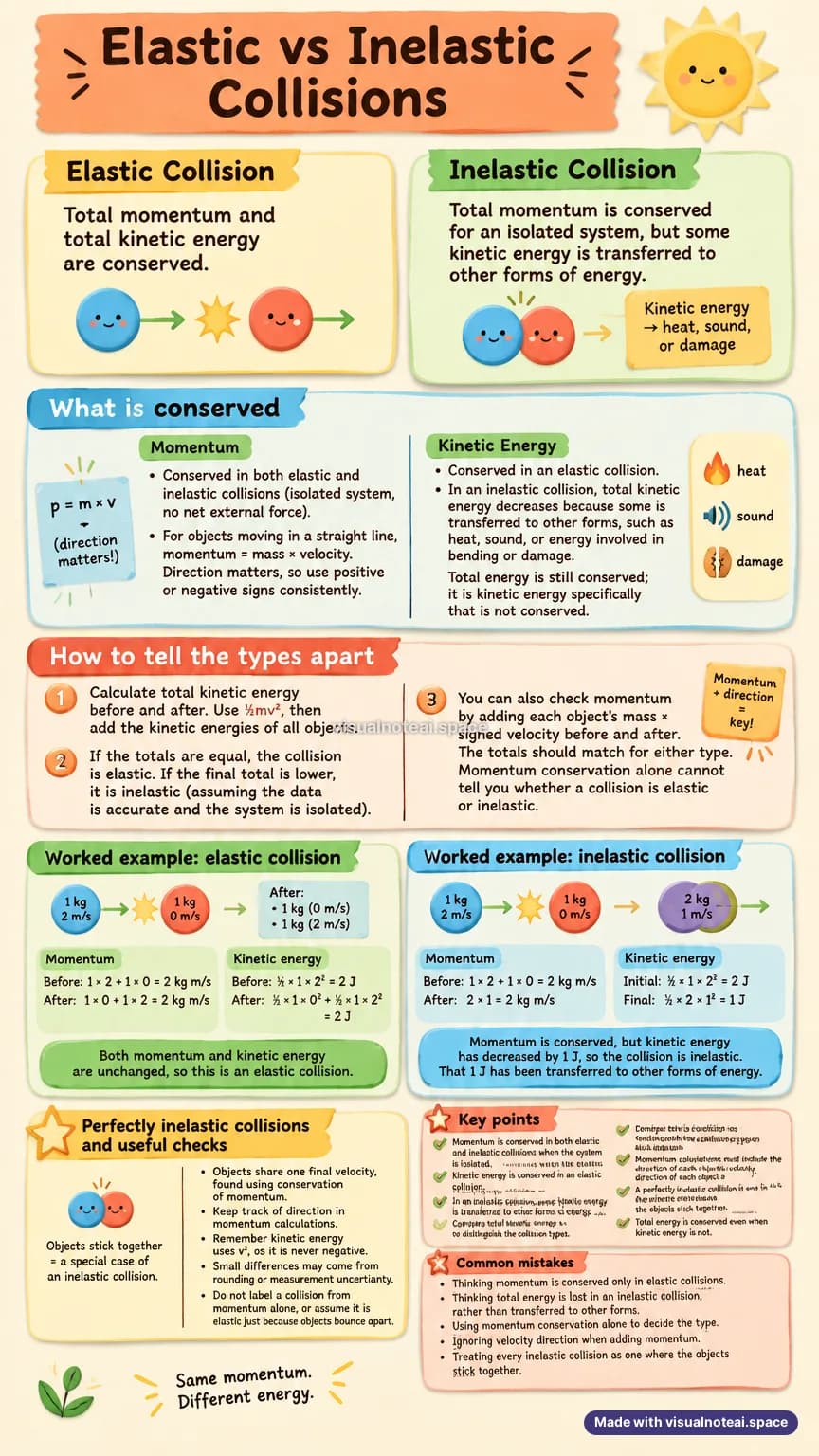
The whole topic on one page. Made with VisualNote.
!Common mistakes
- Thinking momentum is conserved only in elastic collisions.
- Thinking total energy is lost in an inelastic collision, rather than transferred to other forms.
- Using momentum conservation alone to decide whether a collision is elastic.
- Ignoring velocity direction when adding momentum.
- Treating every inelastic collision as one where the objects stick together.
🧠Explore the map34 ideas
The mind map VisualNote made for this topic. Drag to pan, scroll to zoom.
- Elastic and Inelastic Collisions
- Conservation Laws
- Momentum conserved in both types
- Requires an isolated system
- Use signed velocities for direction
- Kinetic energy conserved in elastic collisions
- Inelastic collisions transfer kinetic energy
- Total energy remains conserved
- Distinguishing Collision Types
- Compare total kinetic energy before and after
- Kinetic energy: ½mv²
- Equal totals indicate an elastic collision
- Lower final total indicates an inelastic collision
- Momentum conservation alone cannot classify the collision
- Elastic Collision Example
- Two 1 kg objects: initial velocities 2 m/s and 0
- Objects exchange velocities: 0 and 2 m/s
- Momentum: 2 kg·m/s before and after
- Kinetic energy: 2 J before and after
- Inelastic Collision Example
- Two 1 kg objects stick together
- Combined mass: 2 kg; final velocity: 1 m/s
- Momentum remains 2 kg·m/s
- Kinetic energy falls from 2 J to 1 J
- Perfectly Inelastic Collisions
- Objects stick together after collision
- Objects share one final velocity
- Momentum conservation determines final velocity
- Checks and Common Mistakes
- Kinetic energy uses squared velocity and is nonnegative
- Allow for rounding or measurement uncertainty
- Do not infer elasticity from objects bouncing apart
- Not all inelastic collisions involve objects sticking
- Do not confuse energy transfer with energy loss
- Conservation Laws
🃏Flashcards12 cards
- What is conserved in both elastic and inelastic collisions?
- Momentum is conserved if the system is isolated and there is no net external force during the collision.
- What distinguishes an elastic collision?
- Both total momentum and total kinetic energy are conserved.
- What happens to kinetic energy in an inelastic collision?
- Total kinetic energy decreases as some is transferred into other forms, such as heat, sound, bending, or damage.
- Is total energy conserved in an inelastic collision?
- Yes. Energy is transferred to other forms; it is kinetic energy specifically that is not conserved.
- How can you determine whether a collision is elastic or inelastic from data?
- Calculate total kinetic energy before and after. Equal totals indicate an elastic collision; a lower final total indicates an inelastic collision.
- Why can momentum conservation alone not identify the collision type?
- Momentum is conserved in both elastic and inelastic collisions, so it does not distinguish between them.
- How should direction be handled when calculating momentum?
- Use consistent positive and negative signs for velocities because momentum depends on direction.
- How is kinetic energy calculated, and can it be negative?
- Kinetic energy is KE = ½mv². Because velocity is squared, kinetic energy is never negative.
- What happens in a perfectly inelastic collision?
- The objects stick together and share one final velocity. It is a special case of an inelastic collision.
- In the 1 kg and 1 kg example, what are the results if the first object moving at 2 m/s stops and the second moves at 2 m/s?
- Momentum is 2 kg·m/s both before and after, and kinetic energy is 2 J both before and after. The collision is elastic.
- In the same example, what are the results if the two objects stick together?
- They move together at 1 m/s. Momentum remains 2 kg·m/s, while kinetic energy falls from 2 J to 1 J, so the collision is inelastic.
- Does every inelastic collision involve objects sticking together?
- No. Sticking together describes only perfectly inelastic collisions; objects can separate after other inelastic collisions.
✅Test yourself5 questions
For an isolated system, which statement about momentum in collisions is correct?
Momentum is conserved in both collision types when there is no net external force on the isolated system.
What should you compare to determine whether a collision is elastic or inelastic?
Kinetic energy is conserved in an elastic collision and decreases in an inelastic collision.
In an inelastic collision, what happens to the kinetic energy that decreases?
Total energy is conserved, but some kinetic energy is transferred into forms such as heat, sound, or deformation.
Two objects move in opposite directions along a straight line; how should their velocities be used when calculating total momentum?
Momentum depends on direction, so opposite directions must be represented with opposite signs.
Which description identifies a perfectly inelastic collision?
A perfectly inelastic collision is the special case in which the colliding objects stick together.
📝The notes
What is conserved
Momentum is conserved in both elastic and inelastic collisions, provided the colliding objects form an isolated system with no net external force during the collision. For objects moving in a straight line, momentum is mass multiplied by velocity, and direction matters, so velocities should be given positive or negative signs consistently.
Kinetic energy is conserved in an elastic collision. In an inelastic collision, total kinetic energy decreases because some is transferred to other forms, such as heat, sound, or energy involved in bending or damage. Total energy is still conserved; it is kinetic energy specifically that is not conserved.
How to tell the types apart
If masses and velocities are given before and after a collision, calculate the total kinetic energy before and after. Use kinetic energy equals one half multiplied by mass multiplied by velocity squared, then add the kinetic energies of all objects. If the totals are equal, the collision is elastic. If the final total is lower, it is inelastic, assuming the data describe the collision accurately and the system is isolated.
You can also check momentum by adding each object's mass multiplied by its signed velocity before and after. The totals should match for either type. Momentum conservation alone cannot tell you whether a collision is elastic or inelastic, because it applies to both.
Worked example: elastic collision
A 1 kg object moves at 2 m/s towards a stationary 1 kg object. After the collision, suppose the first object is stationary and the second moves at 2 m/s in the original direction. Before the collision, momentum is 1 × 2 + 1 × 0 = 2 kg m/s. After it, momentum is 1 × 0 + 1 × 2 = 2 kg m/s.
Before the collision, total kinetic energy is one half × 1 × 2² = 2 J. After it, total kinetic energy is one half × 1 × 0² + one half × 1 × 2² = 2 J. Both momentum and kinetic energy are unchanged, so this is an elastic collision.
Worked example: inelastic collision
Use the same initial situation: a 1 kg object moves at 2 m/s towards a stationary 1 kg object. Suppose they stick together after the collision. Their combined mass is 2 kg, and momentum conservation gives 2 × final velocity = 2 kg m/s, so their final velocity is 1 m/s in the original direction.
The initial kinetic energy is 2 J. The final kinetic energy is one half × 2 × 1² = 1 J. Momentum is conserved, but kinetic energy has decreased by 1 J, so the collision is inelastic. That 1 J has been transferred to other forms of energy.
Perfectly inelastic collisions and useful checks
A perfectly inelastic collision is one in which the objects stick together after colliding. It is a special case of an inelastic collision, not a separate type in which momentum fails to be conserved. The objects share one final velocity, which can be found using conservation of momentum when the system is isolated.
When working from numerical data, keep track of direction in the momentum calculation, but remember that kinetic energy uses the square of velocity, so it is never negative. Small differences between calculated kinetic energies may come from rounding or measurement uncertainty. Do not label a collision from momentum alone, or assume that a collision is elastic just because the objects bounce apart.
Make this for your own notes
Paste a chapter or a PDF and get the sheet, map, cards, quiz and episode back in about a minute. No credit card.