
Codominance and incomplete dominance both describe how two different alleles affect the phenotype of a heterozygote. In codominance, both allele effects are visible; in incomplete dominance, the heterozygote has an intermediate phenotype.
★What to remember
- Codominance means both allele effects are visible in the heterozygote.
- Incomplete dominance means the heterozygote has an intermediate phenotype.
- In the ABO blood group, I^A and I^B are codominant, and I^A I^B gives type AB blood.
- The allele i is recessive to both I^A and I^B.
- In the snapdragon example, RR is red, RW is pink, and WW is white.
- A cross of two RW flowers gives an expected phenotype ratio of 1 red to 2 pink to 1 white.
- A 1:2:1 ratio by itself does not distinguish codominance from incomplete dominance.
🎧Listen2:55 · transcript
AnnaWhen people hear codominance and incomplete dominance, they can sound like two names for the same thing. Are they?
MarcoThey’re related, but they describe different heterozygote phenotypes. A heterozygote has two different alleles for a gene. In codominance, both allele effects are visible. In incomplete dominance, the heterozygote has an intermediate phenotype.
AnnaSo the key isn’t whether there are two alleles. It’s what you can actually observe in the heterozygote?
MarcoExactly. In codominance, you can see both forms at once. Think of distinct patches of two colors, or a cell displaying products from both alleles. The effects are both present, not blended into one middle form.
AnnaAnd the classic contrast is flower color, right? Red and white make pink?
MarcoYes. In the snapdragon example, red flowers have two red alleles, written R R. White flowers have two white alleles, W W. The heterozygote, R W, is pink. Pink sits between red and white, so that’s incomplete dominance.
AnnaLet’s compare that with blood type. What makes A B codominance rather than an intermediate blood type?
MarcoA person with one I A allele and one I B allele has type A B blood. Their red blood cells display both A and B antigens. Both effects are visible, so A B is codominance. It isn’t an in-between type.
AnnaAnd where does the little i allele fit? I’ve heard people describe all the ABO alleles as codominant.
MarcoThat’s a common mix-up. I A and I B are codominant to each other, but i is recessive to both. So we shouldn’t say all three are codominant.
AnnaCan we work through a cross to make that concrete?
MarcoSure. Cross a parent with I A and i with a parent who has I B and i. The first parent can pass on I A or i. The second can pass on I B or i. The four outcomes are I A with I B, I A with i, I B with i, and i with i. Each has a twenty-five percent probability. They correspond to blood types A B, A, B, and O.
AnnaAnd for the flowers, what happens when two pink R W flowers are crossed?
MarcoEach parent can pass on R or W. The possible offspring are R R, R W, R W, and W W. That gives one red, two pink, and one white in the expected phenotype ratio.
AnnaThat’s one to two to one. So does that ratio tell us we’re looking at incomplete dominance?
MarcoNo. Both patterns can produce that ratio when two heterozygotes are crossed. You have to look at the heterozygote itself. Does it show both effects distinctly, like type A B blood? That’s codominance. Does it have an intermediate phenotype, like pink flowers? That’s incomplete dominance.
AnnaAnd pink doesn’t mean the red and white alleles have permanently blended into a new allele?
MarcoRight. They remain distinct alleles that can be passed on. That’s why the next generation can include red, pink, and white flowers.
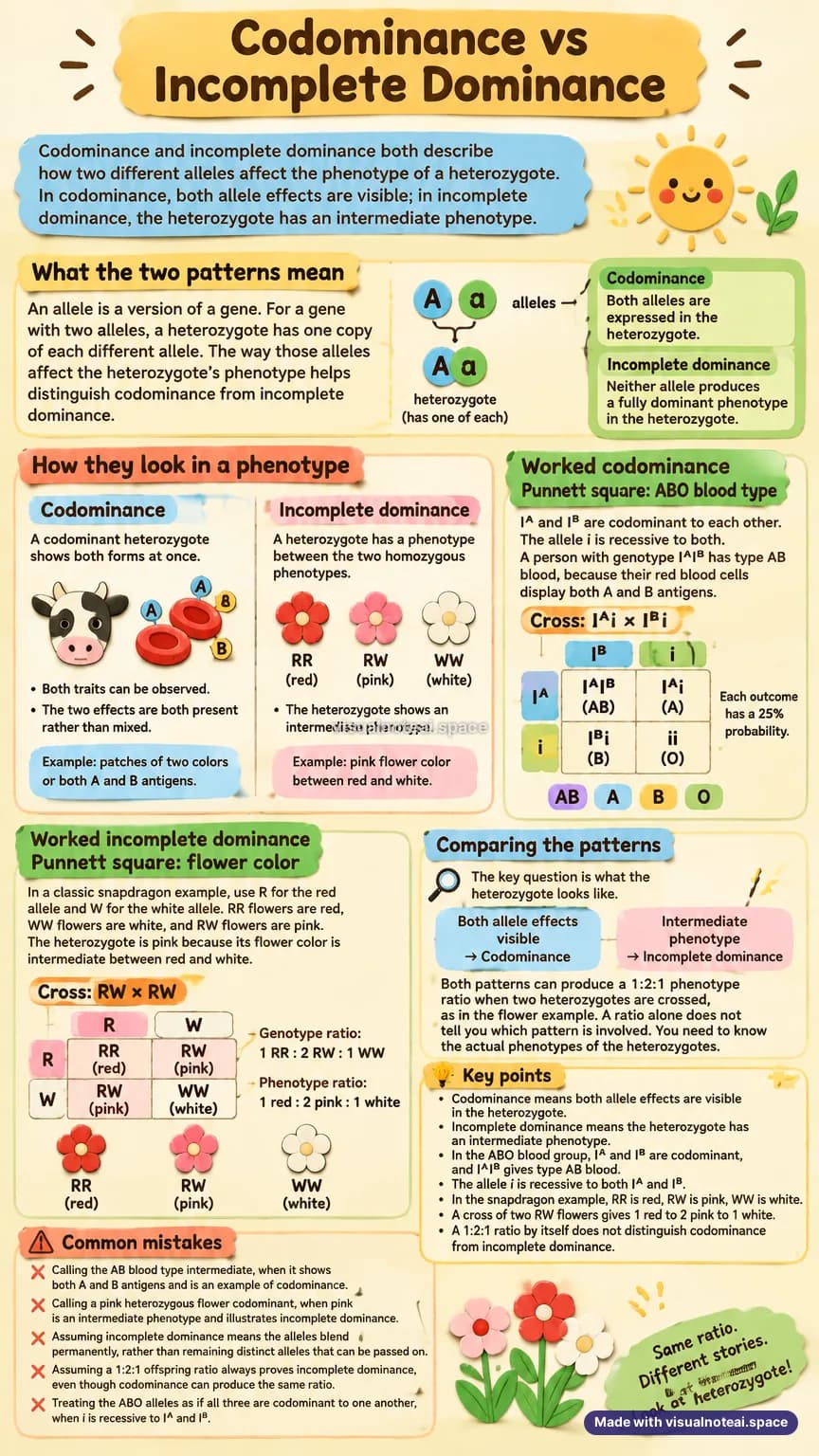
The whole topic on one page. Made with VisualNote.
!Common mistakes
- Calling the AB blood type intermediate, when it shows both A and B antigens and is an example of codominance.
- Calling a pink heterozygous flower codominant, when pink is an intermediate phenotype and illustrates incomplete dominance.
- Assuming incomplete dominance means the alleles blend permanently, rather than remaining distinct alleles that can be passed on.
- Assuming a 1:2:1 offspring ratio always proves incomplete dominance, even though codominance can produce the same ratio.
- Treating the ABO alleles as if all three are codominant to one another, when i is recessive to I^A and I^B.
🧠Explore the map28 ideas
The mind map VisualNote made for this topic. Drag to pan, scroll to zoom.
- Codominance vs. Incomplete Dominance
- Alleles and Heterozygotes
- Allele
- Version of a gene
- Heterozygote
- One copy of each of two different alleles
- Allele
- Codominance
- Both allele effects visible
- Distinct traits present at once
- ABO blood group
- I^A and I^B are codominant
- I^A I^B produces type AB; both antigens visible
- i is recessive to I^A and I^B
- I^A i × I^B i
- Incomplete Dominance
- Heterozygote has an intermediate phenotype
- Snapdragon flower color
- RR red; WW white; RW pink
- RW × RW
- Distinguishing the Patterns
- Both effects distinct: codominance
- One intermediate phenotype: incomplete dominance
- A 1:2:1 ratio alone does not distinguish them
- Common Misconceptions
- AB is not intermediate; it shows both A and B antigens
- Pink is intermediate, not codominant
- Alleles remain distinct; they do not blend permanently
- Not all ABO alleles are codominant with one another
- Alleles and Heterozygotes
🃏Flashcards12 cards
- What is an allele?
- An allele is a version of a gene.
- What is a heterozygote?
- A heterozygote has two different alleles for a gene, one inherited from each parent.
- What is codominance?
- In codominance, both allele effects are distinctly visible in the heterozygote.
- What is incomplete dominance?
- In incomplete dominance, the heterozygote has a phenotype intermediate between the two homozygous phenotypes.
- How can you distinguish codominance from incomplete dominance?
- Look at the heterozygote: codominance shows both traits distinctly, while incomplete dominance produces one intermediate phenotype.
- Why is type AB blood an example of codominance?
- An individual with genotype I^A I^B displays both A and B antigens on red blood cells.
- How are the ABO alleles related in dominance?
- I^A and I^B are codominant to each other, while i is recessive to both.
- What are the outcomes of the cross I^A i × I^B i?
- The genotypes I^A I^B, I^A i, I^B i, and ii each have a 25% probability, corresponding to blood types AB, A, B, and O.
- What are the snapdragon flower-color genotypes and phenotypes?
- RR flowers are red, RW flowers are pink, and WW flowers are white. Pink is an intermediate phenotype, so this is incomplete dominance.
- What offspring are expected from RW × RW snapdragons?
- The genotype ratio is 1 RR : 2 RW : 1 WW, giving a phenotype ratio of 1 red : 2 pink : 1 white.
- Does a 1:2:1 phenotype ratio identify incomplete dominance?
- No. Both codominance and incomplete dominance can produce a 1:2:1 ratio when two heterozygotes are crossed; the heterozygote's actual phenotype distinguishes them.
- Does incomplete dominance mean alleles blend permanently?
- No. The alleles remain distinct and can be passed on, even though the heterozygote has an intermediate phenotype.
✅Test yourself5 questions
Which observation most clearly indicates codominance rather than incomplete dominance?
Codominance is identified when both allele effects are visibly present in the heterozygote.
What blood type results from genotype I^A I^B, and why?
I^A and I^B are codominant, so a person with both alleles displays both antigens and has type AB blood.
For a cross of I^A i × I^B i, what is the expected probability of an offspring with type O blood?
Only the ii outcome produces type O, and it is one of the four equally likely genotypes in this cross.
Two pink snapdragons (RW × RW) are crossed; what fraction of their offspring is expected to have white flowers?
The cross produces one WW offspring genotype out of four equally likely outcomes, and WW flowers are white.
Two heterozygotes produce offspring in a 1:2:1 phenotype ratio; what additional information is needed to distinguish codominance from incomplete dominance?
The phenotype of the heterozygote distinguishes the patterns, since both can produce a 1:2:1 ratio.
📝The notes
What the two patterns mean
An allele is a version of a gene. For a gene with two alleles, a heterozygote has one copy of each different allele. The way those alleles affect the heterozygote's phenotype helps distinguish codominance from incomplete dominance.
In codominance, both alleles are expressed in the heterozygote, so both traits can be observed. In incomplete dominance, neither allele produces a fully dominant phenotype in the heterozygote, which has an intermediate phenotype.
How they look in a phenotype
A codominant heterozygote shows both forms at once. For example, a cell might display products of both alleles, or an animal might have distinct patches of two colors. The two effects are both present rather than mixed into a single intermediate form.
An incompletely dominant heterozygote shows a phenotype between the two homozygous phenotypes. In a simple flower color example, red and white homozygotes produce pink heterozygotes. Pink is intermediate in color, rather than showing separate red and white areas.
Worked codominance Punnett square: ABO blood type
For the ABO blood group, the alleles I^A and I^B are codominant to each other. The allele i is recessive to both. A person with genotype I^A I^B has type AB blood, because their red blood cells display both A and B antigens.
Consider a cross between I^A i and I^B i. The first parent can pass on I^A or i, and the second can pass on I^B or i. The Punnett square outcomes are I^A I^B, I^A i, I^B i, and ii, each with a probability of 25 percent. These correspond to blood types AB, A, B, and O, respectively.
Worked incomplete dominance Punnett square: flower color
In a classic snapdragon example, use R for the red allele and W for the white allele. RR flowers are red, WW flowers are white, and RW flowers are pink. The heterozygote is pink because its flower color is intermediate between red and white.
Cross two pink flowers, RW × RW. Each parent can pass on R or W. The four possible offspring genotypes are RR, RW, RW, and WW. The expected genotype ratio is 1 RR to 2 RW to 1 WW, and the phenotype ratio is 1 red to 2 pink to 1 white.
Comparing the patterns
The key question is what the heterozygote looks like. If it shows both allele effects distinctly, the pattern is codominance. If it has one intermediate phenotype, the pattern is incomplete dominance.
Both patterns can produce a 1:2:1 phenotype ratio when two heterozygotes are crossed, as in the flower example. A ratio alone therefore does not tell you which pattern is involved. You need to know the actual phenotypes of the heterozygotes.
Make this for your own notes
Paste a chapter or a PDF and get the sheet, map, cards, quiz and episode back in about a minute. No credit card.