
The chain rule is used to differentiate a function built by putting one function inside another. Differentiate the outside function while keeping the inside unchanged, then multiply by the derivative of the inside.
★What to remember
- For y = f(g(x)), the chain rule gives y' = f'(g(x))g'(x).
- Identify the inner expression and the outer function before differentiating.
- Differentiate the outer function while keeping its input unchanged.
- Multiply by the derivative of the inner expression.
- For several nested layers, apply the chain rule at each layer.
- The chain rule is needed for functions such as sin(x^2), not just powers of expressions.
- Check that the final derivative includes a factor for every changing inner layer.
🎧Listen2:56 · transcript
AnnaWhen you hear “chain rule,” what do you think it’s helping us do?
MarcoDifferentiate a function that has another function tucked inside it. The key move is to differentiate the outer function, keep its input unchanged, and then multiply by the derivative of that input.
AnnaSo how do we tell which part is inner and which part is outer?
MarcoTake y equals three x plus two, all raised to the fifth power. The inner expression is three x plus two. The outer operation raises its input to the fifth power. We can call the inner expression u, so y equals u to the fifth. That makes the layers easier to see.
AnnaAnd once we’ve named those layers, what’s the rule?
MarcoIf y depends on u, and u depends on x, then the derivative of y with respect to x is the derivative of y with respect to u, times the derivative of u with respect to x. In the notation y equals f of g of x, it’s f prime of g of x, times g prime of x.
AnnaLet’s use that on our fifth-power example. What happens first?
MarcoDifferentiate the outer power and leave the inside alone. That gives five times three x plus two, all to the fourth power. The inside, three x plus two, has derivative three. Multiply by three, and we get fifteen times three x plus two, all to the fourth power.
AnnaDoes the same idea work if the outside isn’t a whole-number power?
MarcoYes. Take the square root of two x plus one. We can write the root as the quantity to the power one-half. Differentiating that outer power gives one-half times two x plus one to the negative one-half. Then we multiply by the inner derivative, which is two. The result is one over the square root of two x plus one. This applies where the original function is defined and differentiable, so x must be greater than negative one-half.
AnnaWhat about a trigonometric function? I can imagine someone forgetting there’s still an inner expression.
MarcoExactly. For the sine of x squared, the outer function is sine, and its derivative is cosine of the same input. So we get cosine of x squared, then multiply by the derivative of x squared, which is two x. The answer is two x times cosine of x squared.
AnnaAnd if there are several layers, do we just keep going?
MarcoOne layer at a time. For the sine of x squared plus one, all cubed, start with the cube. That gives three times the sine of x squared plus one, squared. Then differentiate the sine layer: that gives cosine of x squared plus one. Finally, the inside, x squared plus one, contributes two x. Multiply everything, and we get six x times the sine of x squared plus one, squared, times the cosine of x squared plus one.
AnnaSo what should we check before we call an answer finished?
MarcoCheck that every changing inner layer contributed its derivative. Don’t stop after differentiating the outside, and don’t simplify the inside too early. Also, the derivative of sine of u is cosine of u, not negative cosine of u. Negative sine of u is the derivative of cosine of u.
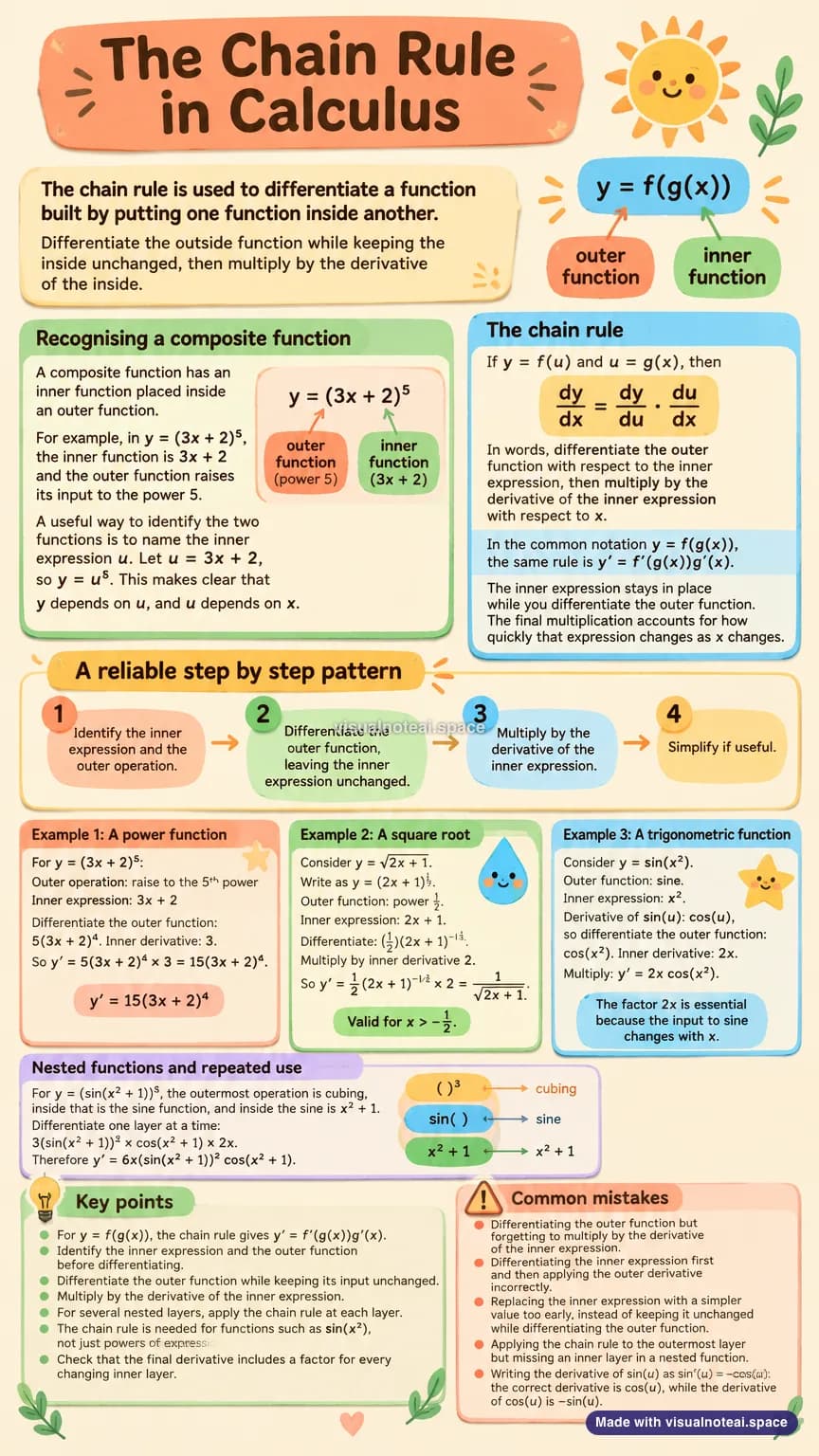
The whole topic on one page. Made with VisualNote.
!Common mistakes
- Differentiating the outer function but forgetting to multiply by the derivative of the inner expression.
- Differentiating the inner expression first and then applying the outer derivative incorrectly.
- Replacing the inner expression with a simpler value too early, instead of keeping it unchanged while differentiating the outer function.
- Applying the chain rule to the outermost layer but missing an inner layer in a nested function.
- Writing the derivative of sin(u) as sin'(u) = -cos(u); the correct derivative is cos(u), while the derivative of cos(u) is -sin(u).
🧠Explore the map37 ideas
The mind map VisualNote made for this topic. Drag to pan, scroll to zoom.
- Chain Rule in Calculus
- Composite Functions
- Inner function
- Outer function
- Example: (3x + 2)^5
- Inner expression: 3x + 2
- Outer operation: fifth power
- Chain Rule Formula
- y = f(u), u = g(x)
- dy/dx = (dy/du)(du/dx)
- y = f(g(x)): y' = f'(g(x))g'(x)
- Differentiate outer function; keep input unchanged
- Multiply by derivative of inner function
- Procedure
- Identify inner expression and outer operation
- Differentiate outer function
- Multiply by inner derivative
- Simplify if useful
- Worked Examples
- Power: (3x + 2)^5
- Derivative: 15(3x + 2)^4
- Square root: sqrt(2x + 1)
- Derivative: 1/sqrt(2x + 1)
- Domain: x > -1/2
- Trigonometric: sin(x^2)
- Derivative: 2x cos(x^2)
- Power: (3x + 2)^5
- Nested Functions
- Example: (sin(x^2 + 1))^3
- Layers: cube, sine, x^2 + 1
- Derivative: 6x(sin(x^2 + 1))^2 cos(x^2 + 1)
- Apply chain rule at every layer
- Example: (sin(x^2 + 1))^3
- Common Mistakes
- Forgetting the inner derivative
- Differentiating in the wrong order
- Changing the inner expression too early
- Missing a layer in nested functions
- Sine derivative is cos(u); cosine derivative is -sin(u)
- Composite Functions
🃏Flashcards12 cards
- What is the chain rule used for?
- It differentiates a composite function, where one function is placed inside another.
- State the chain rule for y = f(g(x)).
- y' = f'(g(x))g'(x). Differentiate the outer function while keeping its input unchanged, then multiply by the derivative of the inner function.
- What does dy/dx = (dy/du)(du/dx) mean?
- Differentiate y with respect to the intermediate expression u, then multiply by the rate at which u changes with x.
- How do you identify the inner and outer functions in y = (3x + 2)^5?
- The inner expression is 3x + 2; the outer operation raises its input to the fifth power.
- What are the basic steps for applying the chain rule?
- Identify the inner expression and outer operation, differentiate the outer while leaving its input unchanged, multiply by the inner derivative, then simplify if useful.
- Find the derivative of y = (3x + 2)^5.
- y' = 5(3x + 2)^4 · 3 = 15(3x + 2)^4.
- Find the derivative of y = √(2x + 1).
- Writing y = (2x + 1)^(1/2), the chain rule gives y' = (1/2)(2x + 1)^(-1/2) · 2 = 1/√(2x + 1), for x > −1/2.
- Find the derivative of y = sin(x²).
- y' = cos(x²) · 2x = 2x cos(x²). The factor 2x comes from differentiating the input x².
- How do you differentiate a function with several nested layers?
- Apply the chain rule one layer at a time, including a derivative factor for each changing inner layer.
- Find the derivative of y = (sin(x² + 1))³.
- y' = 3(sin(x² + 1))² · cos(x² + 1) · 2x = 6x(sin(x² + 1))²cos(x² + 1).
- What common chain-rule mistake should you avoid?
- Do not forget to multiply by the derivative of the inner expression; for nested functions, include a factor from every layer.
- What are the derivatives of sin(u) and cos(u) with respect to u?
- d/du[sin(u)] = cos(u), while d/du[cos(u)] = −sin(u).
✅Test yourself5 questions
If y = f(g(x)), which expression gives dy/dx?
The chain rule differentiates the outer function at the inner input and multiplies by the inner derivative.
What is the derivative of y = (3x + 2)^5?
Differentiating the fifth power gives 5(3x + 2)^4, and multiplying by the inner derivative 3 gives 15(3x + 2)^4.
For x > -1/2, what is the derivative of y = sqrt(2x + 1)?
The outer derivative contributes one half the power of minus one half, and the inner derivative of 2x + 1 is 2, which cancels the one half.
What is the derivative of y = sin(x^2)?
The derivative of sine is cosine, and the derivative of its input x^2 contributes the factor 2x.
What is the derivative of y = (sin(x^2 + 1))^3?
Applying the chain rule at each layer contributes the factors 3(sin(x^2 + 1))^2, cos(x^2 + 1), and 2x.
📝The notes
Recognising a composite function
A composite function has an inner function placed inside an outer function. For example, in y = (3x + 2)^5, the inner function is 3x + 2 and the outer function raises its input to the power 5.
A useful way to identify the two functions is to name the inner expression u. In this example, let u = 3x + 2, so y = u^5. This makes clear that y depends on u, and u depends on x.
The chain rule
If y = f(u) and u = g(x), then dy/dx = (dy/du)(du/dx). In words, differentiate the outer function with respect to the inner expression, then multiply by the derivative of the inner expression with respect to x.
In the common notation y = f(g(x)), the same rule is y' = f'(g(x))g'(x). The inner expression stays in place while you differentiate the outer function. The final multiplication by the inner derivative accounts for how quickly that expression changes as x changes.
A reliable step by step pattern
First, identify the inner expression and the outer operation. Second, differentiate the outer function, leaving the inner expression unchanged. Third, multiply by the derivative of the inner expression. Finally, simplify if useful.
For y = (3x + 2)^5, the outer operation is raising to the fifth power, and the inner expression is 3x + 2. Differentiating the outer function gives 5(3x + 2)^4. The derivative of the inner expression is 3, so y' = 5(3x + 2)^4 times 3 = 15(3x + 2)^4.
Worked example with a square root
Consider y = sqrt(2x + 1). Write this as y = (2x + 1)^(1/2). The outer function is raising an expression to the power 1/2, and the inner expression is 2x + 1.
Differentiate the outer function to get (1/2)(2x + 1)^(-1/2), then multiply by the inner derivative, which is 2. Thus y' = (1/2)(2x + 1)^(-1/2) times 2 = 1/sqrt(2x + 1). This derivative applies where the original function is defined and differentiable, so here x must be greater than -1/2.
Worked example with a trigonometric function
Consider y = sin(x^2). The outer function is sine, and the inner expression is x^2. The derivative of sine of an input u is cos(u), so differentiating the outer function gives cos(x^2).
The derivative of the inner expression x^2 is 2x. Multiplying gives y' = 2x cos(x^2). The factor 2x is essential because the input to sine changes with x.
Nested functions and repeated use
Some functions have more than one layer. For y = (sin(x^2 + 1))^3, the outermost operation is cubing, inside that is the sine function, and inside the sine is x^2 + 1.
Differentiate one layer at a time. The derivative of the outer power gives 3(sin(x^2 + 1))^2. Multiply by the derivative of sin(x^2 + 1), which is cos(x^2 + 1) times the derivative of x^2 + 1, namely 2x. Therefore y' = 3(sin(x^2 + 1))^2 cos(x^2 + 1) times 2x, or 6x(sin(x^2 + 1))^2 cos(x^2 + 1).
Make this for your own notes
Paste a chapter or a PDF and get the sheet, map, cards, quiz and episode back in about a minute. No credit card.