
The fundamental theorem of calculus explains why differentiation and integration are closely connected. It gives one result about differentiating an accumulated area, and another that lets us evaluate definite integrals using antiderivatives.
★What to remember
- The fundamental theorem of calculus connects differentiation with integration.
- If f is continuous, the derivative of the function defined by ∫ from a to x of f(t) dt is f(x).
- If f is continuous on [a, b] and G'(x) = f(x), then ∫ from a to b of f(x) dx = G(b) − G(a).
- For a definite integral, evaluate the antiderivative at the upper limit and subtract its value at the lower limit.
- The variable inside an integral can be a temporary variable such as t.
- A constant added to an antiderivative cancels when its endpoint values are subtracted.
- A definite integral is signed, so portions below the x-axis count negatively.
🎧Listen2:49 · transcript
AnnaWhen you first hear “the fundamental theorem of calculus,” it can sound like a big name for a formula. But it answers a useful question: how are differentiation and integration connected?
MarcoThey describe opposite kinds of work. Differentiation measures change. Integration accumulates quantities over an interval. The theorem shows that, when the function is continuous, the two operations are linked in a precise way.
AnnaLet’s start with the accumulated integral. Suppose f is continuous, and define F of x as the integral from a to x of f of t, d t. What does taking the derivative of F give us?
MarcoIt gives f of x. In symbols, F prime of x equals f of x. As the upper endpoint moves, the accumulated integral changes at a rate equal to the value of the function at that endpoint.
AnnaAnd the t inside the integral isn’t another endpoint, right? It’s just a temporary variable of integration.
MarcoExactly. The integral’s value depends on x because x is the moving upper limit. The letter t is just used inside the integral; choosing it doesn’t change the result.
AnnaSo that’s one part: differentiate an accumulated integral and recover the function. What’s the other part?
MarcoIt gives us a way to evaluate a definite integral. If f is continuous on the interval from a to b, and G is an antiderivative of f there, then the integral from a to b of f of x, d x equals G of b minus G of a.
AnnaSo the order matters: upper endpoint value minus lower endpoint value. Can we walk through the example with two x plus one?
MarcoSure. We want the integral from one to three of two x plus one, d x. An antiderivative is x squared plus x, because its derivative is two x plus one. We evaluate at three, then subtract the value at one.
AnnaAt three, that’s three squared plus three, or twelve. At one, it’s one squared plus one, or two. Twelve minus two is ten.
MarcoRight. And that order is a common place to slip. We calculate the upper value minus the lower value, not the other way around.
AnnaThere’s also a detail about antiderivatives: they aren’t unique. If we add a constant to x squared plus x, why doesn’t the answer change?
MarcoBecause the same constant appears in both endpoint values. When we subtract G of a from G of b, it cancels. So it doesn’t affect the definite integral.
AnnaAnd we shouldn’t always picture a definite integral as total geometric area, should we?
MarcoNo. It’s a signed integral. Parts where the function is below the x-axis contribute negatively. So when using the theorem, we need a genuine antiderivative, and we need to keep the endpoint order straight.
AnnaThat’s the connection in a nutshell: accumulated change can be differentiated back to the function, and definite integrals can be evaluated through antiderivatives.
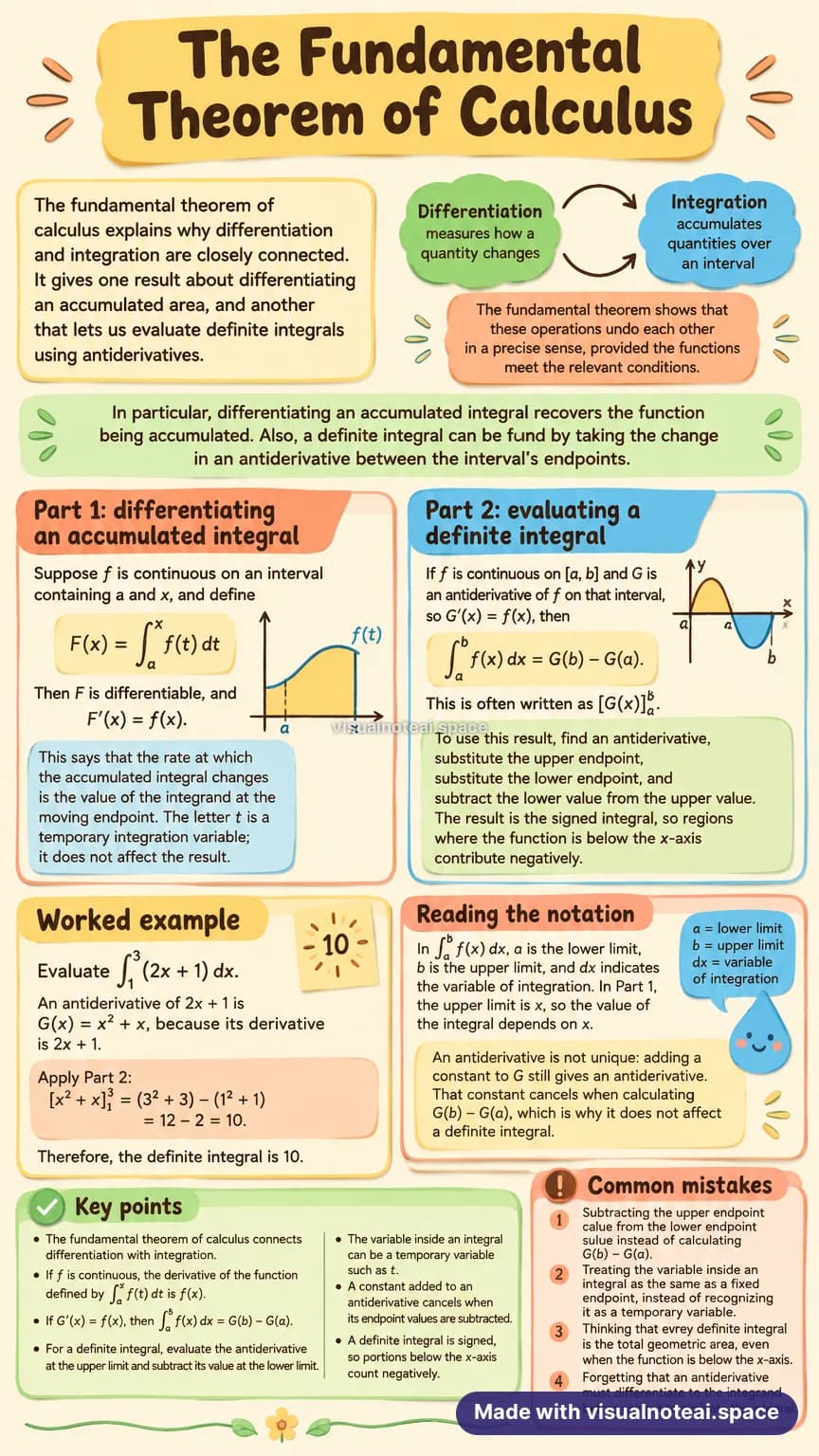
The whole topic on one page. Made with VisualNote.
!Common mistakes
- Subtracting the upper endpoint value from the lower endpoint value instead of calculating G(b) − G(a).
- Treating the variable inside an integral as the same as a fixed endpoint, instead of recognizing it as a temporary variable.
- Thinking that every definite integral is the total geometric area, even when the function is below the x-axis.
- Forgetting that an antiderivative must differentiate to the integrand before using it to evaluate the integral.
🧠Explore the map27 ideas
The mind map VisualNote made for this topic. Drag to pan, scroll to zoom.
- Fundamental Theorem of Calculus
- Connection Between Differentiation and Integration
- Differentiation measures change
- Integration accumulates quantities
- Operations undo each other under continuity conditions
- Part 1: Derivative of an Accumulated Integral
- F(x) = ∫ₐˣ f(t) dt
- If f is continuous, F′(x) = f(x)
- t is a temporary integration variable
- Part 2: Evaluate a Definite Integral
- If f is continuous and G′(x) = f(x), then ∫ₐᵇ f(x) dx = G(b) − G(a)
- Evaluate upper endpoint, then subtract lower endpoint
- Antiderivative must differentiate to the integrand
- Worked Example
- ∫₁³ (2x + 1) dx
- Antiderivative: G(x) = x² + x
- G(3) − G(1) = 12 − 2 = 10
- Notation and Interpretation
- a is the lower limit; b is the upper limit
- dx indicates the integration variable
- An antiderivative may include an arbitrary constant
- The constant cancels in G(b) − G(a)
- Signed Integrals and Common Mistakes
- Regions below the x-axis contribute negatively
- A definite integral is not always total geometric area
- Do not reverse endpoint subtraction
- Do not confuse a temporary variable with an endpoint
- Connection Between Differentiation and Integration
🃏Flashcards12 cards
- What does the Fundamental Theorem of Calculus connect?
- It connects differentiation and integration, showing how they undo each other under suitable conditions.
- What does Part 1 of the Fundamental Theorem of Calculus state?
- If f is continuous and F(x) = ∫ₐˣ f(t) dt, then F is differentiable and F′(x) = f(x).
- What does F′(x) represent when F(x) = ∫ₐˣ f(t) dt?
- It is the rate at which the accumulated integral changes as the upper endpoint moves, and it equals f(x).
- What is the role of t in ∫ₐˣ f(t) dt?
- t is a temporary integration variable. It is distinct from the moving upper endpoint x.
- What does Part 2 of the Fundamental Theorem of Calculus state?
- If f is continuous on [a, b] and G′(x) = f(x), then ∫ₐᵇ f(x) dx = G(b) − G(a).
- How do you evaluate a definite integral using an antiderivative?
- Find an antiderivative, evaluate it at the upper limit, then subtract its value at the lower limit.
- What do the limits and dx mean in ∫ₐᵇ f(x) dx?
- a is the lower limit, b is the upper limit, and dx indicates the variable of integration.
- Is an antiderivative unique? Why does adding a constant not change a definite integral?
- No. Adding a constant gives another antiderivative, but the constant cancels in G(b) − G(a).
- What does a definite integral measure when f is below the x-axis?
- It is a signed integral: portions below the x-axis contribute negatively, so it need not equal total geometric area.
- Evaluate ∫₁³ (2x + 1) dx.
- An antiderivative is x² + x, so the value is (9 + 3) − (1 + 1) = 10.
- What is a common endpoint-subtraction mistake?
- Subtracting the upper-endpoint value from the lower-endpoint value; the correct order is G(b) − G(a).
- What must be true of a proposed antiderivative before using it to evaluate an integral?
- Its derivative must equal the integrand.
✅Test yourself5 questions
If G is an antiderivative of f, how do you evaluate the definite integral of f from a to b?
The Fundamental Theorem of Calculus evaluates the integral as the upper endpoint value minus the lower endpoint value, G(b) − G(a).
If f is continuous and F(x) = ∫ from a to x of f(t) dt, what is F′(x)?
Differentiating an accumulated integral with a moving upper endpoint gives the integrand evaluated at that endpoint, f(x).
In the expression ∫ from a to x of f(t) dt, what role does t play?
The variable t is a temporary integration variable, while x is the moving upper endpoint.
What does a definite integral represent when part of the graph lies below the x-axis?
A definite integral is signed, so portions below the x-axis contribute negatively.
Why does adding a constant to an antiderivative not change the value of a definite integral?
The constant occurs in both G(b) and G(a), so it cancels in their difference.
📝The notes
How differentiation and integration are linked
Differentiation measures how a quantity changes, while integration can accumulate quantities over an interval. The fundamental theorem shows that these operations undo each other in a precise sense, provided the functions meet the relevant conditions.
In particular, differentiating an accumulated integral recovers the function being accumulated. Also, a definite integral can be found by taking the change in an antiderivative between the interval's endpoints.
Part 1: differentiating an accumulated integral
Suppose f is continuous on an interval containing a and x, and define F(x) = ∫ from a to x of f(t) dt. Then F is differentiable, and F'(x) = f(x).
This says that the rate at which the accumulated integral changes is the value of the integrand at the moving endpoint. The letter t is a temporary integration variable; it does not affect the result.
Part 2: evaluating a definite integral
If f is continuous on [a, b] and G is an antiderivative of f on that interval, so G'(x) = f(x), then ∫ from a to b of f(x) dx = G(b) − G(a). This is often written as [G(x)] from a to b.
To use this result, find an antiderivative, substitute the upper endpoint, substitute the lower endpoint, and subtract the lower value from the upper value. The result is the signed integral, so regions where the function is below the x-axis contribute negatively.
Worked example
Evaluate ∫ from 1 to 3 of (2x + 1) dx. An antiderivative of 2x + 1 is G(x) = x² + x, because its derivative is 2x + 1.
Apply Part 2: [x² + x] from 1 to 3 = (3² + 3) − (1² + 1) = 12 − 2 = 10. Therefore, the definite integral is 10.
Reading the notation
In ∫ from a to b of f(x) dx, a is the lower limit, b is the upper limit, and dx indicates the variable of integration. In Part 1, the upper limit is x, so the value of the integral depends on x.
An antiderivative is not unique: adding a constant to G still gives an antiderivative. That constant cancels when calculating G(b) − G(a), which is why it does not affect a definite integral.
Make this for your own notes
Paste a chapter or a PDF and get the sheet, map, cards, quiz and episode back in about a minute. No credit card.