
The law of sines connects each side of a triangle to the sine of the angle directly opposite it. It works for any triangle, not only right triangles, and is especially useful when you know an opposite side and angle pair.
★What to remember
- For sides a, b, and c opposite angles A, B, and C, a / sin A = b / sin B = c / sin C.
- Always match each side with the sine of its opposite angle.
- The law of sines works for any triangle, not just right triangles.
- It is useful when you know at least one side and its opposite angle.
- Use the inverse sine function to find an angle from its sine.
- With SSA information, there may be two valid triangles, one, or none.
- The angles of a triangle add to 180 degrees.
🎧Listen2:43 · transcript
AnnaLet’s talk about the law of sines. Marco, what’s the key idea?
MarcoIt connects each side of a triangle to the sine of the angle directly opposite it. So side a goes with angle A, side b with angle B, and side c with angle C. The relationship is: a over sine A equals b over sine B equals c over sine C.
AnnaAnd that works for any triangle, right? Not just right triangles?
MarcoExactly. Acute, obtuse, or right. It’s especially useful when you know an angle and its opposite side, along with enough information to find another side or angle. You can also write the relationship with sine over side instead of side over sine.
AnnaWhat kinds of information do we usually start with?
MarcoTwo angles and a side, which is called A S A or A A S. Or two sides and an angle opposite one of them, called S S A. That second case needs extra care. The measurements might fit two different triangles, one triangle, or no triangle at all.
AnnaLet’s do a missing side. Suppose angle A is thirty degrees, side a is eight, and angle B is forty-five degrees. We want side b. How do we set it up?
MarcoMatch each side with its opposite angle. So we use a over sine A equals b over sine B. Rearranging gives b equals a times sine B, divided by sine A. That’s eight times sine forty-five degrees, divided by sine thirty degrees. Side b is about eleven point three units.
AnnaSo the pairing is doing a lot of the work. What if we’re finding an angle instead?
MarcoSay side a is ten, side b is seven, and angle A is sixty degrees. Since A is opposite side a, we use sine B over b equals sine A over a. Rearranging gives sine B equals b times sine A, divided by a. Substitute the values, and sine B is about zero point six zero six. Then take the inverse sine. B is about thirty-seven point three degrees.
AnnaBut inverse sine can give another angle too, can’t it?
MarcoYes. The other possible angle is about one hundred forty-two point seven degrees. But it cannot work here. Add it to the known sixty degrees and the total is already more than one hundred eighty degrees. Triangle angles must add to one hundred eighty.
AnnaSo with S S A, we should check both possibilities, rather than assume there’s just one answer?
MarcoRight. Check whether the inverse-sine angle and its supplement could each form a valid triangle. Also keep enough precision while calculating, and round only at the end. And if the angles are given in degrees, make sure the calculator is in degree mode, not radian mode.
AnnaThat gives us a good checklist: opposite pairs, possible second angles, and the triangle’s one-hundred-eighty-degree total.
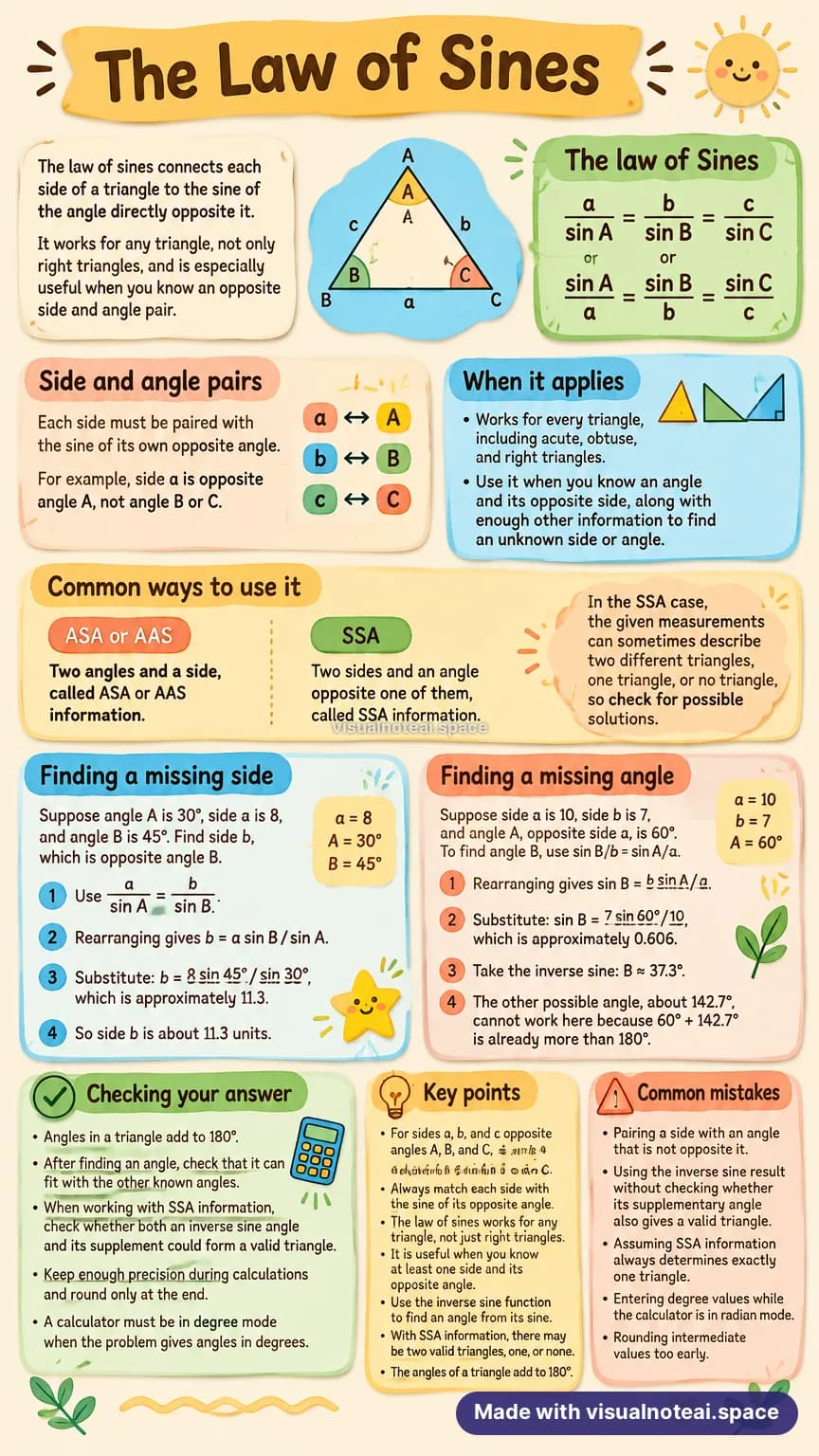
The whole topic on one page. Made with VisualNote.
!Common mistakes
- Pairing a side with an angle that is not opposite it.
- Using the inverse sine result without checking whether its supplementary angle also gives a valid triangle.
- Assuming SSA information always determines exactly one triangle.
- Entering degree values while the calculator is in radian mode.
- Rounding intermediate values too early.
🧠Explore the map23 ideas
The mind map VisualNote made for this topic. Drag to pan, scroll to zoom.
- Law of Sines
- Core Relationship
- a / sin A = b / sin B = c / sin C
- Equivalent form: sin A / a = sin B / b = sin C / c
- Pair each side with its opposite angle
- When It Applies
- Works for acute, obtuse, and right triangles
- Known opposite side-angle pair
- ASA or AAS: two angles and a side
- SSA: two sides and an angle opposite one side
- Solving for Unknowns
- Missing side: b = a sin B / sin A
- Example: a = 8, A = 30°, B = 45°; b ≈ 11.3
- Missing angle: sin B = b sin A / a
- Use inverse sine to find an angle
- Example: a = 10, b = 7, A = 60°; B ≈ 37.3°
- Missing side: b = a sin B / sin A
- Checking Solutions
- Triangle angles sum to 180°
- SSA may yield two, one, or no triangles
- Check whether the supplementary angle is valid
- Calculator and Rounding
- Use degree mode for degree measurements
- Keep precision and round only at the end
- Core Relationship
🃏Flashcards12 cards
- What does the Law of Sines relate?
- It relates each side of a triangle to the sine of its opposite angle.
- State the Law of Sines.
- For sides a, b, c opposite angles A, B, C: a / sin A = b / sin B = c / sin C. Equivalently, sin A / a = sin B / b = sin C / c.
- How should sides and angles be paired in the Law of Sines?
- Pair each side with the sine of its own opposite angle—for example, side a with sin A.
- Does the Law of Sines apply only to right triangles?
- No. It applies to every triangle, including acute, obtuse, and right triangles.
- When is the Law of Sines useful?
- It is useful when you know at least one side and its opposite angle, along with enough information to find another side or angle.
- What information patterns commonly use the Law of Sines?
- ASA and AAS (two angles and a side), as well as SSA (two sides and an angle opposite one of them).
- How can you find a missing side using the Law of Sines?
- Set up matching side-to-opposite-angle ratios and rearrange. For example, b = a sin B / sin A.
- How can you find a missing angle using the Law of Sines?
- Rearrange to find its sine, such as sin B = b sin A / a, then use inverse sine to find the angle.
- What is the SSA ambiguous case?
- With SSA information, the measurements may describe two different triangles, one triangle, or no triangle. Check all possible solutions.
- Why should you check the supplementary inverse-sine angle?
- A sine value can correspond to an angle and its supplement. Check whether either angle can fit in a triangle with the known angles.
- What must the angles of a triangle add up to?
- The three interior angles add to 180 degrees, which helps verify whether a proposed angle is possible.
- What calculation habits help avoid errors with the Law of Sines?
- Use degree mode when angles are in degrees, keep precision during calculations, and round only at the end.
✅Test yourself5 questions
In a triangle, side c is opposite angle C. Which ratio correctly pairs this side with its angle?
The Law of Sines pairs each side with the sine of its own opposite angle.
Which triangles can the Law of Sines be used for?
The Law of Sines applies to every triangle, regardless of its angle types.
Angle A is 30°, side a is 8, and angle B is 45°. What is the approximate length of side b?
Using b = a sin B / sin A gives b = 8 sin 45° / sin 30° ≈ 11.3.
Why should you check for a second possible angle when solving an SSA problem with inverse sine?
An angle and its supplement have the same sine, so either may need to be checked against the triangle's angle sum.
A triangle has angle A = 60° and a candidate value B = 142.7° from inverse sine. What should you conclude?
The angles of a triangle must total 180°, and 60° + 142.7° already exceeds that total.
📝The notes
The law of sines
For a triangle with sides a, b, and c opposite angles A, B, and C, respectively, the law of sines is a / sin A = b / sin B = c / sin C. The same relationship is sometimes written as sin A / a = sin B / b = sin C / c.
Each side must be paired with the sine of its own opposite angle. For example, side a is opposite angle A, not angle B or C.
When it applies
The law of sines applies to every triangle, including acute, obtuse, and right triangles. You can use it when you know an angle and its opposite side, along with enough other information to find an unknown side or angle.
It is commonly used with two angles and a side, called ASA or AAS information, or with two sides and an angle opposite one of them, called SSA information. In the SSA case, the given measurements can sometimes describe two different triangles, one triangle, or no triangle, so check for possible solutions.
Finding a missing side
Suppose angle A is 30 degrees, side a is 8, and angle B is 45 degrees. Find side b, which is opposite angle B.
Use a / sin A = b / sin B. Rearranging gives b = a sin B / sin A. Substituting gives b = 8 sin 45 degrees / sin 30 degrees, which is approximately 11.3. So side b is about 11.3 units.
Finding a missing angle
Suppose side a is 10, side b is 7, and angle A, opposite side a, is 60 degrees. To find angle B, use sin B / b = sin A / a. Rearranging gives sin B = b sin A / a.
Substitute the values: sin B = 7 sin 60 degrees / 10, which is approximately 0.606. Taking the inverse sine gives B approximately 37.3 degrees. The other possible inverse sine angle, about 142.7 degrees, cannot work here because 60 degrees plus 142.7 degrees is already more than 180 degrees.
Checking your answer
Angles in a triangle add to 180 degrees. After finding an angle, check that it can fit with the other known angles. When working with SSA information, check whether both an inverse sine angle and its supplement could form a valid triangle.
Keep enough precision during calculations and round only at the end. A calculator must be in degree mode when the problem gives angles in degrees.
Make this for your own notes
Paste a chapter or a PDF and get the sheet, map, cards, quiz and episode back in about a minute. No credit card.