
Integration by parts is a method for integrating a product when differentiating one factor and integrating the other makes the problem simpler. It comes directly from the product rule for differentiation.
★What to remember
- Integration by parts comes from rearranging the product rule.
- The formula is ∫u dv = uv − ∫v du.
- Differentiate u to obtain du, and integrate dv to obtain v.
- Choose the parts so that the remaining integral is simpler than the original one.
- LIATE is a useful guide for choosing u in a product, but it is not a fixed rule.
- Include + C in an indefinite integral.
- Check an indefinite integral by differentiating the result.
🎧Listen2:45 · transcript
AnnaWhen you see a product inside an integral, it can be hard to know what to do. Integration by parts is one method. Marco, what is the basic idea?
MarcoYou split the product into two parts. You differentiate one and integrate the other. The method comes from the product rule, and the goal is to make the new integral simpler than the one you started with.
AnnaSo it is not just a formula to memorize. It comes from rearranging the product rule. If the derivative of u times v is u times the derivative of v, plus v times the derivative of u, rearrange that and integrate both sides.
MarcoRight. In differential notation, the result is: the integral of u d v equals u v minus the integral of v d u. You differentiate u to get d u, and integrate d v to get v. The minus sign matters.
AnnaHow do you decide which part should be u?
MarcoLook for a factor that gets simpler when differentiated, and another factor that is manageable to integrate. The remaining integral, the integral of v d u, should be easier. If it gets harder, reconsider your choice.
AnnaThere is also the guide called LIATE: logarithmic, inverse trigonometric, algebraic, trigonometric, then exponential. Factors earlier in that order are often good choices for u. But it is a heuristic, not a rule, right?
MarcoExactly. The best choice depends on the integral. Once you choose, find d u by differentiating u, and find v by integrating d v. Then put them into the formula and work on the new integral.
AnnaLet’s use the example: the integral of x e to the x d x. We can set u equal to x, and d v equal to e to the x d x. Then d u is d x, and v is e to the x.
MarcoBecause the derivative and integral of e to the x are both e to the x. Substitution gives x e to the x minus the integral of e to the x d x. So the answer is x e to the x minus e to the x, plus C. We can also write e to the x times the quantity x minus one, plus C.
AnnaAnd we should check it by differentiating. The product rule gives e to the x times x minus one, plus e to the x. That simplifies to x e to the x, the original integrand.
MarcoThat check can catch a sign error or a missing constant. For an indefinite integral, include plus C. For a definite integral, use the endpoint limits on the u v term, then evaluate the remaining definite integral. You do not add a constant there, because the limits determine the value.
AnnaSo the main pitfalls are forgetting the minus sign, mixing up which part to differentiate and which to integrate, or sticking with a choice that makes the integral harder. And for definite integrals, remember both endpoints.
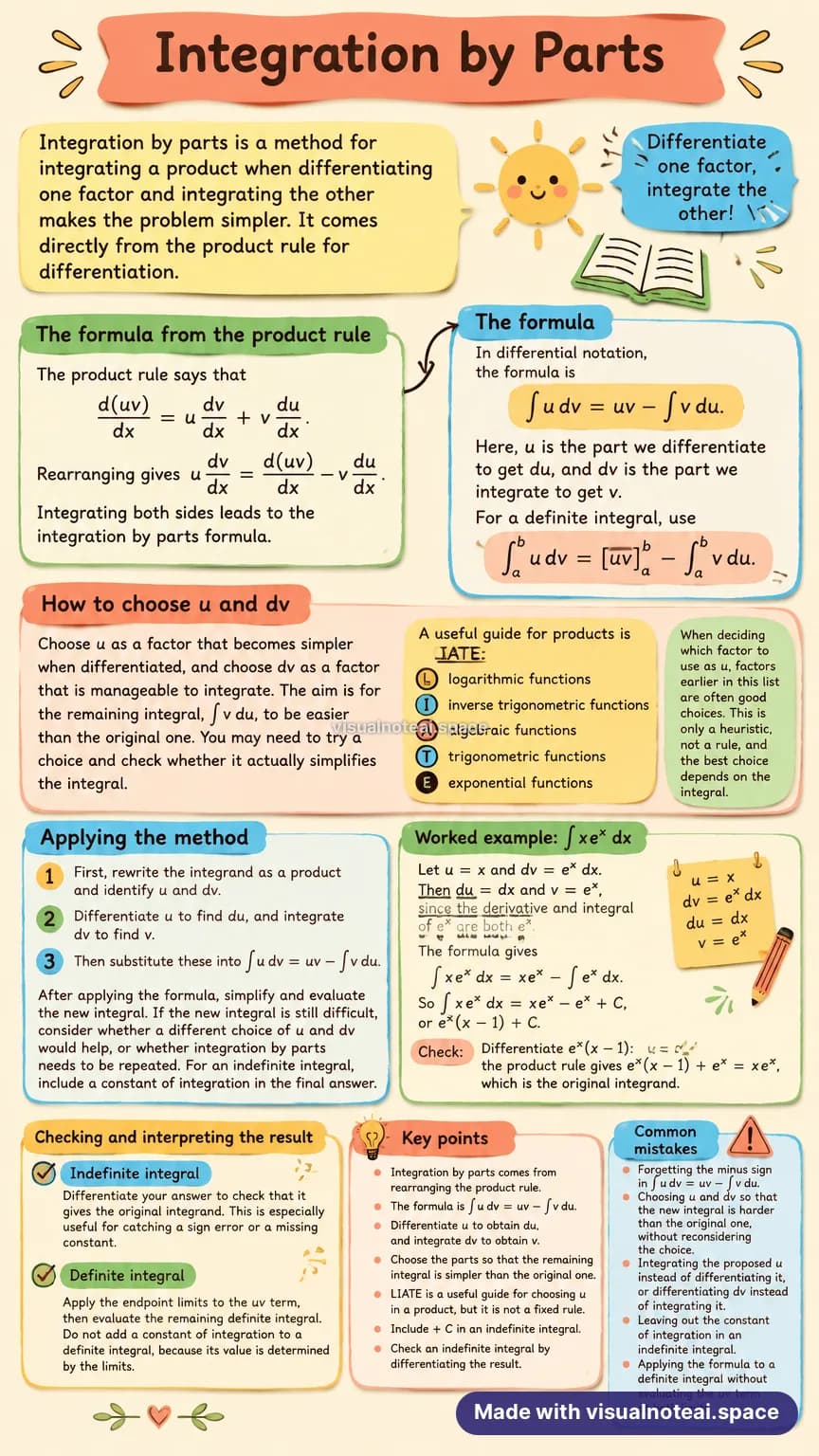
The whole topic on one page. Made with VisualNote.
!Common mistakes
- Forgetting the minus sign in ∫u dv = uv − ∫v du.
- Choosing u and dv so that the new integral is harder than the original one, without reconsidering the choice.
- Integrating the proposed u instead of differentiating it, or differentiating dv instead of integrating it.
- Leaving out the constant of integration in an indefinite integral.
- Applying the formula to a definite integral without evaluating the uv term at both limits.
🧠Explore the map37 ideas
The mind map VisualNote made for this topic. Drag to pan, scroll to zoom.
- Integration by Parts
- Product Rule Foundation
- Product rule
- d(uv)/dx = u(dv/dx) + v(du/dx)
- Indefinite integral formula
- ∫u dv = uv − ∫v du
- Definite integral formula
- ∫ₐᵇ u dv = [uv]ₐᵇ − ∫ₐᵇ v du
- Product rule
- Choosing u and dv
- Choose u to simplify when differentiated
- Choose dv to be manageable to integrate
- Aim for an easier remaining integral
- LIATE heuristic
- Logarithmic
- Inverse trigonometric
- Algebraic
- Trigonometric
- Exponential
- Method Steps
- Rewrite integrand as a product
- Set u and dv
- Differentiate u to find du
- Integrate dv to find v
- Substitute into the formula
- Simplify and evaluate the new integral
- Repeat or reconsider choices if needed
- Example: ∫x eˣ dx
- u = x; dv = eˣ dx
- du = dx; v = eˣ
- Result: eˣ(x − 1) + C
- Checking and Common Mistakes
- Differentiate an indefinite result to check
- Include + C for indefinite integrals
- Evaluate [uv] at both endpoints for definite integrals
- Do not add + C to definite integrals
- Avoid missing the minus sign
- Differentiate u; integrate dv
- Product Rule Foundation
🃏Flashcards12 cards
- What is integration by parts used for?
- It integrates a product when differentiating one factor and integrating the other makes the problem simpler.
- Where does the integration by parts formula come from?
- It comes from rearranging the product rule for differentiation.
- What is the integration by parts formula for an indefinite integral?
- ∫u dv = uv − ∫v du.
- What do u, du, dv, and v represent?
- Differentiate u to obtain du, and integrate dv to obtain v.
- What is the formula for definite integration by parts?
- ∫ₐᵇ u dv = [uv]ₐᵇ − ∫ₐᵇ v du.
- How should you choose u and dv?
- Choose u to become simpler when differentiated and dv to be manageable to integrate, aiming for an easier remaining integral.
- What does LIATE stand for?
- Logarithmic, inverse trigonometric, algebraic, trigonometric, and exponential functions—in that order.
- Is LIATE a strict rule for choosing u?
- No. It is a heuristic; the best choice depends on the integral.
- What are the basic steps of integration by parts?
- Write the integrand as a product, choose u and dv, find du and v, substitute into the formula, and simplify or evaluate the remaining integral.
- How do you evaluate ∫x eˣ dx using integration by parts?
- Take u = x and dv = eˣ dx, giving du = dx and v = eˣ. Then ∫x eˣ dx = xeˣ − eˣ + C = eˣ(x − 1) + C.
- How can you check an indefinite integral?
- Differentiate your answer and verify that it gives the original integrand; include the constant of integration, + C.
- What should you remember when using integration by parts on a definite integral?
- Evaluate the uv term at both endpoints and do not add a constant of integration.
✅Test yourself5 questions
Which formula correctly gives integration by parts in differential notation?
Rearranging the product rule and integrating gives ∫u dv = uv − ∫v du.
When using integration by parts, what is the role of u?
The method differentiates u to find du and integrates dv to find v.
According to LIATE, which factor is often preferred as u in a product containing a logarithm and an exponential?
LIATE places logarithmic functions before exponential functions, making the logarithm a common choice for u.
After finding an antiderivative with integration by parts, what should be included in the final answer?
An indefinite integral represents a family of antiderivatives, so its answer must include + C.
For a definite integral evaluated by parts, how should the uv term be handled?
The definite integration-by-parts formula evaluates the product term at both endpoints using [uv]ₐᵇ.
📝The notes
The formula from the product rule
The product rule says that d(uv)/dx = u(dv/dx) + v(du/dx). Rearranging gives u(dv/dx) = d(uv)/dx − v(du/dx). Integrating both sides leads to the integration by parts formula.
In differential notation, the formula is ∫u dv = uv − ∫v du. Here, u is the part we differentiate to get du, and dv is the part we integrate to get v. For a definite integral, use ∫ₐᵇ u dv = [uv]ₐᵇ − ∫ₐᵇ v du.
How to choose u and dv
Choose u as a factor that becomes simpler when differentiated, and choose dv as a factor that is manageable to integrate. The aim is for the remaining integral, ∫v du, to be easier than the original one. You may need to try a choice and check whether it actually simplifies the integral.
A useful guide for products is LIATE: logarithmic functions, inverse trigonometric functions, algebraic functions, trigonometric functions, then exponential functions. When deciding which factor to use as u, factors earlier in this list are often good choices. This is only a heuristic, not a rule, and the best choice depends on the integral.
Applying the method
First, rewrite the integrand as a product and identify u and dv. Differentiate u to find du, and integrate dv to find v. Then substitute these into ∫u dv = uv − ∫v du.
After applying the formula, simplify and evaluate the new integral. If the new integral is still difficult, consider whether a different choice of u and dv would help, or whether integration by parts needs to be repeated. For an indefinite integral, include a constant of integration in the final answer.
Worked example: ∫x eˣ dx
Let u = x and dv = eˣ dx. Then du = dx and v = eˣ, since the derivative and integral of eˣ are both eˣ. The formula gives ∫x eˣ dx = x eˣ − ∫eˣ dx.
So ∫x eˣ dx = x eˣ − eˣ + C, or eˣ(x − 1) + C. To check, differentiate eˣ(x − 1): the product rule gives eˣ(x − 1) + eˣ = x eˣ, which is the original integrand.
Checking and interpreting the result
For an indefinite integral, differentiate your answer to check that it gives the original integrand. This is especially useful for catching a sign error or a missing constant.
For a definite integral, apply the endpoint limits to the uv term, then evaluate the remaining definite integral. Do not add a constant of integration to a definite integral, because its value is determined by the limits.
Make this for your own notes
Paste a chapter or a PDF and get the sheet, map, cards, quiz and episode back in about a minute. No credit card.