
Factoring rewrites a polynomial as a product of simpler expressions, much as multiplication can be reversed. The best method depends on the polynomial’s form, so first look for a common factor and then check for patterns.
★What to remember
- Always check for a greatest common factor before using another factoring method.
- Grouping works when factoring pairs of terms produces a shared expression.
- The difference of squares identity is a² − b² = (a − b)(a + b).
- For x² + bx + c, the two constants must multiply to c and add to b.
- For ax² + bx + c, splitting the middle term uses numbers that multiply to ac and add to b.
- A sum of two squares does not factor by the difference of squares pattern over the real numbers.
- Multiplying the factors back together is a reliable way to check a factorization.
🎧Listen3:10 · transcript
AnnaWhen you see a polynomial, where do you start?
MarcoI start by looking for a greatest common factor. Before trying a pattern or splitting terms, check whether every term shares a factor. Taking it out can make the rest much simpler.
AnnaLike six x cubed plus nine x squared? Both terms share three x squared, so we get three x squared times the quantity two x plus three. And multiplying those factors back should recover the original.
MarcoExactly. That check is useful for every method. What would you look for next if there are four terms?
AnnaPossibly grouping. Put the terms into two pairs, factor out the greatest common factor from each pair, and see whether the pairs leave the same expression. In x cubed plus three x squared plus two x plus six, the first pair gives x squared times the quantity x plus three. The second gives two times the quantity x plus three. So the shared factor is x plus three, and the result is x plus three times the quantity x squared plus two.
MarcoAnd if those parentheses don’t match, don’t force it. Try regrouping the terms, or consider another method. What about a polynomial with just two terms?
AnnaCheck whether it’s a difference of squares. A squared minus b squared factors into a minus b times a plus b. For example, x squared minus twenty-five is x squared minus five squared, so it becomes x minus five times x plus five. The middle terms cancel when you multiply. But x squared plus twenty-five is a sum, not a difference, so this pattern does not give real linear factors.
MarcoAnd we still check for a common factor first, then see whether the result can be factored further. For three terms, how do you handle a trinomial whose leading coefficient is one?
AnnaFor x squared plus b x plus c, find two numbers that multiply to c and add to b. They become the constants in the factors. With x squared plus seven x plus twelve, three and four multiply to twelve and add to seven. So it factors as x plus three times x plus four.
MarcoThe sum matters just as much as the product. For x squared minus x minus twelve, negative four and three multiply to negative twelve and add to negative one. So the factors are x minus four and x plus three. What changes when the leading coefficient isn’t one?
AnnaFor a x squared plus b x plus c, find two numbers that multiply to a times c and add to b. Use them to split the middle term, then group. Take six x squared plus eleven x plus three. Six times three is eighteen; nine and two multiply to eighteen and add to eleven. Splitting gives six x squared plus nine x plus two x plus three. Grouping gives three x times the quantity two x plus three, plus one times that same quantity. The factors are three x plus one and two x plus three.
MarcoSo the order is: take out a common factor, count the terms, and look for a pattern or a way to group. And don’t stop if a factor can still be factored. Finally, multiply the factors back. That can catch a wrong sign or a pair of numbers with the right product but the wrong sum.
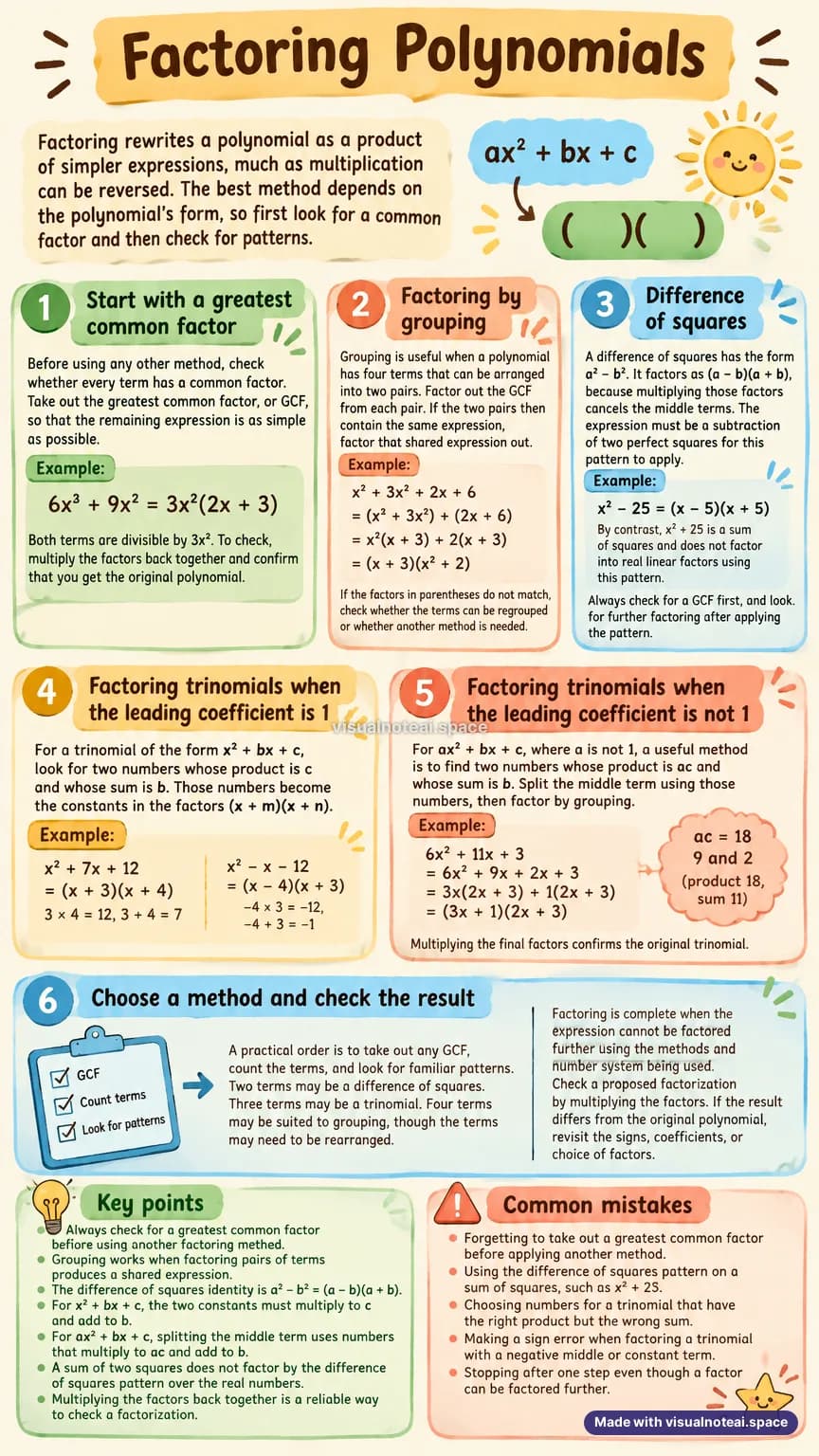
The whole topic on one page. Made with VisualNote.
!Common mistakes
- Forgetting to take out a greatest common factor before applying another method.
- Using the difference of squares pattern on a sum of squares, such as x² + 25.
- Choosing numbers for a trinomial that have the right product but the wrong sum.
- Making a sign error when factoring a trinomial with a negative middle or constant term.
- Stopping after one step even though a factor can be factored further.
🧠Explore the map27 ideas
The mind map VisualNote made for this topic. Drag to pan, scroll to zoom.
- Factoring Polynomials
- Greatest Common Factor
- Check every term for a common factor first
- Factor out the GCF
- Factoring by Grouping
- Arrange four terms into two pairs
- Factor the GCF from each pair
- Factor out the shared expression
- Difference of Squares
- Pattern: a² − b² = (a − b)(a + b)
- Requires subtraction of two perfect squares
- Sum of squares does not fit this pattern over the reals
- Factoring Trinomials
- Leading coefficient 1: x² + bx + c
- Find m and n with mn = c and m + n = b
- Factor as (x + m)(x + n)
- Leading coefficient not 1: ax² + bx + c
- Find numbers with product ac and sum b
- Split the middle term, then group
- Leading coefficient 1: x² + bx + c
- Choose and Check a Method
- Take out the GCF, then inspect the number of terms
- Two terms: check for difference of squares
- Three terms: check for a trinomial pattern
- Four terms: try grouping or rearranging
- Multiply factors to verify the original polynomial
- Factor further until no method applies
- Watch for sign and coefficient errors
- Greatest Common Factor
🃏Flashcards12 cards
- What does factoring a polynomial mean?
- Rewriting it as a product of simpler expressions. Multiplying those factors should reproduce the original polynomial.
- What should you check before using another factoring method?
- Check whether all terms share a greatest common factor (GCF), and factor it out first.
- How do you factor 6x³ + 9x²?
- The GCF is 3x², so 6x³ + 9x² = 3x²(2x + 3).
- When is factoring by grouping useful?
- It is useful for four-term polynomials when factoring each of two pairs produces the same expression, which can then be factored out.
- How do you factor x³ + 3x² + 2x + 6 by grouping?
- Group the terms: x²(x + 3) + 2(x + 3) = (x + 3)(x² + 2).
- What is the difference of squares identity?
- a² − b² = (a − b)(a + b). It applies to the subtraction of two perfect squares.
- Why does x² + 25 not factor by the difference of squares pattern over the real numbers?
- It is a sum of squares, not a difference of squares, so the identity a² − b² = (a − b)(a + b) does not apply.
- How do you factor x² + bx + c when the leading coefficient is 1?
- Find two numbers whose product is c and whose sum is b. Use them as the constants in (x + m)(x + n).
- How do you factor x² − x − 12?
- The numbers −4 and 3 multiply to −12 and add to −1, so x² − x − 12 = (x − 4)(x + 3).
- How do you factor ax² + bx + c when a is not 1?
- Find two numbers whose product is ac and whose sum is b. Split the middle term using those numbers, then factor by grouping.
- How do you factor 6x² + 11x + 3?
- Since 9 × 2 = 18 = ac and 9 + 2 = 11, split the middle term and group: 6x² + 9x + 2x + 3 = (3x + 1)(2x + 3).
- How can you check a factorization, and when is it complete?
- Multiply the factors and compare the result with the original polynomial. Factoring is complete when no further factoring is possible using the methods and number system in use.
✅Test yourself5 questions
What is the fully factored form of 6x³ + 9x²?
The greatest common factor is 3x², and dividing each term by it leaves 2x + 3.
Which factorization results from grouping x³ + 3x² + 2x + 6?
Grouping gives x²(x + 3) + 2(x + 3), so the shared factor is x + 3.
Which statement correctly describes x² + 25 over the real numbers?
The difference of squares pattern requires subtraction, whereas x² + 25 is a sum of squares.
What is the factorization of x² − x − 12?
The numbers −4 and 3 multiply to −12 and add to −1, matching the constant and middle coefficients.
What is the correct factorization of 6x² + 11x + 3 using the ac method?
The numbers 9 and 2 multiply to ac = 18 and add to 11, and splitting and grouping gives (3x + 1)(2x + 3).
📝The notes
Start with a greatest common factor
Before using any other method, check whether every term has a common factor. Take out the greatest common factor, or GCF, so that the remaining expression is as simple as possible.
For example, in 6x³ + 9x², both terms are divisible by 3x². Factoring it out gives 3x²(2x + 3). To check, multiply the factors back together and confirm that you get the original polynomial.
Factoring by grouping
Grouping is useful when a polynomial has four terms that can be arranged into two pairs. Factor out the GCF from each pair. If the two pairs then contain the same expression, factor that shared expression out.
For example, factor x³ + 3x² + 2x + 6 by grouping: (x³ + 3x²) + (2x + 6) = x²(x + 3) + 2(x + 3) = (x + 3)(x² + 2). The matching factor is x + 3. If the factors in parentheses do not match, check whether the terms can be regrouped or whether another method is needed.
Difference of squares
A difference of squares has the form a² − b². It factors as (a − b)(a + b), because multiplying those factors cancels the middle terms. The expression must be a subtraction of two perfect squares for this pattern to apply.
For example, x² − 25 is x² − 5², so it factors as (x − 5)(x + 5). By contrast, x² + 25 is a sum of squares and does not factor into real linear factors using this pattern. Always check for a GCF first, and look for further factoring after applying the pattern.
Factoring trinomials when the leading coefficient is 1
For a trinomial of the form x² + bx + c, look for two numbers whose product is c and whose sum is b. Those numbers become the constants in the factors (x + m)(x + n).
For example, x² + 7x + 12 factors as (x + 3)(x + 4), because 3 times 4 is 12 and 3 plus 4 is 7. For x² − x − 12, the numbers are −4 and 3: their product is −12 and their sum is −1, so the factorization is (x − 4)(x + 3).
Factoring trinomials when the leading coefficient is not 1
For ax² + bx + c, where a is not 1, a useful method is to find two numbers whose product is ac and whose sum is b. Split the middle term using those numbers, then factor by grouping.
For example, factor 6x² + 11x + 3. The product ac is 18, and the numbers 9 and 2 have product 18 and sum 11. Split the middle term and group: 6x² + 9x + 2x + 3 = 3x(2x + 3) + 1(2x + 3) = (3x + 1)(2x + 3). Multiplying the final factors confirms the original trinomial.
Choose a method and check the result
A practical order is to take out any GCF, count the terms, and look for familiar patterns. Two terms may be a difference of squares. Three terms may be a trinomial. Four terms may be suited to grouping, though the terms may need to be rearranged.
Factoring is complete when the expression cannot be factored further using the methods and number system being used. Check a proposed factorization by multiplying the factors. If the result differs from the original polynomial, revisit the signs, coefficients, or choice of factors.
Make this for your own notes
Paste a chapter or a PDF and get the sheet, map, cards, quiz and episode back in about a minute. No credit card.