
Many birds migrate in autumn because food becomes harder to find as days shorten and seasonal conditions change, not simply because the weather gets cold. Their journeys are guided by seasonal signals and by navigation systems that use the Sun, stars and Earth's magnetic field.
★What to remember
- Many birds migrate because seasonal changes reduce food availability, not only because temperatures fall.
- Shortening day length is an important seasonal cue that can prepare birds for migration.
- Internal rhythms, food supply and weather can also affect when birds depart.
- Some birds use the Sun as a compass and compensate for its apparent movement by keeping track of time.
- Some night-migrating birds use star patterns, including the rotation of stars around the north celestial pole.
- Birds can use information from Earth's magnetic field as a compass and possibly as a clue to position.
- Birds often combine several navigation cues, and their use varies among species and circumstances.
🎧Listen2:52 · transcript
AnnaWhen people picture autumn migration, they often imagine birds fleeing the cold. Is that really the main reason?
MarcoNot by itself. A major issue is food. As days shorten, flying insects may become scarce, plants may offer less food, and water can freeze. Birds may leave before the harshest weather, while they can still reach suitable wintering areas.
AnnaSo shortening days matter partly because they signal a wider seasonal change. But do birds simply notice a shorter day and fly south?
MarcoNo. Day length can influence hormones, fat storage, and migratory restlessness. Those changes prepare a bird for travel, but they do not set one universal departure day or point every bird south. Internal seasonal rhythms, food, and local weather also matter. A storm, headwind, or food shortage can delay or alter a journey.
AnnaThat means the decision to leave and the ability to navigate are connected, but not the same thing. Once a bird is moving, how can the Sun help?
MarcoIt can act as a compass. But the Sun seems to move across the sky, so a bird needs to keep track of time to read its direction. Experiments indicate that some birds compensate for that apparent movement using an internal sense of time. The Sun gives directional information, not a complete map, and clouds can hide it.
AnnaAnd some birds migrate at night. Can stars give them a kind of reference point?
MarcoYes. In the northern hemisphere, stars appear to circle around the north celestial pole, a point in the sky close to the North Star. Some birds can learn that pattern and use it to orient themselves. Experiments, especially with young birds, show that the night sky can guide a preferred direction. That does not mean every bird follows one particular star. Clouds and light conditions affect how useful the stars are.
AnnaWhat about Earth's magnetic field? Is it another compass, or does it tell birds where they are?
MarcoEvidence suggests birds can sense aspects of the field and use it as a compass. The field's inclination, the angle at which its lines meet the Earth's surface, may also offer clues about position. But magnetic sensing is complex and still being studied. It works alongside other cues, not as a replacement for them.
AnnaSo a bird might combine magnetic information with stars, the Sun, or landmarks. Does experience change that mix?
MarcoIt can. Experienced birds may use familiar landmarks. Young birds on a first migration may follow an inherited direction and distance pattern. Different species can rely on cues in different ways, and no single method explains every journey.
AnnaThen the simple story is not that birds get cold and head south. Seasonal changes, especially food and daylight, help shape when they leave; several cues can help them keep course. And routes do not always point south.
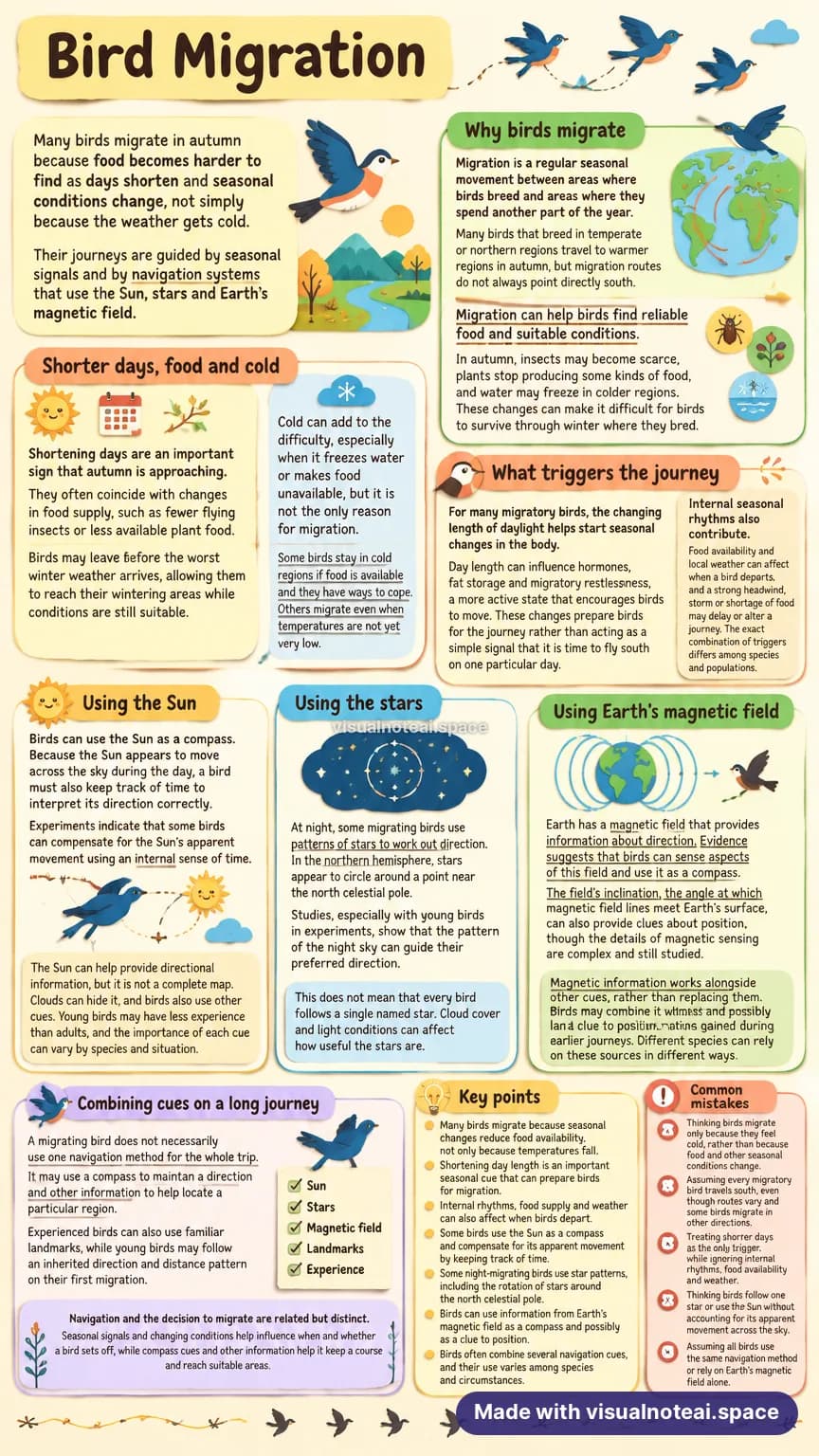
The whole topic on one page. Made with VisualNote.
!Common mistakes
- Thinking birds migrate only because they feel cold, rather than because food and other seasonal conditions change.
- Assuming every migratory bird travels south, even though routes vary and some birds migrate in other directions.
- Treating shorter days as the only trigger, while ignoring internal rhythms, food availability and weather.
- Thinking birds follow one star or use the Sun without accounting for its apparent movement across the sky.
- Assuming all birds use the same navigation method or rely on Earth's magnetic field alone.
🧠Explore the map30 ideas
The mind map VisualNote made for this topic. Drag to pan, scroll to zoom.
- Bird Migration
- Why Birds Migrate
- Seasonal movement between breeding and wintering areas
- Food becomes scarce
- Water may freeze; conditions become unsuitable
- Routes vary and do not always lead south
- Migration Triggers
- Shortening daylight
- Hormonal changes and fat storage
- Migratory restlessness
- Internal seasonal rhythms
- Food supply and local weather
- Sun Compass
- Provides directional information
- Birds track time to compensate for apparent Sun movement
- Clouds can limit usefulness
- Star Navigation
- Night-sky patterns guide direction
- Stars rotate around the north celestial pole
- Cloud cover and light affect visibility
- Earth's Magnetic Field
- Magnetic field provides compass information
- Field inclination may provide position clues
- Magnetic sensing remains under study
- Combining Navigation Cues
- Celestial cues, magnetic information, and landmarks
- Compass maintains direction; other cues help locate regions
- Experienced birds may use familiar landmarks
- Young birds may follow inherited direction and distance patterns
- Cue use varies by species and conditions
- Why Birds Migrate
🃏Flashcards12 cards
- What is bird migration?
- A regular seasonal movement between breeding areas and places where birds spend another part of the year.
- Why do many birds migrate in autumn?
- Seasonal changes can make food and suitable conditions harder to find. Cold may contribute, but it is not the only reason.
- Do all migratory birds travel south?
- No. Routes vary and do not always point directly south.
- How can shorter days affect migration?
- Changing day length can influence hormones, fat storage, and migratory restlessness, helping prepare birds for travel.
- What other factors affect when a bird departs?
- Internal seasonal rhythms, food availability, and local weather can all affect departure; storms or headwinds may delay or alter a journey.
- How do birds use the Sun to navigate?
- Some use the Sun as a compass and track time to compensate for its apparent movement across the sky.
- What are limitations of using the Sun for navigation?
- Clouds can hide the Sun, and it provides directional information rather than a complete map. Birds may use other cues as well.
- How can stars guide night-migrating birds?
- Some birds learn star patterns, including the apparent rotation around the north celestial pole, and use them for orientation.
- How can Earth's magnetic field help birds navigate?
- Birds can sense aspects of the field as compass information; its inclination may also provide clues about position.
- Do all birds rely on the same navigation method?
- No. Reliance on the Sun, stars, magnetic information, landmarks, and other cues varies by species and situation.
- How might young birds navigate their first migration?
- They may follow an inherited direction-and-distance pattern, while experienced birds can also use familiar landmarks.
- How are migration decisions different from navigation?
- Seasonal signals and changing conditions influence when or whether a bird sets off; compass cues and other information help it stay on course and reach suitable areas.
✅Test yourself5 questions
Which explanation best describes why many birds migrate in autumn?
Autumn migration often helps birds find reliable food and suitable conditions as seasonal resources decline.
Which statement best describes the role of shortening days in triggering migration?
Day length can influence body changes that prepare birds to migrate, while other factors also affect departure.
Why must a bird using the Sun as a compass also keep track of time?
Because the Sun appears to move across the sky during the day, time information helps a bird interpret its direction.
How can patterns of stars help some birds orient at night in the northern hemisphere?
Some birds can learn the rotation pattern of stars around the north celestial pole and use it for orientation.
Which statement best describes how birds navigate on long migrations?
Birds can combine multiple navigation cues, and the cues they use vary by species and circumstances.
📝The notes
Why birds migrate
Migration is a regular seasonal movement between areas where birds breed and areas where they spend another part of the year. Many birds that breed in temperate or northern regions travel to warmer regions in autumn, but migration routes do not always point directly south.
Migration can help birds find reliable food and suitable conditions. In autumn, insects may become scarce, plants stop producing some kinds of food, and water may freeze in colder regions. These changes can make it difficult for birds to survive through winter where they bred.
Shorter days, food and cold
Shortening days are an important sign that autumn is approaching. They often coincide with changes in food supply, such as fewer flying insects or less available plant food. Birds may leave before the worst winter weather arrives, allowing them to reach their wintering areas while conditions are still suitable.
Cold can add to the difficulty, especially when it freezes water or makes food unavailable, but it is not the only reason for migration. Some birds stay in cold regions if food is available and they have ways to cope with the conditions. Others migrate even when temperatures are not yet very low.
What triggers the journey
For many migratory birds, the changing length of daylight helps start seasonal changes in the body. Day length can influence hormones, fat storage and migratory restlessness, a more active state that encourages birds to move. These changes prepare birds for the journey rather than acting as a simple signal that it is time to fly south on one particular day.
Internal seasonal rhythms also contribute. Food availability and local weather can affect when a bird departs, and a strong headwind, storm or shortage of food may delay or alter a journey. The exact combination of triggers differs among species and populations.
Using the Sun
Birds can use the Sun as a compass. Because the Sun appears to move across the sky during the day, a bird must also keep track of time to interpret its direction correctly. Experiments indicate that some birds can compensate for the Sun's apparent movement using an internal sense of time.
The Sun can help provide directional information, but it is not a complete map. Clouds can hide it, and birds also use other cues. Young birds may have less experience than adults, and the importance of each cue can vary by species and situation.
Using the stars
At night, some migrating birds use patterns of stars to work out direction. In the northern hemisphere, stars appear to circle around the north celestial pole, a point in the sky close to the North Star. Birds can learn the pattern of this rotation and use it as a reference for orientation.
Studies, especially with young birds in experiments, show that the pattern of the night sky can guide their preferred direction. This does not mean that every bird follows a single named star. Cloud cover and light conditions can affect how useful the stars are.
Using Earth's magnetic field
Earth has a magnetic field that provides information about direction. Evidence suggests that birds can sense aspects of this field and use it as a compass. The field's inclination, the angle at which magnetic field lines meet Earth's surface, can also provide clues about position, though the details of magnetic sensing are complex and still studied.
Magnetic information works alongside other cues, rather than replacing them. Birds may combine it with celestial cues, landmarks and information gained during earlier journeys. Different species can rely on these sources in different ways.
Combining cues on a long journey
A migrating bird does not necessarily use one navigation method for the whole trip. It may use a compass to maintain a direction and other information to help locate a particular region. Experienced birds can also use familiar landmarks, while young birds may follow an inherited direction and distance pattern on their first migration.
Navigation and the decision to migrate are related but distinct. Seasonal signals and changing conditions help influence when and whether a bird sets off, while compass cues and other information help it keep a course and reach suitable areas.
Make this for your own notes
Paste a chapter or a PDF and get the sheet, map, cards, quiz and episode back in about a minute. No credit card.