
The Water Cycle: Visual, Flashcards & Mind Map
One set of class notes on the hydrologic cycle, turned into a complete learning pack: a labeled diagram for the wall, a 12-card deck for self-testing, and an interactive mind map of how every process connects. All three came from the same paragraphs.
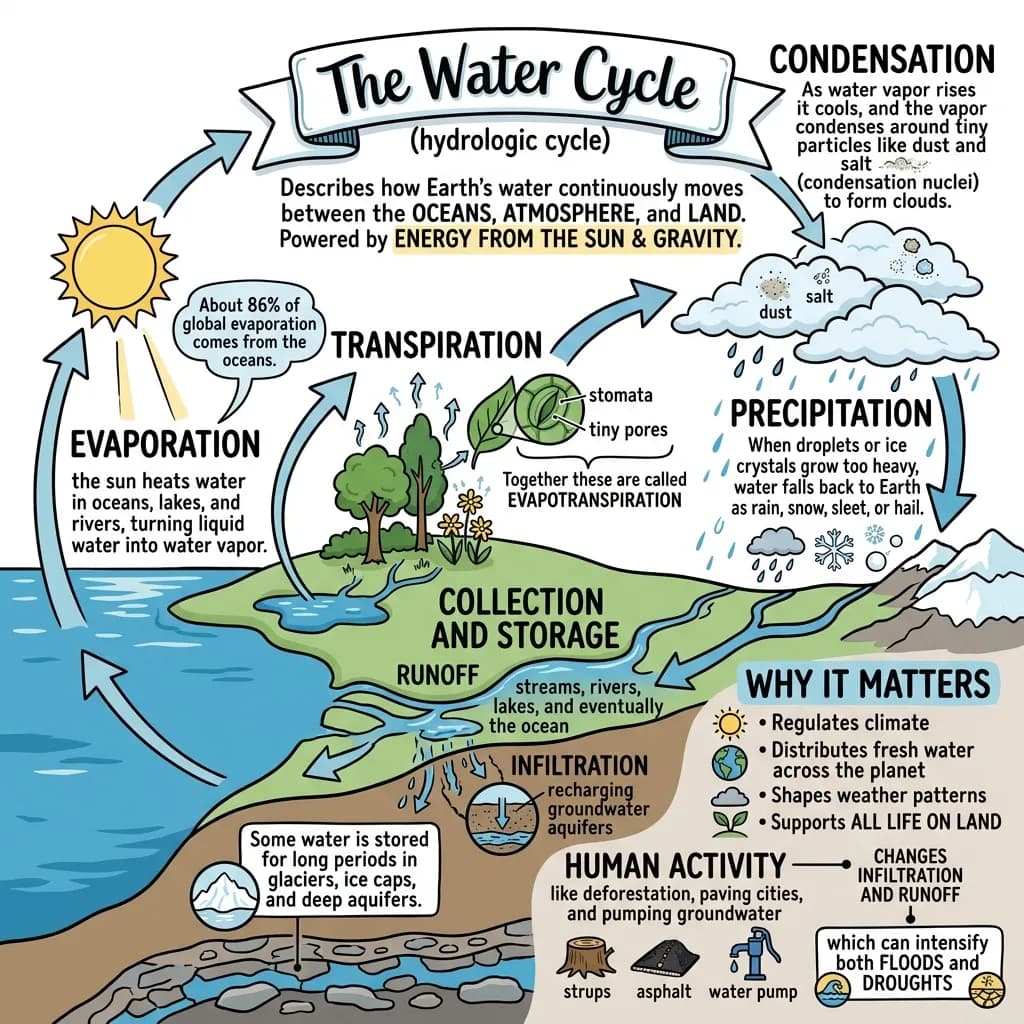
The water cycle (hydrologic cycle) describes how Earth's water continuously moves between the oceans, the atmosphere, and the land, powered by energy from the sun and by gravity. Evaporation: the sun heats water in oceans, lakes, and rivers, turning liquid water into vapor; about 86 percent of global evaporation comes from the oceans. Transpiration: plants release vapor through stomata; together these are evapotranspiration. Condensation: rising vapor cools and condenses around condensation nuclei like dust and salt to form clouds. Precipitation: heavy droplets or ice crystals fall as rain, snow, sleet, or hail. Collection: water infiltrates the soil and recharges aquifers, or becomes surface runoff flowing to rivers and the ocean; some is stored long-term in glaciers, ice caps, and deep aquifers. The cycle regulates climate, distributes fresh water, shapes weather, and supports all life on land. Deforestation, paved cities, and groundwater pumping alter infiltration and runoff, intensifying floods and droughts.
The mind map from the same notes
Real canvas, read-only. Drag to pan, scroll to zoom.
Map your own notes with the AI mind map generator.
The flashcards from the same notes
Exports as Anki CSV, printable PDF, or plain text.
What is the hydrologic cycle?
The continuous movement of Earth's water between the oceans, the atmosphere, and the land.
What are the two main power sources of the water cycle?
Energy from the sun and gravity.
What is evaporation?
The process where the sun heats liquid water in oceans, lakes, and rivers, turning it into water vapor that rises into the atmosphere.
What is transpiration?
The process by which plants release water vapor into the atmosphere through tiny pores in their leaves called stomata.
What is the combined term for evaporation and transpiration?
Evapotranspiration.
What is condensation?
The process where rising water vapor cools and condenses around particles to form clouds.
What is precipitation?
When water droplets or ice crystals in clouds grow too heavy and fall to Earth as rain, snow, sleet, or hail.
What is infiltration?
The process where precipitation soaks into the soil to recharge groundwater aquifers.
What is runoff?
Water that flows over the Earth's surface into streams, rivers, lakes, and oceans.
Where is water stored for long periods?
Water is stored in glaciers, ice caps, and deep aquifers.
Why is the water cycle important?
It regulates climate, distributes fresh water, shapes weather patterns, and supports all life on land.
How do human activities affect the water cycle?
Activities like deforestation and paving cities alter infiltration and runoff, which can intensify floods and droughts.
Make a deck from your own notes with the AI flashcard generator.
What's in this visual
The water cycle is one of the first diagrams every science student meets, and one of the most searched topics every September. It is also the perfect example of a learning pack: the same notes become a diagram (to see the cycle), a deck (to test the vocabulary), and a mind map (to hold the structure). Here is what each piece covers.
The four processes, in order
Evaporation starts the cycle: the sun heats surface water and turns it into vapor, with about 86 percent of global evaporation coming from the oceans. Transpiration adds vapor released by plants through their stomata; the two together are called evapotranspiration. Condensation happens as the vapor rises and cools, gathering around tiny particles (condensation nuclei) to build clouds. Precipitation closes the loop: when droplets or crystals grow too heavy, water returns as rain, snow, sleet, or hail.
Where the water goes next
Precipitation that reaches the ground splits two ways. Part of it soaks in (infiltration), refilling the groundwater aquifers wells draw from. The rest flows over the surface as runoff, feeding streams, rivers, lakes, and finally the ocean, where evaporation starts the cycle again. Some water leaves circulation for centuries, locked in glaciers, ice caps, and deep aquifers.
Why teachers test it and students search it
The water cycle carries a heavy load of paired vocabulary (evaporation and condensation, infiltration and runoff) that students routinely swap in exams. A diagram fixes the direction of each arrow; the flashcards force each definition to be recalled on its own; the mind map shows the four branches (energy sources, processes, storage, importance) so the parts stop blurring together.
The human fingerprint
The modern syllabus adds a fourth branch older textbooks skipped: human impact. Deforestation removes the plants that drive transpiration, paved cities block infiltration and speed runoff, and pumped aquifers refill slower than they drain. That is why the same regions can swing between harder floods and longer droughts.
For teachers
The problem
- Every student has seen a water cycle diagram, but half still confuse condensation with evaporation on the test.
- The topic spans vocabulary, a process loop, and human impact: three different kinds of teaching material.
- Making a diagram, a quiz deck, and a recap map for one lesson normally means three separate evenings.
How to use it in class
- Project the diagram as the lesson anchor and trace the arrows as you teach each process.
- Print it with the labels covered as an instant labeling worksheet.
- Use the 12 flashcards as exit-ticket questions at the end of the unit.
- Put the mind map on screen for the recap: ask the class to rebuild each branch from memory.
For students & visual learners
The problem
- The words all sound alike: evaporation, condensation, precipitation, infiltration.
- You can recite the cycle but freeze when a question starts mid-loop.
- Re-reading the textbook chapter takes 20 minutes and fades by tomorrow.
How to use it to study
- Study the diagram until you can draw the loop from memory with all four arrows.
- Drill the deck the night before: each card is one definition the test will ask.
- Use the mind map to check yourself: cover a branch and name what is under it.
- Generate the same pack from your own class notes so it matches what your teacher actually said.
Make your own visual like this
Paste your notes or upload a PDF
Drop in your own class notes, a textbook chapter or a PDF. Any subject, any language.
Pick a visual style
Choose a sketchnote, infographic or diagram style that fits the topic.
Generate and download
In about 15–40 seconds you get a one-page visual you can print, share or revise from.
Frequently asked questions
What are the 4 main stages of the water cycle?
Evaporation (water becomes vapor), condensation (vapor forms clouds), precipitation (water falls as rain, snow, sleet, or hail), and collection (water infiltrates the ground or runs off to rivers and oceans).
What is the difference between infiltration and runoff?
Infiltration is water soaking into the soil to recharge groundwater aquifers; runoff is water flowing over the surface into streams, rivers, and eventually the ocean.
Can I make a water cycle pack from my own notes?
Yes. Paste your class notes and VisualNote AI generates the diagram, the flashcard deck, and the mind map from the same source. Try the study guide generator.
More visual examples
Turn your notes into a visual
Paste any notes or upload a PDF and get a sketchnote-style visual in under a minute.