
The 8 Parts of Speech: Chart, Flashcards & Mind Map
Grammar's most-taught lesson as a complete pack: a one-page chart of all eight parts of speech with examples, a 12-card deck that drills each job, and an interactive mind map that groups them the way grammar actually works.
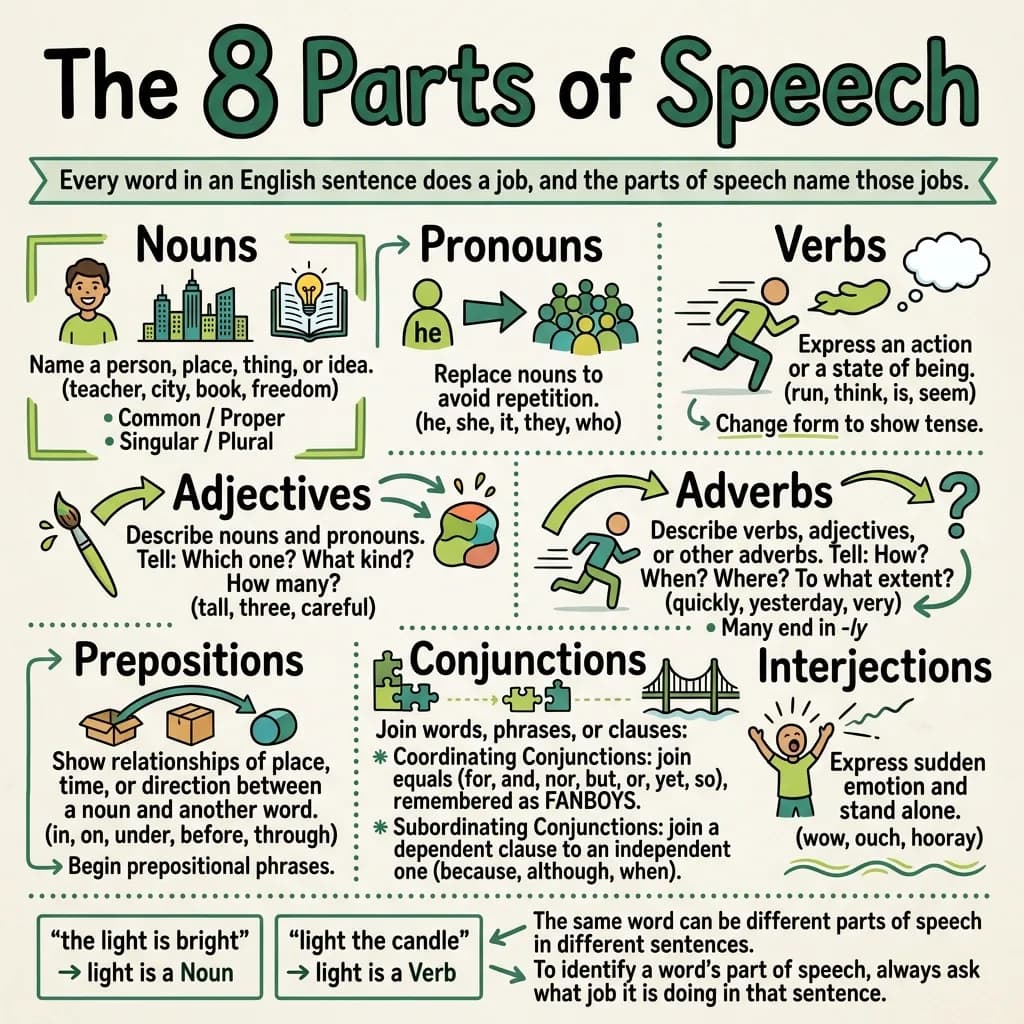
Every word in an English sentence does a job, and the parts of speech name those jobs. Nouns name a person, place, thing, or idea (teacher, city, book, freedom); they can be common or proper, singular or plural. Pronouns replace nouns (he, she, it, they, who). Verbs express action or state of being (run, think, is, seem) and change form to show tense. Adjectives describe nouns and pronouns, telling which one, what kind, or how many. Adverbs describe verbs, adjectives, or other adverbs, telling how, when, where, or to what extent; many end in -ly. Prepositions show relationships of place, time, or direction (in, on, under, before, through) and begin prepositional phrases. Conjunctions join words, phrases, or clauses: coordinating conjunctions (FANBOYS: for, and, nor, but, or, yet, so) join equals; subordinating conjunctions (because, although, when) join a dependent clause to an independent one. Interjections express sudden emotion and stand alone (wow, ouch, hooray). The same word can be different parts of speech in different sentences: in 'the light is bright' light is a noun, in 'light the candle' it is a verb.
The mind map from the same notes
Real canvas, read-only. Drag to pan, scroll to zoom.
Map your own notes with the AI mind map generator.
The flashcards from the same notes
Exports as Anki CSV, printable PDF, or plain text.
What are nouns?
Nouns name a person, place, thing, or idea.
What is the purpose of a pronoun?
Pronouns replace nouns to help avoid repetition in a sentence.
What do verbs express?
Verbs express an action or a state of being and change form to show tense.
What is the function of an adjective?
Adjectives describe nouns and pronouns by indicating which one, what kind, or how many.
What do adverbs modify?
Adverbs describe verbs, adjectives, or other adverbs, often indicating how, when, where, or to what extent.
What is a preposition?
A preposition shows relationships of place, time, or direction between a noun and another word.
What do conjunctions do?
Conjunctions join words, phrases, or clauses together.
What is the difference between coordinating and subordinating conjunctions?
Coordinating conjunctions join equals, while subordinating conjunctions connect a dependent clause to an independent one.
What are interjections?
Interjections are words used to express sudden emotion and typically stand alone.
What does the acronym FANBOYS stand for?
It represents the coordinating conjunctions: for, and, nor, but, or, yet, so.
Can the same word function as different parts of speech?
Yes, the part of speech of a word depends on the specific job it is performing within a sentence.
How do you identify a word's part of speech?
To identify a word's part of speech, you must ask what job it is doing in that specific sentence.
Make a deck from your own notes with the AI flashcard generator.
What's in this visual
Every English course opens the year with the parts of speech, and every year the same eight labels slide off by October. The fix is the same one that works for science: see the system on one chart, drill each definition as its own card, and keep the grouping in a map. Here is how this pack organizes it.
Words that name and words that replace
Nouns name a person, place, thing, or idea, and split into common versus proper and singular versus plural. Pronouns exist so you never have to write the same noun twice: he, she, it, they, who. On the mind map these two live together under one branch, because they do the same job of pointing at things.
Words that act and words that describe
Verbs carry the action or state of being and are the only words that change form to show tense. Adjectives decorate nouns (which one, what kind, how many); adverbs decorate everything else, answering how, when, where, and to what extent, often wearing the -ly ending. The chart keeps each with its question words, because the questions are how you identify them in a sentence.
Words that connect
Prepositions position things in place, time, and direction (in, on, under, before, through) and start prepositional phrases. Conjunctions join: coordinating ones join equals and are memorized as FANBOYS (for, and, nor, but, or, yet, so), while subordinating ones (because, although, when) hang a dependent clause on an independent one. That coordinating-versus-subordinating split is the most-tested distinction in the whole topic.
The rule that unlocks everything
The bottom of the chart carries the insight that turns memorizers into grammarians: the same word can be different parts of speech in different sentences. In 'the light is bright', light is a noun; in 'light the candle', it is a verb. The label belongs to the job, not the word, so the question to ask is always: what is this word doing in this sentence?
For teachers
The problem
- Eight abstract labels in week one, and half the class still writes 'adverb' next to adjectives in week six.
- Grammar charts from the textbook are dense walls of terminology with no visual anchors.
- You need the same content three ways: a wall chart, a quiz, and a revision recap.
How to use it in class
- Print the chart for the classroom wall and point to the panel every time the label comes up.
- Run the deck as a warm-up: read the back, class calls out the part of speech.
- Use the 'light' example as a mini-lesson on words changing jobs, then hunt for more double-agents.
- Cover the map's branches during review and have students rebuild the groupings.
For students & visual learners
The problem
- Adjective versus adverb trips you up every single quiz.
- FANBOYS is easy to memorize and easy to forget what it is for.
- You can define every label but cannot tag words in a real sentence.
How to use it to study
- Learn the question words first: which one/what kind is an adjective, how/when/where is an adverb.
- Drill the deck until each definition comes back in under three seconds.
- Use the map's four branches (naming, action and description, connecting, emotion) as your mental filing system.
- Practice on real sentences: pick any sentence and label every single word.
Make your own visual like this
Paste your notes or upload a PDF
Drop in your own class notes, a textbook chapter or a PDF. Any subject, any language.
Pick a visual style
Choose a sketchnote, infographic or diagram style that fits the topic.
Generate and download
In about 15–40 seconds you get a one-page visual you can print, share or revise from.
Frequently asked questions
What are the 8 parts of speech?
Nouns, pronouns, verbs, adjectives, adverbs, prepositions, conjunctions, and interjections. Each one names the job a word does in a sentence.
What is the difference between an adjective and an adverb?
Adjectives describe nouns and pronouns (which one, what kind, how many). Adverbs describe verbs, adjectives, or other adverbs (how, when, where, to what extent), and many end in -ly.
What does FANBOYS mean in grammar?
FANBOYS is the memory aid for the seven coordinating conjunctions: for, and, nor, but, or, yet, so. They join words, phrases, or clauses of equal weight.
Can I make a grammar pack from my own notes?
Yes. Paste your grammar notes and VisualNote AI generates the chart, the flashcards, and the mind map from the same text. Teachers can also turn it into fill-in-the-blank guided notes.
More visual examples
Turn your notes into a visual
Paste any notes or upload a PDF and get a sketchnote-style visual in under a minute.