
The Solar System: Visual, Flashcards & Mind Map
One page of notes about the Sun, the eight planets, and the belts between them, turned into a full learning pack: a one-glance visual, a 12-card deck of the facts tests actually ask, and an interactive mind map of the whole neighborhood.
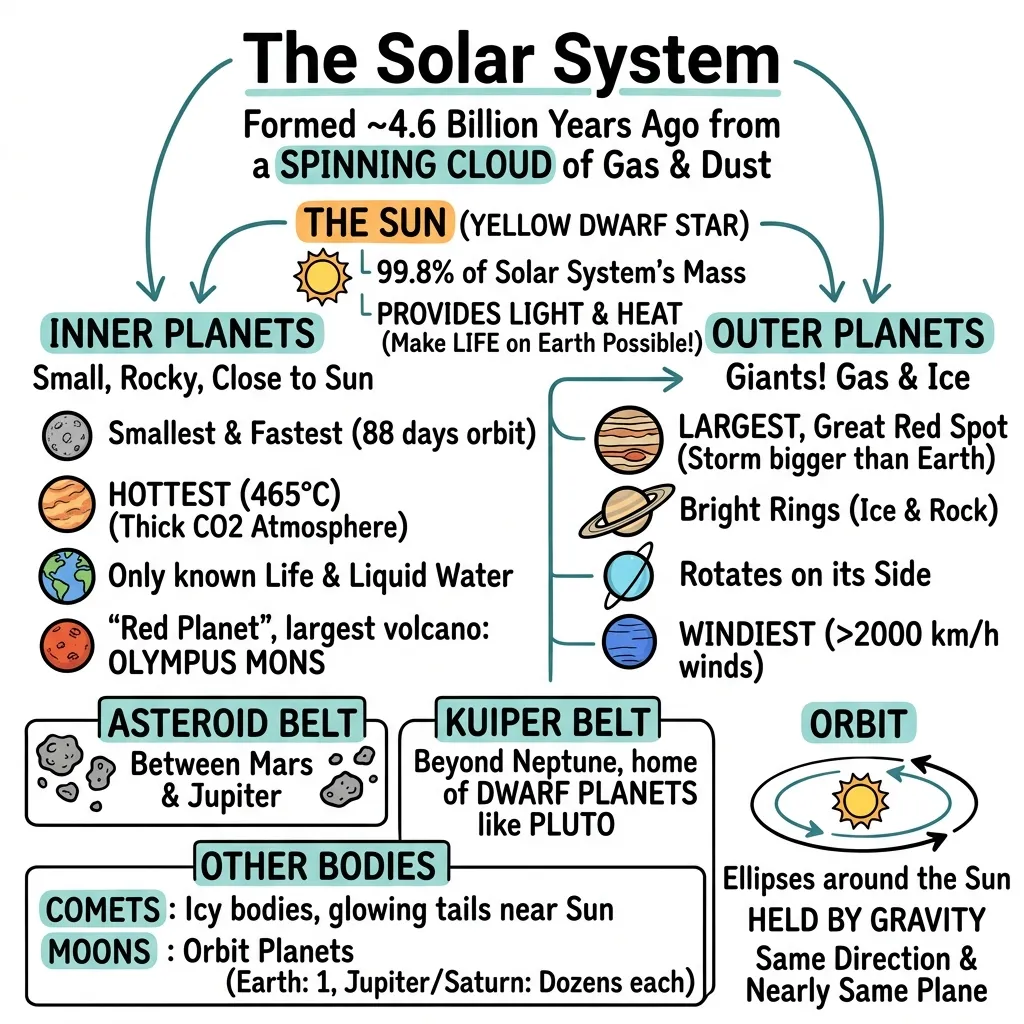
The solar system formed about 4.6 billion years ago from a spinning cloud of gas and dust. At its center is the Sun, a yellow dwarf containing 99.8 percent of the system's mass. The inner planets (Mercury, Venus, Earth, Mars) are small and rocky: Mercury is smallest and fastest with an 88-day orbit; Venus is hottest at about 465 degrees Celsius because of its thick CO2 atmosphere; Earth is the only known planet with liquid surface water and life; Mars has the largest volcano, Olympus Mons. The outer planets (Jupiter, Saturn, Uranus, Neptune) are gas and ice giants: Jupiter is largest with the Great Red Spot; Saturn has bright rings of ice and rock; Uranus rotates on its side; Neptune has winds over 2000 km/h. The asteroid belt lies between Mars and Jupiter; the Kuiper Belt beyond Neptune holds dwarf planets like Pluto. Comets grow tails near the Sun; moons orbit planets. All planets orbit the Sun in ellipses, held by gravity, in the same direction and nearly the same plane.
The mind map from the same notes
Real canvas, read-only. Drag to pan, scroll to zoom.
Map your own notes with the AI mind map generator.
The flashcards from the same notes
Exports as Anki CSV, printable PDF, or plain text.
How old is the solar system?
The solar system formed approximately 4.6 billion years ago.
What percentage of the solar system's mass does the Sun contain?
The Sun contains 99.8 percent of the solar system's total mass.
Which planets are considered the inner planets?
The inner planets are Mercury, Venus, Earth, and Mars.
Why is Venus the hottest planet in the solar system?
Venus is the hottest planet due to its thick carbon dioxide atmosphere.
What is unique about Earth compared to other planets?
Earth is the only known planet to have liquid water on its surface and support life.
What is the largest volcano in the solar system?
The largest volcano is Olympus Mons, located on Mars.
What defines the composition of the outer planets?
The outer planets (Jupiter, Saturn, Uranus, and Neptune) are giant planets composed mostly of gas and ice.
Which planet is known for having the Great Red Spot?
Jupiter is known for the Great Red Spot, a storm larger than Earth.
Which planet rotates on its side?
Uranus is the planet that rotates on its side.
Where is the asteroid belt located?
The asteroid belt is situated between the orbits of Mars and Jupiter.
What are comets?
Comets are icy bodies that develop glowing tails as they approach the Sun.
What force keeps the planets in orbit around the Sun?
Gravity holds the planets in their elliptical orbits around the Sun.
Make a deck from your own notes with the AI flashcard generator.
What's in this visual
The solar system is a list-heavy topic: eight planets, two belts, a star, and a fact attached to every one of them. Lists are exactly what flashcards are for, order and grouping are exactly what a visual is for, and the hierarchy (star, planet families, small bodies) is exactly what a mind map is for. This pack does all three from one set of notes.
The Sun, first and always
Every question about the solar system starts from its center: a yellow dwarf star holding 99.8 percent of the system's mass, whose light and heat make life on Earth possible. The visual anchors the Sun at the top so the two planet families literally branch away from it, the same way gravity actually arranges them.
Inner planets: small, rocky, close
Mercury, Venus, Earth, and Mars share a family resemblance, and each carries one testable superlative: Mercury is the smallest and fastest (88-day orbit), Venus the hottest (about 465 degrees Celsius under a thick CO2 atmosphere), Earth the only known home of liquid water and life, and Mars the owner of Olympus Mons, the largest volcano in the solar system.
Outer planets: giants of gas and ice
Jupiter, Saturn, Uranus, and Neptune are a different species: huge, distant, and mostly gas and ice. Their superlatives are just as examinable: Jupiter is the largest with the Great Red Spot (a storm bigger than Earth), Saturn has the bright rings of ice and rock, Uranus rotates on its side, and Neptune is the windiest, with winds beyond 2000 kilometers per hour.
The small stuff between and beyond
Two belts frame the planets: the asteroid belt between Mars and Jupiter, and the Kuiper Belt beyond Neptune, home of dwarf planets like Pluto. Comets swing in from the cold and grow glowing tails near the Sun; moons orbit the planets themselves, from Earth's one to the dozens around Jupiter and Saturn. Everything moves in ellipses, held by gravity, in the same direction and nearly the same plane.
For teachers
The problem
- Eight planets each with their own facts means a blackboard that fills up fast and a lesson that turns into dictation.
- Students remember the planet order song but miss the grouping logic: rocky versus giant, belt versus belt.
- Building a poster, a quiz, and a recap chart for one astronomy unit takes longer than teaching it.
How to use it in class
- Print the visual as the unit poster and quiz one planet fact off it each morning.
- Use the deck for a class quiz game: superlatives (hottest, windiest, largest) make perfect quick-fire questions.
- Open the mind map on the board and let students place each body in the right family.
- Blank out the planet facts on a copy for a fill-in review before the test.
For students & visual learners
The problem
- You know the planet order but mix up which one is hottest, windiest, or biggest.
- The belts, dwarf planets, comets, and moons feel like loose facts with nowhere to live.
- Textbook diagrams show orbits but not the facts you are actually tested on.
How to use it to study
- Learn the two families first (rocky versus giants), then attach one superlative to each planet.
- Drill the 12 cards until every superlative has an owner: hottest Venus, windiest Neptune, largest Jupiter.
- Use the mind map branches (Sun, inner, outer, small bodies, orbits) as your recall checklist.
- Make the same pack from your own science notes the week before the exam.
Make your own visual like this
Paste your notes or upload a PDF
Drop in your own class notes, a textbook chapter or a PDF. Any subject, any language.
Pick a visual style
Choose a sketchnote, infographic or diagram style that fits the topic.
Generate and download
In about 15–40 seconds you get a one-page visual you can print, share or revise from.
Frequently asked questions
What are the inner and outer planets?
The inner planets are Mercury, Venus, Earth, and Mars: small, rocky, and close to the Sun. The outer planets are Jupiter, Saturn, Uranus, and Neptune: giants made mostly of gas and ice.
Where are the asteroid belt and the Kuiper Belt?
The asteroid belt sits between Mars and Jupiter. The Kuiper Belt lies beyond Neptune and is home to dwarf planets like Pluto.
Can I generate a solar system pack from my own notes?
Yes. Paste your science notes and VisualNote AI builds the visual, the flashcards, and the mind map from the same text. Try the AI mind map generator.
More visual examples
Turn your notes into a visual
Paste any notes or upload a PDF and get a sketchnote-style visual in under a minute.