
Newton's Laws of Motion: Visual Notes & Flashcards
Three laws that sound simple in words and fall apart the moment a question mentions two objects, rebuilt as one diagram with force arrows, a worked calculation and a matching flashcard deck.
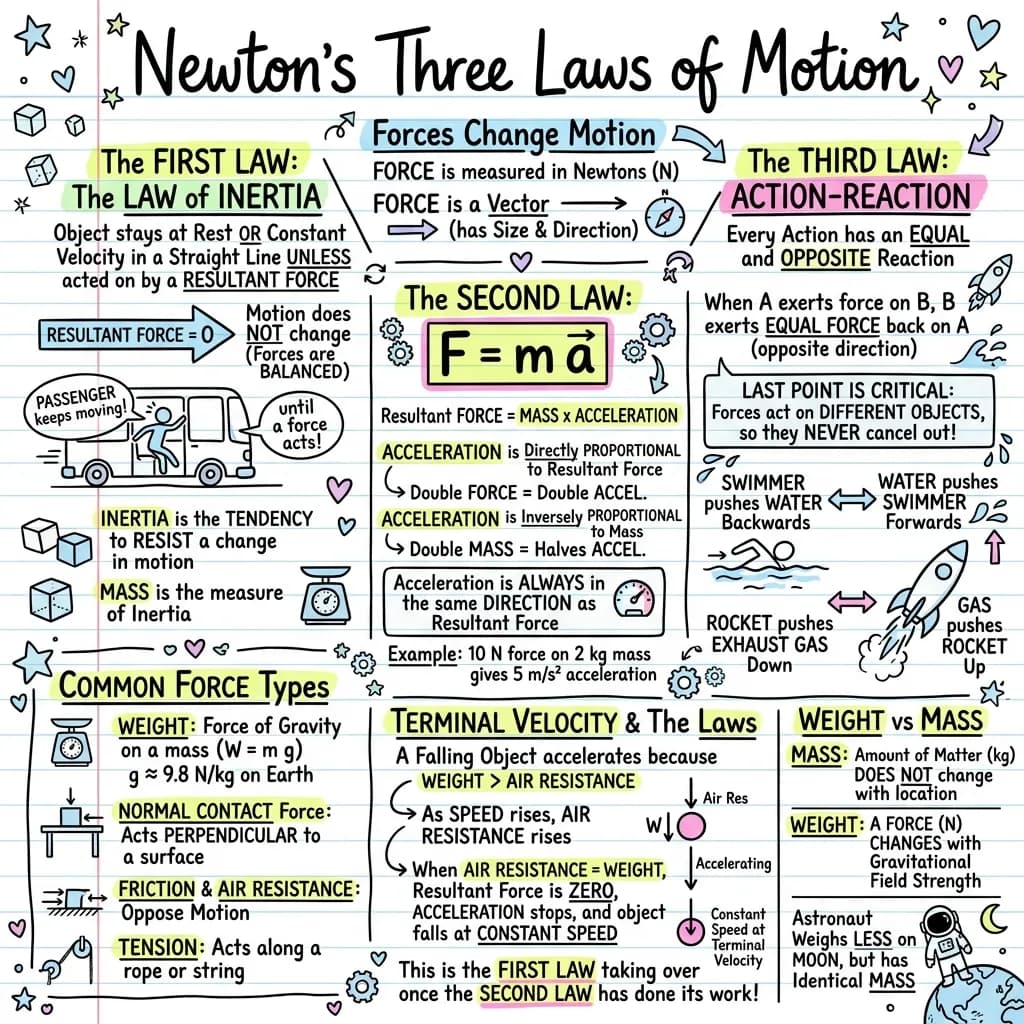
Unit 3: Forces and motion. 3.1 Force. A force is a push or a pull acting on an object. It is a vector quantity, so it has both magnitude and direction, and it is measured in newtons (N). Forces are drawn as arrows whose length shows the size and whose direction shows the line of action. 3.2 Newton's first law. An object at rest stays at rest and an object moving at constant velocity continues at that constant velocity unless acted on by a resultant force. This tendency to resist a change in motion is called inertia and it depends on mass. If the forces on an object are balanced the resultant force is zero and the velocity does not change. A passenger on a bus lurches forward when the bus brakes because the passenger continues moving while the bus slows. 3.3 Newton's second law. The acceleration of an object is directly proportional to the resultant force acting on it and inversely proportional to its mass. F = ma, where F is the resultant force in newtons, m is mass in kilograms and a is acceleration in metres per second squared. Example: a resultant force of 10 N acting on a mass of 2 kg produces an acceleration of 5 m/s squared. Doubling the force doubles the acceleration; doubling the mass halves it. 3.4 Newton's third law. For every action there is an equal and opposite reaction. The two forces are equal in magnitude, opposite in direction, of the same type, and crucially they act on different objects, which is why they never cancel each other out. A swimmer pushes water backwards and the water pushes the swimmer forwards. A rocket pushes exhaust gases downwards and the gases push the rocket upwards. 3.5 Types of force. Weight, the force of gravity on a mass, W = mg. Normal contact force, acting perpendicular to a surface. Friction and air resistance, opposing relative motion. Tension, in a rope or cable being stretched. 3.6 Terminal velocity. A falling object accelerates under its weight, air resistance increases with speed, and when air resistance equals weight the resultant force is zero and the object falls at a constant terminal velocity. 3.7 Mass and weight. Mass is the amount of matter in kilograms and does not change with location; weight is a force in newtons and changes with gravitational field strength.
The flashcards from the same notes
Exports as Anki CSV, printable PDF, or plain text.
State Newton's first law of motion.
An object stays at rest, or keeps moving at constant velocity, unless a resultant force acts on it.
What is inertia and what does it depend on?
The tendency of an object to resist a change in its motion. It depends on mass: more mass means more inertia.
A resultant force of 10 N acts on a 2 kg mass. What is the acceleration?
5 m/s squared, from a = F divided by m.
Why do the action and reaction forces in Newton's third law never cancel out?
Because they act on two different objects. Forces only cancel when they act on the same object.
Why does a falling object reach terminal velocity?
Air resistance increases with speed until it equals the weight, so the resultant force becomes zero and the object falls at constant velocity.
What is the difference between mass and weight?
Mass is the amount of matter in kilograms and does not change with location; weight is the force of gravity in newtons and changes with gravitational field strength.
Make a deck from your own notes with the AI flashcard generator.
What's in this visual
Newton's three laws are short enough to memorise in an evening and still lose students marks all year, because the exam does not ask you to recite them. It asks you to identify which law applies, which forces act on which object, and what happens to the numbers. The visual above draws each law as a labelled situation with force arrows rather than as a sentence, so the law you need becomes something you recognise. Here is what each panel covers.
Force is a vector, and that is why we draw arrows
A force is a push or a pull measured in newtons (N), and it is a vector: it has size and direction. That is the reason every panel in the visual uses arrows, with length for magnitude and direction for the line of action. It also explains the idea the whole topic runs on, the resultant force. Add the arrows together and if they cancel, the resultant is zero and nothing about the motion changes. If they do not cancel, there is a resultant force and the object accelerates. Almost every forces question is really asking you to find that resultant first.
The first law: inertia and balanced forces
Newton's first law says an object at rest stays at rest, and an object moving at constant velocity keeps moving at that constant velocity, unless a resultant force acts on it. The property behind this is inertia, the resistance to a change in motion, and it depends on mass: a loaded lorry is harder to get moving and harder to stop than a bicycle. The classic illustration is the bus passenger. When the bus brakes sharply the passenger lurches forward, not because something pushed them, but because nothing stopped them; the bus slowed and the passenger carried on. Note what the law does not say. Constant velocity does not mean no forces, it means balanced forces.
The second law: F = ma with a worked example
When forces are unbalanced you need the second law. Acceleration is directly proportional to the resultant force and inversely proportional to the mass, which is written F = ma, with force in newtons, mass in kilograms and acceleration in metres per second squared. The worked example on the diagram keeps it concrete: a resultant force of 10 N on a mass of 2 kg gives an acceleration of 5 m/s squared, because a = F divided by m. Double the force to 20 N and the acceleration doubles to 10 m/s squared. Keep the force at 10 N but double the mass to 4 kg and the acceleration halves to 2.5 m/s squared. Seeing both proportionalities in one worked strip is what stops students inverting the formula in the exam.
The third law: equal, opposite, and on different objects
For every action there is an equal and opposite reaction, and the part that earns the marks is the part that usually gets left out: the two forces are the same type and they act on different objects, which is precisely why they never cancel. A swimmer pushes water backwards and the water pushes the swimmer forwards; a rocket pushes exhaust gases down and the gases push the rocket up. If both forces acted on the same object, nothing could ever accelerate. The visual colour-codes each pair by the object it acts on, which is the fastest way to see that a book resting on a table and the table pushing back is a different situation from an action and reaction pair.
Force types, terminal velocity and the mass trap
Four force names cover most questions: weight (gravity acting on mass, W = mg), the normal contact force perpendicular to a surface, friction and air resistance opposing relative motion, and tension in a stretched rope. Terminal velocity ties the first two laws together neatly: a falling skydiver accelerates under weight while the second law is in charge, air resistance grows with speed until it equals weight, the resultant force reaches zero, and from then on the first law takes over and the fall continues at constant velocity. Finally, do not let the exam catch you on mass versus weight: mass is matter in kilograms and does not change on the Moon, while weight is a force in newtons and does. The deck under the visual was generated from the same source notes as the diagram, so the cards drill exactly these distinctions; see flashcards for students and teachers for how to work them into revision.
For teachers
The problem
- Students recite the third law perfectly and then claim the two forces cancel out.
- F = ma gets rearranged wrongly under time pressure, so correct physics still scores zero.
- Terminal velocity is taught as a graph to memorise instead of as the first and second law changing hands.
How to use it in class
- Project the force arrow panels and have students name the resultant before you reveal it.
- Use the colour-coded third law pairs to run a quick sorting task on which object each force acts on.
- Hand out the visual as a one-page revision sheet before the forces assessment.
- Set the deck as a starter quiz, then reteach only the panel where the class lost the most cards.
For students & visual learners
The problem
- You know all three laws by heart but cannot tell which one a question is testing.
- You mix up mass and weight, then lose the unit mark as well as the answer.
- Terminal velocity questions ask for an explanation and your notes only give you a graph.
How to use it to study
- Match a question to a law by recognising the picture rather than by rereading the definitions.
- Use the worked 10 N on 2 kg example as a check that you have rearranged F = ma correctly.
- Learn the third law as two arrows on two different objects so you never say they cancel.
- Run the deck for a few minutes a day in the week before the exam.
Make your own visual like this
Paste your notes or upload a PDF
Drop in your own class notes, a textbook chapter or a PDF. Any subject, any language.
Pick a visual style
Choose a sketchnote, infographic or diagram style that fits the topic.
Generate and download
In about 15–40 seconds you get a one-page visual you can print, share or revise from.
Frequently asked questions
If action and reaction forces are equal and opposite, how does anything move?
Because the two forces act on different objects. The swimmer pushes the water and the water pushes the swimmer, so each object feels only one of the pair and can accelerate.
Which law explains terminal velocity?
Both, in sequence. The second law governs the acceleration while weight exceeds air resistance, and once the two balance the resultant force is zero and the first law takes over, giving constant velocity.
Can I turn my physics notes into a diagram and a flashcard deck?
Yes. Paste your notes or upload the chapter and VisualNote AI builds the visual, then generates a deck from the same source so both cover the same ground. See flashcards for students and teachers.
More visual examples
Turn your notes into a visual
Paste any notes or upload a PDF and get a sketchnote-style visual in under a minute.