
Significant Figures — Rules Infographic & Examples
All the significant-figures rules — counting, arithmetic and rounding — collected into one infographic you can keep next to your calculator.
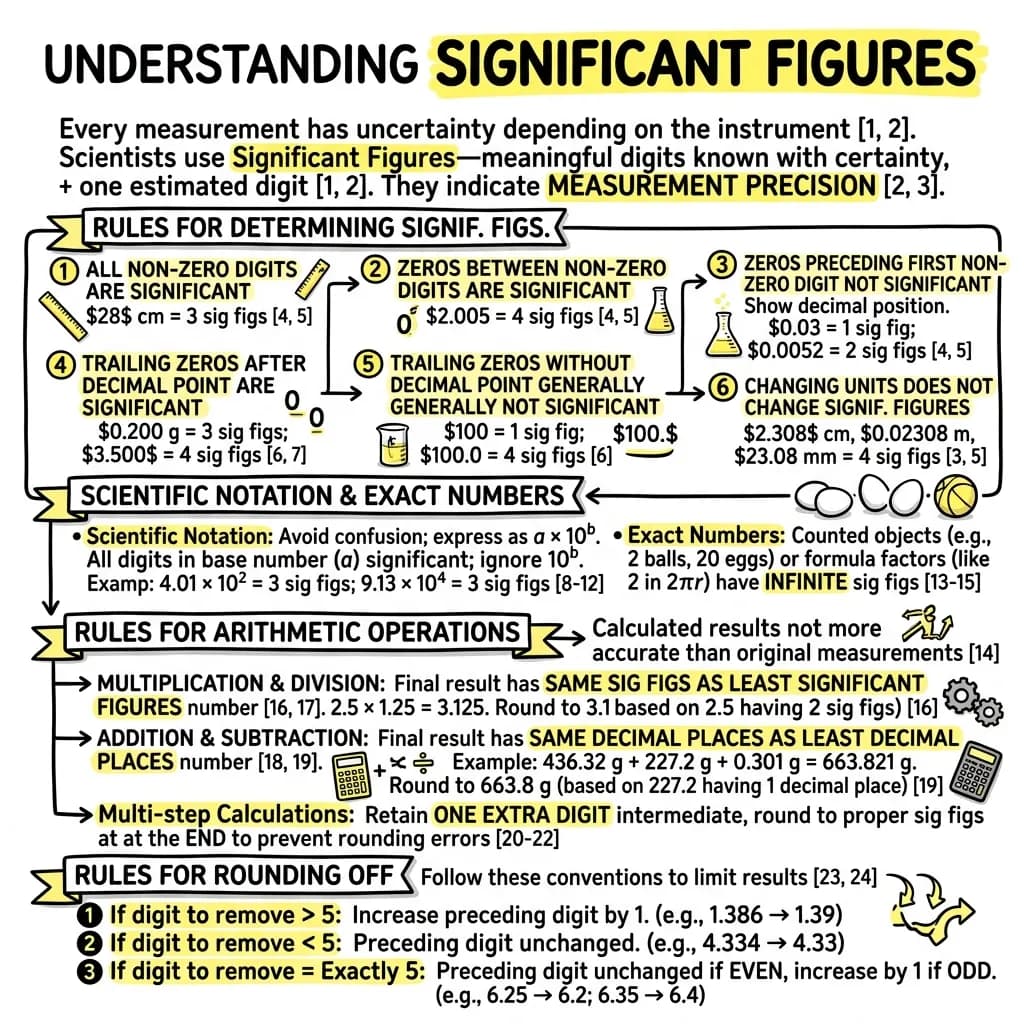
Every experimental measurement has some uncertainty depending on the instrument used. Scientists use significant figures — the meaningful digits known with certainty plus one estimated digit — to indicate the precision of a measurement. Rules for counting: all non-zero digits are significant; zeros between non-zero digits are significant; leading zeros are not significant; trailing zeros after a decimal point are significant; trailing zeros without a decimal point are generally not significant; and changing units does not change the count. Numbers are best expressed in scientific notation; exact counted numbers and mathematical factors have infinite significant figures. For multiplication and division the result keeps the least significant figures; for addition and subtraction it keeps the least decimal places; intermediate steps keep one extra digit. Rounding: digit above five rounds up, below five stays, exactly five rounds to even.
What's in this visual
Significant figures look simple and quietly cost marks all year — counting rules, two different arithmetic conventions and a rounding rule with an awkward exception. The infographic above gathers every rule into one place, with worked examples, so it works as a cheat sheet rather than a chapter to re-read. Here is the full breakdown.
What significant figures are
Every experimental measurement carries some uncertainty, set by the instrument used — a ruler marked in millimetres cannot honestly report a thousandth of a millimetre. Significant figures are how scientists express this honestly: they are the meaningful digits of a value, made up of all the digits known with certainty plus one final digit that is estimated. The number of significant figures therefore communicates the precision of the measurement. Getting this right is not pedantry — it is what stops a calculated answer from claiming more accuracy than the original data can support.
The rules for counting significant figures
Six rules decide how many significant figures a number has. All non-zero digits count — 285 has three. Zeros between non-zero digits count — 2.005 has four. Leading zeros do not count; they only place the decimal point, so 0.0052 has two. Trailing zeros after a decimal point do count — 0.200 has three. Trailing zeros with no decimal point generally do not — 100 has one, but 100. has three and 100.0 has four. And changing units changes nothing: 2.308 cm, 0.02308 m and 23.08 mm all have exactly four.
Scientific notation and exact numbers
Two ideas remove the ambiguity around zeros. Scientific notation writes a value in the form a × 10 to a power: every digit in the base number is significant and the power of ten is ignored, so 4.01 × 10² unambiguously has three significant figures. Exact numbers are the other special case — quantities that are counted (2 balls, 20 eggs) or exact mathematical factors, like the 2 in 2πr. These have an infinite number of significant figures and never limit the precision of a calculation, because they carry no uncertainty at all.
Rules for multiplication, division, addition and subtraction
Arithmetic uses two different rules, and mixing them up is the classic mistake. For multiplication and division, the result keeps the same number of significant figures as the input with the fewest — 2.5 × 1.25 = 3.125, but since 2.5 has only two, the answer is 3.1. For addition and subtraction, the result keeps the same number of decimal places as the input with the fewest — 436.32 + 227.2 + 0.301 = 663.821, but 227.2 has one decimal place, so the answer is 663.8. In multi-step calculations, keep one extra digit through the working and round only at the very end.
The rounding-off rules
Once you know how many significant figures to keep, three rules say how to round. If the digit being removed is greater than 5, increase the preceding digit by one — 1.386 to three figures becomes 1.39. If it is less than 5, leave the preceding digit unchanged — 4.334 becomes 4.33. The tricky case is when the removed digit is exactly 5: leave the preceding digit alone if it is even, but round it up if it is odd. So 6.25 becomes 6.2, while 6.35 becomes 6.4 — the 'round half to even' convention that keeps rounding unbiased.
Why a rules-heavy topic needs a cheat-sheet visual
Significant figures are not hard to understand once, but they are hard to recall correctly under exam pressure — which zeros count, which arithmetic rule applies, what to do with an exact 5. Read as prose, the rules sit in separate paragraphs and blur together. An infographic puts every rule and a worked example in one frame, so it works the way you actually use it: a glance next to your calculator, not a chapter to re-read mid-problem.
For teachers
The problem
- Significant figures quietly cost marks across every numerical topic, all year, not just in one unit.
- Students apply the multiplication rule to addition problems because the two conventions are easy to swap.
- The 'round half to even' rule for an exact 5 surprises students who learned 'always round 5 up'.
How to use it in class
- Hand it out as a permanent cheat sheet to keep inside the lab or exercise book.
- Project it when marking calculations so students see exactly which rule was missed.
- Use the worked examples to drill counting, arithmetic and rounding in quick succession.
- Blank the worked answers to turn the infographic into a rapid practice sheet.
For students & visual learners
The problem
- You understand significant figures in the moment but lose marks applying them under time pressure.
- Multiplication keeps significant figures and addition keeps decimal places — and you keep mixing them up.
- The rounding rule for an exact 5 contradicts the 'round 5 up' habit from earlier school maths.
How to use it to study
- Keep it next to your calculator so the right rule is one glance away.
- Use the counting examples to settle quickly which zeros are significant.
- Check arithmetic problems against the two separate rules instead of guessing.
- Revise the rounding cases — including the exact-5 exception — straight before the exam.
Make your own visual like this
Paste your notes or upload a PDF
Drop in your own class notes, a textbook chapter or a PDF. Any subject, any language.
Pick a visual style
Choose a sketchnote, infographic or diagram style that fits the topic.
Generate and download
In about 15–40 seconds you get a one-page visual you can print, share or revise from.
Frequently asked questions
How many significant figures does a number have?
Count all non-zero digits and any zeros between them; leading zeros never count, and trailing zeros count only if there is a decimal point. For example, 2.005 has four significant figures, 0.0052 has two, and 100.0 has four.
What is the rounding rule when the digit to remove is exactly 5?
When the digit being removed is exactly 5, leave the preceding digit unchanged if it is even, but round it up if it is odd. This 'round half to even' rule means 6.25 becomes 6.2 while 6.35 becomes 6.4, keeping rounding unbiased.
Do trailing zeros count as significant?
It depends on the decimal point. Trailing zeros after a decimal point are significant — 0.200 has three — but trailing zeros with no decimal point generally are not, so 100 has just one. You can turn rules like these into a one-page cheat sheet with VisualNote AI.
More visual examples


Turn your notes into a visual
Paste any notes or upload a PDF and get a sketchnote-style visual in under a minute.