
Ionic vs Covalent Bonding: Visual Notes & Flashcards
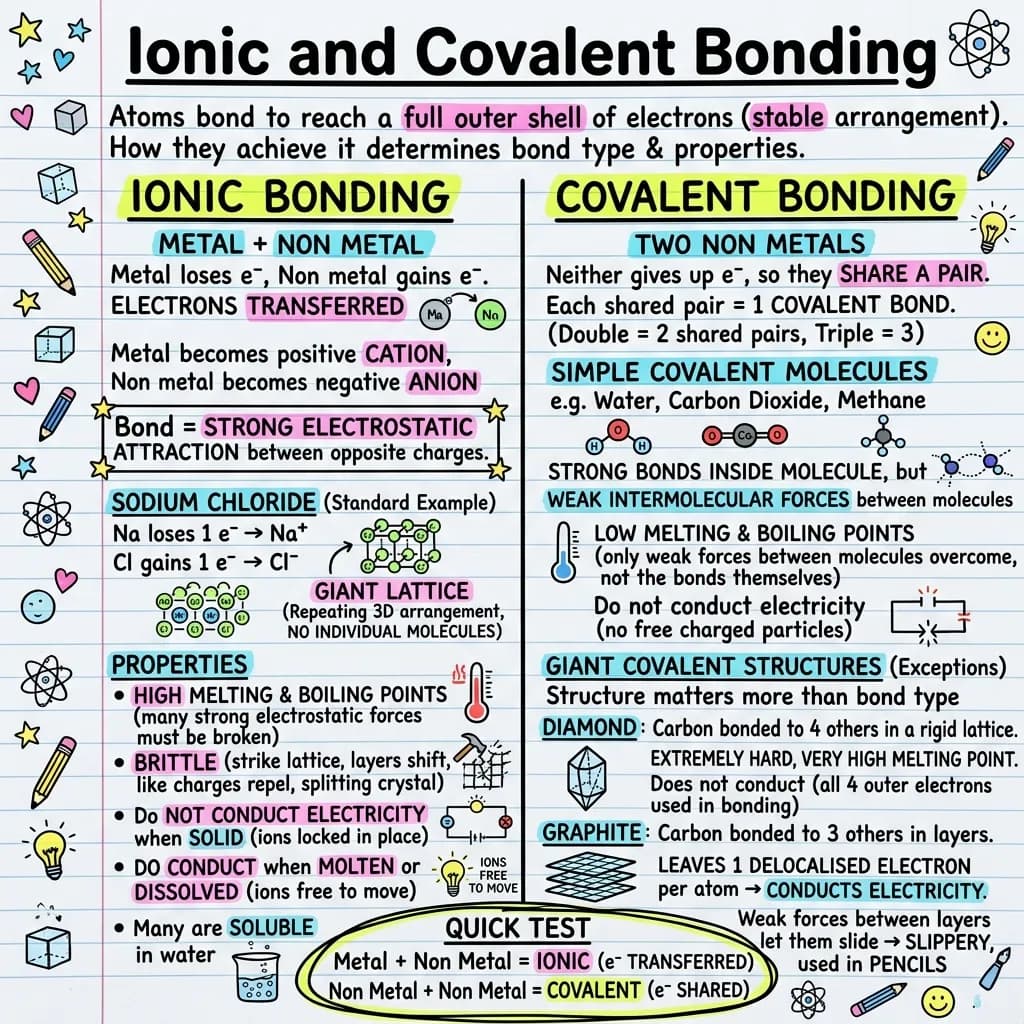
Two bonding chapters that students answer interchangeably, redrawn as a single comparison diagram where the transfer of electrons and the sharing of electrons sit side by side, with a matching flashcard deck.
Topic 2: Bonding, structure and properties. 2.1 Why atoms bond. Atoms react in order to gain a full outer shell of electrons and reach the stable electronic structure of a noble gas. 2.2 Ionic bonding. Occurs between a metal and a non metal. Electrons are transferred from the metal atom to the non metal atom. The metal atom loses electrons and becomes a positive ion, a cation; the non metal atom gains electrons and becomes a negative ion, an anion. The oppositely charged ions are held together by strong electrostatic forces of attraction acting in all directions. In sodium chloride, sodium loses one electron to form Na+ and chlorine gains one electron to form Cl-, and the ions arrange into a giant ionic lattice. Properties of ionic compounds: high melting and boiling points because a large amount of energy is needed to overcome the strong electrostatic attraction; brittle, because displacing the layers brings like charges together and the lattice splits; they do not conduct electricity when solid because the ions are fixed in position, but they do conduct when molten or dissolved in water because the ions are then free to move; many are soluble in water. 2.3 Covalent bonding. Occurs between two non metal atoms. A pair of electrons is shared between the two atoms and the bond is the strong electrostatic attraction between the shared pair and the two nuclei. A single bond is one shared pair, a double bond is two shared pairs as in oxygen and carbon dioxide, a triple bond is three shared pairs as in nitrogen. 2.4 Structures. Simple molecular substances such as water, methane and chlorine have low melting and boiling points because the weak intermolecular forces between the molecules, not the strong covalent bonds within them, are the ones broken on melting; they do not conduct electricity because there are no free charged particles. Giant covalent structures such as diamond, graphite and silicon dioxide have very high melting points because covalent bonds must be broken. In diamond each carbon atom forms four covalent bonds in a rigid three dimensional lattice, so diamond is very hard and does not conduct electricity. In graphite each carbon atom forms three covalent bonds in layers of hexagonal rings, leaving one delocalised electron per atom, so graphite conducts electricity, and the weak forces between layers let them slide, so graphite is soft and slippery.
The flashcards from the same notes
Exports as Anki CSV, printable PDF, or plain text.
Which types of element form an ionic bond?
A metal and a non metal. The metal transfers electrons to the non metal.
What holds an ionic lattice together?
Strong electrostatic forces of attraction between oppositely charged ions, acting in all directions.
Why does an ionic compound conduct electricity when molten but not when solid?
The ions carry the charge, and they are only free to move once the lattice has melted or dissolved.
What is a covalent bond?
A shared pair of electrons attracted to the nuclei of both bonded atoms.
Why do simple molecular substances have low melting points?
Melting breaks only the weak intermolecular forces between molecules, not the strong covalent bonds inside them.
Why does graphite conduct electricity when diamond does not?
Each carbon in graphite bonds to only three others, leaving one delocalised electron per atom free to move; in diamond all four outer electrons are used in bonds.
Make a deck from your own notes with the AI flashcard generator.
What's in this visual
Ionic and covalent bonding are taught back to back, tested together, and confused constantly, because both are described with the same phrase about atoms wanting a full outer shell. The visual above puts transfer on one side and sharing on the other, then runs the same property checklist down both columns so the consequences line up. Here is the reasoning behind each block of the diagram.
Why atoms bond at all
Every bond in this topic exists for one reason: atoms react to reach a full outer shell and copy the stable electron arrangement of the nearest noble gas. That single motive splits into two routes depending on what is in the room. If a metal meets a non metal, electrons move across in a transfer and you get ionic bonding. If two non metals meet, neither will give electrons up, so they share them and you get covalent bonding. Starting the visual with that fork means every later fact hangs off a cause rather than floating on its own.
Ionic bonding: transfer, ions and the lattice
In ionic bonding a metal atom loses its outer electrons and becomes a positive ion, a cation, while a non metal atom gains them and becomes a negative ion, an anion. In sodium chloride, sodium loses one electron to become Na+ and chlorine gains it to become Cl-. What holds the compound together is the strong electrostatic attraction between opposite charges, and because that attraction acts equally in every direction, the ions do not pair off. They build a giant ionic lattice, a repeating three dimensional arrangement, which is why the formula NaCl is a ratio rather than a description of a molecule.
Ionic properties all come from one idea
Four properties are worth memorising, and every one of them follows from strong forces holding fixed ions in a lattice. High melting and boiling points, because breaking that many strong attractions needs a lot of energy. Brittle, because pushing one layer sideways lines up like charges, which repel, and the crystal splits along the plane. Conducts only when molten or dissolved, because charge carriers exist in both states but are locked in place in the solid. Often soluble in water, because polar water molecules pull the ions away from the lattice. Answering a properties question is then a matter of tracing one arrow on the diagram instead of recalling four separate sentences.
Covalent bonding: shared pairs, molecules and giants
A covalent bond is one shared pair of electrons attracted to both nuclei at once. Two shared pairs make a double bond as in oxygen and carbon dioxide; three make a triple bond as in nitrogen. What varies wildly is the structure built from those bonds. Simple molecular substances such as water, methane and chlorine melt at low temperatures, and the reason is the most commonly dropped mark in the topic: melting breaks the weak intermolecular forces between molecules, not the strong covalent bonds inside them. Giant covalent structures behave completely differently. In diamond every carbon forms four bonds in a rigid three dimensional network, so it is extremely hard and does not conduct. In graphite every carbon forms only three, leaving one delocalised electron per atom, so graphite conducts electricity, and the weak forces between its layers let them slide, which is why it feels slippery.
The quick test, and turning the comparison into recall
When a question gives you a substance and asks for the bonding, run three checks in order. Metal plus non metal means ionic; non metal plus non metal means covalent. Then use the melting point: very high suggests ionic or giant covalent, low suggests simple molecular. Then use conductivity: conducting when molten or dissolved but not when solid points to ionic, while graphite is the exception that conducts as a solid. Those three checks are drawn as a decision strip along the bottom of the visual. The flashcard deck below was generated from the same source notes as the diagram, so the cards test exactly the comparisons the layout sets up; you can build the same pair for any chemistry topic with the AI flashcard generator.
For teachers
The problem
- Students explain low melting points by saying covalent bonds are weak, which loses the mark every time.
- Dot and cross diagrams take up the whole board, leaving no room for the properties that depend on them.
- Diamond and graphite get taught as two facts to memorise rather than two consequences of bond count.
How to use it in class
- Project the two columns and have students predict the properties before you reveal them.
- Use the decision strip as a starter: name a substance, students call out the bonding and their reason.
- Hand out the visual as a one-page revision sheet before the bonding assessment.
- Run the deck as a retrieval quiz, then send students back to the column where they lost cards.
For students & visual learners
The problem
- You can define both bond types but freeze when asked why one conducts and the other does not.
- Simple molecular and giant covalent are both covalent, so you keep giving the wrong melting point answer.
- Cation and anion swap places in your head under exam pressure.
How to use it to study
- Revise both bond types from one page instead of flipping between two chapters.
- Trace the arrow from structure to property so explanation questions write themselves.
- Memorise diamond and graphite as four bonds versus three bonds, not as two lists.
- Test yourself on the deck the day before the exam and reread only the blocks you miss.
Make your own visual like this
Paste your notes or upload a PDF
Drop in your own class notes, a textbook chapter or a PDF. Any subject, any language.
Pick a visual style
Choose a sketchnote, infographic or diagram style that fits the topic.
Generate and download
In about 15–40 seconds you get a one-page visual you can print, share or revise from.
Frequently asked questions
How do I tell whether a compound is ionic or covalent?
Look at the elements first: a metal with a non metal is ionic, two non metals are covalent. Then check the data. A high melting point with conductivity only when molten or dissolved confirms ionic; a low melting point and no conductivity points to a simple covalent molecule.
Are covalent bonds weaker than ionic bonds?
No. Covalent bonds are very strong, which is why diamond and silicon dioxide melt at extreme temperatures. Simple covalent substances melt easily because the forces between whole molecules are weak, not because the bonds within them are.
Can I generate a visual and a flashcard deck from my own chemistry notes?
Yes. Upload the chapter or paste your notes, and VisualNote AI produces the diagram and a matching deck from the same source. Try the AI flashcard generator.
More visual examples
Turn your notes into a visual
Paste any notes or upload a PDF and get a sketchnote-style visual in under a minute.