
Drug Suffixes Cheat Sheet: Pharmacology Notes and Flashcards
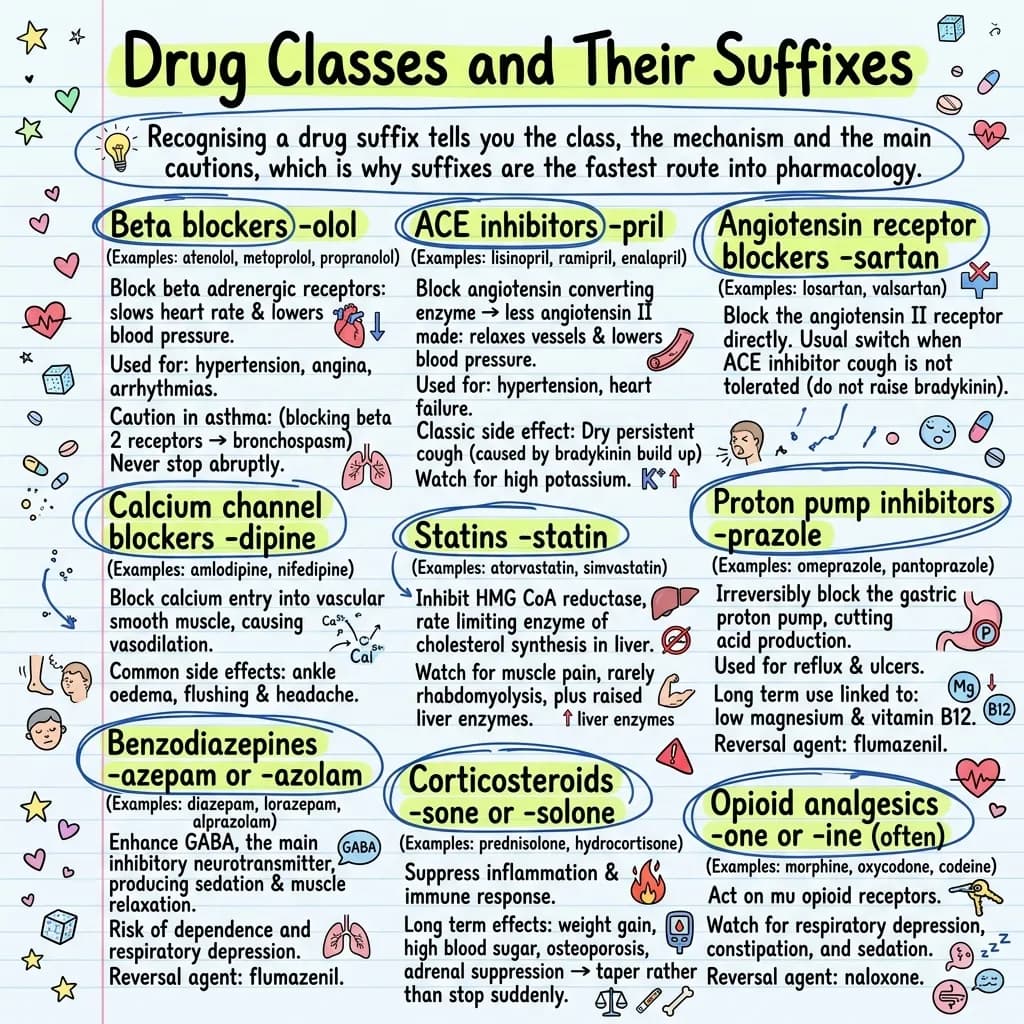
A pharmacology handout listing hundreds of drug names, compressed into one chart organised by the suffix that gives the class away. The matching flashcard deck came from the same handout, so it drills the same stems and the same side effects.
Topic 6: naming conventions and drug classes. Most generic drug names share a stem that identifies the pharmacological class, which allows an unfamiliar name to be placed into a class on sight. Drugs ending in -olol are beta adrenoceptor blockers, for example propranolol, atenolol and metoprolol, which reduce heart rate and myocardial oxygen demand and are used with caution in asthma. Drugs ending in -pril are angiotensin converting enzyme inhibitors, for example ramipril and lisinopril, whose characteristic adverse effect is a persistent dry cough attributed to accumulation of bradykinin. Drugs ending in -sartan are angiotensin II receptor blockers, for example losartan and valsartan, which act at the receptor and do not raise bradykinin, so cough is not a feature. Drugs ending in -dipine are dihydropyridine calcium channel blockers, for example amlodipine and nifedipine, which cause vasodilation and commonly produce ankle oedema and flushing. Drugs ending in -statin are HMG-CoA reductase inhibitors, for example atorvastatin and simvastatin, which lower LDL cholesterol and may cause myalgia and, rarely, rhabdomyolysis. Drugs ending in -prazole are proton pump inhibitors, for example omeprazole and pantoprazole, which irreversibly inhibit the gastric hydrogen potassium ATPase. Drugs ending in -azepam or -azolam are benzodiazepines, for example diazepam, lorazepam and midazolam, which enhance GABA A transmission and whose reversal agent is flumazenil. Drugs ending in -cillin are penicillins, for example amoxicillin and flucloxacillin, beta lactam antibiotics that inhibit bacterial cell wall synthesis. Drugs ending in -sone or -solone are corticosteroids, for example prednisolone and hydrocortisone, with adverse effects including hyperglycaemia, immunosuppression and osteoporosis on long term use. Opioid analgesics including morphine, codeine, oxycodone and fentanyl cause respiratory depression, and their reversal agent is naloxone.
The flashcards from the same notes
Exports as Anki CSV, printable PDF, or plain text.
A drug name ending in -olol belongs to which class?
Beta blockers, for example propranolol, atenolol and metoprolol.
Which class ends in -pril, and what is its classic adverse effect?
ACE inhibitors. Their classic adverse effect is a persistent dry cough caused by bradykinin accumulation.
Why is a patient switched from a -pril to a -sartan?
Sartans block the angiotensin II receptor without raising bradykinin, so they give similar blood pressure control without the dry cough.
Which side effect is most associated with -dipine drugs?
Ankle oedema, along with flushing, caused by arteriolar vasodilation.
A patient on a -statin reports severe unexplained muscle pain. What must be excluded?
Rhabdomyolysis, the rare but serious muscle breakdown associated with statins.
Naloxone and flumazenil each reverse one drug class. Which reverses which?
Naloxone reverses opioids; flumazenil reverses benzodiazepines.
Make a deck from your own notes with the AI flashcard generator.
What's in this visual
Pharmacology looks like an impossible memory task until you notice the naming system underneath it. Generic drug names are built from agreed stems, so the ending of a name usually tells you the class, the mechanism and the side effect the examiner is fishing for. The chart above groups the high yield stems in one place; the deck below drills them. Here is what each group buys you.
Why the ending of a drug name is doing so much work
Generic names are not random. International naming committees assign a shared stem to each pharmacological class, so amlodipine, nifedipine and felodipine all announce themselves as dihydropyridine calcium channel blockers before you know anything else about them. This means you never have to memorise every drug, only the stems plus a handful of exceptions. On a ward, meeting a name you have never seen and still being able to say which class it belongs to and what to monitor is a genuinely clinical skill, not just an exam trick.
The cardiovascular stems: -olol, -pril, -sartan, -dipine
These four cover most of a cardiology drug chart. -olol marks beta blockers such as propranolol, atenolol and metoprolol: they slow heart rate and reduce myocardial oxygen demand, and are used cautiously in asthma. -pril marks ACE inhibitors such as ramipril and lisinopril, whose signature adverse effect is a persistent dry cough caused by bradykinin building up. -sartan marks angiotensin II receptor blockers such as losartan and valsartan, which block the receptor directly, leave bradykinin alone and therefore do not cause the cough; that is exactly why a patient intolerant of a -pril is switched to a -sartan. -dipine marks dihydropyridine calcium channel blockers such as amlodipine, which dilate arterioles and commonly produce ankle oedema and facial flushing.
-statin and -prazole: the two most prescribed stems you will meet
-statin drugs such as atorvastatin and simvastatin inhibit HMG-CoA reductase, the rate limiting enzyme of cholesterol synthesis, lowering LDL. The examinable adverse effect chain is muscle ache, then raised creatine kinase, then rhabdomyolysis in rare cases, so any statin patient reporting severe unexplained muscle pain needs investigating rather than reassuring. -prazole drugs such as omeprazole and pantoprazole are proton pump inhibitors: they irreversibly block the gastric hydrogen potassium ATPase, the final common step of acid secretion, which is why they outperform H2 blockers and why acid output takes days to recover after stopping.
Sedatives, antibiotics, steroids and the two reversal agents
-azepam and -azolam mark benzodiazepines such as diazepam, lorazepam and midazolam, which enhance GABA transmission; the reversal agent is flumazenil. -cillin marks the penicillins such as amoxicillin and flucloxacillin, beta lactam antibiotics that block bacterial cell wall synthesis. -sone and -solone mark corticosteroids such as prednisolone and hydrocortisone, with hyperglycaemia, immunosuppression and osteoporosis on the long term side effect list. Opioids do not share a tidy suffix, which is why morphine, codeine, oxycodone and fentanyl get their own box on the chart; their danger is respiratory depression and their reversal agent is naloxone. Keeping flumazenil and naloxone side by side on one page is the fastest way to stop swapping them under pressure.
How to revise stems without drowning in drug names
The mistake is revising drug by drug. Revise stem by stem, and for each stem hold three things: the class, the mechanism in one line, and the one adverse effect the question will hang on. That is exactly how the chart above is laid out, and the six cards below were generated from the same handout, so they test the same three things rather than random pharmacokinetics. If you want a deck built from your own lecture slides in the same shape, the AI flashcard generator will produce one from the file you already have.
For teachers
The problem
- Students try to memorise individual drug names and never notice the naming system that would save them hours.
- Side effects get detached from their mechanism, so nobody can explain why an ACE inhibitor causes a cough.
- Building a clean, current cheat sheet for a pharmacology session is an evening of formatting.
How to use it in class
- Give it out in week one so students meet the stems before they meet the drug lists.
- Project one stem group per slide and ask for the adverse effect before revealing it.
- Blank the class column and use the chart as a quick formative quiz.
- Pair the deck with a medicines round simulation so the stems are recalled in context.
For students & visual learners
The problem
- Every new drug name feels like a fresh thing to learn instead of a member of a class you already know.
- You mix up flumazenil and naloxone at exactly the moment you cannot afford to.
- You know statins cause muscle problems but not the word the examiner wants.
How to use it to study
- Learn nine stems instead of ninety drug names.
- Check any unfamiliar name on a drug chart against the suffix column.
- Run the deck the night before an OSCE where medicines questions are likely.
- Use the side effect column as your prompt sheet for counselling practice.
Make your own visual like this
Paste your notes or upload a PDF
Drop in your own class notes, a textbook chapter or a PDF. Any subject, any language.
Pick a visual style
Choose a sketchnote, infographic or diagram style that fits the topic.
Generate and download
In about 15–40 seconds you get a one-page visual you can print, share or revise from.
Frequently asked questions
What do the suffixes -pril and -sartan mean?
A name ending in -pril is an ACE inhibitor, such as ramipril. A name ending in -sartan is an angiotensin II receptor blocker, such as losartan. Both lower blood pressure through the renin angiotensin system, but only the ACE inhibitor causes the classic dry cough.
Do all drugs in a class share the same suffix?
Most do, and that is what makes stems so useful, but there are exceptions. Opioid analgesics are the common example: morphine, codeine, oxycodone and fentanyl have no shared ending, so they have to be learned as a group.
Can I make flashcards from my own pharmacology slides?
Yes. Upload the slide deck or paste the notes and you get a visual summary plus a matching set of cards drawn from the same content. See how the flashcards work for students and teachers.
More visual examples
Turn your notes into a visual
Paste any notes or upload a PDF and get a sketchnote-style visual in under a minute.